In Hollywood audition lore, you hear stories of accidental encounters transforming the destiny of unassuming non-actors. It usually goes something like: said non-actor pops out for milk but takes a wrong turn, trips over a sleeping cat and falls through a doorway into the front of an audition line. After brushing themselves down and delivering an earth shattering “to be, or not to be…” (the only monologue they know), it turns out they’re “just perfect” for the role and three months later have their face plastered all over a billboard.The production of Rolling Together, an upcoming film made by a collective of food couriers and filmmakers about the struggles of migrant workers in Germany, also involved a chance encounter. Only when Jamie Anderson and Nitesh Kimar met, it wasn’t through the kind of sickly sweet serendipity Hollywood likes to sell us. They were navigating the cold, hard reality that food couriers, and especially migrant workers, face in the food delivery industry.
Crossing paths
When Nitesh arrived in Germany from India in 2023, it was his first time outside the country. He had a bachelor’s degree in biotechnology, experience in business development, e-commerce, marketing and sales, and was looking for a good work-life balance. What he found was the opposite.
With state-funded integration courses increasingly being cut and studying without subsidies too expensive, jobs with German-language requirements were closed off. Those that were available were far removed from the career he had trained for. “Even with all my experience, I wasn’t able to get a job in any of the corporate sectors,” says Nitesh. Instead he cleaned hotel rooms, worked in a restaurant, and eventually, like many other migrants, found himself on a bike, delivering food.
“You had to work in winter in precarious conditions without proper equipment,” Nitesh says of the new reality he faced. “People also treat you like you are nobody; like they don’t respect you” he adds, before explaining how, as a delivery courier, you can walk into a restaurant to collect an order and not only be made to feel like you don’t belong there by other workers, but far worse.
“One day I was assaulted. I went to this restaurant, Burgermeister, in Schönhauser Allee, and just because I was sitting inside the restaurant, waiting for the order, they told me to go outside. I told them, “I’m not taking anybody’s space, I’m just sitting, I’m tired.” And they said, “No, you are a rider, you are not allowed to sit inside.” I resisted, and then they started pushing me before they assaulted me. It was all recorded on camera and because I was with worker councils, we held a protest outside the restaurant two days later. It was there that I met Jamie.”
Jamie had moved to Berlin in 2020 and started working as a food delivery courier for Lieferando later that year. After his probation, he began organising with other workers while studying documentary filmmaking at a local film school. One of his first films was made with two friends who worked at Flink and had been fired. The film documented the conditions his friends and their colleagues faced but in true corporate fuckery, at the Labor Court the footage was submitted as evidence against them by Flink who claimed trust had been broken. They didn’t get their jobs back. “For me it was like a complete failure,” Jamie says. “I obviously made this video to help them, and in the end they got fired.” It was a lesson that stayed with him.
Already thinking about how to document the subcontracting experience without putting workers at risk, Jamie began talking to other couriers, including Nitesh, about whether they wanted to get involved in a new project. “I was a bit more careful and didn’t want to force workers to expose themselves, or maybe get them into trouble,” Jamie says. “One good way of doing that is making a completely fake company, and then the workers can talk about their problems without being like, hey, I’m this person from Lieferando, but rather, I’m a fictional character in this fictional film about a fictional company.”
From idea to “and action”
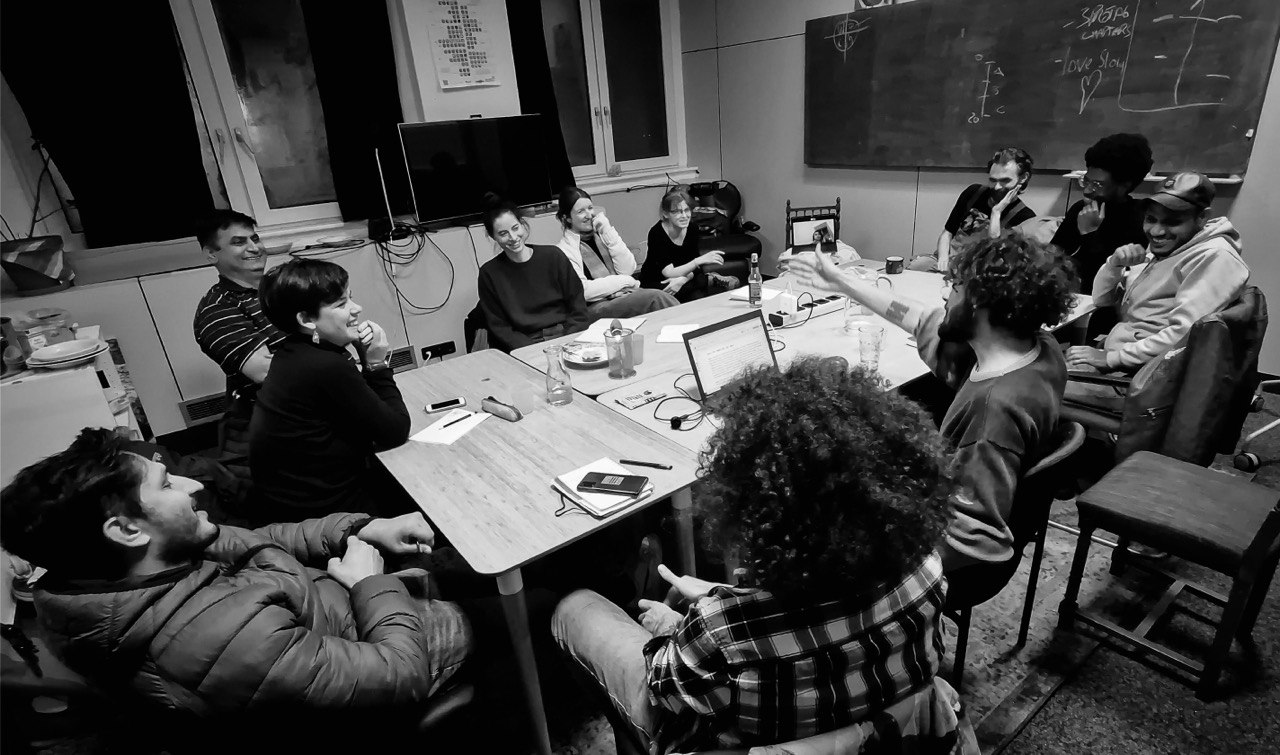
In September 2024, around half a dozen film workers and roughly a dozen current and former riders met in Berlin to start building this idea together. They called their fictional company Dingzapp, and over the next 18 months more than 70 people would rotate through the project, cooking on shoot days, acting in scenes, helping write and rewrite the script, and debating over rough cuts.
Like the name suggests, Rolling Together isn’t a vehicle for anyone’s individual experience. “We did all this collectively. The whole designing and the whole thinking of the name and the script—everything,” Jamie explains.
The film opens with Raahi, a young Indian delivery worker, waking up on a mattress in a cramped flat he shares with other couriers. Each person pays hundreds of euros for a bed in the same room. “This is part of the script I helped to write, because I was living like this,” Nitesh says. “I was sharing my room with four people, each of us paying 500 euro for a bed.”
From there, the film pushes Raahi through the same bureaucratic maze most migrant workers know too well. His immigration status is suddenly threatened because he needs a document signed by his boss. The problem is, he doesn’t know who his boss is.
“Who is the boss? That’s the movie.” Nitesh explains. “Raahi gets this letter from Ausländerbehörde. He calls customer care and realises everything’s a dead-end. He got his contract from a subcontractor located in a Späti. The Späti guy doesn’t care about him and there’s no real office or employer properly there to help, so he doesn’t know who he’s working for.”
Just like real-life, the app, algorithm, and logo on Raahi’s jacket, turn out to be a mirage. “Everything is on your phone. This is how the delivery sector and the platform economy works,” Nitesh says. “You have an illusion of security, ‘okay, I will get paid, they are tracking me.’ But behind the curtain there is no realistic institution protecting you. It just gives you a false sense of security.”
If you’re unfamiliar with the world of subcontracting, the whole thing can sound pretty unbelievable. How can a system be so sophisticated on the surface, yet leave workers with so little protection underneath? You order through an app, track your delivery moving across a map before a courier arrives at your door. But when it comes to getting basic paperwork, good luck. It’s a murky world and an almost comical contradiction, which eventually became part of the film’s tone.
“From the beginning we wanted it to have more of a comedy feel,” Jamie says. “It was also important to not make it too heavy and depressing. We don’t want people to feel sorry for workers and take pity on them, like ‘poor South Asian migrants.’ We’d rather make people laugh because then they become more open and receptive to what comes after.”
For all its satirical flourishes the film’s absurdity is very specific. While Dingzapp’s website promises “predictive taste technology,” the uniforms, colours and slogans are only a couple of notches more ridiculous than the real apps branding. “It’s leaning a little bit towards absurd sometimes” Jamie says. “but there’s truth behind it all.”
Film as a tool to organise
Rolling Together isn’t just about telling a story. The film grew out of workers organising around Lieferando, Wolt, and the subcontractors behind them. Now the group wants to take the film back to those communities through screenings at workers’ meetings, union groups, community spaces and universities. “From the beginning we were thinking ahead to the screenings,” Jamie says. “Screening to an audience then talking about the film with the audience and having workers explaining their problems based on the movie they created. The film they have ownership over.”
The collective ownership aspect makes the Rolling Together project useful beyond its ability to raise general awareness of the subcontracting scandal. Nitesh talks about it in relation to strikes, protests and other direct actions that he’s been part of in the past. Those are essential, he says, but they burn people out and often end in frustration when there’s no quick win. “When someone is directly doing any action, we’re always expecting a certain result. People become very involved but then start to feel frustrated when nothing happens and that’s why you lose the continuity.” By contrast, he sees Rolling Together as a “backup net” for the movement. “Making something like a movie has continuity, because you’re celebrating something,” he says. “You are seeding an idea and making a collective out of it. If a direct initiative falls apart, we can go back to this, create something, and bring people together again.”
And the hope is that this way of working won’t stop with delivery workers. “In the future it would be great to do more organising like this because it’s very open and very low risk. But it would be nice to also do it again with a different sector,” Jamie says. “Delivery workers are quite scattered. Many aren’t connected with the cleaning sector, for example. But there are many problems shared so it would be amazing if we continue as this group and combine with another group. Maybe it sounds a bit utopian, but to kind of unite different sectors in the working class would be the goal.”
This is also where the film has similarities with the tradition of Latin American Third Cinema. The movement treated screenings as more than a chance to watch a film. They were opportunities to discuss their experiences and organise. Rolling Together is intended to work in much the same way. It’s not just telling a story about delivery workers, but giving them something to bring into a room with other workers and a reason to start talking about what they have in common.
It’s a wrap
Before the film has even reached an audience, the process of making it has already achieved some of the things the collective set out to do at the start. “There’s like three main parts to the project,” Jamie says. “One is that we already did something great. We made a community of filmmakers and delivery workers and all these other people. The second part is learning. Many, many people learned more about delivery work and the problems in the sector around migrant labour, while at the same time the delivery workers learned more about making films. The third part is the result and the final product that we hope will actually make a difference.”
Rolling Together is due for release later this year. Follow Dingzapp to support the collective and stay in the loop. You can also support the workers by signing the Lieferando Workers’ Collective petition for direct employment here.