Over the past few days, I have read far too much BILD and WELT — Germany’s biggest tabloid and one of its leading conservative newspapers, both published by Axel Springer. I had wanted to understand what happened after Berlin voted on 20 September. Instead, after enough Springer, I found myself asking a different question: is the Springer press Antisemitic?
It isn’t. Consider the question an experiment. Take an ugly statement, add another, draw a few lines between people and organisations. Individuals become a “network”; the network becomes an institution. Soon enough, Axel Springer has an “antisemitism problem”. Nonsense, obviously. But useful nonsense. The point is not that Springer and Die Linke are equivalent, or that allegations against Linke members disappear because the same method can be turned against a newspaper company. The comparison concerns the method, not the substance: when does evidence about particular people become evidence about the institution to which they belong?
That is the problem with the Springer argument here. Maybe BILD and WELT do not need to invent the controversies around individual Linke members. The missing step is institutional. Whether a member, activist or party group said something antisemitic or not may establish a case against that person or group. To establish that Berlin’s Die Linke itself has an antisemitism problem would require something more: evidence that such positions are endorsed, protected, systematically tolerated or sufficiently widespread within the party to characterise the institution. Instead, particular controversies are repeatedly made to carry that larger conclusion — and the resulting diagnosis becomes an argument that Die Linke is unfit to govern.
Die Linke emerged from the 20 September state election as Berlin’s strongest party, taking 25.7 per cent of the second vote. In the days around the election, that progression became
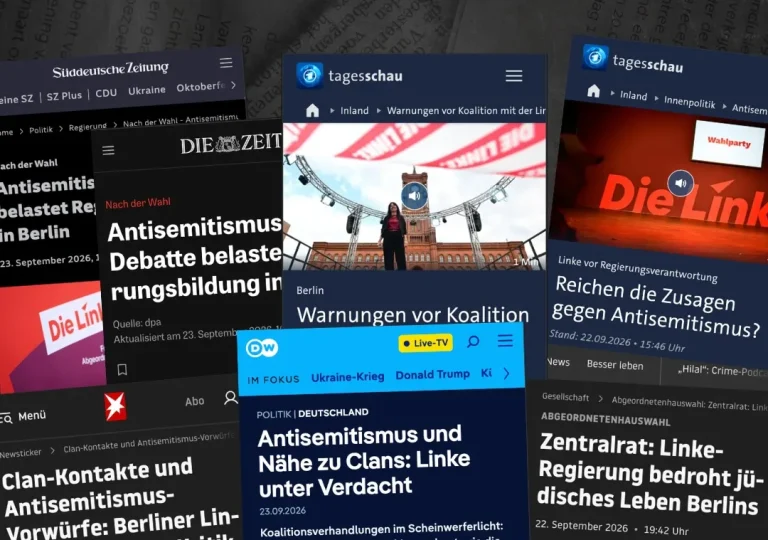
increasingly explicit. Before the election, WELT reported on an audio recording from Die Linke’s Palestine Solidarity working group in Berlin under the headline: “7 October was a horrific terrorist act? We should clearly say: no.”
After the election, WELT published a commentary entitled “The Left-Wing Alliance with Hate”. It began with the presence of a clan leader and an activist at Die Linke’s election-night party whom the newspaper described as a Hamas sympathiser, and concluded: “This is no coincidence.” BILD made the political consequence explicit. On 23 September, editor-in-chief Marion Horn demanded that the SPD and Greens refuse even to negotiate with Die Linke. She describedBerlin’s Die Linke as home to “Israel haters and socialisation cranks”.
Springer did not create the controversy, and criticism of the people involved does not become invalid because Springer publishes it. The objection is narrower: evidence supporting an allegation against individuals is not automatically evidence for a diagnosis of an institution. That institutional claim requires its own evidence. Once that distinction collapses, however, the political conclusion follows easily: a party described as institutionally antisemitic becomes a party with which others should not govern.
From accusation to verdict
The case of Hannah Bruns shows why precision matters. Bruns is a spokesperson for Die Linke Berlin’s Palestine Solidarity working group and faces an application for expulsion from the party. Berlin’s party arbitration commission has received the application but has not yet ruled. There is substantive material behind the criticism, but the context matters. At a Berlin demonstration around a year before the September 2026 report, Bruns said: “The liberation of Palestine does not end when the West Bank is liberated. The liberation of Palestine ends when Tel Aviv is back in the hands of Palestine!”
Tagesspiegel reported that the statement could be interpreted as calling for Israel’s elimination. In a July 2025 ARD interview, Bruns said that her group supported left-wing forces in Palestine but would also not distance itself from other forces engaged in what she called a “justified struggle against the Israeli colonial regime”. When the reporter then pressed her on whether that included refusing to distance herself from the Hamas massacre of 7 October 2023, she replied: “I will not distance myself from anything.” Tagesspiegel then reported that many interpreted the exchange as a positive reference to those responsible for the massacre.
Those statements have been criticised as antisemitic. But an application for party expulsion is not a verdict, and a judgement about Bruns would still leave the institutional question open. Critics have pointed to other incidents and party figures as well; those cases deserve scrutiny on their own evidence.
A definition is intended to distinguish
At its federal party conference in Chemnitz on 10 May 2025, Die Linke adopted the Jerusalem Declaration on Antisemitism. Under the Jerusalem Declaration, holding Jews collectively responsible for Israel’s conduct is antisemitic, while supporting Palestinian rights or opposing Zionism is not in itself antisemitic. That tells us which definition the party has formally adopted, not how consistently its members or organisations apply it. A definition is useful only if it distinguishes. Otherwise, you might as well write a newspaper column. An internationalist Left must be capable of fighting antisemitism and defending Palestinian rights at the same time. The question remains concrete: what was actually said, and what about it was antisemitic?
From verdict to coalition
The argument changes once the question becomes who should govern Berlin. A diagnosis of Die Linke then becomes a condition of coalition politics. Stefanie Schüler-Springorum, director of the Centre for Research on Antisemitism at Berlin’s Technical University, described the debate as “overblown” and said it was “obviously also about influencing the formation of the government in Berlin”. Meanwhile, 150 Jewish Berliners published an open letter rejecting blanket portrayals of Die Linke and describing the controversy as a “cynical political instrumentalisation”.
Numerous former senior Berlin SPD politicians, including former Governing Mayor Michael Müller declared that there was “no basis” for talks with Die Linke. In preliminary discussions, Die Linke and the Greens first addressed security, the protection of Jewish and queer life, antisemitism, racism and social cohesion. Both parties said regular exploratory talks would begin only once those questions have been clarified.
For politicians who sincerely regard antisemitism as a fundamental test of a prospective coalition partner, that position need not be tactical. But a diagnosis of the party nevertheless provides an argument against governing with it — without anyone having to invent the allegations or invoke them cynically.
On 25 September, five days after the election, Die Linke’s state conference voted to invite the Greens and SPD to exploratory talks. By the following evening, all three parties had agreed to talks. The controversy did not prevent negotiations. It did, however, help define the terms on which Die Linke’s fitness to enter them was debated. And there was another disagreement waiting at the negotiating table.
Meanwhile, the rent keeps rising
Arguments about antisemitism, Israel and the boundaries of legitimate criticism of Israeli policy have occupied the German Left for decades. For a political tradition that once wanted to make social relations dance, an extraordinary amount of time has been spent arguing about the seating arrangements. Meanwhile, the rent went up.
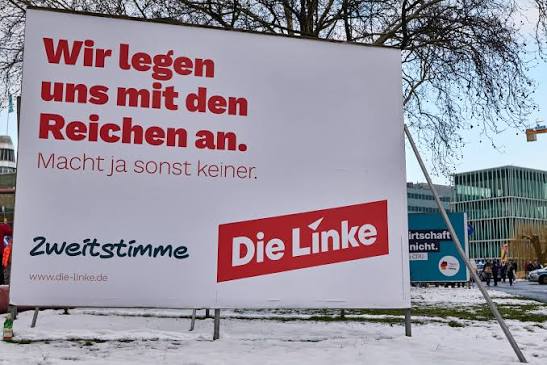
Die Linke fought the Berlin election with housing and affordability at the centre of its campaign. Reuters described housing as the dominant issue in the election, with rents nearly doubling since 2014. While television studios debated the identity of the Left, its members were standing at Berliners’ front doors. A dispute about Zionism fits neatly into eight minutes of television; organising a housing block has the discourtesy to take longer.
Eralp put socialisation (Vergesellschaftung) at the centre of prospective coalition negotiations: taking large housing portfolios out of the profit-driven property market and into public or collective ownership. She later put it bluntly: “If Die Linke governs, there will be socialisation.”
In a non-binding 2021 referendum, 57.6 per cent of voters backed the socialisation of large private housing companies owning more than 3,000 flats. The proposal has still not been implemented. Five years later, Berlin remains in no obvious hurry to discover what 57.6 per cent meant. The SPD resists Die Linke’s plan, while the Greens supported socialisation in principle during the campaign but raised questions about implementation.
So behind the argument about who is fit to enter the negotiating room lies a different conflict: who owns Berlin?
One small word: “and”
Return to Marion Horn’s phrase: “Israel haters and socialisation cranks.” The most revealing word may be the smallest: “and”. It joins two different arguments. One morally disqualifies Die Linke; the other attacks its challenge to private property. Horn puts them in the same sentence and reaches the same conclusion: do not negotiate with these people. That does not mean BILD manufactured an antisemitism controversy to protect landlords. That would give conspiracy too much credit and politics too little. The point is simpler: a moral argument against governing with Die Linke intersects with a material conflict over what a government including Die Linke might actually do.