Opening titles inform us that in Gaza on January 29th, 2024, the Israeli Army ordered the evacuation of the Tel al-Hawa neighbourhood, and that this dramatisation is based on real events and emergency calls recorded that day. We see a graphical reproduction of a recorded message, then intrude on the Palestine Red Crescent Society office in Ramallah. Some people are on the phone telling the person on the other end to stop the blood. Others are playing rock paper scissors as a way of releasing the tension.
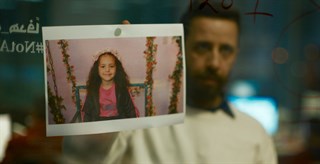
The phone rings. It is a 15-year-old girl begging for help. She says she is in a car and a tank is approaching. “They’re shooting at us,” she screams. We hear the sign of gunfire, then nothing more. Omar, who answered the call, is asked if he is ok. He is given a piece of paper with an anonymous face on it, which he should hang by his desk. When they identify who has just been killed, they will find a photograph of her and display it much larger on the office wall.
The phone rings again. This time the call is from Germany. It is a Palestinian man who says that his six-year-old niece Hind Rajab is trapped in a car, sharing the space with the corpses of her aunt, uncle, and cousins. The car is trapped in a battle zone, that is, a group of civilians were driving in an area chosen by the Israel Defense Forces for random military action. Omar’s colleague Rana tells him to return to the phone. “You were trained for this,” Rana says.
Omar reaches Hind by phone. She pleads for help, but there is only so much that Omar can offer. The Red Crescent offices have been forced to move out of Gaza, and now they are 83 kilometres away in the West Bank. There is one remaining Red Crescent ambulance in Northern Gaza, and amazingly, it is only eight minutes away from Hind’s car. But it is unable to move without fulfilling an elaborate protocol including liaising with the Red Cross and gaining a green light from the Israeli army—the same people who are shooting at Hind.
Charities have bosses too
One unexpected lesson from the film is that management hierarchies exist even in non-governmental organisations, where the work is mainly voluntary. No-one is in it for the money, but there are clear power structures at play. This means that while Omar wants them to use any means to save Hind—proper and improper—his boss Mahdi wants to play by the book. There is no exchange or dialogue. Mahdi gives the orders, causing Omar to shout out in frustration: “It’s because of people like you we’re occupied!”
I’m not saying that Mahdi necessarily makes the wrong decision, in this situation at least. He has seen too many of his colleagues die to act recklessly. He knows that if he sends an ambulance to save Hind without the cooperation of the Israeli security forces, he is effectively signing the death warrants of those health workers. We are not invited to agree or disagree with Mahdi’s decisions—only to understand that he is onto a hiding to nothing whatever he chooses.
At the same time, we can absolutely understand Omar’s frustration. Not just because he is unable to save a six-year-old girl when an ambulance is just minutes away, but also because he is unable to affect any of the decisions being made. At this point, he is not a humanitarian volunteer, he is a cog in the wheel driven by the Israeli occupation forces. He is trying to protect the most desperate victims of Israeli Defence Forces (IDF) violence, while having to play according to IDF rules.
While all this is happening, we hear the voice of Hind, saying that everyone in the car is covered in blood, trying to reassure herself that they are sleeping. But she eventually concedes that they are all dead. In a pleading voice, she cries out: “I’m so scared, please come.” Members of the Red Crescent team take it in turns to try and reassure Hind, asking her to tell her personal history (ironically she goes to a kindergarten called A Happy Childhood), or telling her to imagine that she’s at the beach. It is heartrending.
The team members who are not on the phone discuss strategy. Should they endanger further lives by trying to rescue this one? Should they try other tactics, like releasing Hind’s message on social media? Maybe this would shame the Israelis into letting the ambulance through. But do the Israeli occupying forces have any shame? We hear different opinions, but the people behind the voices are united in their frustration and impotence. The audience is invited to actively participate in the drama.
It sounds surprising at first, but one of the film’s strengths is that it largely concentrates on office bureaucracy. There is little exploitative concentration on a young girl’s mortifying experience. Eventually, we see some scenes of violence, but these are largely blurred. We later hear that 355 bullets riddled Hind’s car, but ultimately this is just a number. The Voice of Hind Rajab does not just tell us that what happened to Hind was an atrocity. It allows us to feel her tragedy.
The contradictory involvement of Hollywood royalty
Judged by Hollywood standards, The Voice of Hind Rajab is already a success. It has been nominated for an Oscar, and it won the Silver Lion Prize at the Venice Film Festival, where it received a standing ovation of a record 23 minutes. Its executive producers include Brad Pitt, Joaquin Phoenix, Rooney Mara, Jonathan Glazer, Alfonso Cuarón, Mark Ruffalo, Spike Lee, Michael Moore, and Jemima Khan. If it means that more people go and see this essential film, then this support from Hollywood figures is on balance a good thing.
It is not, however, an entirely good thing. Firstly, a room full of people applauding the documentation of the murder of a six-year-old girl feels icky. Secondly, there is a danger that, through no fault of its own, the film becomes a mainstream “issues” film on the festival circuit, which is detached from the real life events that it depicts (which are ongoing). People like Glazer and Ruffalo have consistently spoken up for Gaza, but it is likely that other producers may just be chasing the next hot film.
I am reminded of 12 Years a Slave, Steve McQueen’s excellent film about slavery. This film was also co-produced by Pitt, who had an acting role as a troubled white liberal. For me at least, Pitt’s role was the least convincing part of the film. Moreover, a film that was to be mainly about Black liberation was slightly hijacked by a narrative about how slavery made some white people sad. Orville Lloyd Douglas responded to the film: “As a black person, I can honestly say I am exhausted and bored with these kinds of ‘dramatic race’ films.”
Such criticism is justified, and if The Voice of Hind Rajab becomes the same sort of global phenomenon as Steve McQueen’s masterpiece, then we should be aware of which story is being told, and whose story is not being told. In this case, I believe that the ends justify the means. If the involvement of well-to-do Hollywood stars means that more people learn about a tragic case which was insufficiently covered by the world media, then this is a good thing whatever the motivations of the stars themselves.
This reminds me of a discussion that we had before the demonstration for Gaza on September 27th, 2025—the largest Germany has ever seen. Some activists were justifiably annoyed that NGOs and leaders of Die Linke, who had thus far been silent on Gaza, suddenly wanted to get involved with a growing movement. And yet despite their hypocrisy, it is their involvement that meant that we got our point across to a much larger audience and were able to mobilise way beyond our previous ranks.
To plot spoil or not to plot spoil?
All of this makes The Voice of Hind Rajab different from most other films. Although it is exceedingly well made, the whole point of this film is the content, not the form. Its success should be judged not by Oscar wins, or the length of an ovation at a festival, or even by the number of people who go and see it. If it does not inform people, change minds, and force them into action to stop further massacres in Gaza, then it could be judged as a failure.
Very few critics have hated The Voice of Hind Rajab, but there is a marked difference between those who applaud a well-made film (and this film is very well made) and those who have been obviously moved by a gut-wrenching account of an epochal event that should have an important part in all future history books. In case it is not already clear, I am very much of the second bond of opinion. The murder of Hind Rajab was a monumental occasion and should be commemorated as such.
There is a reasonable case to be made that, due to the exceptional nature of the film, a review should include plot spoilers. How can you review a film like this while staying silent about its barbaric content? In the face of something so horrific, how important are the sensitivities of readers who don’t want to know what happens next? You may feel slightly inconvenienced by being told what’s going to happen, but you need to know what happened. More importantly you need to know why it happened.
Nonetheless, this review contains only spoilers that are absolutely necessary. The story of what happened is so alarming that maybe it is better experienced by an audience that is unprepared for what it is about to see. Either way, this is compulsory viewing, especially for those who do not know every last detail. And if you don’t know the details before watching, it is your job to find out exactly what happened, and why Hind’s murder was not exceptional, but standard Israeli procedure in Gaza.
Some people who do know the story may be reluctant to visit the film. I have friends who have committed themselves to Hind—some for years. Some of those friends can’t bring themselves to watch this film. They don’t need to inflict another round of misery upon themselves. I understand this reaction fully. This is a film that is not just for Palestine activists, not even primarily for activists. It is for those who looked away. And, as the film argues, after the murder of a six-year-old child, looking away is no longer an option.
This is a righteous piece of proselytism which is aimed at changing hearts and minds. We should be encouraging people to go and see a film that documents nothing less than a war crime—one of many such crimes that have been committed in Gaza. But watching the film is not the end of the discussion. We also need to find the people who have seen the film—even those who were at star-spangled festivals—and ask them what they thought about it, and more urgently, what are they going to do about it?
This article is an extended version of a review that originally appeared on the Cinephil Berliner Film Blog. Thanks to Inês Colaço for their feedback, which led to some extra analysis on the film’s production and distribution.