International Workers Day, or May Day, has been celebrated by Berlin’s working class since 1890 through strikes, marches, and demonstrations. However, on 1 May 1929, following orders of the Prussian interior ministry and Berlin’s police chief, both from the Social Democratic Party (SPD), the Berlin police violently enforced a ban on public demonstrations. This led to the single bloodiest episode of police violence in Berlin’s history, later known as Blutmai (“Bloody May”).
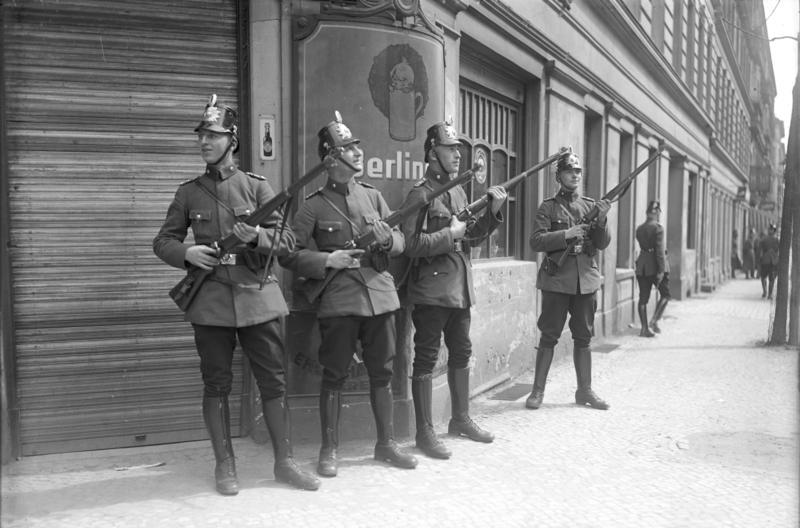
In the wake of clashes between communist and Nazi paramilitary wings following a speech by Adolf Hitler in late 1928, open-air political gatherings were prohibited in Berlin by the chief of police and member of the SPD, Karl Zörgiebel. He explicitly extended the ban to demonstrations on May Day, citing the likelihood of violence being instigated by the Communist Party of Germany (KPD). While the SPD planned indoor assemblies on May Day, the KPD called on workers to defy the ban and take to the streets in peaceful demonstration, as was tradition. With tensions rising, Zörgiebel brought in police from surrounding areas of the Prussian state, declaring that they were tasked with stopping an insurrection by the KPD.
On the morning of 1 May 1929, workers gathered and formed processions heading toward the city centre. The police, far outnumbering the protesters, attacked the columns marching through the city and civilians caught in the vicinity, leading to demonstrators being repeatedly chased into nearby streets before reassembling again. Police tactics became increasingly violent, and finally at midday, the police opened fire without distinguishing between protesters and bystanders. The violence was especially concentrated in Wedding and Neukölln, where police fired into buildings and at protesters in the street with armoured vehicles, and workers erected barricades.
In the days that followed, clashes continued and the police carried out extensive house-to-house searches, resulting in mass arrests and further shootings. By the afternoon of 3 May, the fighting had largely ended. Police bullets from the street skirmishes and searches had left over 30 dead—none of whom were KPD members. Over 1,200 people were arrested, but only a fraction of these had any connection to the KPD. No deaths were counted on the side of the police, nor were any officers later investigated or charged.
The Blutmai of 1929 marked a major sharpening of hostilities between the SPD and KPD during the final years of the Weimar Republic. This deepened divisions within the German left and further weakened possibilities for resistance against the rising Nazi movement. The events also highlighted the willingness of the SPD to employ state violence to repress radical working-class movements, echoing the party’s role in the suppression of the German Revolution of 1918–19 and the murders of Rosa Luxemburg and Karl Liebknecht. This May Day, let us honour those and other victims of police brutality, and remain aware of those who would benefit from our division.