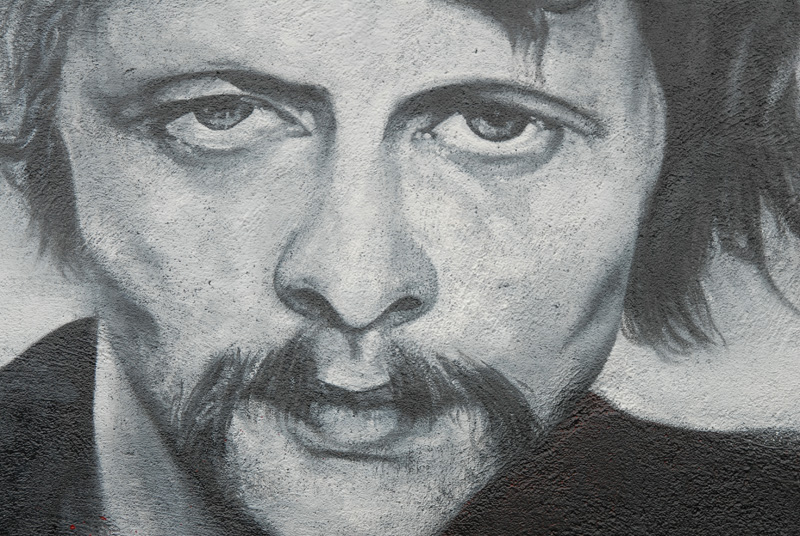
May 6th marks the 83rd birthday of Andreas Baader, founding member and one of the leaders of Rote Armee Fraktion (RAF), an anti-imperialist guerrilla group that tried to denazify Germany through armed forces. Followed by the anniversary of his comrade’s death, journalist Ulrike Meinhof, on May 9th, and the birth of the RAF itself in May 1970, this week and month are a heavy time to reflect on the influence and legacy of the RAF in Germany.
With a criminal record for petty offenses, Baader arrived in Berlin in his early 20s, had links to Kommune 1, and was part of the 1968 student movements. Radicalized by the police killing of the student Benno Ohnesorg, Baader soon made a name for himself in the left-wing scene. In Berlin, he met Gudrun Ensslin, a communist writer, who became his partner in life and crime. The pair joined the APO (Extra-Parliamentary Opposition) and planned and carried out arson attacks in department stores, which led to their imprisonment.
During a subsequent visit to the prison for an interview, the group met Ulrike Meinhof, who was already a renowned left-wing journalist at the time and also a member of the APO. After Baader’s escape and a visit to Palestine in 1970 to learn about resistance, weapons, and liberation movements, the RAF members returned to Germany for the 1972 Mai-Offensive, which consisted of bomb attacks against US army bases, police headquarters and, ultimately, against Axel Springer publishing house.
The group then went into hiding. Whilst Baader, Ensslin, and other member Raspe were apprehended by the police in Frankfurt, Ulrike Meinhof remained at large for longer. The RAF continued their resistance behind bars in the form of hunger strikes, and then were transferred to the high-security wing of Stammheim Prison, in whose courthouse the Ulm 5 were recently brought to trial. Remaining RAF members’ acts, intended to release the prisoners, proved in vain: the occupation of the German Embassy in Stockholm, the kidnapping of Hans-Martin Schleyer, former SS-officer and Chairman of the Employers’ Association, as well as the hijacking of a Lufthansa aircraft.
In 1976 Ulrike Meinhof hung herself in her cell; the following year in October, Gudrun Ensslin and Andreas Baader were found dead as well, the latter with a shot in the back of the head. The state said it was meant to look like murder; the comrades said that it was. To this day, the Rote Armee Fraktion remains one of the most significant anti-imperialist movements in Germany in the fight against fascism and its oppressive anti-democratic laws, restricted fundamental rights, police authority and violence, and the nazification of the government and the state. Politics that echoes eerily familiar in today’s Germany.