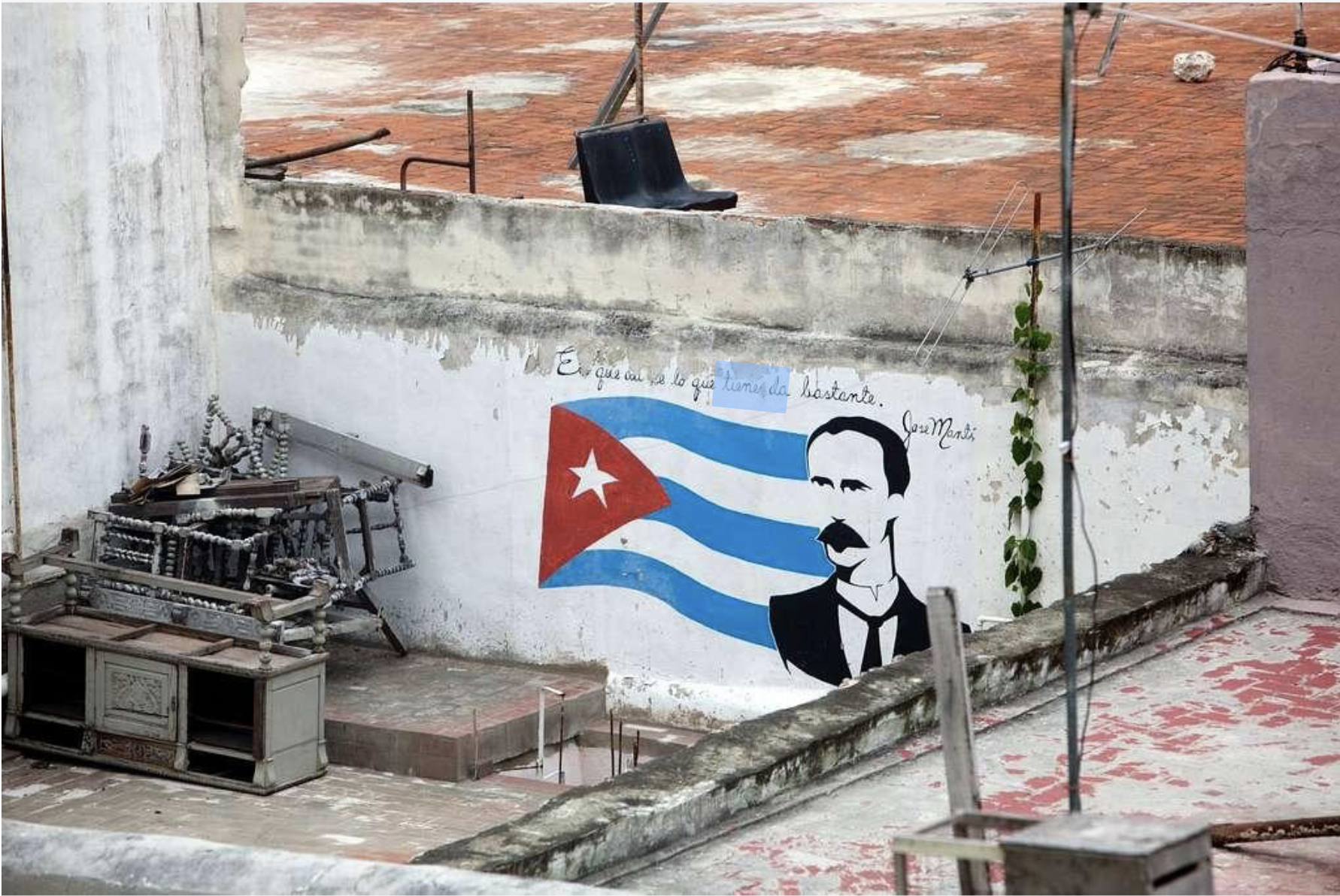
“Con los pobres de la tierra quiero yo mi suerte echar.”
“With the poor of the earth I will cast my lot.”
On May 19th, 1895, the Cuban national hero José Martí was killed in action during the Cuban war of independence against the Spanish. He was 42 years old. As the preeminent political theorist on Cuban nationalism at the time, his organising work galvanised Cubans at home and abroad to ultimately expel the Spanish, a day he did not live to see. His legacy post-martyrdom is co-opted by all strains of the Cuban political spectrum, a reflection of his radical anti-imperialist positioning vis-a-vis today’s mainstream liberal politics.
Martí was born in Cuban capital city, Havana, to Spanish parents and spent part of his childhood in Spain before returning to the island. He was politicised during the first Cuban war of independence against Spain–also called the Ten Years War–which was centered around the abolition of slavery and mobilised slaves and workers in sugar plantations, the primary colonial crop in Cuba. It was during this time that he published his first political writings, which were generally anti-imperialist and anti-slavery in nature. This led to him being exiled to Spain by the colonial authorities, from where his serious work on building internationalist solidarity for the Cuban independence cause took form.
His exile took him through Mexico, Guatemala, Venezuela, the West Indies, and the United States where he spent time teaching, writing, uniting, and working with Cuban exiles and the diaspora. The Cuban expatriates in Florida–polar opposite from what they are now–were exiles seeking political asylum and tobacco workers, whom he rallied for the cause of the plantation workers back in Cuba. In 1895, Martí organised an armed expedition from abroad, setting sail to Cuba, in order to start an uprising, a revolutionary move that would be the “intellectual author” of a similar expedition in 1953 by Fidel Castro and comrades. It is in this uprising that he was eventually killed, at the Battle of Dos Rios.
Martí’s most famous essay, “Nuestra America”, argued that Cubans should not look outside of Cuba for their solution, as all problems were fomented outside. He saw the oppressed in Cuba as the real leaders of the revolution and warned against what would turn out to be an accurate reading of US imperialist interests in the West Indies and eventually Cuba. At the same time, Martí was wary of Marx and communism, and saw US liberal democratic society at the time as a blueprint for Latin America. Moving away from what would now be contemporarily termed decolonial, Martí also saw merit in working with European and American society for reforms essential for Latin America to detach themselves from Spanish subjugation. These juxtapositions simmer of course, from a contemporary positioning of Martí.
Martí’s politics played a pivotal foundational role in politics post the revolution in 1959 and is equally appropriated by socialists and their critics alike. Several parks and streets are named in his honour today, including Havana’s airport.
Martí was also a famous poet. His political vision of the world can best be summarised in one of his most famous poems “Cultivo una rosa blanca” (I cultivate a white rose), which is interestingly the possible inspiration behind the name “The White Rose”, a student resistance movement in Munich in 1942-43 led by Sophie Scholl and others.
Cultivo una rosa blanca
en julio como en enero
para el amigo sincero
que me da su mano franca.
Pero para el cruel que me arranca
el corazón con que vivo,
cardo ni ortiga cultivo…
cultivo una rosa blanca.
Translated to English:
I cultivate a white rose
In July as in January
For the sincere friend
Who gives me his hand frankly.
And for the cruel person who tears out
the heart with which I live,
I cultivate neither nettles nor thorns:
I cultivate a white rose.