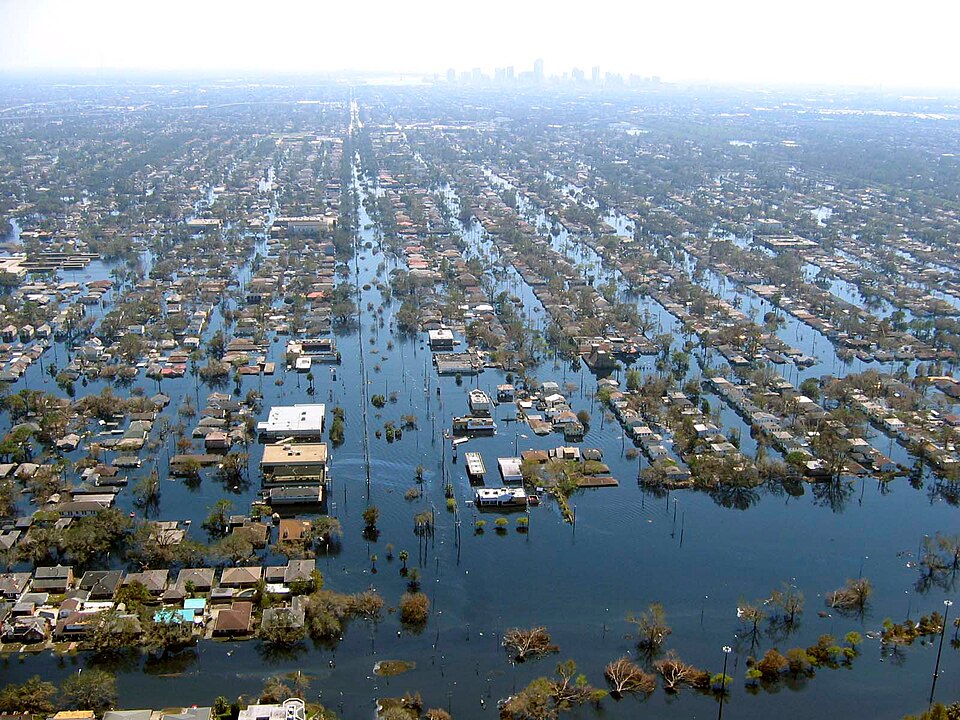
Hurricane Katrina killed 1,392 people in the contiguous United States, the deadliest American hurricane since 1928, and caused property and environmental damage now estimated at over $200 billion, the costliest tropical cyclone in US history. The storm crossed Florida, entered the Gulf of Mexico on August 26, and rapidly intensified into a Category 5 hurricane, the highest level on the Saffir–Simpson scale. Investigators found that most of the deaths came not from the storm itself, but from Louisiana’s levee system failing on August 29. This flood prevention system was designed and built by the federal government, part of a hurricane and flood protection project the Army Corps had underfunded and mismanaged for decades. Washington was no better prepared: two years earlier, President George W. Bush had folded the Federal Emergency Management Agency (FEMA) into the newly created Department of Homeland Security, subordinating disaster relief to an agency oppressively focused on counterterrorism post 9-11. The price was not paid evenly: the Lower Ninth Ward, a historically Black neighborhood in New Orleans, took the hardest hit, many residents unable to afford evacuation, and the resulting displacement so severe that the city still has 121,000 fewer Black residents today than in 2000. Its Black population share is down from 67 to 58 percent.
Across the river in Algiers, Louisiana, a different failure was underway, armed and organized along the same racial line. White residents sealed off the neighborhood with makeshift barricades and armed patrols, hunting for anyone who “didn’t belong.” On September 1, Donnell Herrington, his cousin Marcel Alexander, and their friend Chris Collins were shot trying to cross a barricade toward a Coast Guard evacuation point. They were among at least eleven Black residents shot in Algiers Point during that period; none of the shootings were ever investigated by local police. It took until 2019 for a single shooter to face any consequence, when Roland Bourgeois was sentenced to ten years for the Herrington shooting. A few streets away, former Black Panther Malik Rahim was held at gunpoint by armed white residents in those same days.
Rahim had been here before. Thirty-five years earlier, fresh back from the Navy and Vietnam, and radicalized by the racism he faced in the service and the environmental devastation he witnessed there, he helped run a Black Panther breakfast program in the Desire housing project that survived two armed police raids. He and eleven others were charged with attempted murder and acquitted. He spent the following decades organizing tenants in San Francisco and campaigning to free the Angola 3, three Black Panthers whose murder convictions kept them in solitary confinement in Louisiana for decades. By the time Katrina hit, he was back in Algiers, running a housing program that had already helped more than a thousand former prisoners rebuild their lives.
On September 5, 2005, Rahim joined Algiers resident Sharon Johnson and Texas organizer scott crow to found the Common Ground Collective, defending itself from the start against the same armed white vigilantes patrolling the neighborhood. Rahim’s Panther politics and crow’s anarchism shaped it in equal measure: health clinics, free schools, food distribution, house-gutting crews, and worker co-ops, run largely by volunteers with no state backing. Within three years, roughly 23,000 volunteers had passed through, outpacing anything FEMA or the Red Cross delivered. Some volunteers criticized the group’s leadership, and one organizer later conceded that most of Common Ground’s coordinators, being white, approached the work from a different politics than the Black radical tradition Rahim represented. Regardless, for thousands of New Orleanians, it was still the only thing that worked.
What volunteers built from nothing in 2005, the government still can’t manage with a budget. FEMA has cut roughly 14 percent of its workforce since January 2025, and the Trump administration has floated eliminating the agency outright, even as a funding standoff lasting nearly eleven weeks left the agency’s disaster fund running on empty and hundreds of thousands of recovery projects stalled nationwide. In that same shutdown, ICE sat on $75 billion, enough to run for years tormenting immigrant communities—the same working-class communities most at risk when the next storm hits—while aid and prevention have been weaponized as political tools rather than public necessities. Floods, fires, and increasingly volatile weather aren’t going away. Our ability to prepare for and respond to them collectively is our greatest strength. To look away and divert public resources is to consciously accept unnecessary tragedy, over and over again. Katrina already proved what happens when people are left without the resources to survive a disaster: those with the least often end up losing the most.