Lena Hartog is a Dutch climate activist, researcher, and documentary director. Together with Belgian climate activist Anuna De Wever, she produced The Cost of Growth, a documentary that explores the human and ecological costs of Europe’s model of endless economic growth. It follows grassroots resistance movements in Serbia, Italy and Sápmi. We caught up with her at a screening of the documentary at Apocalypse Predrinks on the 21stof August, wanting to know her thoughts on these difficult topics and what hopes she has for the future.
Hi Lena. Your documentary begins with the failure of global climate policy, particularly of the European Green Deal. It then continues and connects climate change to perpetual growth, militarisation, Europe’s anti-migration policies, the genocide in Gaza, and imperialism. Why was it important for you to take this expansive angle?
The starting point of the documentary is when my co-producer Anuna and I ended our activism in the climate movement. We had become disillusioned not with the climate movement itself, but with what climate policy had done to the global momentum of movements such as Fridays for Future.
The European Green Deal was promised almost as an answer to that momentum. But if you looked under the hood, not only was it doing very little to solve the climate crisis, but it was also largely reproducing the same power dynamics that we’ve seen throughout history.
For example, look at what it advocates in terms of extractivism, especially around the mining of lithium in different parts of the world. You very quickly see its colonial roots and how the word “empire” still accurately describes our continent and its relationship with a large part of the world. The externalisation of violence that is a bare necessity for our economies to thrive has been so deeply normalised that we just don’t commonly think to describe Europe in those terms.
Another problem with the Green Deal, besides that it is not that green, is that it allows Europe to protect its “progressive image”. In fact, climate change generally has offered a large part of empire, including Europe and the United States, the opportunity to rebrand itself as the saviour—but “green”.
That’s what we wanted to do in the documentary: to hold up a mirror to ourselves as Europeans and benefactors of this system, and to the European project, and show how it works to keep existing power relations in place. Because if we’re not honest about what the situation actually is, how can we change it?
Was this understanding something you came to during your time as a climate activist, or was it something that developed in the process of making the documentary? It reminds me a bit of Greta Thunberg’s shift from purely climate-focused activism to her global activism around Palestine and colonialism.
I think both.
A lot of people that joined the climate movement in the Global North were at some point educated by activists from the Global South. Especially during the period of COVID, there was a period of exchange and education, where the analysis of climate change was taken much further to a more decolonial perspective.
Sometimes the critique from outside the global climate justice movement is that it used to be a movement of young people focusing on climate, and now they’ve lost their focus and are connecting all these other things.
There’s a particular moment that illustrated this in the Netherlands during a massive climate march that Greta Thunberg attended. She shared the stage with a Palestinian activist and a Dutch white man then pushed himself forward, took the microphone, and said: “This is a march about climate change, not about Palestine”. It was a huge moment in Dutch politics, and it was also an important moment for me.
I realised that we cannot simply organise a climate protest one month and a Palestine protest the next, and then say “those are connected”. We can’t expect everyone who has been indoctrinated by mainstream stories to connect all the dots. We have to guide people.
How do you see the importance of raising awareness, as opposed to direct action or other forms of resistance and activism?
Both direct action as well as building real alternatives, so things that are actually physically happening in the real world, are essential and no awareness can replace that. But I think that raising awareness can grow support for those actions and the space for them to succeed. It can shift something from a radical idea to something that can actually be widely talked about. That’s the idea of the “Overton window” changing.
But a push will always be needed for change. We can keep watching movies, reading newspapers and books, and continue growing our understanding of how everything is connected. In the end though, the goal is to build movements that are dangerous to the status quo.
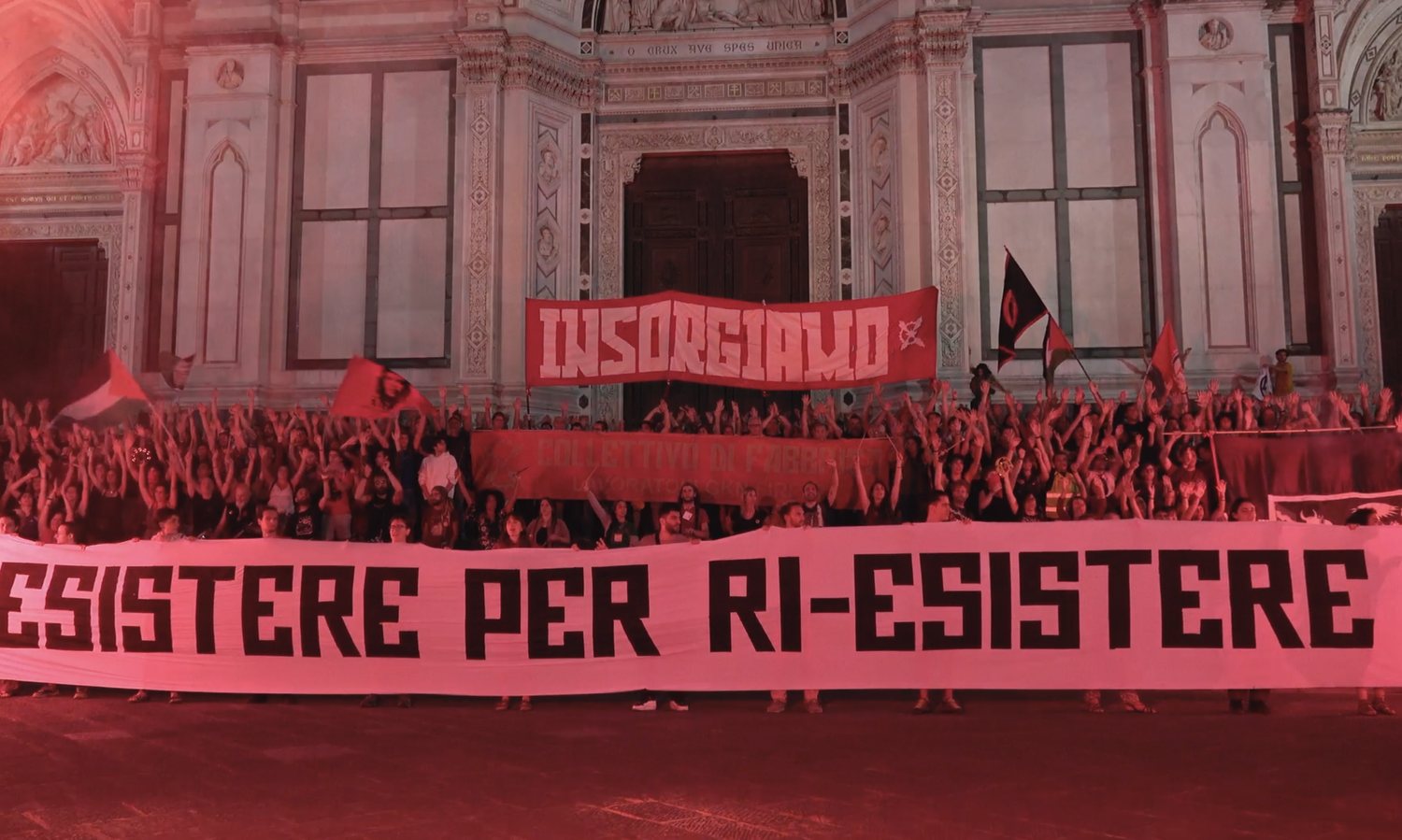
In the documentary you touch on alternatives happening right now, for example housing co-ops and the GKN factory in Florence that was transformed into a workers’ cooperative. But the documentary leaves no room for interpretation on the systemic nature of the issues we face. How much of an effect can movements and alternatives have without overhauling the system completely?
Movements like mutual aid movements, workers cooperatives, food cooperatives, and housing cooperatives are necessary to believe we can build a different kind of economic and political system, but they will also increasingly simply become necessary for survival.
For example, global water shortages are coming up very quickly and will have a rapid effect on food production in most parts of the world, even in Europe. It’s hard to imagine that the system could crumble because we have such an organised system, but already we’re living through decades of normalised collapse.
What I’m hoping for is movements of alternatives that show a different world is possible while also being rooted in political analysis. They also call it prefigurative movements, so movements that prefigure the future in the present.
Can you explain more about what you mean by alternatives “rooted in political analysis”?
For me the question is: who is the alternative for? The risk of an alternative without political analysis is that it becomes an escape and reinforces privilege.
If a group of people decides to leave activism, leave society, and live in an eco-community for example, it will not grow momentum or grow a bigger movement, and it will not put pressure on governments to change anything.
Throughout the documentary, you emphasise that the capitalist political and economic system is fundamentally undemocratic. What does real democracy look like?
We talk about democratising the economy in the documentary a lot, and it means two things.
On one hand there’s the undemocratic nature of the current European political system, both on a national and European level. We have the chance to vote every few years, but the actual process of how policy is made is deeply influenced by corporate lobby interests. It begs the question, is that a democracy? So that’s one part of the job, making democracy live up to its promises through less corporate influence.
On the other hand, there’s the question about whether our political system actually has control over the most important function of the economy—providing for our material needs.
The question then becomes how can we democratise the economy more directly? This takes us away from thinking about only political democracy in parliaments, and towards realising that we need to take control over our own production. So decisions around how much is produced, for whom, in what way, and making sure that it benefits the people that actually make the things.
That’s why we think GKN in Florence is such a great example, because the workers literally took over the factory when it closed. They developed a plan to make useful, sustainable products, such as cargo bikes and solar panels. Though sadly the Italian government doesn’t allow them to follow this plan and isn’t supporting them. The government should be grateful!
And besides movements, there are concrete government policies like what Zohran Mandami has been fighting for in New York, such as city-owned grocery stores for everyone. That’s a step in the direction of democratising the economy and turning some of our most important needs into public goods, such as food and energy, rather than them being owned or controlled by the market.
Is there anything else that you would have liked to cover or that you’re seeing right now like this gives you hope?
Something that gives me hope is the idea of mutual aid—the idea of very directly supporting each other, whether it be financially or by providing for our basic needs. In Europe, there are some different time-sharing initiatives and of course some food-sharing initiatives, but there’s no larger political movement advocating for it as there has been in the USA.
In Minnesota there have been successful mutual aid movements as part of resisting ICE. Some of these activists were previously part of the sunrise movement, a climate movement focused on lobbying and resistance, who then shifted towards mutual aid. A big part of the work was literally bringing bags of groceries to neighbours.
Neighbours who wouldn’t feel safe going outside because of ICE arrests.
Exactly. And then the question is this an alternative, is this a movement? It’s both, because it’s deeply political and it takes a political position by saying people deserve food and deserve to be treated as humans. And it also aims to do something about that.
Your work right now extends past this documentary. You’re also setting up an organisation to encourage and help other people do further documentary work. Can you tell me about that?
We’re still developing it and we don’t know yet whether it’ll become a network, a platform, or something similar. But we want it be something that supports and grows stories by movements, for movements, rooted in political analysis. We want to help tell stories about people that are democratising the economy and that are challenging the current status quo.
We’ve seen from the response to The Cost of Growth that there’s a real longing for stories that tell you how to actually do things, how to actually resist. That’s what we’re dreaming of: to support other filmmakers or activists and storytellers to tell their stories. Every time I see this documentary, I realise again that none of us who are in it can tell the complete story—we only understand a piece of it.