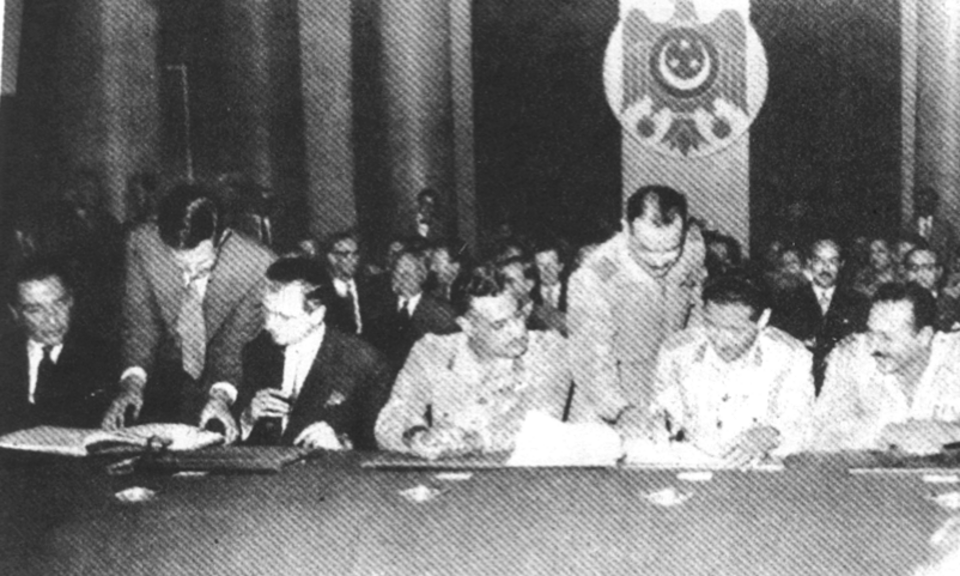
On 13th June, 1956, Britain gave up control of the Suez Canal. This was part of a general withdrawal by the country from its colonies, the result of Britain’s declining economic power after the Second World War, and its fear of growing national liberation movements. The British government decided to concentrate its “defence” spending in supporting the Cold War in Europe, and—following anti-British riots in Egypt in 1952—signed an agreement to remove its troops and military bases from the area around Suez.
In 1952, the Free Officers seized power in Egypt (in an action incidentally supported by the CIA). Colonel Gamal Abdel Nasser became acting president in 1954, promising “a bright new era” in which “Egypt no longer would be under the domination of the imperialists.” On July 26th 1956, in defiance of the World Bank, he nationalised the Suez canal, and with it the ability to control the world’s most important oil delivery waterway and vital link to the West’s Asian colonies.
Britain responded by freezing Egyptian assets and imposing an arms embargo. In October, Israel invaded Gaza with the support of Britain and France, but the USA refused to support the action. In the early years of the Cold War, President Eisenhower feared that Nasser, who was already receiving Russian weapons, would fully go over to the Soviet zone of interest. After the Soviet Union invaded Hungary in October, he also saw USA support of a foreign intervention as an optics problem.
Suez demonstrated a shift in power in the post-war world. It was no longer possible for the old colonial powers, Britain and France, to act independently of the USA and the Soviet Union. Shortly after Suez, in 1958, the Brits were also driven out of Iraq. But this was not just a question of the USA and the USSR dictating world politics. Changes in Egypt, Iraq, and Hungary were the result of mass popular movements prepared to act independently of the great powers or their own governments.
I recently read an article in which Hussein Said argued that Trump’s defeat in Iran was “on a bigger scale than Iraq, Afghanistan, or Vietnam—or even the Suez Crisis of 1956 which sunk the British Empire.” Time will tell whether Hussein’s analysis is correct, but at least it gives the scale of what happened then, and what is currently happening. Suez was a world-shattering event; it affected the imperial balance of power and control over natural resources. We should learn from its importance—then and now.