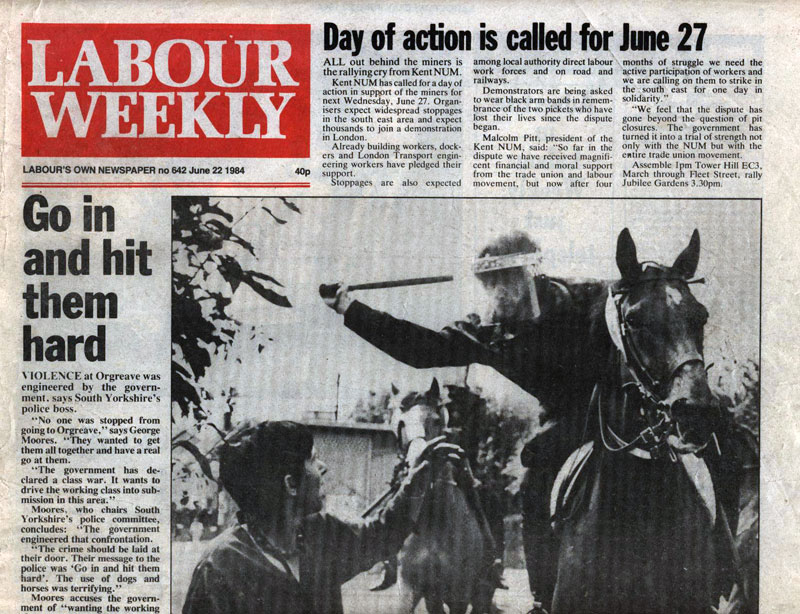
18th June 1984 witnessed one of the worst riots in British history. This riot did not follow the usual cliché—an uprising by disaffected youth, mainly from ethnic minorities. It was, as civil rights NGO Liberty described, a “police riot”. That evening, when the battle was shown on the news, the state broadcaster, the BBC, reversed their film to make it seem that an assault by armed police on striking miners was in fact an attack on the police.
Orgreave was an attempted mass picket of the steel plant near Rotherham in South Yorkshire. The British miners’ strike had been going on for three months. Steel unions had promised support, but also said that the steel factories needed coal supplies to stay open. In May, British Steel management ordered 5,000 extra tonnes of top quality coke from Orgreave. The NUM miners’ union’s response was to call for mass pickets of Orgreave aimed at stopping the coke deliveries, starting on 23 May.
This strategy was based on a successful action in a previous miners’ strike. In 1972, 30,000 pickets shut down the Saltley Gate fuel storage depot, an action which won the strike and indirectly led to the fall of a Tory government. Since 1972, the police had been used by Margaret Thatcher to put down riots across Britain. By the time they were sent to Orgreave, police were carrying riot shields and truncheons, and supported by snarling dogs. Mounted police in riot gear charged at the pickets without provocation.
71 miners were charged with riot, and 24 with violent disorder. The trials collapsed after the police evidence was found to be “unreliable”. South Yorkshire Police (SYP) falsely claimed that they had been attacked by miners. Five years later, the same police made similar claims following the disaster at Hillsborough football stadium. In 1991, SYP paid £425,000 to 39 miners for assault, wrongful arrest, unlawful detention and malicious prosecution. No policeman or politician was prosecuted for misconduct.
Orgreave was a turning point in the strike. There were no more mass pickets after 18 June. Arthur Scargill, who as a local union leader had led the mass pickets of Saltley Gate, was now union president, but local leaders of the NUM were more circumspect. Rather than increasing the mass pickets of Orgreave, they sent pickets elsewhere. The strike went on for a year, but was finally defeated, leading to mass job losses. The legitimation of police violence was also used to increase repression across Britain.