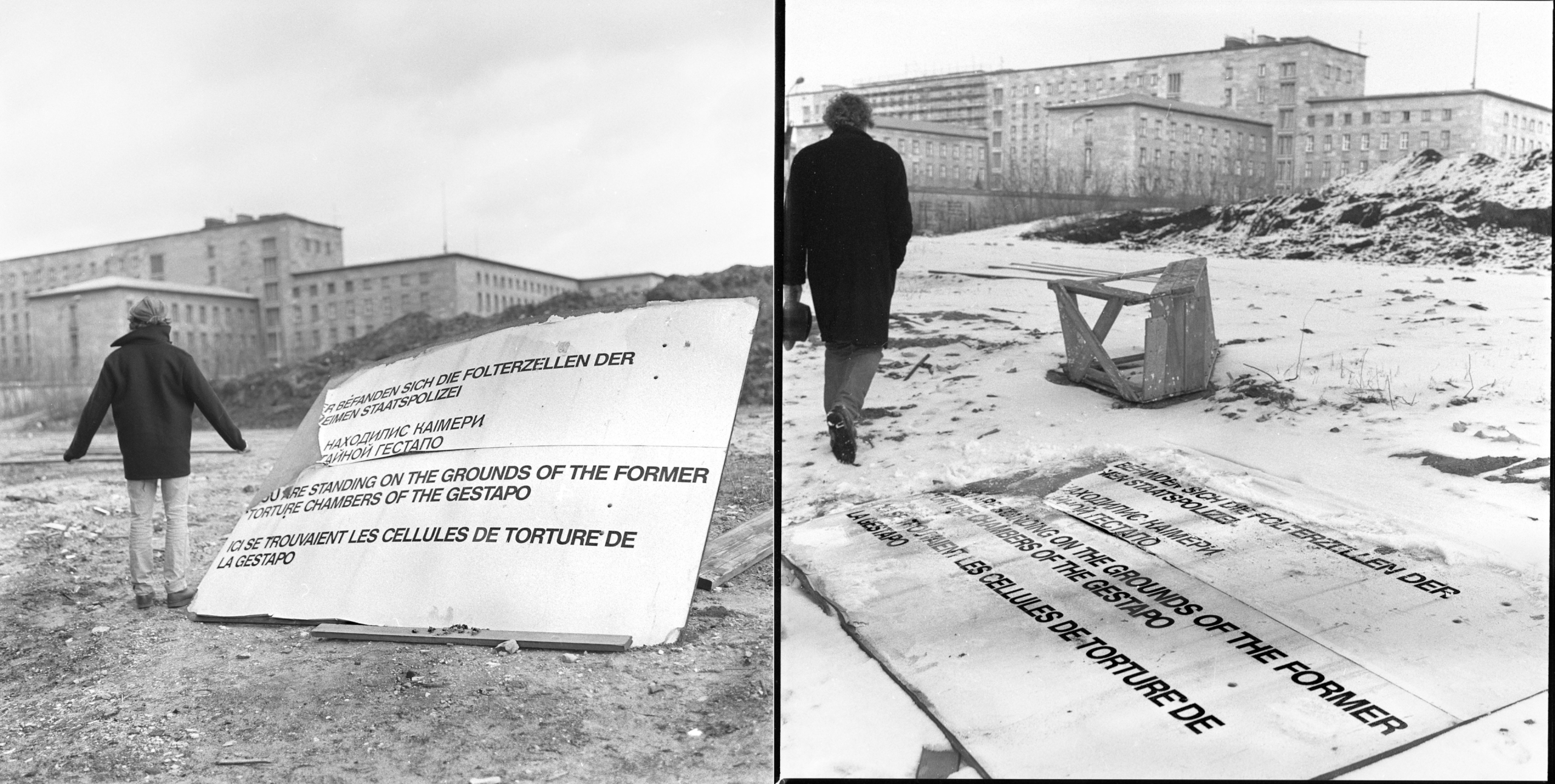
It is the mid-1980s. The Berlin Wall between the two Germanys is still intact and visible in the background of these photos. It was defined as the “Anti-Fascist Protection Wall” by the East German authorities. This will soon change.
In these two images, the concept of the Berlin Wall being a protective “anti-Fascist barrier” is valid, visually. The pictured site in West Berlin was the former torture center of the Gestapo on “Wilhelmstraße,” West Berlin. It was sealed off from East Berlin by the Berlin Wall facing West Berlin. The Nazi torture center, a symbol of evil that the East Germans thought they could keep out with a wall.
The official German Democratic Republic (GDR) title of the border barrier as the Anti-Fascist Protection Wall was met with ridicule in the West, where they preferred the description “Wall-of-Shame.” The playwright, Heiner Müller would later describe the GDR as a “nursing home for Communists and Concentration Camp victims.” Anti-Fascism was a State doctrine taken seriously by the GDR as many of East Germany’s elite had been imprisoned or held in Concentration Camps during the Nazi years. The Berlin Wall did have negative ramifications, but it was necessary for the economic survival of the GDR, and the claim that it prevented WW3 in the middle of the Cold War is a valid argument.
The context of an Anti-Fascist Wall separating Berlin into an “Anti-Fascist” East and a “Neo-Fascist” West would also seem to be confirmed by the fact that this informative sign about the historic Gestapo site was repeatedly attacked and damaged by Fascists and ultra-Nationalists in West Berlin who did not want to be reminded of the dark side of Nazi history and German Nationalism. In post-WWII West Germany a Nazi past or Nazi sympathy were not barriers to a successful career. Other people of that era who considered themselves Anti-Fascists, like Bertolt Brecht or Anna Seghers, did not feel welcomed in the West and returned from WWII exile to settle in the GDR. Much later, the young West Germans who came to West Berlin to avoid the German military draft were told to migrate to the East side of the Wall if they were not satisfied with things in the West. This was a typical reaction in West German media to critics of a government largely run by former Nazis in the West.
The first actual physical split of Berlin was not carried out by the East German authorities and their wall: it was done by the police in the West who blocked trams coming from East Berlin at the still-open sector border. Why? The GDR gave women employment equality immediately with the founding of the republic in 1949. Women were hired as drivers of the trams, an act that the West Berlin authorities considered illegal. The trams were stopped at the sector border, and a male driver from the West had to replace the female GDR driver in order for the tram to be allowed by the West to proceed through Berlin. It wasn’t until 1980 that West Berlin gave women equal rights at work.
Back to the photo: directly adjacent to this Gestapo torture site stands a building, “Deutschlandhaus,” where the offices of the “Berlin Landesverband der Vertriebenen” (Organisation of the Exiled Germans, BdV) are located. It still exists there as the organisation of Germans who left or were expelled as Nazi sympathizers from regions that were claimed by Nazi Germany or populated by Germans before national borders were changed after WWII.
This organisation, BdV, has the reputation of holding extreme right-wing views and revisionist concepts of German history. Their website writes of “massacres” committed by the Soviet Red Army and partisans fighting Nazi Germany. It was and still is funded by the current Federal German Government, 81 years after the end of WWII.
That large building in the background formally served as the headquarters for the Nazi Wehrmacht under Hermann Göring. After German re-unification in 1989, the Federal Economic Ministry moved their offices there. The new West German ministry received an unwelcome visitor in 2015: the Greek Economic Minister, Yanis Varoufakis. He came to Berlin to negotiate the alleged debts owed by Greece to Germany, or more accurately, to German banks.
Greece had been devastated by the Nazi Wehrmacht during WWII but never received any reparations from Germany; a point of contention to this day. Varoufakis came to Berlin to negotiate the 2015 debt crisis in Greece, or more accurately, debt owed to German and French banks. Varoufakis vividly describes the “toxic atmosphere” of the former Wehrmacht headquarters in a discussion with Slavoj Žižek in this video clip, where he also explained that the “Euro” is actually the old “German-Mark.” Varoufakis failed to get any compromise from Germany and had to resign his post as Greek economic minister. Germany now has more economic power over Europe than the Nazis could ever have imagined.
Forty years after this photo was made, it is 2026. The Berlin Wall at this site is still intact. But the GDR—the State that called itself the “New Germany”—is now gone. In 1992 the former GDR leader, Erich Honecker, was arrested and imprisoned in the exact same cell in West Berlin in which he was held as a Communist during Nazi times. He is now dead.
West Germany did not “develop” this centrally located property in the photo after 1989, when most public properties were privatized. Financial corruption had ripped a hole in the Berlin government budget in the late 1990s, which accelerated the sale of public property to Capitalists speculating on real estate prices. The government decided to use the historic significance of this property for their “remembrance culture,” re-naming the site “Topography of Terror.” They constructed a museum about the Nazi era right where that lonely, battered sign formerly stood. Unlike other properties on the former border, the West German authorities did not tear down the Berlin Wall at this location. Now, next to the new museum, the Wall serves as a useful symbol to emphasize the West German narrative associating Hitler’s Germany and the East German Democratic Republic as being the “two dictatorships” of German history. The Anti-Fascist Wall suddenly metamorphosed into a symbol equating it and the East German State with Nazi Fascism. The happy-end of the Cold-War was declared.
A history written by the “victors.” The “dictatorship of private property” now rules over re-united Berlin, and the terror persists in other forms. Ask Greece, racked by austerity/privatisation where over 60% of the population cannot meet the cost-of-living, or ask anyone trying to secure a rental roof over their head in Berlin today, where real estate speculation has exploded the housing crisis and ruined neighbourhoods. Ask Palestine, which has been decimated thanks to German weaponry provided to Israel for its genocide. For the first time since WWII, a weapons factory is being constructed in Berlin by Rheinmetall, a corporation which funded the militias that murdered the leftists Karl Liebknecht and Rosa Luxemburg, and used slave-labour to produce Third Reich armaments. Rheinmetall’s profits have soared over the last 3 years during unprecedented militarization in Europe, pushed largely by Germany and the German head of the EU, Ursula von der Leyen.
East Germany may no longer exist, but it is happily resurrected by German media to shoulder the blame for numerous problems currently facing Germany. One of them is the rise of the extreme-right party, Alternative für Deutschland (Alternative for Deutschland, AfD), which is polling at record highs in former East Germany. The West Germans claim this was more proof of the failings of the former socialist system which never taught their citizens to respect “democratic values.” But the fact is that the GDR ceased to exist 37 years ago, meaning over 1/3 of the current voters in the East grew up under the current system, not in the GDR. Secondly, when you include voters in the West, the shocking result in the polls show that the AfD is the strongest party in Germany as a whole, even ahead of the current conservative Christian Democrats of Chancellor Merz.
The AfD is a party whose leader, Alexander Gauland, dismissed critical attention on Germany’s Fascist history, calling the Nazi era “just a piece of pigeon-poop” in relation to “1000 years of successful German history.” 1000 years of successful history? Does that sound familiar to anyone?
Nationwide parliamentary elections are scheduled for September 2026. The rise of the extreme right in Europe is especially alarming in Germany, where the historical consequences of Fascism are brutally clear. That inspired Ali Abunimah, editor of “Electronic Intifada,” to renew the call for a 2-State solution for Germany, and the right-to-exist for the GDR.
The Berlin Wall was born on August 13th and lasted a mere 28 years. The generation that grew up under GDR socialism is dying out. Ideologies do not necessarily depend on the physical world for their existence; yet when they feel threatened, things can quickly “get physical.” For the past three years, Berlin has banned all symbols of the Soviet Union at the famous memorial site to the triumph of the Red Army over Nazism on Victory-Day. “Victory Day”: a day of liberation from Fascism or a day-of-defeat for Berlin? That may still be an unanswered question.
Berlin and Germany remain a mine-field of dangerous memories.