On 4th July, the Alternative für Deutschland (AfD) will be holding its conference in Erfurt. The date appears to have been deliberately chosen. Exactly 100 years earlier, on 4th July 1926, Hitler’s NSDAP (Nazi) party held its second conference in nearby Weimar. This conference “had the main goal of unconditionally aligning the fragmented party with Adolf Hitler and presenting the NSDAP as a unified ‘movement’.” It was here that the Hitler Youth was formed.
The AfD Conference is taking place at a time when the party is leading in the national polls. All recent polls show that the AfD is the most popular party in Germany, and in the most recent one it was polling at 29%, with the CDU at 20%, followed by the Greens on 14%, with the SPD and die LINKE trailing on 12%.
In Eastern Germany, which includes Erfurt, the situation is even more grim. In Saxony and Saxony-Anhalt, the AfD is polling at 42%; in Thüringen—under the leadership of neo-Nazi demagogue Björn Höcke—39%; in Mecklenburg-Vorpommern 34%; and in Brandenburg 32%. Excluding the special case of Berlin, the AfD is polling at least 9% ahead of its nearest rival in each of the former East German states. In most states, the lead is much higher.
All this is happening when the party as a whole is becoming gradually taken over by neo-Nazis, and when its new youth organisation is looking at building street-fighting cadres. For this reason, a range of anti-fascist organisations have called for a blockade of the Erfurt conference. In this article, I want to argue why you should drop everything and join that blockade.
What the AfD was and what they are now
The AfD was formed in 2013 as a “party of professors” opposed to the Euro. In 2017, following the “Syrian refugee crisis”, it had its first electoral breakthrough, winning 12.6% of the votes. Since then, it has continued to grow, and it has swung dramatically to the right.
In 2022, I wrote an article charting the development of the AfD, in which I argued: “Until now, the anti-Fascist Left has preferred to say that the AfD is not a Nazi party, but a party with Nazis in it. I think that this analysis still holds. This is not static nor is it definite that Nazis will not be able to take over the party in the relatively near future.” Four years on, I now believe that the Nazis are in full control.
The AfD’s three original leaders have all been forced out. In 2015, Bernd Lucke left the party, two years after he had founded it, saying it had “fallen irretrievably into the wrong hands”. He was followed two years later by Frauke Petry following a power struggle with Björn Höcke, whom she accused of “consciously reverting to the National Socialist [Nazi] past”. Konrad Adam left the party on 1 January 2021.
The party has become increasingly dominated by Höcke and Der Flügel, the party wing around him. Der Flügel was officially disbanded in April 2020, after accusations of right-wing extremism, but as journalist Sabine Am Orde argued: “You don’t lose the ability to organise majorities on which some national party leaders are dependent by just removing a Flügel logo, nor do you lose the extreme right wing ideology.”
Björn Höcke is a Nazi
Björn Höcke, a man who has realistic ambitions of being national party leader, now leads the party in Thüringen. A court in Frankfurt-Main has ruled that the slogan “Björn Höcke is a Nazi” is not libellous as it is “a value-judgement based on facts.” Courts in Hamburg, Nuremberg, and Aachen have made similar rulings.
You can read more about Höcke here, but here are some of his greatest hits:
In 2015, the AfD discussed expelling Höcke from the party, after he made statements like “Christianity and Judaism are an antagonism. That is why I cannot comprehend the term ‘Christian-Judeo Occident.”
Also in 2015, in a speech in Magdeburg, Höcke referenced Hitler’s plan for a 1,000 year Reich, saying: “I want Magdeburg and Germany to have not only a thousand-year past. I want them to have a thousand-year future as well, and I know you want that too.”
In 2017, Höcke called for an end to the culture of Shoah remembrance, calling the Holocaust memorial in Berlin a “monument of shame”. As his audience from the AfD youth organisation applauded, Höcke called for “nothing other than a 180-degree reversal on the politics of remembrance.” These statements precipitated the power struggle with Petry—a struggle which she clearly lost.
In 2022, Höcke made a speech in Gera, in which he said that the German Volk, whom he understood as a biological entity, “must stand at the center of politics. It must assert itself in a hostile environment by fighting against other peoples and, in particular, be armed against the dangers of Judaism.”
Höcke is a professional history teacher who knows exactly which political precedents his statements are echoing.
Not just Höcke
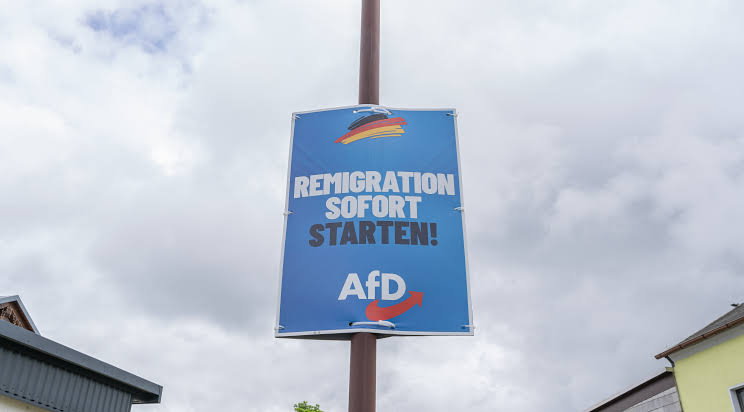
It is no longer possible to just talk about a Fascist wing under Höcke. The AfD is now Fascist through and through. Remigration—the forced expulsion of millions of people, which would only be possible through massive state force—is now a central part of the party’s policy.
In 2024, Bayerischen Rundfunk reported that the AfD’s 78 MPs were employing more than 100 members of the far right scene. Over half of AfD MPs—including both leaders of the parliamentary fraction Alice Weidel und Tino Chrupalla—were employing members of groups that even the Verfassungsschutz designated as extreme right.
In 2024, eight young men were arrested by police in Saxony for “planned ethnic cleansing”. The taz reported that “They had already procured equipment: camouflage suits, combat helmets, gas masks, and protective vests … unregistered live firearms were also found in the possession of several of the accused.” Three of those arrested were local AfD functionaries, including the parliamentary group leader in Grimma city council.
Although the party propagandists like to point out that party leader Alice Weidel is a lesbian with a partner who was born in Sri Lanka, Weidel’s election campaign was accompanied by the chant “Alice für Deutschland”—a deliberate reference to the Nazi slogan Alles für Deutschland (everything for Germany).
At last year’s party conference, speaking about the party’s attitude to Remigration, Weidel said: “I have to be honest with you: if it’s going to be called remigration, then that’s what it’s going to be: remigration.”
A new youth organisation
In March 2025, the AfD dissolved its youth organisation Junge Alternative (JA) for fear that it would be closed down. In 2024, the Office for the Protection of the Constitution had designated the JA as right-wing extremists.
Its successor organisation, Generation Deutschland, is even closer to the far right. WDR and NDR reported the launch of Generation Deutschland: “the AfD youth wing plans to invite not only right-wing conservative organizations to set up information booths, but also several organizations whose representatives are active in right-wing extremist circles.” This list of neo-Nazi organisations and influencers was approved by the AfD party leadership.
A government report on the head of the youth organisation, Jean-Pascal Hohm, noted that he and his followers had been “politically socialized in Brandenburg strongholds of right-wing extremism; they maintain personal networks there and participate—both personally and privately—in a right-wing extremist subculture that the party is increasingly prepared to absorb.”
Reacting to the new youth organisation, Höcke tweeted: “youth must be led by youth”. Like many of Höcke’s public statements, this phrase, which has since been deleted, was originally used by a Nazi organisation, in this case the Hitler youth.
Why a blockade?
In 1933 at a Nazi Party rally in Nuremberg, Adolf Hitler said: “Only one thing could have broken our movement—if the adversary had understood its principle and from the first day had smashed with extreme brutality the nucleus of our new movement.”
The AfD’s first day was already quite a few years ago, but they are following a strategy which gives us a little more time. Encouraged by the electoral success by Eurofascists like Rassemblement National (National Rally) in France and Giorgia Meloni in Italy, the AfD has deprioritised building a fighting street cadre, instead aiming at winning votes.
This does not mean that the AfD has no connection to street thuggery. The party was always close to the violent racist Pegida demonstrations. Dresden-based sociologist Werner J. Patzelt surveyed people who attended these demos. His conclusion was that “we should realize that Pegida and the AfD are the same thing.”
So we should in no way be complacent. But there is a tension between the search for respectability, and the street fighters who are needed by any Nazi organisation. Confronting the AfD does not just contribute towards destroying the Nazi core. It drives a wedge between AfD voters, desperate people who are “just” racist, and the hardcore Nazis.
The start of resistance
In February, 2025, following the Remigration scandal and with a general election imminent, 300,000 demonstrated against the AfD. These demonstrations were not sustained, partly because the mainstream political parties lost interest after the elections, but there have been some significant mobilisations and blockades at AfD conferences aimed at confronting the AfD.
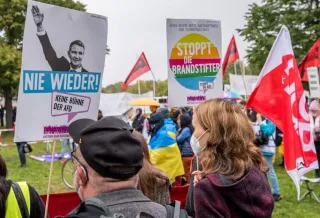
In June 2024, 50,000 demonstrated against the AfD conference in Essen, while a smaller number of people blocked access of delegates to the conference. In January 2025, 15,000 blockaded the AfD conference in Riesa. In November 2025, a similar number of people joined blockades against the formation of the AfD youth wing in Gießen, with 50,000 on a demo. That conference was delayed for several hours.
An AfD representative spoke of a “new quality of confrontation”, and indeed the attempts to confront the AfD are a qualitative shift away from symbolic protest. And yet, so far the blockades have managed to delay the party conferences for an hour or two, but have not been large enough to shut the whole thing down. Radical actions matter, but so do numbers.
Learning from Dresden Nazifrei
At the beginning of the century, the largest Nazi demonstration in Europe took place every year in Dresden on the anniversary of the bombing of the city. In 2009, 7,000 neo-Nazis were confronted by 4,000 protestors organised by the new alliance ‘Dresden Nazifrei’. The following year, there were 6,000 Nazis and 12,000 anti-fascists, including the then-president of the Bundestag, Wolfgang Thierse (SPD). The Nazis did not march again.
Two strategies were important to Dresden Nazifrei. The first was that it takes more than a handful of radical antifas – however courageous they may be – to prevent Nazis from marching. Although the Dresden Nazifrei blockade was technically illegal, support from the SPD and DGB trade union association encouraged people to demonstrate who would not have otherwise been there.
The second lesson was the need for radical politics. Every year in Dresden, there was an anti-Nazi demonstration. The problem was that it was in a different part of town, which left the Nazis able to march unhindered. Dresden Nazifrei was insistent that the Nazis must be stopped.
But it was not sectarian towards the other demonstrators, many of whom were there to remember relatives killed in 1945 by British bombs. Despite the tendency of parts of the antifa scene to take bottles of champagne to Dresden and shout “Bomber Harris, do it again!,” Dresden Nazifrei successfully encouraged the other protestors to join both the demonstration and the blockade. The Fascists did not pass.
Which way forward?
Erfurt is the obvious next step in the fight against the AfD. It is important that as many people as possible join the demonstrations, but also that the blockades are both well-attended and effective. This requires a broad movement, but also the presence of socialists who are looking for the right moment to break through police lines and to physically stop Germany’s new Nazis.
In the words of anti-fascist poet Erich Kästner: “You can’t wait for the snowball to turn into an avalanche. You have to step on the rolling snowball. Nobody can stop the avalanche. It only rests when it has buried everything under itself. That is the lesson of what happened to us in 1933. That is the conclusion we must draw from our experience, and it is the end of my speech. Impending dictatorships can only be fought before they have taken power.”
You can book a bus ticket to the blockades at Erfurt here. You can make a contributionto help subsidize places on the buses for low-earners. by sending a PayPal donation to @momosaddei using the keyword “Donation für Erfurt”