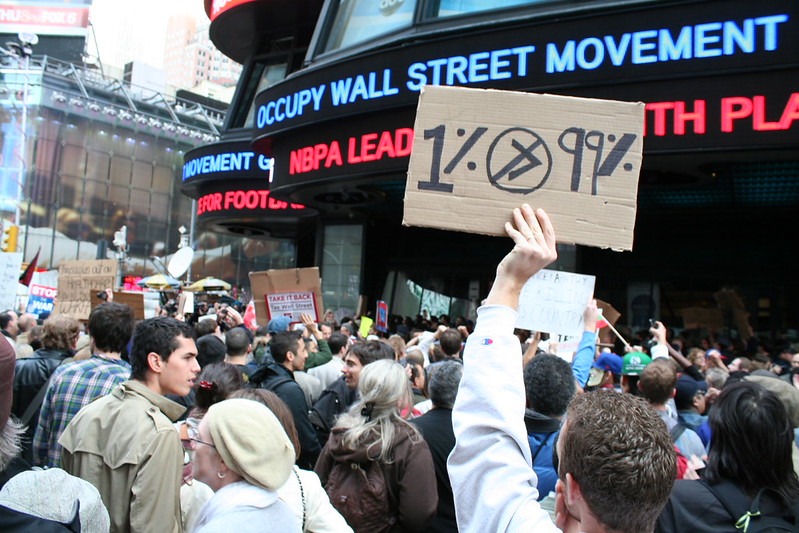
Nobody who caused the 2008 crash went to prison. The people who lost their jobs and homes over it were everyone else. The 2008 bank bailouts used taxpayers’ money to rescue the very institutions, who recklessly speculated on mortgage bonds, responsible for the crisis, while ordinary Americans absorbed the damage. In January 2010, the Supreme Court’s Citizens United v. FEC ruling let corporations spend unlimited money on political campaigns, tightening a link between finance and government, already the best of friends. Called for by Adbusters, a Canadian anti-consumerist magazine, an occupation of Wall Street (OWS) began on September 17, 2011, after police fenced off the group’s first two chosen sites and left Zuccotti Park open by comparison. Within weeks, “We are the 99%”, the mantra of the demonstration, had spread across the country, giving shape to an argument that a small ownership class held wealth and power completely disproportionate to everyone else.
Zuccotti Park’s General Assembly met twice daily, making decisions by consensus rather than through any elected leadership. Since New York City required a permit for amplified sound, organizers used a call and response method known as the “human microphone,” where the crowd repeated a speaker’s words in unison so everyone nearby could hear. A pile of donated books left in a cardboard box grew into the People’s Library, cataloging over 5,500 volumes within two months. On October 1, over 700 protesters were arrested attempting to cross the Brooklyn Bridge, the largest single-day arrest count of the entire movement.
By mid October, the encampment model had spread to hundreds of cities across the United States and beyond, with solidarity marches drawing crowds as large as 15,000 in Lower Manhattan alone. The Department of Homeland Security started watching the movement almost immediately (because of course), flagging the protests internally as a potential security concern despite their nonviolent character, a harbinger of Trumps NSPM-7 countering domestic terrorism and political violence (i.e., anti-capitalism, anti-Americanism, anti-Christianity, and so on). Years later, documents obtained by the Partnership for Civil Justice confirmed the scale of that surveillance: federal agents across more than a dozen FBI offices had been quietly building files on a movement the government itself knew posed no threat. On November 15, 2011, police in riot gear cleared Zuccotti Park before dawn, destroying the People’s Library in the process. New York City ultimately spent an estimated $17 million policing the protest, dwarfing the $360,000 it later paid to settle the lawsuit over the library.
The real weakness of the OWS movement sat inside the movement’s own structure. The Assembly’s refusal to issue formal demands was celebrated at the time as proof of its openness, a deliberate rejection of hierarchy and of the idea that a list of policy asks could contain what the protest was actually about. When one internal faction tried to draft a concrete platform, the 99 Percent Declaration, the General Assemblies of both New York and Philadelphia voted it down, unwilling to let a small group speak for the whole movement. Horizontalism kept the tent broad, but it also meant there was no organized vehicle to hold onto anything once the tents themselves were gone. Without a program, a party, or an organized base among unionized or Black working-class communities, the energy Zuccotti generated had nowhere durable to go once police moved in ultimately leading to its fizzling out.
Fifteen years on, little of it stuck. President Barack Obama called the protests an understandable expression of frustration, Nancy Pelosi voiced her support (the same Pelosi with stock trading indexes made to model her portfolio moves), and Mitt Romney, after first calling the movement dangerous class warfare, softened his tone within a week and expressed sympathy for the protesters. To no one’s surprise, none of them changed anything that mattered; their interests are coupled with those of big finance and government, not with small business owners who lost their livelihood, not with working class Americans who defaulted on their mortgage, and not with all the others deemed collateral damage. The 99% slogan went on to get borrowed and reworked by movements that came after, from anti-austerity protests abroad, to the bloc against the AfD here in Germany, and to the Gaza Solidarity Encampment students set up at Columbia in 2024, but the wealth concentration it named in 2011 has only deepened since; it should now be more like the 99.9%. Occupy Wall Street proved that millions of people could be made to see the system clearly, to mobilize all at once, but it never answered the harder question of what to do next.