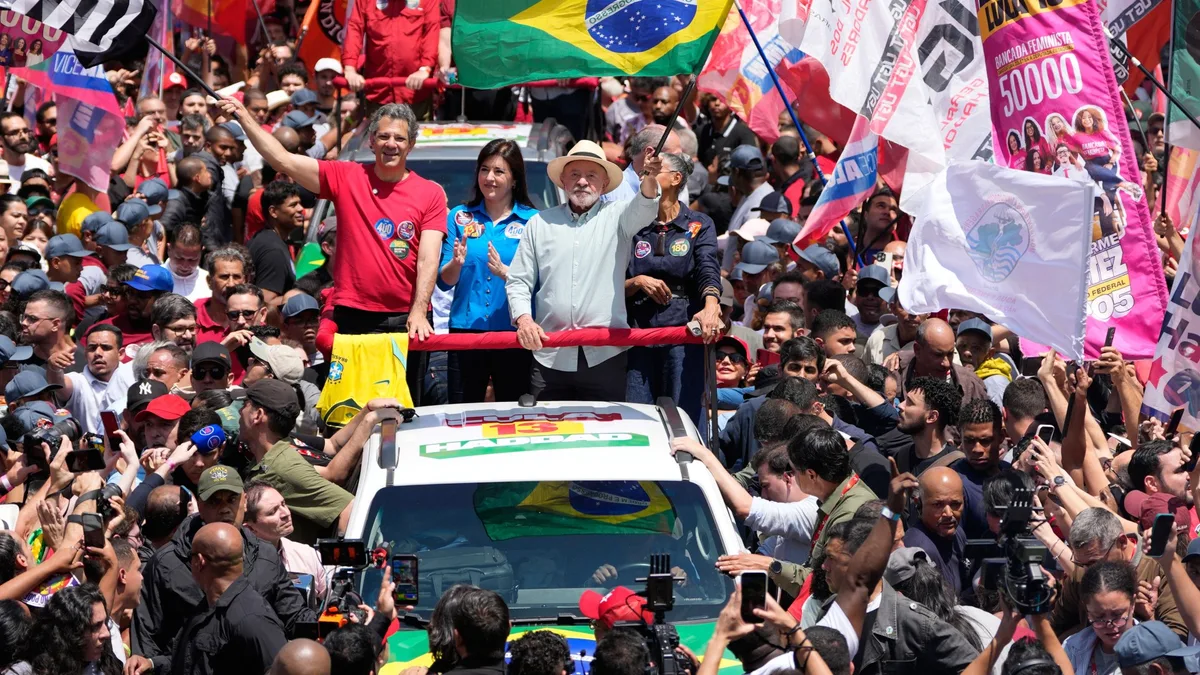
At the outset of Luís Inácio Lula da Silva’s third term, I concluded my analysis of the incoming government’s political economy by noting that their main goal would be to avoid the return of the far right, while the government coalition’s orthodox macroeconomic policy would aim for stability in employment, prices, and exchange rates. The question remained whether this conventional formula would be enough to achieve the main goal.
When the first-round results dropped on the evening of 4 October 2026, we had the answer: a resounding no.
The election race was agonizingly close, and the numbers–47.03 percent to Flávio Bolsonaro, 45.16 percent to Lula and a “right-wing wave” in state assemblies, governorships and both houses of Congress–tell a familiar story. Lula and Bolsonaro will face off in the second-round vote on October 25. This tightness is as infuriating as it is predictable. It reflects the critique leveled against the center-left/liberal left elsewhere in the “Western” world: it didn’t have to turn out this way.
It is unforgivable for a nominally left-wing party in power to spend four years pursuing neoliberal economic policies and austerity. There has been no policy innovation, no political education, no real organization, and no movement-building – just business-as-usual politics, managing a hostile and deeply corrupt Congress while the Workers’ Party (PT) simply plays along. The policy for Education has been marked by austerity and the strengthening of the private sector; nothing was done to strengthen the country’s dilapidated public health sector; housing policy is pro-business and following market logic, compounding rather than solving the problem.
Despite the reduction in deforestation, the Lula government has pursued expansion of energy and oil exploitation in the Amazon and construction of major infrastructure projects with devastating social and environmental impacts, all the while overseeing relaxing of environmental licensing rules. Under the four and half PT administrations, it has overseen neoliberal pension reforms, weakening of unions, cooptation of social movements, and means-tested social programs that, whilst ameliorating the life conditions of millions, did so merely by inserting them in the consumers market, with no politicization or organization ensuing.
Lula’s government has fallen short on every front, offering no material benefits or structural change. Since coming to power in 2003, Lula’s approach has consisted of what Nancy Fraser has called progressive neoliberalism — the macroeconomic tripod that has been the adopted economic policy model in Brazil since the government of center-right President Fernando Henrique Cardoso. It is based on orthodox guidelines associated with neoliberalism: inflation targeting, a primary surplus, and a floating exchange rate. Under Lula, it has also been giving nods of recognition to ideals like feminism, anti-racism, multiculturalism, and LGBTQ+ rights. Only in the last couple of weeks of the first round did the Lula government attempt at offering some material gains — it increased welfare benefits, for the first time since taking office, and banned online betting. In the end, government advocates sound indistinguishable from centrist administrations elsewhere, defending stagnation with the hollow and condescending refrain that “the economy is good, unemployment is low, and the stock exchange is doing well”. Meanwhile, the lives of most Brazilians are objectively bad – historically high levels of household indebtedness; tens of millions of workers without formal registration, labor rights, or guaranteed social security; tens of millions of Brazilians still live without adequate access to basic sanitation, treated water, and urban infrastructure in the outskirts of urban centers; urban mobility is expensive and inadequate; and on top of all of this, people live in constant fear for their lives. The list goes on.
This election cycle was dominated by public safety and the controversial Supreme Court. Ironically, it was not the far right that brought in the culture war – it was Lula’s campaign. Flávio’s TV ads showed him doing grocery shopping in a t-shirt, commenting on the price of basic food items and talking directly to the voter. Somewhat shockingly, it was the PT that brought the culture war into the fold, by cynically playing into Catholic fears over a supposed Evangelical sweep. While from New York City to Berlin the Left has managed to win elections on an affordability agenda, in Brazil Lula has managed to keep that flank wide open for the far-right.
The result is that Lula lost among the poor, while gaining some ground in the urban middle classes (in a phenomenon not dissimilar to other center left/left liberal parties) – Flávio Bolsonaro climbed from 27 percent to 32 percent among the lower-income bracket. Revealingly, Lula’s losses were greater in the regions where agribusiness prevails – a sector that has grown enormously under the PT. Over 33 million people (21,08 percent of voters) simply didn’t bother to vote – the highest abstention rate since 1998. That figure jumps to over 39 million if you add those who showed up to vote but rather than choosing between the candidates, preferred to vote blank or null.
Of course, the rise of the far-right is not restricted to Brazil. It’s a phenomenon across the western world, rooted in the social wreckage left by 40 plus years of the neoliberal onslaught. There’s also Donald Trump and Marco Rubio’s push for pliant governments across Latin America (and beyond). But even this shows a short-sightedness from Lula and his team. Lula’s foreign policy, once known for being assertive and bold, was timid, unambitious, almost aimless this time around. In the last four years, Lula watched passively as the U.S. intensified its grip over Latin America – to the point that today all South American countries are governed by the U.S.-aligned far-right.
As I mentioned in my analysis on this very website exactly four years ago, the Workers’ Party had demonstrated a lack of imagination that needed to be overcome. Four years on, we can now say, they have completely fumbled it, paving the way for a devastating scenario where Lulismo risks losing to a reactionary figure deeply tied to the worst kinds of scandals (this 2020 exposé summarizes the web of crimes that Flávio Bolsonaro, his brothers, and their inner circle are involved in; not to mention his involvement more recently in the sprawling Banco Master scandal).
A Bolsonaro government would represent a profound disaster for Brazil, for indigenous peoples, and for the region at large. We can expect an eventual Flávio Bolsonaro government to be extremely pro-market, to intensify austerity politics with the further dismantling of the State, a tough-on-crime approach, an anti-environment policy, and a pro-U.S. foreign policy. As Brazilian philosopher Rodrigo Nunes, author of the recently-translated Anatomy of Disintegration: What Brazil Reveals About the Global Far Right, succinctly puts it, “one of the models here is very clearly Nayib Bukele in El Salvador, both in the sense of the public security policies […], an intensification of the militarization of social conflict, and with absolute disregard to human rights, but also in the sense of a policy of automatic alignment with U.S. interests.”
That is the stark contradiction: the current administration has been deeply disappointing, yet it must win.
Looking past the immediate nightmare of the ballot, there is a silver lining in what must come next. The eventual collapse of this era of Lulismo opens essential space for something new and better. The only way to truly combat an extremist right is with an assertive, proud, and confident left – not with the hollowed-out social-liberal technocracy that the PT has become.
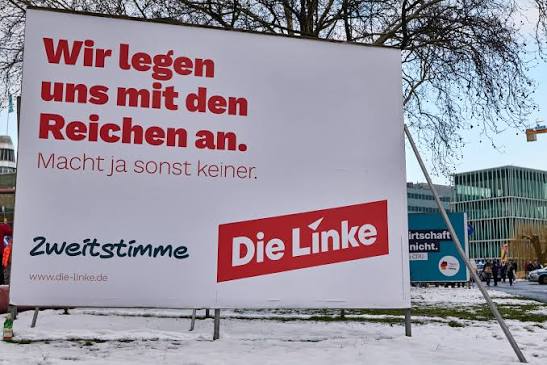
There’s a lesson for the broader global left. This trajectory was a cowardly, policy-driven choice to take the path of least friction. They took no risks and confronted no entrenched powers – and for what? The cost of political inhibition is that it leaves the political space open to the forces of reaction. By failing to deepen social justice, Lulismo did not merely preserve the status quo; it left the flank open for the far right to dismantle social rights as a popular demand under the banner of “economic freedom.” Only a bold left can mobilize the people. Not fighting entrenched power is a political choice. But that’s a fool’s errand, it’s short-sighted and ultimately counterproductive. For, in doing so, the entrenched power does not disappear, it gets even more powerful and therefore harder to combat. In fact, earlier moderation makes it so that an even more radical approach is required further down the line, in an even less favorable balance of power.
Moving forward, the vital work lies in reconnecting and reuniting with the MST (Landless Workers’ Movement), the MTST (Homeless Workers’ Movement), and what remains of the autonomous, independent, and popular social movements. They will be indispensable for the next phase: rebuilding a genuine institutional framework and a political horizon far removed from what lulo-petismo has transformed into. But what we need is for progressive forces to get off its high horse and go back to meeting people – both physically and philosophically – where they’re at.
In other words, what we need is for Lulismo to pull off in two weeks what it never did in twenty years. It’s a tall order, but one that we urgently need to achieve.