“If they kill me, I shall reach my arms out of the grave and I shall be stronger.”
-Minerva Mirabal
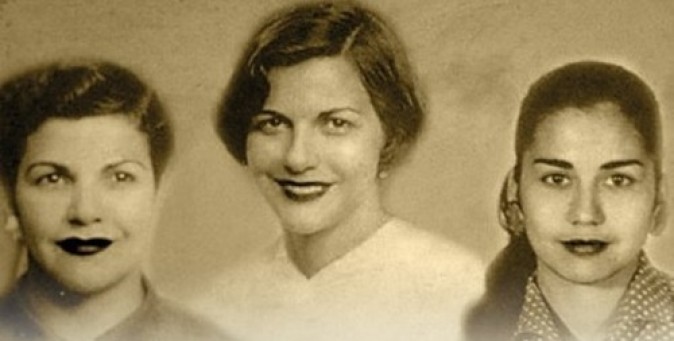
November 25 marks the International Day for the Eliminiation of Violence against Women, and the world commemorates a horrific crime that took place in 1960 in the Dominican Republic. It is the story of Patria, Minerva, and María Teresa Mirabal—three sisters who fought Rafael Trujillo’s violent dictatorship as leaders of an underground revolutionary movement and were ultimately murdered by his regime. Their deaths sparked greater action against Trujillo, contributing to his assassination six month later. Known by their codename Las Mariposas (“The Butterflies”) and considered by Trujillo one of his greatest enemies, the Mirabals’ courage and strength remain to this day a powerful symbol of the struggle against oppression.
By the time the sisters became active in the organized resistance in the late 1950s, the Dominican Republic had already been tormented by Rafael Trujillo’s rule for nearly three decades. His bloody reign took on new proportions in 1937 with the massacre of thousands of Haitian men, women, and children. As a former army general trained by the US military, the dictator relied on the SIM (Servicio de Inteligencia Militar, or Military Intelligence Service), the regime’s secret police, as a tool for surveillance of the population. Its agents resorted to intimidation, kidnapping, torture, and political murder. Trujillo used his power to demand sexual access to young women, having his aides seek them out and leaving families who resisted afraid of retaliation.
Born into a well-off family in a rural area of the Dominican Republic, the Mirabal sisters were part of the local provincial elite. Patria, Dedé (who kept away from politics), Minerva, and María Teresa were able to go to prestigious boarding schools, where they had their political awakenings after learning about the real horrors of Trujillo’s regime from classmates’ experiences. While all four eventually married and had children, only Las Mariposas (Minerva, Patria, and María Teresa) pursued higher education. Around Minerva’s time at university, the Mirabal family was forced to attend a party hosted by Trujillo, where the dictator preyed on her. When Minerva opposed him in front of everyone, Trujillo ordered her father to be arrested, marking the whole family as enemies of the state.
Inspired by the victorious Cuban Revolution in 1959, the Mirabal sisters and their husbands rallied other opponents against Trujillo, pledging to overthrow his regime. With Minerva serving on the movement’s central committee, Patria’s farm acting as a safe house and storage depot for smuggled weapons, and all three sisters traveling across the country to organize secret cells, Las Mariposas united a nationwide underground network—all while managing their lives as mothers and keeping a low profile during the day. However, soon after its founding, the movement was discovered by the SIM; Patria’s house was burned to the ground, while Minerva and María Teresa were arrested along with their partners. After spending months in a prison notorious as a torture chamber, the two sisters were released under house arrest. They continued supporting the resistance and visiting their husbands, who were still held captive.
On the evening of November 25, 1960, as the Mirabal sisters were returning from such a visit to the prison, they were ambushed and murdered by the SIM. All efforts to make it seem like a car accident could not fool the Dominican people, who survived decades of Trujillo’s tyranny, ready to end it. The three sisters left behind six children, who were raised by their surviving fourth sister, Dedé, who kept the memory and legacy of Las Mariposas alive, proving Minerva’s words right that even in death, they would grow stronger.