Growing inequity, the polarisation of politics into stark class lines, rising tides of fascist or near-fascist ideology, fears about national debts, and amazing technical innovations. It all sounds very familiar, doesn’t it?
But I am not talking about 2026, but rather the world depicted in the exhibition entitled Ruin und Rausch [Ruin and Rush] Berlin 1910–1930 at the Neue Nationalgalerie, which shows 35 pictures and sculptures. Despite the huge number of artworks still extant from both the pre-fascist era and the ‘socialist’ art era of the German Democratic Republic (DDR), it is astonishingly difficult to see such works. Granted, the Berlinische Galerie has a permanent collection featuring art from these eras, but it is surprisingly sparse. This is supplemented by the works of Käthe Kollwitz (1867–1945), which can be found at the Neue Wache and the Käthe Kollwitz Museum Berlin. With the recent closure of the Das Kleine Grosz Museum, it became more difficult to see the work of George Grosz (1893–1959) in Berlin.
Of course there is other stuff floating about in Germany. The Albertinum in Dresden, for example, is home to some excellent work, such as those from Willi Sitte (1921–2013), whose Die Überlebenden (The Survivors) (1963) is a fine painting. They also have lots of Otto Dix (1891–1969) and also some works by Werner Tübke (1929–2004), including Gruppenbild (Zimmerbrigade Schirmer) (Group Portrait (Schirmer’s Carpentry Brigade))(1972). But even in Dresden or Leipzig, there seems to be a veil over the “socialist” sections of art.
In any case, it is not so easy to see the great works of German art, even including those of German Expressionism. Since Berlin tourism thrives on the fashionable image of the “Weimar Period”, it is quite surprising that famous pictures of this era are not to be so easily seen. Therefore, while the exhibition is small, it is worthwhile to see Ruin und Rausch.
Given the exhibition’s host, the state-run Neues Nationalgalerie of Berlin, don’t expect a searing commentary. The materials are certainly presented as the product of a time of growing inequality and alienation, but the overall tenor is a liberal falsetto of “Isn’t it a pity?” Do not be fazed, Marxists, it is still worth seeing.
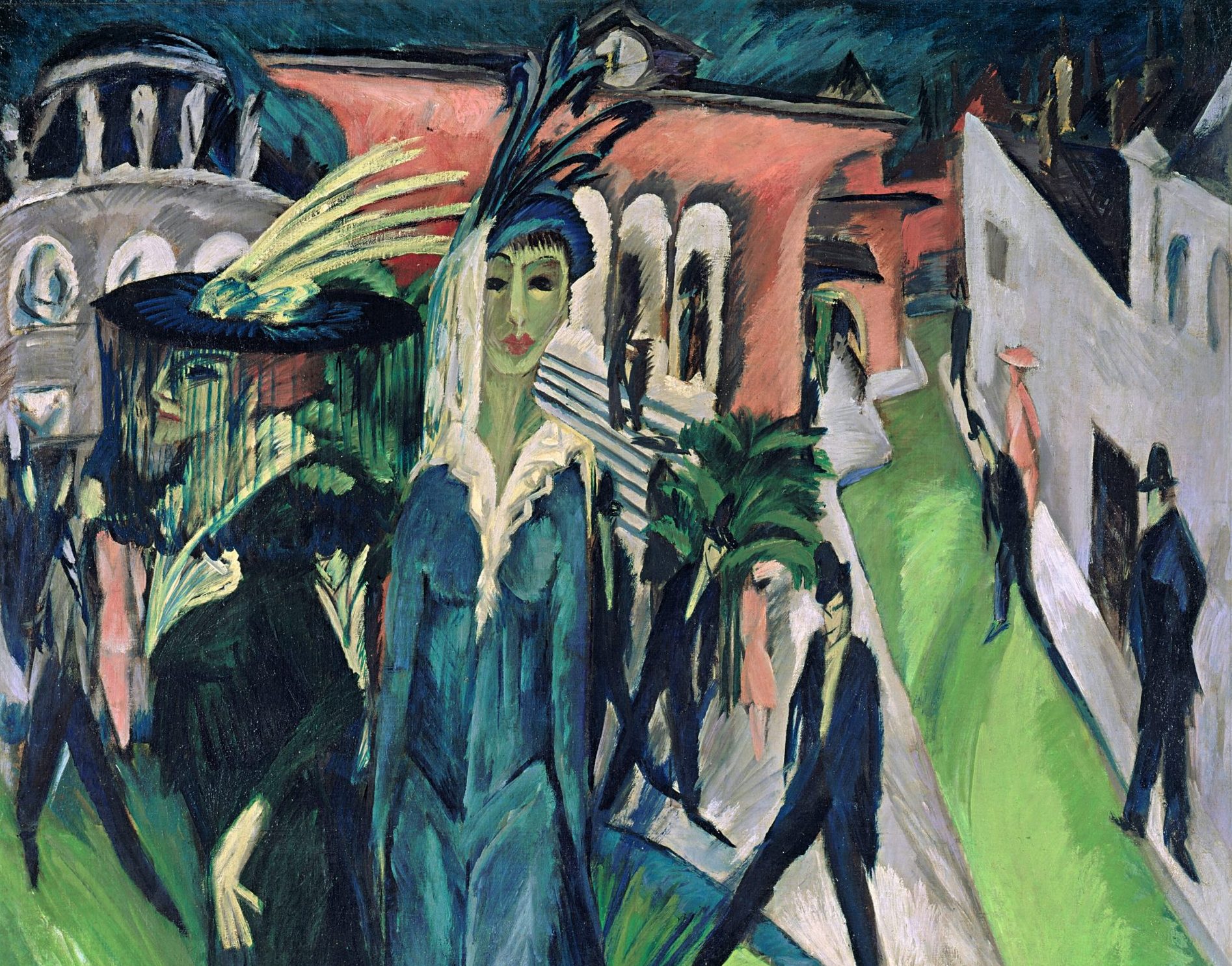
Ruin und Rausch begins with Ernst Ludwig Kirchner’s (1880–1938) famous painting, Frauen am Potsdamer Platz (Women at Potsdamer Platz) (1914), which depicts prostitutes in Potsdamer Platz at the start of the war. The exhibition ends with Lotte Laserstein’s (1898–1993) Abend über Potsdam (Evening over Potsdam)(1930), showing a gathering of five sad people on a rooftop terrace as dark clouds roll in. A German shepherd, far from terrifying others, is cowering under the table. Laserstein, as a Jew, soon fled Germany before the dark clouds unloaded. And so the era of this small exhibition ends with a marked foreboding.
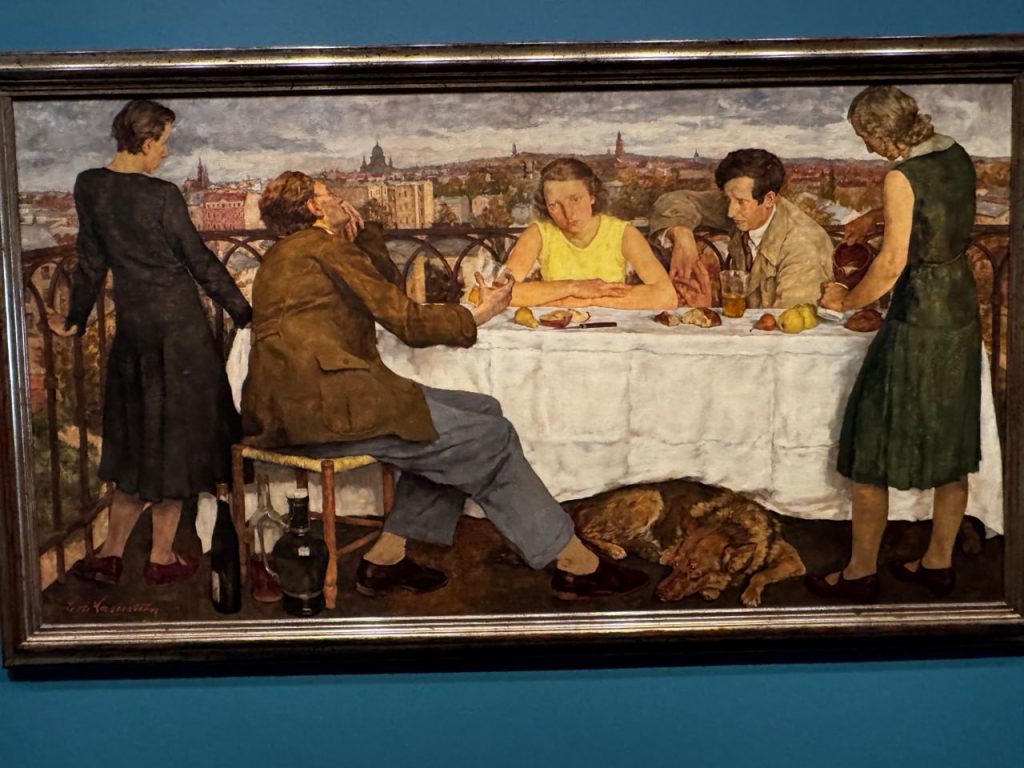
Lotte Laserstein, Abend über Potsdam (1930). Neue Nationalgalerie. Photo: Hari Kumar.
In between these two bookends are a number of startling images and sculptures. Likely the organisers felt that they had to include one Kollwitz. Unsurprisingly, they chose her somewhat unpolitical, but lovely sculpture Liebespaar II (Pair of lovers II) (1913).
The “rush” of a huge developing metropolis is well explored—from paintings by the not well-known Jakob Steinhardt (1887–1968), such as Die Stadt (The City) (1913), to the more renowned work of Lesser Ury (1861–1931), Nollendorfplatz bei Nacht (1925), depicting wet streets at night lit by automobile lights. The clips from various movies of the time are evocative, including the ones from Fritz Lang’s (1890–1976) 1927 film Metropolis. The stills from the film show a human inventor facing his creation of a robot. Again, the parallels to today are obvious. In the “rush” is also a frenetic hurling into dance, with Otto Dix’s sensuous, red-clingy-clad dancer in Bildnis der Tänzerin Anita Berber (Portrait of the dancer Anita Berber) (1925), and the movie of French dancer Josephine Baker (1906–1975) hoofing and hurling herself into it. There is also the dissolution of gender lines and dress codes.
The “ruin” does come across also. Those who have read the Penguin edition of Marx’s Grundrisse will quickly recognise the picture by August Sander (1876–1964), Bricklayer (1928). Ruin also shows up in the astonishing montage-oil painting Die Skatspieler (Skat Players) (later titled Kartenspielende Kriegskrüppel [Card-Playing War Cripples]) (1920), which shows three male faces, disfigured from war, playing cards. And for those starved of George Grosz, the exhibition includes the famous painting Grauer Tag (Grey Day) (1921), which portrays a caricature of a cross-eyed bureaucrat who, without a glance back, crosses the path of a disabled war veteran. But for me the dark pictures of Otto Nagel (1894–1967)—Asylisten (Homeless People) (1928) and Weddinger Jungen (Boys from Wedding) (1928)—were equally startling. These are overlaid with so much black oil that it throws into sharp contrast the figures depicted in the foreground. We don’t hear so much about Nagel, likely because of his importance in the DDR. He was a close friend of Kollwitz and was hunted by the Nazis. Incarcerated in Sachsenhausen, after liberation he became a leading DDR painter.
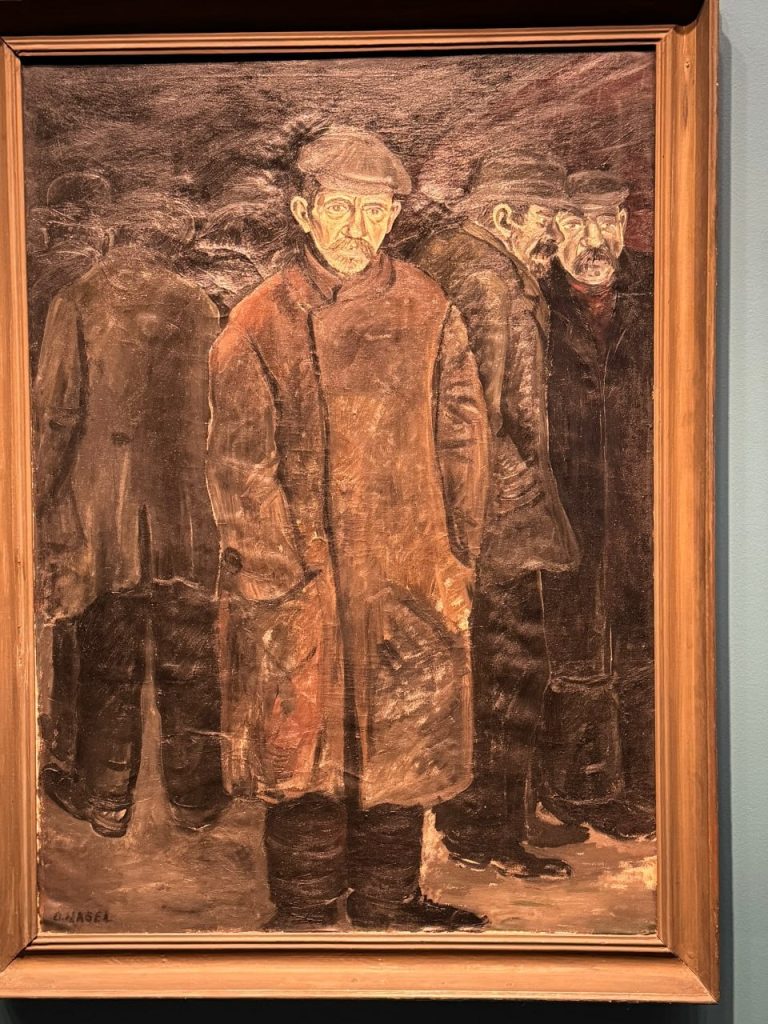
Otto Nagel, Asylisten (1928). Neue Nationalgalerie. Photo: Hari Kumar.
This small but interesting show is well worth the visit in my opinion. To learn more than the liberal gloss-overs given by the curators, other texts need exploring—regrettably these are not so easy to find either. The best I can recommend is one long-out-of-print book, possibly to be found in a library, Bild der Klasse: Die deutsche Arbeiterklasse in der bildenden Kunst (Image of the class: The German working class in the visual arts) (1971). Others are more easily available, including Eberhard Roters’ book Berlin 1910–1933 (1982).