
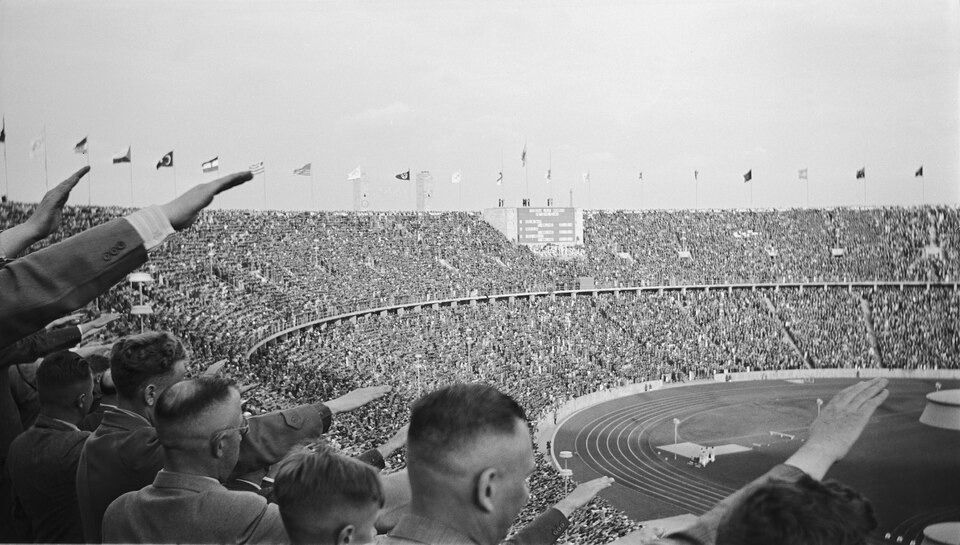
On 1 August 1936, the Olympic Games opened in Berlin, presided over by Adolf Hitler. These were the largest Games so far, and the first to be broadcast live on television. Nazi filmmaker Leni Riefenstahl released two documentaries from the footage: Olympia Part One and Olympia Part Two. The Games were a massive propaganda coup for the Nazis, coming just one year after the passing of the Nuremberg Race Laws in 1935. Germany won the most medals at the Games and claimed the result as proof of “Aryan supremacy.”
There had been an unsuccessful campaign to boycott the Berlin Games, which led instead to the People’s Olympiad—an alternative Games due to open in Barcelona two weeks earlier, on 18 July. As well as delegations from established countries, athletes came from Algeria, Catalonia, and Galicia, with events including chess, folk dancing, and theatre. Franco’s fascist coup and the outbreak of the Spanish Civil War forced the People’s Olympiad to be cancelled before it began, although some of the athletes who had already arrived stayed on to fight for the Republicans.
Although the sporting establishment expressed horror at Hitler’s antisemitism, many of its leading figures held similar views themselves. Henri de Baillet-Latour, President of the International Olympic Committee, said: “I am personally not fond of Jews and of the Jewish influence.” Avery Brundage, President of the American Olympic Committee, spoke of a “Jewish-Communist conspiracy” to boycott the Games. Evan Hunter, secretary of the British Olympic Committee, wrote: “We are pandering too much to the Jews.”
Some have argued that the success of Jesse Owens—a Black athlete who won four gold medals—made the Games an embarrassment to Hitler. But US President Franklin D. Roosevelt refused to invite Owens and other Black athletes to a White House reception for medal winners. Many found the calls to boycott Berlin hypocritical, given that the Jim Crow laws of the US South were, in their own way, as discriminatory as the Nuremberg Laws. Gold-winning athletes like John Woodruff remained barred from competing in some events at home.
Berlin 1936 shows that sport and politics are inextricably linked. Events like this were used to legitimize Nazism on an international stage. And in a sense, Hitler’s manipulation of the 1936 Games was only an extension of the rabid nationalism that accompanies international sport more generally. Sport can provide entertainment and fitness, but it is also part of the superstructure of society. It can be turned into ruling-class propaganda, as it clearly was in Berlin—but it can also be a site of resistance.