On September 12th, a new party will be born, focused specifically on Berliners with Slavic roots or who identify with the culture. The main inspiration is the folkloric character Baba, one of the most iconic and influential symbols of Slavic culture.
Baba Yaga—not a witch, but a guardian of the world of the dead
Western European folklore is rich in stories about nameless witches (such as those of the stories of Hansel and Gretel or Snow White). Characteristically, Eastern European witchcraft centres around the character of Baba Yaga, not simply a witch but rather a distinct personage in Slavic folklore. One of the best Eastern European folklorists, Vladimir Propp, in his book Historical Roots of the Wonder Tale, described in detail Baba Yaga’s role in tales and its spiritual significance: she is a guardian of the world of the dead.
Baba Yaga may be portrayed as someone who grants a valuable gift to a hero—or who tries to kill children—but most importantly, she invokes an initiation ritual which is directly connected to spiritual death. Her log cabin abode, standing on scaffolded chicken feet, is always situated at the edge of the forest, which itself represents the kingdom of death. Interestingly, the hero must recite a specific phrase to make the hut face him: “Little hut, little hut, turn so your eyes face the forest, and the gates face me.” After the hero enters the building, he goes through a ritual death; he removes the scent of the living by going to the sauna, before enjoying a meal, answering tricky questions and taking on the challenge to not fall asleep. Only after completing all these challenges does the hero gain Baba Yaga’s protection, granting him the story’s magical object and allowing him to move forward with his adventure.
But Baba Yaga’s most striking facet is her appearance. In folklore, she always bears consistent features. Resting stretched out while lying on the stove, her body takes up the hut. Her bony legs stretch from one corner of the cabin to the other, and her nose has grown up into the ceiling. Though her eyes are covered in opaque cataracts, she can see everything. Most importantly, Baba Yaga is a mistress of the forest; therefore, her features (especially the female secondary sex characteristics) are exaggerated: she has huge breasts and sharp teeth. Additionally, her character is inextricably linked to the hearth: she flies on a mortar, sleeps on the stove, rakes coal with her hands.
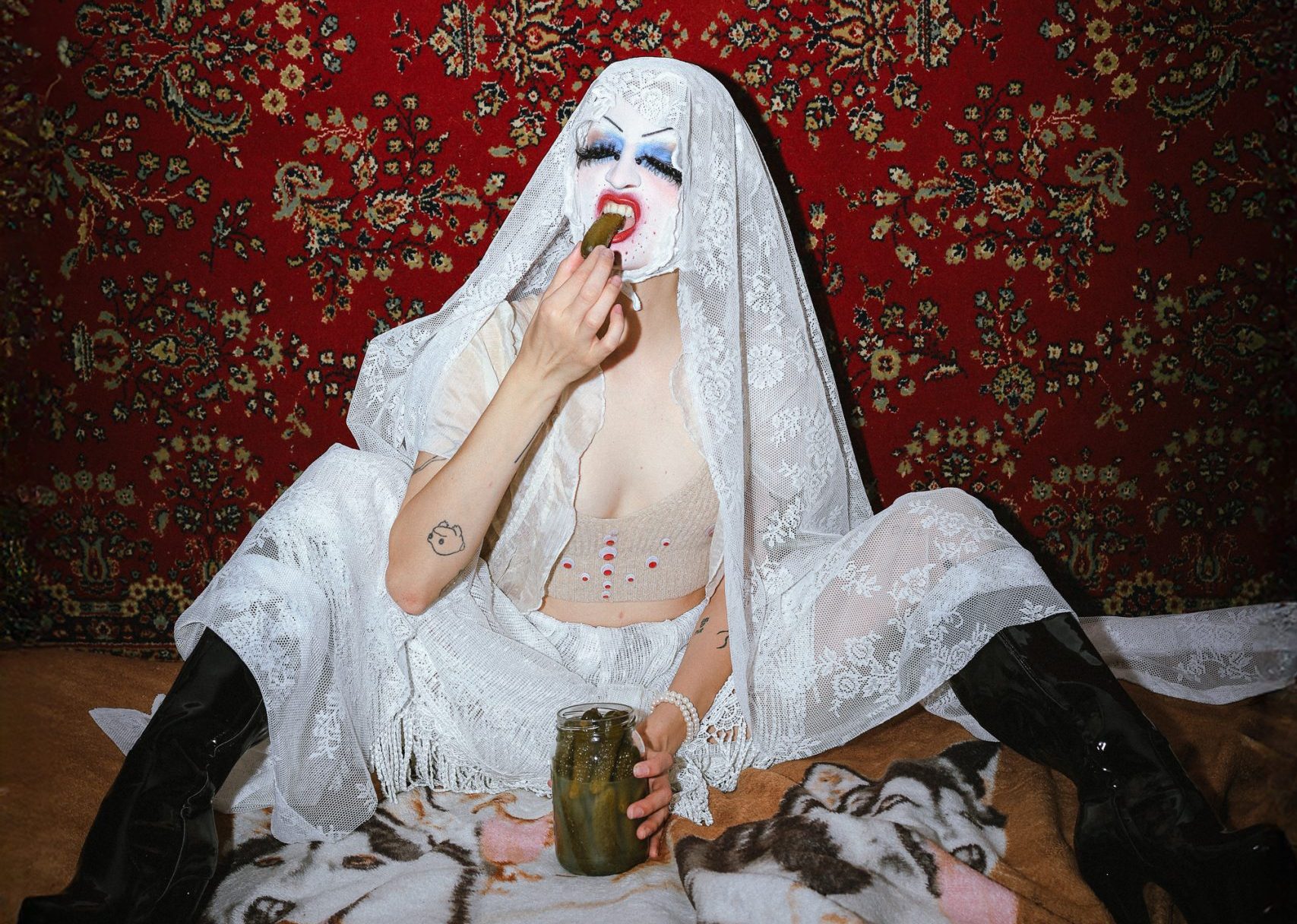
It was clear, however, to Vladimir Propp in the middle of the 20th century, that Baba Yaga is a queer character, making the claim that Baba Yaga is associated with travestism. If we continue to look at Baba Yaga through a contemporary queer lens, we can also see how Baba Yaga is a depiction of the non-normative “other.” If we look outside of Eastern folklore, adapted fairy tales feature similar characters, and they often become fan-favourites in queer community. (A well-known example is the sea witch Ursula, who appeared in Disney’s interpretation of the tale The Little Mermaid and was inspired by the iconic drag queen Divine.) Speaking of drag – Plane Jane (Andrew Dunayevskiy), the finalist of the show RuPaul’s Drag Race (Season 16), created a Baba Yaga look for the crowning ceremony, in this way honouring her Slavic roots (the performer grew up in a Russian-Jewish family).
In this sense, Baba Yaga is the perfect central-cast character for the Slavic queer party. An encounter with her means a rebirth, relatable for many transgender or female-representing persons; she herself is a character who does not fit in the “normal,” self-apparent human world. Unlike Western European witches, characterized typically as evil or self-motivated, Baba Yaga is a neutral character, one who rewards those who deserve it. And in the end, Baba Yaga is not the fruit of the Christian, monotheist patriarchal world — she is a chthonic creature that has existed beyond centuries.
Importance for the Slavic community in Berlin
As a Russian person living in Germany since 2022, I remember clearly how queers survived and partied in Moscow. We had some events which were more sex-oriented and tried to copy some Berlin raves. In 2013, the Russian government adopted a law about gay propaganda against children—a typical excuse for queerphobic governments in many countries—putting the LGBTQ+ community in the same category as pedophiles. Despite everything, gay clubs, nudist gay beaches with cruising zones, and openly queer parties and events existed. Some of them, of course, faced repression—for example, the LGBT International Film Festival “Side by Side” was attacked multiple times by activists and politicians and had to change to an online format. In November 2023, over a year and a half after the start of the Russian full-scale invasion of Ukraine, the“LGBT movement” was legally classified as extremist in Russia. Queer culture didn’t die—some events and even raves still exist—but the fear of prosecution and prison is real. Therefore, I personally value all Slavic and Eastern European queer spaces because they remind me of something that I lost. Unfortunately, similar repression against the LGBTQ+ community happens in other Slavic countries, those of which, for example, attempt to enshrine in law the concept of marriage as the union of a woman and a man. Oppression of queer people is, of course, not just a problem endemic to Russia.
When I heard about the Baba Yaga party, I got excited. I rarely see events in Berlin aiming not at a specific Eastern European nationality but rather at the whole region. Slavic is not just a word but an identity and a cloud of assumptions and stereotypes that others will see in you—I came to these thoughts after four years of living in Germany. We can look pretty similar—white skin and light hair—but our culture is different from that of Germans or the French. Neither is it about the performed trappings and residual influence of the USSR, but about the lifestyle—about preparing pickles for the winter; about going to the sauna and then running in the snow; about making crepes and eating them with caviar or with honey; about tea made from different herbs growing in the garden; about collecting mushrooms in the forest. Emigration takes more than the opportunity to talk in your native language every day; it takes a huge chunk of your identity, removing familiar sounds, smells, and tastes.
Nothing can be replicated, but that does not mean that trying to create something new is meaningless. I see the Baba Yaga party as an opportunity for unity not through picking an enemy (which is Russian colonialism and European exploitation of Slavic people) but rather through longing and a shared dream of peace. In this way, Baba Yaga is not just a character from fairy tales but something that many Slavic people actually share and that reminds them of childhood. She is also not a patriarchal figure but a matriarchal figure, which I find important for the current political landscape in Eastern European countries, still politically dominated by men.
Before the party, I decided to talk to one of the DJs performing at the party—Silesian enchantress, DJ Border Diva (Martyna).
“To be Slavic is to be a witch, to be in between, in darkness. It is heavy and not easy”
While the DJ name conjures associations with the idea of crossing borders between states, in reality, Martyna chose the name to be open about her borderline personality disorder (BPD). She did it because she wanted to be open about her mental health condition and to break the stigma around it.
Martyna started DJing 4 years ago, when she emigrated from Poland, Katowice, to Berlin. “Katowice is a heavy post-industrial area with a lot of coal mines. Our culture is pretty heavy; as a teenager, I often heard about death in mines—this darkness I try to channel through my music,” Martyna explained. Since Katowice is not a big city, the future Berlin DJ travelled to Krakow by minibus or train for raves. Another important aspect of Katowice is its location. The city lies in the region called Silesia, which is rich in natural resources and spread across the territories of three countries: Germany, Poland and the Czech Republic. Because of it, Martyna speaks the Silesian dialect of Polish, which contains many German words, like Zug (train).
Reflecting her journalistic background, Martyna approaches DJing through the lens of storytelling. She comes up with a story and searches on the internet for music that might fit. Then she tries to get the vibe, tighten the sounds and carve the set from her entire sound collection. For her, Baba Yaga is the main point of inspiration and fueled her process of self-identification as a Slavic person. “To be Slavic is to be a witch, to be in between, in darkness. It is heavy and not easy—it is connected to death and winter,” said Martyna.
At the same time, living in Berlin changed how the DJ looks at her own country and presents herself. In Germany, she felt how much her Slavic identity matters: “We are white, and our skin is white, but we don’t enjoy many privileges of Western Europeans. For example, you always hear those stereotypes about cleaning ladies from Poland. In the past, I was kinda ashamed of being Eastern European, but not anymore.” As soon as Martyna started to be aware of her cultural background, she felt much more confident. Right now, she is deeply saddened about the anti-Ukrainian sentiment in Poland with people nationwide blaming them for economic stagnation. “Why do we hate fellow humans who are just like us in many aspects? Just last century, we were hunted by the Nazis—did we just forget about other people hiding us in the basement? Why are we afraid of malnourished women and children entering our country? I can’t understand it,” expressed Martyna.
Music meets performance and contemporary art
More than six months ago, Voyteq Maik-Lendzion, Gabriela Zawojska, and Justin Polera started to organize around the notion of a Baba Yaga party. They realised that Berlin, which is world-famous for its parties for local diasporic communities (Puticlub for the Latin community and Adira for the Arab community), doesn’t have one for Slavs. For them, it was important not to make a rave around one ethnicity or nationality but to create a place for solidarity. “We wanted, for one night, to suspend international conflicts and tensions,” explained Justin.
While brainstorming, the folklore character of Baba Yaga came to them, and they delved into Slavic mythology, collecting tales from different regions. In their interpretation, Baba Yaga is an old, mysterious woman who radiates a dangerous sexual energy; reflecting on such contradictions became the fuel for their inspiration. From there, they dug deeper and created an image of a sexy Baba Yaga who lures young people into the darkness, scares them with bloody, sharp teeth, but ultimately helps them in the end.
Unlike many raves of the sort, the Baba Yaga party is not just about music and dancing. Its founders invested additional resources in engaging with the contemporary art circles and inviting artists to exhibit their pieces at the club. On September 12th, guests will see not only video art from New York-based photographer Slava Mogutin, who is already famous in Berlin and around the world, but also from other talents who are still under the radar despite their local success. To name some, Dante Buu, who was responsible for the pavilion of his home country Montenegro in 2022 at the Venice Biennale, will show the recording of his performance “IF A BOY CANNOT BREAK YOUR HEART YOUR COUNTRY CERTAINLY WILL,” and queer icon Ivana Vladislava will present her silk prints.
The party’s goal is in part a project of mutual aid. At the Baba Yaga party, people will collect donations for the non-profit organisation Quarteera e. V., which helps queer refugees and migrants from Eastern Europe, Central Asia and the Caucasus. Raised funds will support their programme created for the parents of queer children. After the beginning of the full-scale invasion began, many Ukrainian families moved to Germany, and in those four-and-a-half years many children grew up and started to realise their changing gender and sexual identities. To accommodate this growing need, the program, through which specialists help support parents in the process of better understanding and accepting their queer children, is in need of additional funding. Hopefully, the aims will be reached.