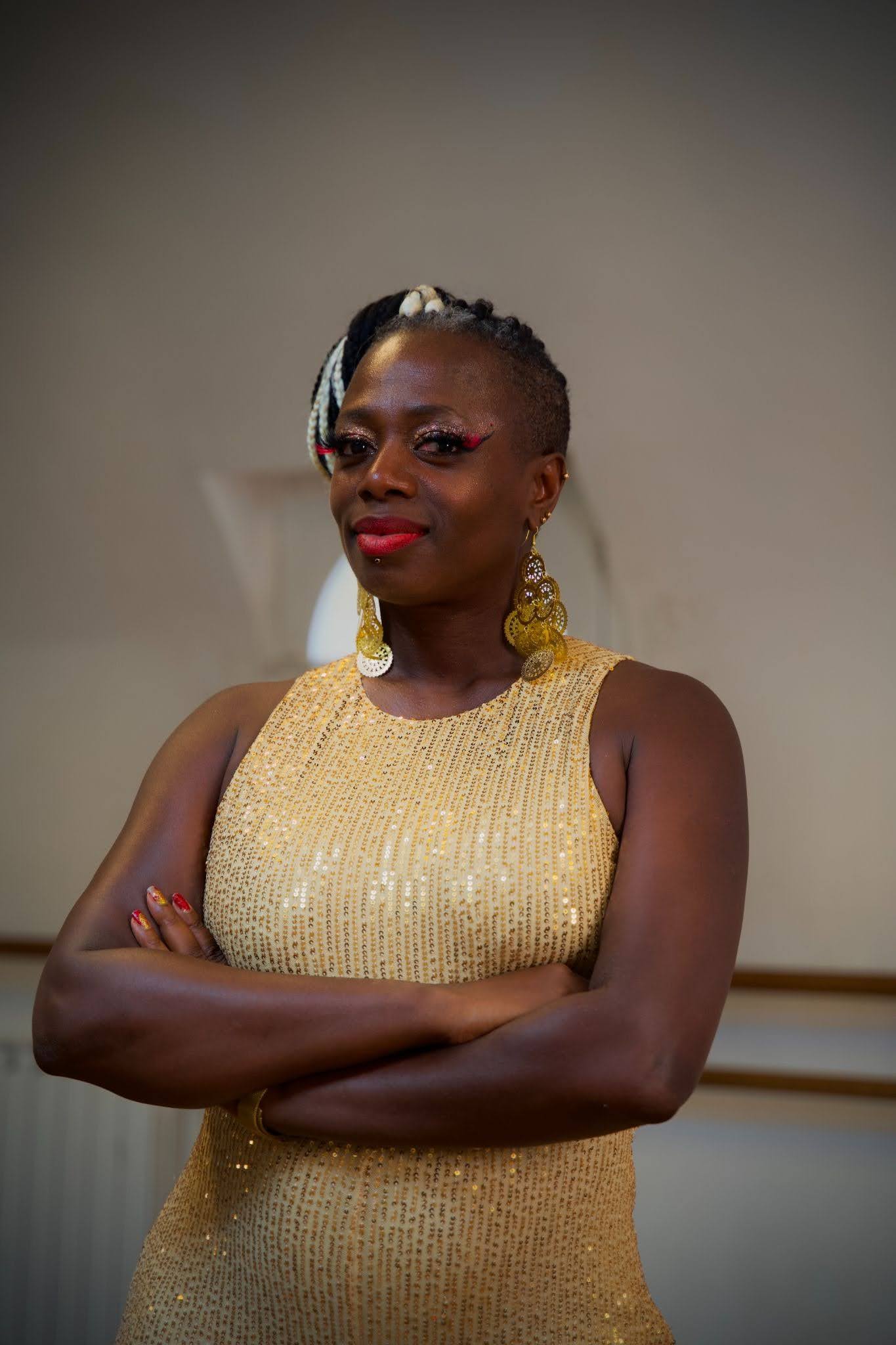
Maïmouna Coulibaly is a French dancer, theater director and playwright of Malian descent. For more than twenty years, she’s been teaching Booty Therapy: a fiery twerking class inspired by African urban dances that aims to release trauma. Every week, countless women gather at her workshops in Berlin to shake their bodies and scream together. Her company also takes Booty Therapy into the public arena by regularly organizing flash mobs. In 2023, they performed at the European election campaign launch of the French left-wing party Les Écologistes.
This public dimension is very much by design. A survivor of female genital mutilation and sexual violence, Maïmouna sees twerking not just as a powerful tool for women and gender minorities to heal their trauma, but also as an act of collective resistance against oppressive structures.
A documentary depicting her life and work, Madame Booty Therapy, recently premiered at Babylon cinema. It also won the Audience Award at the Barcelona Choreoscope Festival. We sat down with Maïmouna for an exclusive interview on the power of dance as a means of resistance.
Women who attend your classes often describe the experience as liberating, joyful, or radical. Many of them are survivors of sexual violence who come to process their trauma. What is it about Booty Therapy that feels so powerfully healing?
Booty Therapy is based on traditional dances that originated in Africa and spread to other countries through slavery, colonization, and diasporas. Originally, these dances induce a trance state that allows self-healing. When we’re depressed and lack self-confidence, they help us to realign and reconnect with ourselves.
This part of the body [editor: the pelvis] is considered our second brain. Some people even tell me it’s the first brain. And emotions are also located at that level. That’s why it’s important to move these body parts, to move traumatic feelings and joy. Trauma blocks emotions like confidence, happiness, creation. If we keep our trauma without doing anything with it, we become frustrated, unhappy in our own skins. When we move our pelvis and connect the movement with a painful emotion or a terrible event that happened to us, we are able to move this trauma through the body and make space for positive things.
There’s also a more spiritual dimension. Before monotheistic religions arrived in Africa, animist religions saw gods and goddesses everywhere in nature: in the wind, in stones… For example, the Mapouka dance from Ivory Coast connects us with the goddess of fertility; women who want to become pregnant can shake their buttocks to connect with the goddess. The same dance allows you to abort a pregnancy and to regulate your period. It really brings everything back into alignment.
You mentioned in interviews that the dances that inspired Booty Therapy were originally a form of resistance against colonial oppression. Can you elaborate?
Yes, they were dances of resistance. People made colonizers and slave owners believe that their dancing was part of their folklore, when actually it was full of hidden codes. Dancing gave you a way to communicate without the colonizers understanding what was going on.
The Afro-urban dances I identify with, the ones that speak to me most, come from many different countries and islands, such as Congo, Ivory Coast, Angola, Jamaica, Trinidad… And most of the time, those dances were born after a societal event, like a riot. There was all this frustration, the fact that there was no platform through which we could express ourselves to say how unjust it was.
For example, it’s not one of my dances, but take krump. In the film Rize, David Lachapelle shows how krump was born out of riots in the nineties.
[editor: In March 1991, LAPD officers beat up a Black man named Rodney King during his arrest, and were acquitted on nearly all charges, which set off riots in LA. Dancer Tommy Johnson began “clowning” in 1992 as a joyful and nonviolent outlet for young people, and krump grew out of clowning in the early 2000s as a rawer, more aggressive street dance.]
So when people couldn’t demonstrate, dancing allowed them to express their anger without the oppressor finding anything to object to.
That’s it. It all sits in the body, so either we riot and smash everything, or we turn our rage into dance and release it through movement.
This is true of my own teachings. A lot of my choreographies were born as a reaction to rage and trauma.
There are two dimensions to your work. A private one with your classes, where women dance among themselves in a safe space, and a public one with flash mobs. Why did think it was important to promote Booty Therapy outside of the classroom?
In the classroom, you get to see a lot of transformation; you see how people change when they come regularly. At first, they might be a little shy or uncomfortable in their bodies, lacking self-confidence. But after a few months, they become these incredibly strong, fully present people.
One day, a student told me, “what happens in class is so powerful. It’s a shame we can’t show it to the outside world.” I realized it was important to show that we can be women or gender minorities out in public and fully own our bodies as they are, our sensuality and our strength. Because we know that we live in patriarchal societies.
When I take the bus at Bercy [editor: a neighbourhood in the 12th arrondissement of Paris], there’s a park where you see a lot of guys exercising and showing off their muscles and workout gear. It’s like a men’s playground: they’re all there working out, shirtless. They have their own outdoor space where they can display their strength and their masculinity. I think no space like this exists for women.
With Booty Therapy, we’re creating one. That way, women can see people of all different body types, skin colours and backgrounds, using feminine movements we’re usually criticized for. It’s about normalizing our bodies in public spaces.
In public spaces, men can do pretty much anything they want, whether they’re dressed or undressed, while women can face a lot of street harassment and assault. For me, dancing in public is a way to show that we’re not just victims. Of course, you can be a victim—and there’s nothing wrong with that—but we’re not just victims. We also have strength.
When you express your sensuality, you display a kind of power that can be scary. And since we know the main goal of patriarchal societies is to control women’s bodies, emotions, and pleasure, owning our sensuality lets us reclaim our power. It also shows people that it’s possible to express it, it belongs to us and we can do whatever we want with it.
I started to organize flash mobs in 2011. Our first dance took place at the Eiffel Tower. It went super well, people were very happy to see us. Now we do flash mobs regularly. Every year, we perform on March 8th [editor: International Women’s Day] and around November 25th [editor: International Day for the Elimination of Violence against Women].
Most of the time, it goes very well. The people in the audience, some get it, some don’t. It’s not a big deal. The ones who don’t get it just go on their way.
In 2021, Booty Therapy made a splash in the French media after a flash mob at the “Nous Toutes” women’s rights demonstration. The reactions were highly polarized, but what I find especially interesting is the fracture it illustrates within feminism.
On the one hand, you have what you may call sex-positive feminism, which holds that sensual dances like twerk can be reframed as acts of empowerment. These feminists largely supported you. On the other hand, another movement, usually coming from radical feminism (sometimes labeled sex-negative feminism) which argues that twerk can only serve the male gaze and reinforce patriarchy. What would you say to this second group?
I’ve taken a lot of flak from that second group. The thing is, I don’t want to hide and make myself smaller because of the male gaze. I think it’s up to critics to educate themselves and get past this sexual image that they impose on us.
I would tell these feminists to dig deeper. It’s true that if you see it through the male gaze, then of course we’re just teases who go out in the street… But you have to look beyond that. These are traditional African dances that used to be considered religious practices. There’s a whole universe to discover. A lot of work went into making this kind of dance look ridiculous; the goal was to destroy preexisting religions to impose monotheistic religions. What was considered sacred back then in many African societies is now seen as vulgar in other [editor: Western] societies.
To those feminists who are very smart, who do a lot of research and really dig for the right vocabulary to impose their discourse: I’m asking them to do the same work and go look at what we’ve done with Booty Therapy before they criticize us. There’s plenty of research out there on the topic, like Fannie Sosa’s thesis on twerk. If people are open and want to understand, there’s a lot of material to work with.
And if they don’t want to understand, there’s not much I can do about it. I just move on with my life.
You recently published an Instagram post denouncing systemic racism in Germany, with personal examples. How different is it to what you experience in France?
In France, racism is more indirect; in Germany, it’s frontal. You feel it on the street, the way people look at you. I’ve had several unpleasant encounters, things that would never happen to me in France. A white person once bumped into me with her cart at the supermarket because I wasn’t grabbing my groceries fast enough. We almost came to blows. A store employee—I think he was Turkish—came over and told me, seriously, don’t get into a fight, because if you do, when the police arrive, you know very well whose side they’ll take.
Now, whenever I go out, I wear a kind of armor. I pay attention to my surroundings and I’m ready to shut people down if they show any signs of being unpleasant, so it stops quickly. But the moment I let my guard down, I get pushed around. People speak to me rudely, they look at me with hostility. But as soon as I have my armor on, put on makeup and make myself look good, then it’s fine.
The reason I’ve stayed in Germany is that I have so much more artistic freedom here.
That was going to be my last question: why Germany. So, you’d say that you have more creative freedom here in Berlin?
Yes! Recently, I got a commission from the Ballhaus Prinzenallee theater. They asked me to write, perform, and direct my own show. This is the first time in my life I have gotten a commission like this.
That’s something I’ve never been offered in France. The problem in France is that, as an artist, people always tell you, “Yeah that’s good, but take that out, erase that, remove that political message.” But here in Berlin, I have this incredible freedom that I just never had in France.
And that’s why I feel good here, at least when it comes to the stage, my dance classes, and my artistic creations. I have the possibility to express myself as I am, with my real messages.