Hi Fairouz. Thanks for talking to us. Could you introduce yourself to us?
I’m Fairouz Hasan. I’m a Palestinian film maker. I’m an interdisciplinary artist. I’m based in Bethlehem, and I hold a BA in film production from Dar al-Kalima University.
I work across experimental cinema, documentary, and essay films and installations. I do live audiovisual performances, and my work investigates memory, political absence, imprisonment, and grief. It’s usually through archival materials and personal observations.
My most recent work is the film Lovely Butterfly. It’s a documentary, which premiered at Visions du Réel in Switzerland. I’m tracing what happened with my dad. It’s a work in which I reflect on my experience. I try to take all of the fragments of what happened and how I was managing that through Google Maps, his letters, and archival footage.
Alongside film making, I do installations. I did an installation for the Krupa Art Foundation called A Tree Fenced In, and I developed other installations during a residency at the Goethe Institute in Palestine. It’s called Rock Scissors.
Could you tell us about your father? Was he a political prisoner?
My dad was a political prisoner for 20 years. He was arrested when I was three, and we waited for 20 years until he came out. He finished his sentence. Then after the war, they retook him again without any specific reason, just because he had been involved in politics before.
He stayed in administrative detention for two years. When he disappeared, it was so heavy emotionally for me and my family. I didn’t know when he was going to come out. I felt the need to make the film because I was feeling heavy and lost and dark. I needed to do something with all of these feelings, That led me to make the film Lovely Butterfly.
So, you had to spend the whole of your childhood without a father at home?
Basically all my life, because when I was 24, they took him again for two years. And when he got out, we discovered that he had been forced to take Corona vaccines in prison. At the time, they were doing some medical experiments on the prisoners, and my dad got a very rare disease where he lost his abilities.
When they took him the second time, lots of media in Palestine were saying that if he died it was the responsibility of the Israeli prison authorities if he died. He was in a very sensitive medical position where he can’t be in prison, and he can’t be beaten, and he can’t be without food.
All the circumstances in Israeli prisons since the start of the war mean that I know that he’s dying there, and he might die in prison with that disease. After two years, when he got out, he was paralyzed, and he could only talk very briefly because of this disease. It’s taking his abilities little by little.
The film includes you trying to track his prison down on Google Maps. What were you trying to show there?
To be honest, the film was at first something I needed to do to reflect on what happened through the 20 years. His disappearance the second time was especially important because it opened a wound. I thought that I would try to start to heal it, and to start to know my dad. When they took him again, I realized that this wound was being opened again.
I usually hated the process of going to prison because I had been going since I was a child, and it’s a very unpleasant process and takes a very long time to reach the prison, as the prisons are very far away. I have very bad memories of Israeli prisons like Nafha and Eshel prison.
There are no visits now. So when they took him the second time and I was trying to reach him, I used to send him small sentences through his lawyer, because the lawyers are not allowed to bring in any papers. I started to wish that I could go to prison again, which was something I had really hated all my life.
But I wanted to go to see where he is now, just to see the prison from far away, and to know anything about him. I started to miss him to the point that I’m paralyzed, I can’t do anything to help him or to reach him.
I started to open Google Maps and use Google Street View around the prisons. Obviously the prison is a very restricted area, so you can’t use Google Street View around it. I started just to see what’s around him and in what prison he might be, and to guess and look around, because it was the only thing that I could do in life at that point when I miss him.
What is the significance of the title “Lovely Butterfly”?
It’s funny and sad at the same time. When I was making the film, I took all the letters my dad wrote for us and started to scan them and to read them again. And there’s letters from when I was going into kindergarten, and letters from when I was a teenager and very curious.
I had so many questions about society, life, and everything, and I saw my dad telling me: “yeah, we can talk about your questions. They’re valid to me, I want to be your friend, and I’m in a prison where I can send you letters from here”. Then he was in prisons where he couldn’t send us anything. Out of the twenty years that he was in prison, there were around 10 years with no letters at all. There are no phones in prison, so letters were the only way we had of communicating. When the letters stopped, there was nothing
There’s a letter he sent me when I was five. I have two sisters, Dana and Aqsa, and he used to send a letter for all of us to say happy birthday because he could not send us letters on the day or month of our birthday. He didn’t know in which prison he was going to be in the next months. They used to move him a lot from prisons because my dad was a teacher. He used to teach Hebrew and English, and then he became a college teacher.
Anyway, he sent me a letter in 2005, and there’s a stamp he made. “Lovely butterfly” was written on the stamp – farashat jamila in Arabic. When I saw it, I felt like the film was making itself because I already had a relationship with butterflies before I read that letter.
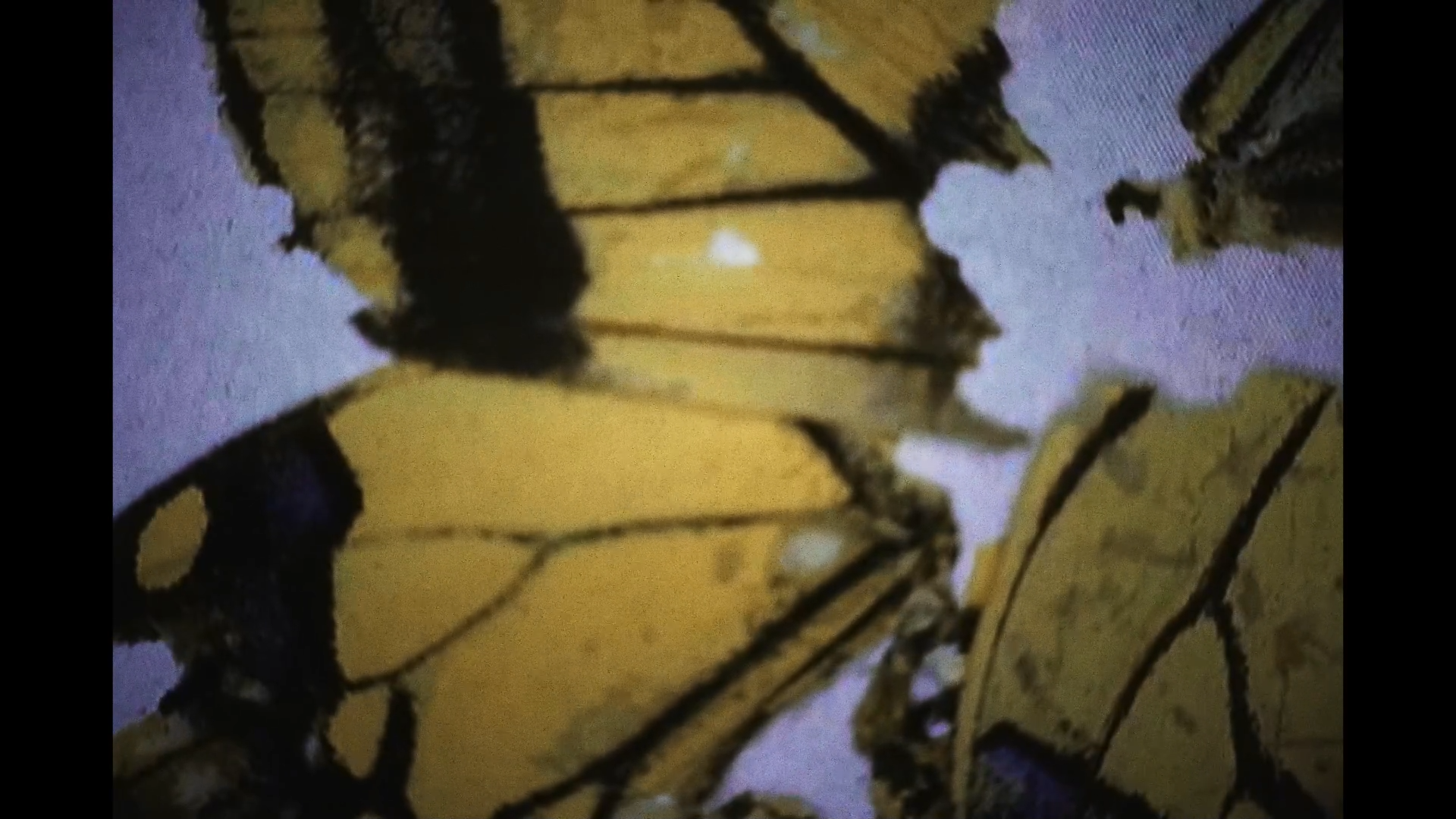
After seeing the stamp “lovely butterfly”, I felt that I was not a lovely butterfly any more. I was a shattered, fragmented butterfly. So I started to order dead butterflies and look at them under the microscope. I started to take the butterfly apart and try to put it back again to be a whole butterfly. I felt like the butterfly thing was a metaphor of how I feel and how he saw me as a sensitive creature. But I wasn’t a lovely butterfly any more.
I was wondering if there’s any connection with Papillon, the film about Dustin Hoffman and Steve McQueen breaking out of a French prison, or is that just a coincidence?
It’s just a coincidence.
It is perhaps worth pointing out that you’re talking about life in the West Bank. In the last three years, attention has been drawn more to Gaza. Could you say something about the terrible prison conditions in the West Bank?
Conditions were always horrible. But after the war and the genocide, the prisons have become much more scary. There aren’t any human conditions. I call it in Arabic maslakh bashari – the slaughterhouse – for real.
When my dad was released for the first time, it was before the war. The second time, I saw a look in his eyes, and he wasn’t the same person who went into prison, not mentally and not physically. He was very weak and tired.
I know that my dad went through a lot of things that I might never know about, but I also have a filmmaker friend who had been in prison before, and was taken again during the genocide. He told me that the prisons are terrifying and you can barely survive. He saw people die in front of him.
The prisoners are starved they are given almost nothing to eat. The wings are raided with dogs and with guns. This is routine, not exceptional. None of this is hidden; Israeli ministers talk about it openly.
Ben Gvir wanted to dig a moat around Ketziot prison in the Naqab and fill it with crocodiles. They actually started digging. A court froze it ,not for the prisoners. An animal rights organisation went to court to protect the crocodiles, and the judge wrote that the harm expected to the crocodiles justified stopping it.
This is the system Palestinian prisoners are held under.
In the West Bank, there are checkpoints between every place, and something is always blocked or broken. You can’t reach the destination you want to reach. Nothing continues; everything is interrupted.
And if you happen to be in the wrong place at the wrong moment, you get shot. Every time we move between two places, our mothers text us: “Text me when you get there.” It means: tell me you weren’t shot.
You’ll be in Berlin in September. What are you doing here?
I’m doing a live visual performance. It’s called False Vectors. It’s a live performance I do with Muqata’a. He works with the sound, I work with the image, both live. The images are microscopic and the sound is granular, so both of us are working with very small fragments.
A vector in physics is something that has a size and a direction. Ours are false. The direction keeps breaking, things don’t arrive where they were going. That’s how memory works for us, and space, and how you move through a place that is cut into pieces.
It’s about birth and death, about histories that get interrupted, and about how fragile it is to try and rebuild something.
This is the system Palestinian prisoners are held under. .
Do you think that artists and film makers have a particular job in the current situation?
Film making helps you understand. It’s like giving someone your glasses and making them see how you see. I don’t see Palestine and what’s happening to us just as news. It’s not something I need to teach someone about. I feel that people now know about Palestine and what’s happening. In cinema, it’s more about the personal details – to see a person’s life from his perspective.
I don’t make films about things that I already understand. I make films because I need the camera to show me something that I cannot reach any other way. This is a way of me seeing things around me and the violence is happening to me and my people, and then sharing it with people.
Are you making your films mainly for yourself or for your audience, or a bit of both?
It’s for both. But when you make a film to understand parts of yourself, collect all the parts and make it a whole thing, it’s a different approach. All the time when you make a film, you share it with your audience. But there’s a difference between talking to the audience if you’re trying to make them understand something, or if you are trying to understand something which you share.
Lovely Butterfly wasn’t a political statement. I didn’t add interviews with my mom, and I didn’t mention Israel. I was just trying to reach it personally from my pain as the daughter of a prisoner.
And are you planning any new projects? What are you doing next?
I’m working on a project about the posters of the martyrs in Palestine – in Ramallah and Jenin and Bethlehem. When someone is killed by Israelis, we usually make a poster for the martyr with his face and his name. Cities are filled with these posters.
It’s an experimental documentary that follows the martyr posters across cities, and traces how walls become a living archive of memory and loss and resistance, how public spaces perceive grief, while time and violence become witnesses to different ways of death. Now when the military goes to any city, they shoot the pictures and they rip them down. Sometimes they spray the faces of the martyrs.
Where can people see your films?
My film will be at the Camden International Film Festival in Maine from 17 to 20 September, at the Vancouver International Film Festival from 1 to 11 October, and at ULTRAcinema in Mexico from 17 to 25 October.
Fairouz Hasan will be performing at 90mil in Berlin at 8pm on 13th September. On Saturday 19th September, Lovely Butterfly will be showing at the Unframe festival, followed by a Q&A with Fairouz.