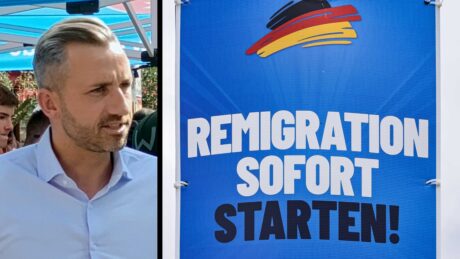
There is certainly not one single reason for the AfD’s triumph in Saxony-Anhalt (44%), and people will make all kinds of analysis that places emphasis on this or that factor (salience of migration, regional grievances, racialised fears of downward social mobility, etc.). That’s perfectly fine.
But in my opinion, two things stand (or should stand) out in this election. One is the failure of different and often contradictory strategies meant to challenge the far right. The one (followed by Die Linke) was that of the “Brandmauer” (“firewall”), a strategy of uniting all “democratic” forces against the far right, albeit on a parliamentary basis of unity with the parties perceived as the establishment. So we had Die Linke’s leader in neighbouring Thuringia, Bodo Ramelow, making a plea last August for a cooperation between the left and Christian Democracy. The other failed strategy is that pursued by Sahra Wagenknecht’s BSW split from Die Linke, which has rapidly abandoned any left-wing pretense on a “neither left-nor-right”-basis of reaching out to the AfD.
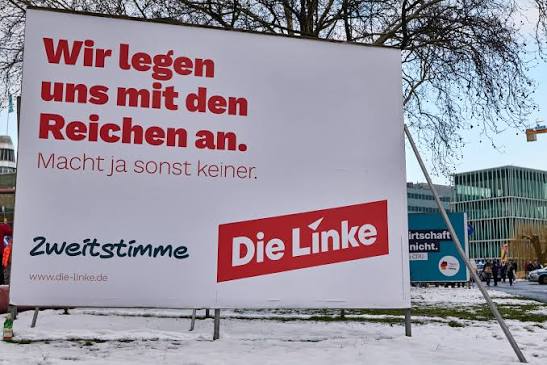
Specifically for Die Linke, the result demonstrates how ephemeral the party’s success was during the last general election. Die Linke has a pattern of scoring relatively well in general and European elections, while failing miserably on the state level outside of city-states like Berlin or Hamburg. This is because the party has not so much to say about, say, a factory being closed down because of higher energy costs due to sanctions against Russia other than abstractions about “social justice” and “redistribution”.
The other highlight is the way that Germany’s ruling CDU-led coalition (and the SPD-led coalition preceding it) have effectively acted as preparatory regimes for the current far-right wave. The arming of genocide, police repression, further restrictions in the asylum regime, deportation or stripping of citizenship as punishment for criticizing I*rael, a shift to social militarization and “preparedness” for a future war (which the AfD does not oppose in principle, even if for various reasons it does not share the anti-Russian thrust of these measures) — all these have normalised the kind of worldview that the AfD pushes.
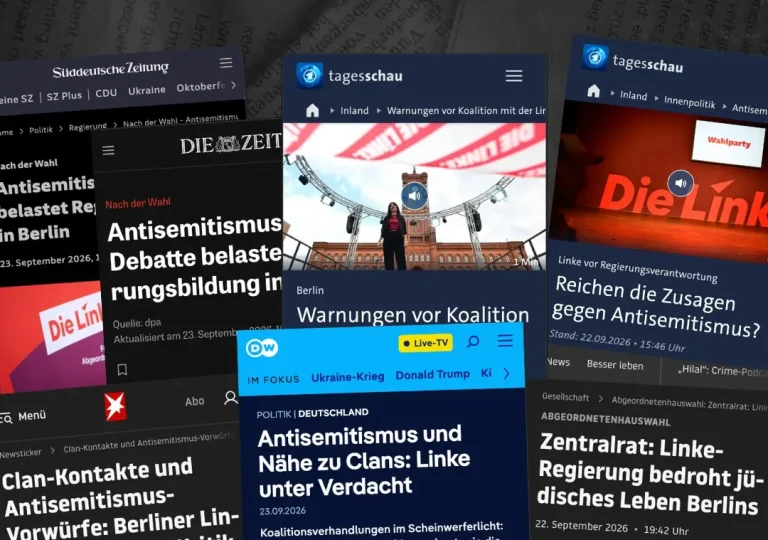
Here Die Linke has also been responsible. Acting as the “extreme left of what is permissible by liberal discourse”, its leadership has been keen to show that it intends to channel its newly acquired political capital into respectable avenues”. So, Die Linke’s mayoral candidate for Berlin, despite all the cringeworthy Mamdani hype, and in breach of her own party’s decisions, has recently thrown the Palestine solidarity movement under the bus by distancing herself from the slogan “Yalla yalla intifada”.
It’s not so much the case that the average AfD voter will be swayed to vote for the left if Die Linke has better politics on Palestine or Ukraine. But the only thing that can undercut the AfD’s momentum is an oppositional political subjectivity with an even bigger momentum, and that the left has miserably failed so far to create.
Simply put, the German left is pretty bad at doing politics, aka, creating sharp political antagonisms. That’s why the strategic debate is (to my knowledge and crudely speaking) falsely polarised between those that want to pursue antifascist unity on a moral rather than class basis (if need be through coalition governments), and those that will only entertain antifascism if “one also talks about the system that generates fascism”. I include in the latter strand not only sectarians of all sorts but also essentially social democratic and academically hyped concepts such as an “antifascist economic policy”, which effectively trace the origins of fascism in material deprivation rather than in ideological built-in mechanisms at the heart of the system.
I am not saying that there are easy ways out of the impasse, but political antagonisms have been staring us in the face for some time now: 1) a state born out of the historical responsibility of “never again” is arming and enabling a genocide condemned by the overwhelming majority of the planet; 2) a state that pledged that “no war should emanate from its soil” after 1945 is not only fueling a dangerous proxy war against a nuclear-armed Russia of all states, but is, to that end, also planning to reintroduce conscription and place the entire economy on a war footing.
These are not “normative” or “immaterial” issues, but affect the daily material lives of millions, within and outside of Germany.