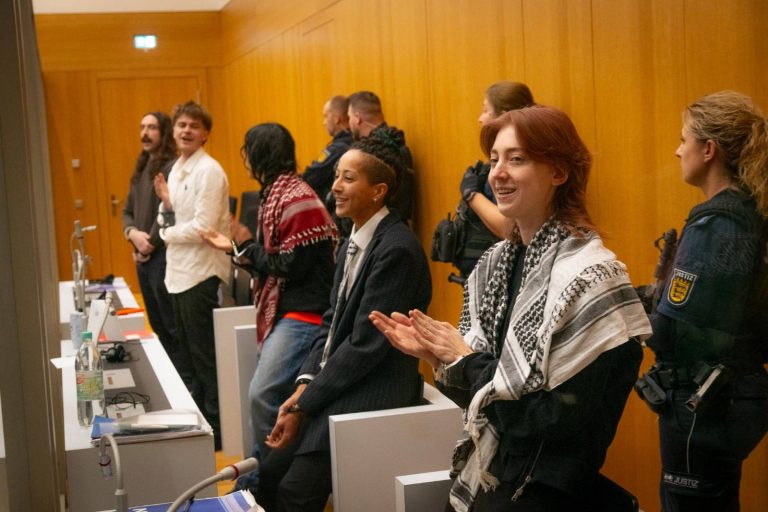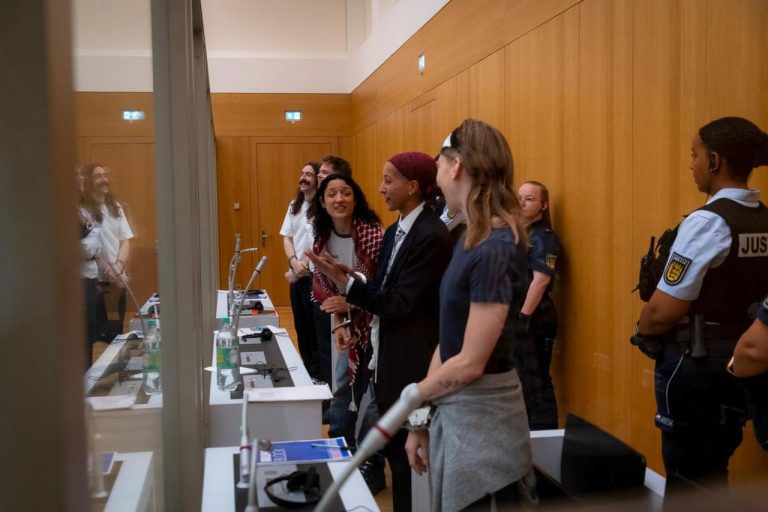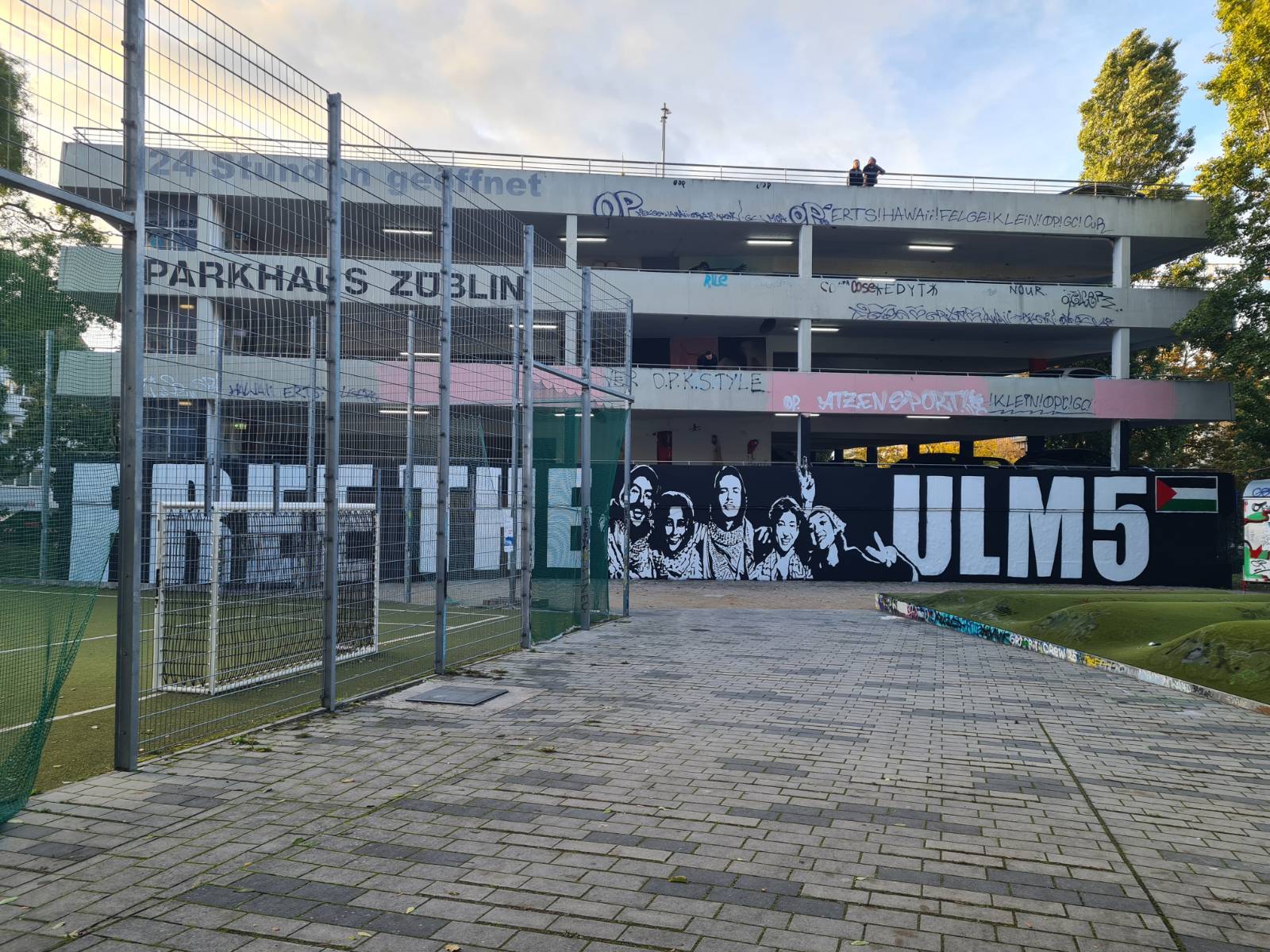
On Friday 30 October, the 28th hearing took place in the show trial of the Ulm5, the five human rights activists who, on 8 September 2025, entered the Elbit Systems headquarters in Ulm and damaged, in particular, equipment in the TDL (Tactical Data Links) laboratory. Their aim, as stated in their videos and opening statements, was to stop the genocide in Gaza even for one hour and expose the German state’s complicity in it. In this laboratory, they waited for the police to arrest them without offering any resistance. Since that day, the five individuals have been held in pre-trial detention across five different prisons, with some confined to their cells for up to 23 hours a day. They are charged with trespass, damage to private property and membership of a criminal organisation. The trial, which began in late April 2026, is taking place in the high-security courtroom at the Stammheim-Stuttgart courthouse.
Having heard most of the prosecution’s witnesses, the defence team – comprising 11 lawyers – has been attempting for the past two weeks to call its own witnesses. On 14 October, the defence called Dr Shir Hever to testify. He has studied the Israeli arms industry for 17 years. “Dr Hever’s expert report will reveal that the software-defined radio technology manufactured at the Ulm branch of Elbit Systems Deutschland constitutes a necessary link in the genocide against the Palestinian population of Gaza, fuelled by artificial intelligence. Therefore, the damage caused to the development laboratory for this technology in Ulm was proportionate to, at the very least, slowing down this crime and, in doing so, saving human lives,” explains Daniel’s lawyer, Benjamin Düsberg.
The defence subsequently called further experts to support its central argument: that the damage caused to the Ulm arms factory was justified by the duty to render emergency aid.
On 16 October, the defence called Professor Dr Isabel Feichtner, from the University of Würzburg, to testify about what constitutes genocide and how all the criteria are met in the livestreamed genocide in Gaza.
Both witnesses were present at Stammheim and ready to give their expert opinions. However, both were rejected by the judge on the grounds that the reports they had produced in their respective fields of expertise “lacked relevance to the case”.
On 28 October, we began the day in disbelief when Matthias Schuster, Vi’s lawyer, asked the court why Vi’s defence team had not been informed that Vi had spent the night in a holding cell at Stammheim men’s prison, having been transported there from their women’s prison in Schwäbisch Gmünd the previous day. The “reason” given was that Vi’s prison had been informed that a vigil would be held to wave Vi goodbye as they left for court at 6 am on Wednesday. The prison asked the judge to sign the transport order, which she did; however, no one informed Vi’s lawyers, and Vi was not allowed to tell them. This prompted several breaks to clarify the matter. Once again, Judge Lauchstädt dismissed some of the defendants’ basic rights – in this case, their right to have their lawyers know their whereabouts at all times. After Matthias Schuster filed a motion for the judge to recuse herself, all the defence lawyers joined him, stating that the judge was consistently trampling on their clients’ rights.
The defence then called on Dimitra Andritsou to present the report produced by Forensis on the flow of arms between Germany (the Zionist state’s second-biggest weapons dealer) and Israel between 2023 and 2025. The Chief Prosecutor opposed hearing her evidence that day. After leaving this third defence expert witness waiting all day at Stammheim, the presiding judge, Kathrin Lauchstädt, decided that she needed more time to make a decision. At the next day’s hearing, the court was still undecided as to whether this arms trade expert’s report was relevant to the case.
On Friday 30 October, the defence team began by presenting its customary motions: that their clients be allowed to sit alongside them in the courtroom; that the defence team’s note-taker be permitted to sit in court; that defence lawyers be permitted to meet their clients in the courthouse’s cells without a security glass partition; and that members of the public be provided with pens to take notes. These requests were, as usual, rejected by the presiding judge.
Added to these was a request that the five Die Linke MPs present that day – Nicole Gohlke, Lea Reisner, Violetta Bock, Lizzy Schubert and Aaron Valent – be allowed to take notes as parliamentary observers. After a brief pause to “consider” the matter, Judge Kathrin Lauchstädt rejected the request on the grounds that being MPs did not make them any different from the rest of the public. This meant, according to the judge, that pens in their hands were also stabbing weapons and therefore a security risk. As Mathes Breuer, Leandra’s lawyer, explains: “It is absurd that the court should prohibit members of the Bundestag (the German Parliament) from taking notes with pen and paper, citing the risk that MPs might attack court officials with pens. Without the ability to take notes during a trial lasting several hours, there can be no effective public scrutiny, and that precisely seems to be the presiding judge’s aim: to obstruct public scrutiny of the way she is conducting the proceedings. This shows contempt for the Bundestag and is dishonest.”
The team of lawyers then once again requested that Dr Shir Hever, who was present again, be allowed to testify. Having been told by the prosecution the first time around that the motion to hear Dr Hever was insufficiently explained, lawyer Benjamin Düsberg proceeded to read out a much longer and more detailed explanation of why his testimony was relevant to the case. The judge called a two-hour adjournment, during which all five Die Linke MPs present held a joint press conference with Zo’s lawyer, Nina Onèr, expressing their disbelief and astonishment at the nature of this political show trial.
After the break, the Attorney General read out his arguments against hearing Dr Hever, arguing, among other things, that Hever was no longer a neutral expert because of statements he had made at the press conference on 14 October, the first day he was invited to testify. At that press conference, Hever had said that Elbit Systems’ employees bear responsibility for the nature of the work they do. In response, Anna Busl, Leandra’s lawyer, said during the trial: “Well, the question of neutrality is very interesting, because I believe that in reality it does not exist (…). I believe that, above all, someone with specialist knowledge is compelled to adopt a stance, to take sides, and that implies, in a way, that one possesses that knowledge in order to reflect on which stance to adopt; and if I were to name four people now… Oppenheimer, Szilard, Rotplat, Hinton. They were four outstanding theoretical physicists, and no one would doubt that they possessed specialist knowledge in the field of theoretical physics simply because they had dared to speak out publicly against further research or against the dropping of the atomic bomb.”
This is the responsibility that workers at 113 ports in 22 countries took upon themselves during the strike action to halt the flow of weapons used in genocide, which took place on the very same day that the Attorney General made these statements.
Following a new motion tabled by Nina Onèr, Zo’s lawyer, to recall Professor Dr Isabel Feichtner as a witness, the judge adjourned the proceedings for the day without addressing the question of whether Dimitra Andritsou would be heard, as the defence team had requested the previous day. The defence team expressed its frustration at the court’s refusal to hear its witnesses, as Mathes Breuer explained: “The Regional Court and the Attorney General’s Office have once again demonstrated today that they are not interested in truly clarifying the facts. The defence has already summoned three expert witnesses on its own initiative and brought them to the hearing. The court always reacts in the same way: it delays its decision on the applications and then rejects them. The court wants to avoid at all costs any discussion during the trial of Elbit Systems’ responsibility for the situation in Gaza, even though that was precisely the defendants’ motive and, without it, it is not possible to assess their actions from a legal perspective.”
Two legal observers from the Spanish association Juristas por Palestina also attended the trial for the first time on 30 October. Cesar Estirado stated: “I saw a judiciary terrified by the link between the action on trial and genocide. That overwhelming terror and insecurity led them to reject all evidence that might bring them closer to that link. That bias undermined their impartiality.” Gemma Arbesú continued: “We observed an unprecedented violation of the right to a defence, with the exclusion of evidence proposed by the lawyers in order to prevent any discussion of the link between the acts on trial and the genocide in Gaza, the involvement of Elbit Systems and, ultimately, Germany’s complicity in the genocide.”
After attending the trial in person for the first time, Die Linke MP Lizzy Schubert declared: “It is terrifying to witness this trial, the aim of which is to make an example of activists showing solidarity with Palestine. Whilst authoritarian restructuring is in full swing and those fighting against war and for human rights are facing relentless repression, the real question arises: when will Germany be held to account for its complicity in genocide?”
Nicole Gohlke, also a Die Linke MP, who attended the Ulm5 trial in person on 30 October for the second time, stated: “The charges and the nature of the trial are completely disproportionate. For the defence, but also for us as parliamentary observers, it is important to demonstrate that the Ulm5 acted on ethical grounds, with the aim of saving human lives.”
The court’s attitude – preventing a fair trial from taking place against these human rights activists – is making the German state’s position abundantly clear: those who oppose war and genocide must be physically brutalised in the streets and condemned in the courts. To defend its warlords, the German state is prepared to sacrifice its much-vaunted rule of law. If this show trial continues as it is, the repercussions for all political movements fighting for justice in this country will be severe and will echo those bygone times from which Germany has learnt nothing.