“And let us ask ourselves, first and foremost, whether, in a world marked by flagrant social injustice, there is not more violence in maintaining the status quo than in changing it.”
– Pierre Mertens
Last week, the vital importance of following the Ulm5 trial became clear to everyone present. After 22 days of the trial, when the defence team sought to call their first witness the judge refused. In her refusal to hear Dr. Shir Hever, an arms expert, it appears as though she has already reached her verdict months before the trial has even been concluded. Once more, this highlights what has been clear to many attending the trial all along: that this is not a fair trial. Crucially, the judge’s refusal to hear Dr. Shir undermines the defence’s right to present its evidence and witnesses, a right that is protected by the German Constitution itself. If this absurdity continues, the German state and its rule of law will be seriously undermined.
All those who have been following the case against the human rights activists, known as the Ulm5, who caused damage at the Elbit Systems arms factory in Ulm are aware that from the outset, their arrest, their pre-trial detention, and now the trial itself, have all been a cruel spectacle designed to punish the accused even before the verdict is handed down and to intimidate anyone who opposes Germany’s militarised status quo.
The lawyers, family members, friends, journalists, members of various parliaments and legal observers who have attended any of the 24 hearings in this farcical trial have agreed that, at the very least, it falls short of the legal standards recognised under German law. Most have described it as a show trial.
Since the day of their arrest and remand in custody on the 8th of September 2025, following the action carried out at the TDL laboratory at the Elbit Systems arms factory in the German city of Ulm, Leandra, Vi, Zo, Daniel and Crow have been victims of vindictive German institutional violence. They face charges not only of destruction of private property and breaking and entering, but also of being a member of a criminal organisation.
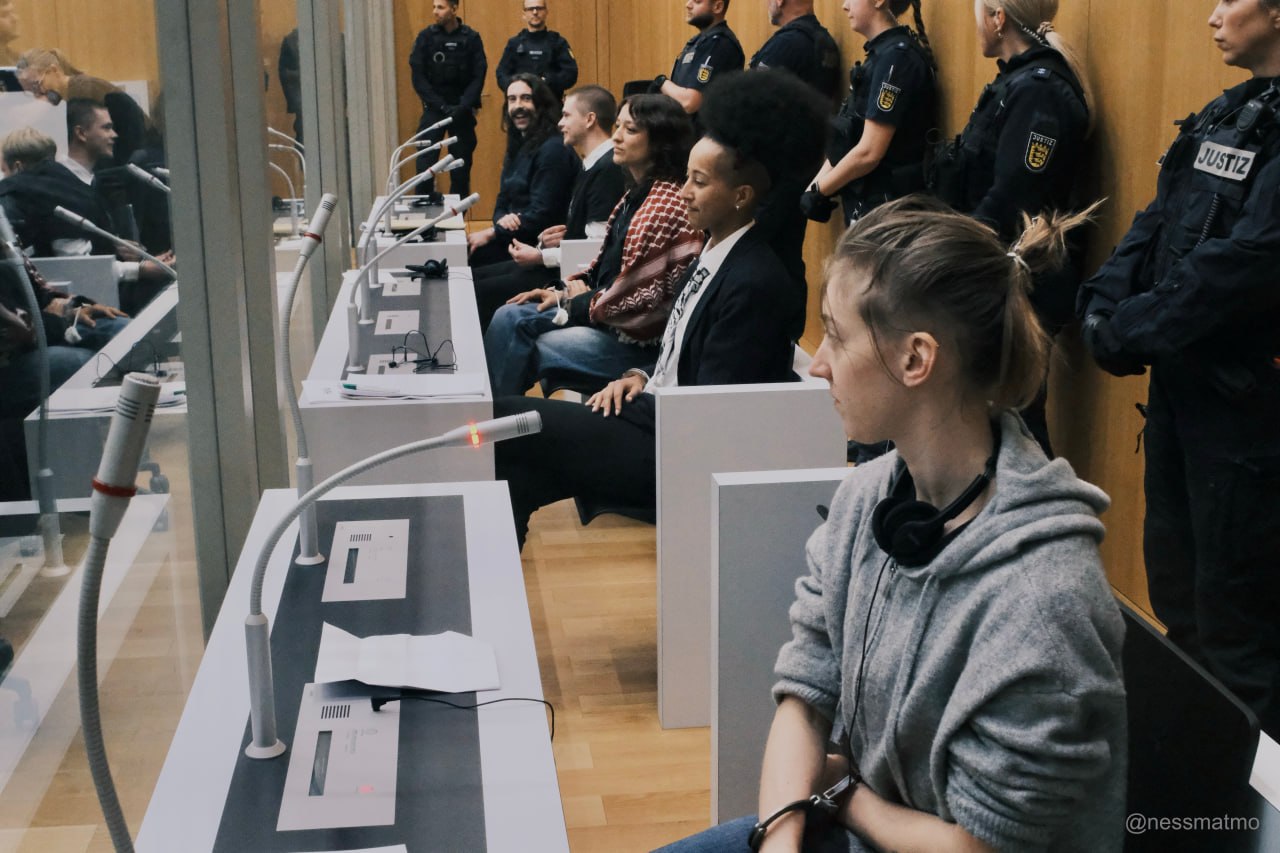
The trial was transferred from the Stuttgart Regional Court (Landgericht) to the notorious high-security Higher Regional Court (Oberlandesgericht) at Stammheim — where the RAF trials took place in the 1970s and where trials for violent crimes or terrorism charges are currently held. The appearance of these five activists, handcuffed and separated from their lawyers and the public by bulletproof glass, shows that the court, presided over by Judge Kathrin Lauchstädt, in its ‘impartial’ opinion, believes that these individuals — who attempted to halt the genocide, even if only for an hour — deserve the same security measures as the Reichsbürger, a far-right group accused of attempting to overthrow the German state by force. That trial is taking place in the adjoining courtroom, while several of the accused, unlike the Ulm5, are not even in pre-trial detention.
During the first 21 sessions of the Ulm5 trial, the prosecution presented its investigation and evidence. This included, amongst other things, the videos that the Ulm5 had recorded themselves and that were posted on social media; the full-length documentary “To Kill a War Machine”; hundreds of photos of the damage, particularly to the TDL laboratory (which the Ulm5 have acknowledged); an unboxing video of parcels containing red overalls; and shockingly messy police investigations consisting mainly of social media posts and selected photos found on the defendants’ phones. One police witness reported in court that Leandra and Vi took a trip to Cairo in 2025, but didn’t know why. (Spoiler alert: to take part in the massive international march to Gaza in 2025 and to try to deliver food and medicines when Israel had cut off all supplies.)
Were it not for the fact that this trial is setting a precedent and these activists’ freedom is at stake, the investigation and the evidence presented by General Prosecutor Stengel would border on the pathetically comical.
At the 23rd session of the trial, on the 14th of October, the defence team had formally invited, and then attempted to call, their first witness. They also announced their intention to call their second witness on the 16 of October. As Leandra’s lawyer, Mathes Breuer, explains:
“The court never showed any interest in investigating the company where the events took place. They never showed any interest in investigating the genocide. And that is what we have tried to do in the court’s stead, because we believe it is important to understand why the five acted as they did and why it was also justified for them to act in that way.”
The activists’ defence team and the activists themselves have always maintained that they acted in an emergency, in an act of defence of a third party – in this case, Gaza and its people – and to stop the genocide. Their motives must be clarified at trial for a fair verdict.
First, on the 14th of October, the defence invited weapons expert Dr. Shir Hever. He has conducted research into how the technology produced at the Ulm TDL laboratory – the section of the facility damaged by the Ulm5 – is crucial to the genocide in Gaza. The software the German factory exports is used in coordinating the Israeli army’s attacks: it enables gathering and distributing information on targeted individuals and factoring in the permitted ‘collateral damage’, amongst other things.
As Dr Hever explained at the subsequent press conference: “Software-defined radios are a type of TDL. TDL stands for ‘Tactical Data Links’, which enable units to combine information in real time with great speed, not only so that soldiers can communicate with one another verbally, but also to transmit complex tactical information, such as the location of targets(…)Thus, the way in which this genocide is unfolding in Gaza is unprecedented, as it involves the industrial and exponential generation of aggregated data to create targets faster than any human being could do. And there is a new film that has just been released, called NAZA. NAZA, in Hebrew, is an acronym referring to collective collateral damage. And given that the film is facing widespread criticism in Israel and the Israeli Government is attempting to deny it, many soldiers have come forward in recent days and provided additional testimonies which I have included in my report to the court. These testimonies reveal how many civilians may be killed without authorisation for each of these targets, which are, in fact, generated by computers using information transmitted via radios developed in Germany by Elbit Systems Germany. And these reports from the soldiers, these testimonies from the soldiers, are shocking. They show the extent of the disregard for human life.”
On the 14th of October, following two breaks of two hours each, the judge decided that she would not reach a decision that day and would instead deliver her ruling on Friday.
On the 16th of October, to no one’s surprise, Judge Kathrin Lauchstädt decided not to hear what Dr. Hever had to say. In her reasoning, which sounded more like the final judgement, she stated: “The fundamental aim of the application is to demonstrate the central role played by the company Elbit Systems Deutschland in Israeli military operations in Gaza. If the evidence on which the application is based were to be proven, this — according to a provisional assessment — would not alter the conviction or the statement of legal consequences.”
She continued: “Following a provisional review, they do not demonstrate either that action was taken against an aggressor, or that the ‘defensive action’ alleged by the defendants was suitable for ending, mitigating or even delaying a virulent armed conflict in Gaza. An attack is the threat by a person to infringe legally protected interests. ‘Legal persons’ and other groups of people, in their capacity as legal entities without physical existence, are not in a position to carry out an attack.”
It can be inferred from this line of reasoning, for example, that if an ultra-fascist party built weapons for an attack, and you enter a building where the bombs and weapons are being manufactured, defuse and destroy them, but do not assault any people, this would not constitute an ‘act of defence’. Not only that, but the people manufacturing the weapons, knowing what they were to be used for, bear no responsibility whatsoever because they were manufacturing what had been requested of them – in other words, they were following orders. Furthermore, if you enter only one building and not all of them, your action does not count. In short, either you stop the entire fascist attack or you’d better stay at home.
The state’s protection for large corporations shielding them from any legal consequence is nothing new, but rather an integral part of the capitalist system. It was already described in the documentary “The Corporation” (2003), which explained how some large companies, that are considered “non physical legal persons”, if they were actual people, would exhibit all the traits that define psychopathy. And how even in their worst psychopathic behaviour they are shielded by subservient governments that prioritise the interests of investors over those of their people.
The judge also demonstrated her profound ignorance regarding what she calls the conflict in Gaza by stating: “According to current evidence, the attack does not meet the criterion of imminence. An attack is imminent when the infringement of a legal right is about to occur, is occurring at that very moment, or is still ongoing.” I do not know what world the judge lives in, but in 2025 the genocide had already been ongoing for years and has continued ever since.
The judge continued: “The supply of defence material and its possible use abroad do not constitute imminent attacks, nor do they constitute attacks taking place at that very moment against individual legal interests. Rather, they are persistent dangers or future events that do not fall within the narrow concept of act of defence. Therefore, the prevailing view rejects ‘pre-emptive act of defence’ against future attacks; the disruption of preparations for an attack does not constitute a situation of self-defence. Even if the weaponry were subsequently used for offensive purposes, the research, production or supply in themselves cannot be classified as a current attack.”
Having suggested that acts must be directed against natural persons rather than legal entities in order to be considered ‘an act of defence’, the judge stated: ‘Action taken in a state of necessity — assuming such a situation existed — would have had to be necessary, that is to say, appropriate to immediately put an end to a danger or, at the very least, to mitigate it, and would have had to be the least severe means available.’ There is no direct, less severe means than damaging only that which causes harm, as the Ulm5 did. Could the judge perhaps be suggesting instead looking disapprovingly at the weapons, or insulting the software to hurt its feelings? And yet she continues: “An act of necessity is considered appropriate when, from an objective and ex ante (before the event) perspective, it can help to avert or, in any event, reduce the specific danger; mere long-term or symbolic effects are not sufficient.”
In other words, emergency aid must be an immediate act, and only placing oneself between the bullet and the victim counts; sabotaging the gun that shoots the bullet does not, as in this view, it is a long-term, symbolic action.
The judge then even went on to say that politically motivated actions aimed at putting pressure on decision-makers and institutions – such as calling for Germany to stop supplying 30 per cent of the weapons used to commit genocide in Gaza – are not appropriate for defending anyone from any danger in the meaning of Section 34. And after a long tirade on the kind of protest that she considers appropriate in bourgeois society, which actions are legitimate to stop a genocide and what is appropriate within the framework of ‘civil disobedience’ (which, to the ears of the spectators present, sounded as though the best course of action is to stay at home signing petitions whilst reflecting on the many freedoms we enjoy in this country), the judge also found time to conclude with a real bombshell: “Nor is further evidence required for sentencing. Should they be convicted, the defendants’ motivation to save human lives could, based on evidence taken so far, — in particular their statements and the facts of the case — already be taken into account in mitigation”.
In other words, in Judge Kathrin Lauchstädt’s view, the Ulm5’s motivation for destroying a laboratory crucial to preventing genocide in Gaza might be a mitigating factor, but she does not need to hear from any more experts, or evidence, or testimony, or anything else, since the accused themselves state that this was their motivation and that is sufficient for her to be the most objective judge there could possibly be.
As Benjamin Düsberg, Daniel’s lawyer, said at Friday’s press conference: “That means the only possibility the court sees is for the judge to pass judgement after the event, but preventive resistance, to halt or prevent injustice, is not an option in this case. And that is why they are doing everything in their power to prevent it, and they do not mind disregarding and undermining the most basic rights of the defence, such as the right to call witnesses. And that constitutes an attack on the rights of the defence, in other cases as well.”
On Friday the 16th of October, the defence then called upon international law and human rights expert Professor Dr. Isabel Feichtner to give evidence; she was due to testify on how the conditions in Gaza fulfil the criteria to classify it as a textbook case of genocide. However, despite having had advance notice of her invitation, the prosecutor and judge refused to state their views regarding her admissibility. So we will have to wait a few days to see whether the judge will allow Professor Feichtner to speak, as she may deem her evidence irrelevant too. Yet, as Breuer pointed out, neither the genocide, nor the production carried out at Elbit Systems Ulm, have been addressed in any part of the prosecution’s evidence. Not only that, but statements from police witnesses have evidenced that Attorney General Stengel gave orders not to investigate Elbit Systems from day one of this investigation.
The judge’s remarks left the public with the impression that the verdict has already been decided, that the court assumes the only acceptable form of protest is to do nothing. This is because any protest against arms manufacturers is viewed as an attack on the German state and its rule of law. And indeed it is. The German state and its elites are making a fortune out of the war. The violence inflicted on Palestinians pays for their yachts and beer.
The fact is, there is violence that is acceptable to the German state – such as genocide or brutal police charges against pro-Palestinian demonstrators, or keeping human rights activists locked up in solitary confinement for over a year – and there are direct actions that are unacceptable, such as breaking into an arms factory seeking to end that genocide, or blocking ports from which such weapons are shipped.
As Dom Hélder Câmara, Archbishop of Brazil (1909–1999), said:
“There are three types of violence. The first, the mother of all the others, is institutional violence—the kind that legalises and perpetuates domination, oppression and exploitation; the kind that crushes and curtails millions of men and women within its silent, well-oiled machinery. The second is revolutionary violence, which arises from the will to abolish the first. The third is repressive violence, which aims to stifle the second by becoming an accomplice and an ally of the first violence—the violence that gives rise to all the others. There is no greater hypocrisy than to call only the second ‘violence’, whilst pretending to forget the first—which gives rise to it—and the third—which kills it’.”
In these particularly violent times, when states – in collusion with arms manufacturers – see themselves as the sole masters of violence, curtailing rights worldwide to fund genocidal, endless wars in other countries, and slashing social spending at home, it is important to understand the structure of violence and how to combat it, both on the streets and within institutions.
¡No pasarán!