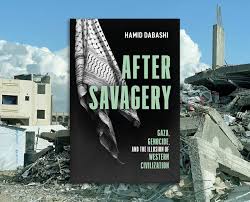
Hamid Dabashi’s After Savagery is a book written with smoke still hanging over Gaza. There is no retrospective calm here, no archival distance to dilute the immediacy of horror. The prose feels as though it was typed between air raid sirens and casualty updates, in the blue light of screens that will not stop showing the same craters, the same small bodies, the same parents howling over the remains. This is not simply a work about Gaza, but one written from the perspective of Gaza, asking a question that refuses to go away: What does it mean for the world’s self-appointed custodians of “civilization” to watch a genocide unfold—and to arm, fund, and rationalize it in the name of their values?
From the outset, Dabashi strips Gaza of the language that has caged it: “conflict,” “escalation,” “cycle of violence.” Gaza is not a humanitarian crisis to be “managed”; it is the concentrated truth of what calls itself “Western civilization.” One statement becomes the conceptual fulcrum of the book: “Israel is the microcosm of the West—doing in Palestine what the West has done to the world.” The force of this assertion lies in its refusal of exception. Israel is not an unfortunate deviation from Western ideals, he suggests, but their most distilled form.
Yet After Savagery begins from an even more fragile position: the difficulty of writing in the middle of a genocide. Dabashi insists that it is morally imperative to think and write about Gaza; silence is one more layer of rubble. At the same time, he is honest about how easily language buckles under a daily roll call of massacres, amputations, and mass graves. One aim of Israeli violence, he argues, is precisely this: to produce so much horror relentlessly that the global public drifts from shock into indifference. “Shock and awe” is not merely a military doctrine; it is a strategy of perception. After Savagery is an attempt to keep perception alive.
To keep looking, however, is to confront something searing about the world that claims to be looking back. The genocide in Gaza, Dabashi writes, will be remembered as one of the darkest episodes in modern history. But what makes it historically decisive is not only its brutality; it is the way it exposes the entire self-image of “the West.” This is a civilization that has spent centuries narrating itself as the pinnacle of philosophy, art, democracy, and human rights. In Gaza, that same civilization is exposed as a history of conquest, slavery, and extermination, now live-streamed as policy. It is not that genocide has returned to a previously peaceful order, it is that the genocidal architecture of that order has finally lost its alibi.
To make that case, Dabashi turns to the archive. He places on his desk Sven Lindqvist’s Exterminate All the Brutes, Arendt’s reflections on imperialism and totalitarianism, and Aimé Césaire’s insistence that Europeans only discovered the horror of their own violence when it recoiled upon Europeans themselves. The trail is brutally clear. Before Auschwitz, there was the Congo. Before the crematoria, there were plantations, slave forts, forced famines, and “civilizing” massacres in Algeria and across the Global South. The Nazi Holocaust is not denied its singularity, but it is refused its isolation. When Dabashi writes that “the two atrocities are interrelated as the two sides of the same coin of European genocidal practices,” he folds the camps back into the colonial world that enabled them.
From there, the line to Gaza is not a rhetorical leap but a structural continuation. Zionism, in Dabashi’s reading, is not an aberration in European political thought. It emerges from the same climatic zone as antisemitism and colonialism: a world of racial hierarchies, of chosen and expendable peoples, of “empty lands” and surplus populations. Israel, then, is not an external solution to European crimes; it is one of their afterlives. The siege, starvation, and carpet bombing of Gaza are read not as failures of policy but as the logical continuation of a project that has always required the elimination or containment of those it marks as native. In this sense, Gaza becomes, for Dabashi, a new moral and philosophical ground zero. The metaphors we habitually use—“cradle of civilization,” “Enlightenment,” “liberal order”—disintegrate once we place Gaza at their center. If Gaza is what “civilization” looks like when its weapons and doctrines are fully deployed, then the term has rotted from within. Any serious attempt to think about ethics, politics, or liberation today, he insists, must begin from Gaza’s ruins, rather than from European abstractions that have never considered Palestinians fully human.
That question—who counts as human?—pulses through the book like an open wound. Dabashi asks, bluntly: “Are we non-Europeans, Palestinians or otherwise, even human beings in the enduring philosophical traditions of what calls itself ‘the West’?” The answer, he suggests, is inscribed in both policy and prose. On one side, Israeli ministers describe Palestinians as “human animals,” a phrase that drifts effortlessly into military directives. On the other side, Immanuel Kant treats the Blackness of an African man as “proof” of stupidity, or entire continents as incapable of “great” achievements. These are not accidental slips; they are symptoms of an epistemic order in which non-Europeans appear, in Dabashi’s phrase, as “a metaphysical menace … a racialised noise that must be quieted, conquered, and pacified.”
Here, After Savagery makes one of its starkest claims: that what Europe calls a “metaphysics of morals” has historically functioned as a metaphysics of barbarism. Grand ideas of duty, rights, and rational agency stand atop a world constructed by enslaved, colonized, and dispossessed people whose lives did not count as fully human in those systems. When those same concepts are invoked today to explain away Gaza—when “self-defense,” “security,” and “the rule of law” become the vocabulary of mass killing—they expose themselves, in Dabashi’s hands, not as neutral tools but as weapons with a very specific lineage.
The media, in this narrative, are not innocent bystanders. One of the most compelling threads in the book is Dabashi’s analysis of Western news outlets as part of the machinery that renders genocide palatable. He is not interested in easy language like “fake news.” He speaks instead of “processed speech,” a diet of language engineered to keep the killing machine well-oiled. In this lexicon, airstrikes “hit targets,” civilians “perish,” and Gaza “teeters on the brink” of famine long after famine has been deliberately manufactured. Numbers—of the dead, the displaced, the amputated—are recited without ceremony, flattened into background noise.
Dabashi’s counsel is to read these reports contrapuntally, to listen for what they cannot say. When an anchor intones that “both sides have suffered losses,” what structures of power and race make that sentence possible? When a think-tank analyst speaks of “mowing the lawn,” what histories of colonial agriculture and extermination are being repackaged as common sense? If we follow his lead, the nightly news becomes a ritual of the empire, carefully updated for the age of high-definition atrocity.
And yet, for all its exposure, After Savagery is not primarily a voyeuristic catalogue of horrors. It is also a book about resistance—intellectual, aesthetic, and spiritual. Mahmoud Darwish becomes one of Dabashi’s central companions. “Darwish has, in short, become synonymous with his poetry, and his poetry with his occupied and stolen homeland,” he writes. The now-iconic imperative—“Write it down!”—echoes throughout the text as both command and accusation. To write is to refuse erasure. To write from Palestine is to insist that those the world treats as expendable have a history, a future, and a name.
For Dabashi, this is what “poetry after genocide” must mean. Against Adorno’s anguished claim that poetry after Auschwitz might be barbaric, he suggests that for those who have always lived “after” one genocide or another, poetry is among the few remaining acts of civilization. It is not consolation; it is not ornament. It is sumud: steadfastness in the face of a world built to unhouse you. He finds this poetics not only in Darwish but in Ghassan Kanafani, in The Little Lantern, in the work of filmmakers who move through the camps with their cameras and unarmored hearts. A kindergarten in a refugee camp becomes an ark of memory; a lantern carried by a child becomes a theory of shared light.
If poetry and film carry forward the work that “Western philosophy” abandoned, After Savagery also gestures toward a different theological horizon. Dabashi sketches, briefly but suggestively, a Palestinian liberation theology that cuts across confessional lines—Muslim, Christian, and secular—grounded not in chosenness but in justice. In the same horizon, he discerns the faint outlines of a post-Zionist Jewish liberation theology, one that would free Jewish thought from entanglement with a state that demands supremacy in one place while Jewish voices demand equality in another. Zionism, he argues, has colonized both Judaism and Palestine. Genuine decolonization would have to liberate both.
The book’s later pages widen further without losing the centre. Dabashi writes with James Baldwin on his desk and Gaza on his screen. Baldwin’s words, he admits, have accompanied him ever since he arrived in the United States in the 1970s; now, in the shadow of Gaza, they offer urgent companionship. Like Baldwin, he is skeptical of any civilization that asks its victims for patience. Like Baldwin, he insists that the fire next time will not be a metaphor.
It is in this spirit that Dabashi takes seriously comparisons that defenders of Israel find intolerable. When Burmese genocide scholar Maung Zarni says that “what we are seeing in Gaza is a repeat of Auschwitz” and calls it “a collective white imperialist man’s genocide,” Dabashi does not retreat. Committed to the historical reality of the Jewish Holocaust, he finds something “profoundly liberating” in bringing that suffering “out into the open, into the fold of humanity, where it rightly belongs,” rather than incarcerating it inside a garrison state. The point is not to compete over victimhood but to refuse the monopolization of grief in service of the empire.
The book’s conclusion returns to the term that has hovered over it all: “the West.” For Dabashi, Gaza signals the end of that illusion. “The myth and the illusion of the West,” he writes, have ended “in ignominy, buried forever under the rubble of Gaza.” The West was never a geographic fact; it was an ideological construct of global capitalism, an identity that depended on casting everyone else as “the Rest.” What Gaza has done, he suggests, is to strip that myth of its last moral cover. A civilization that can watch, excuse, and underwrite what is happening there cannot credibly claim to be the yardstick of the human.
Where, then, do we begin instead? Dabashi’s answer is modest and uncompromising: “We need to begin with the most brutalized facts on the ground—the Palestinians, the Jews, the Native Americans, all those who have been displaced, all those who are the wretched of the earth.” From that premise, he believes, “a new moral intuition emerges,” a philosophy and political prose that “embrace us all and are reducible to none.” It will not resemble what passes today for “Western philosophy,” nor will it simply invert the hierarchy of West and Rest. It will be written from Gaza and places like it, by people who were never meant to survive the world that now calls itself civilized.
After Savagery does not claim to have completed this task. It offers neither a neat theory nor a finished map. It is closer to what Baldwin once called a record of how it felt to be alive at a particular historical moment. It records the insomnia of watching a genocide unfold while universities debate “civility” and newspapers editorialize about “both sides.” It registers the fury of reading Kant while children starve in a besieged strip of land his categories cannot see. It records, too, the stubbornness of those who keep banging on the walls of the tank.
Ultimately, Dabashi’s book is not simply something to agree or disagree with; it is a demand that we choose where we stand when we say “we.” Do we continue to think with the old words—civilization, security, democracy—as if Gaza has not exposed what they are doing in the world? Or do we accept his proposition that Gaza is now the measure, the new categorical imperative: if a principle justifies Gaza, it is not moral; if a civilization requires Gaza, it is not civilization.
To read After Savagery is to lose the luxury of innocence. It is also, in a strange way, to recover a kind of hope—not the hope that “the West” will redeem itself, but the hope that another moral imagination is already being born in the places it has tried hardest to erase. Gaza, in this book, is not only the world’s wound; it is also its compass.
AFTER SAVAGERY: Gaza, Genocide, and the Illusion of Western Civilization by Hamid Debashi, 218 pp. Haymarket Books, 2025, $19.95