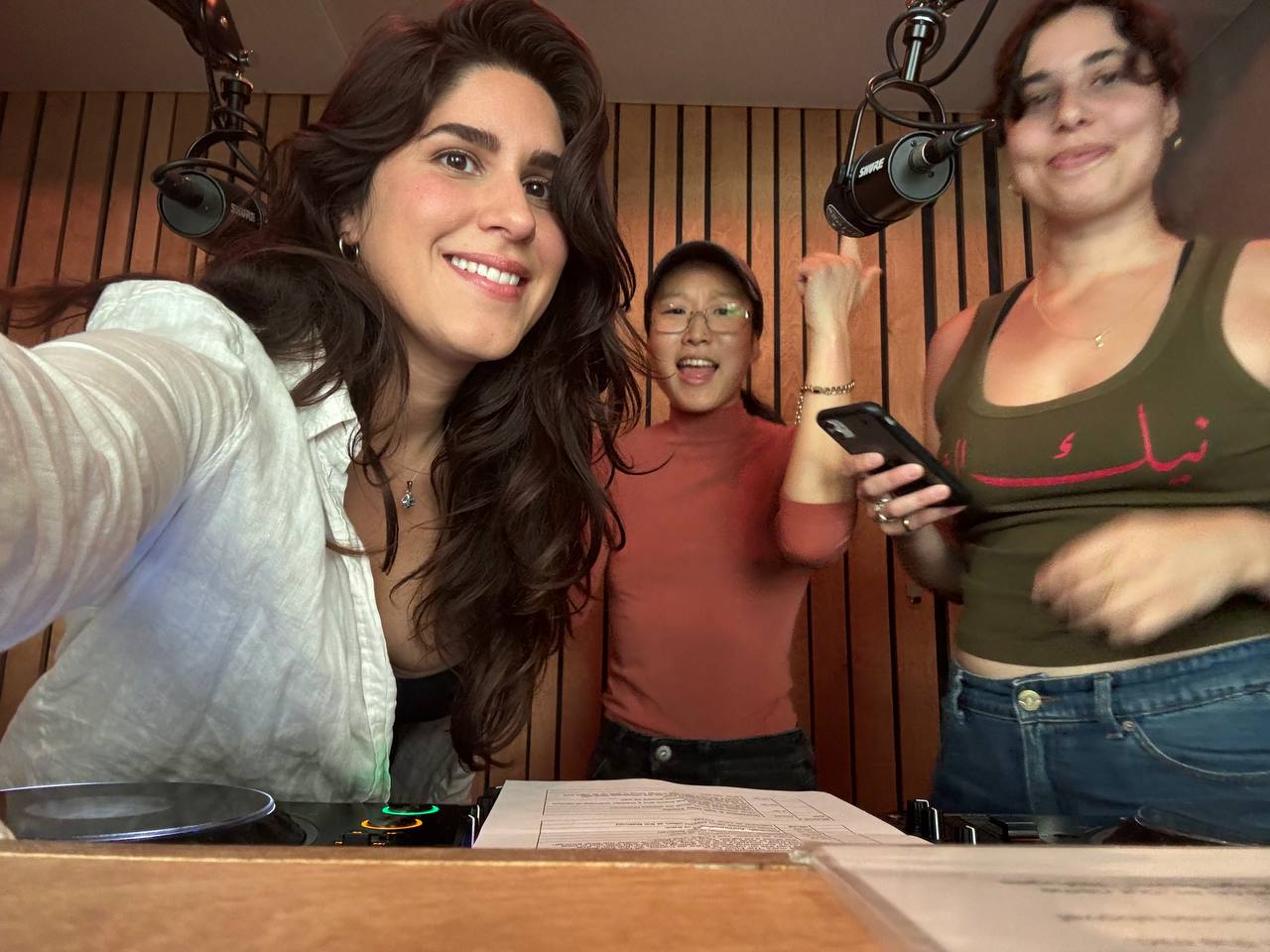
Thanks for talking to us. Could you start by briefly introducing yourself?
I’m Damineh, and I’m one of the co-founders of the Unframe Festival. Ina and I first started the festival in 2024, and Erna joined our team last year. Alongside my work with Unframe, I’m also part of a political organisation, so political activism plays a big role in my life.
Why “Unframe”? What does the name mean?
The name actually comes from something I saw written on a wall in a bar maybe five years ago: “Unframe your reality”. For some reason, that sentence just stayed with me.
When the genocide in Gaza began and I saw the way it was being reported in much of the media, I kept thinking about that phrase. Because propaganda doesn’t necessarily have to consist of completely invented facts. It can work by taking a tiny fragment of reality, putting a very narrow frame around it and leaving everything outside that frame invisible. The individual thing you are showing might even be factually true, but by excluding the much larger context, you can create a completely distorted picture of reality.
You can see the same mechanism in racist narratives around crime. Individual cases are constantly highlighted and framed in a way that suggests that certain groups of people are simply more criminal than others. You zoom in on one incident while making the social conditions, the broader statistics and the actual causes invisible. That very narrow frame then becomes the basis for a much larger story about Muslims, migrants, or other minorities.
And I think that’s how a lot of propaganda works: you don’t necessarily have to invent reality, you just have to decide which tiny part of it people are allowed to see.
So “Unframe” is about trying to break open that frame – to look at what has been left outside of it and to understand the broader social and political conditions behind what we are being shown. And that became the basic idea behind the festival.
Is there a common theme running through the programme?
The programme has changed somewhat over the years and I would say it has become broader. We ourselves are Marxists, we have a materialist understanding of society and believe in revolutionary Marxism. So naturally, that shapes the way we think about the programme. But at the same time, we want to provide space for ideas and analyses that we might not necessarily consider Marxist ourselves, as long as we think they are worth discussing and engaging with.
One thing that is very important to us is that Unframe is not tied to any particular political organisation. Organisations are welcome to use the festival to organise, agitate and argue for their politics, but we as the organisers are completely independent. There is no party, political organisation or funder behind us – and that is very intentional.
We wanted to create a space where different political positions can actually be argued out, where people can defend their ideas and potentially convince others. Most of the political congresses and festivals we knew before starting Unframe were connected to a particular party or organisation. There is nothing inherently wrong with that, but I think they serve a different purpose.
For us, one of the threads running through the programme is the attempt to connect different struggles and political questions. People are often politicised through one very specific issue – whether that is Palestine, racism, feminism, climate change, war, housing or something completely different. We want to create a space where people can take the next step and ask how that particular issue relates to other struggles and to the society we live in as a whole.
From our perspective, Marxism provides the strongest framework for making those connections. But rather than simply presenting that as a finished answer, we want the festival to be a space where those ideas can be discussed, challenged and argued for.
This will be the third Unframe festival. What have you learned from the previous two?
That there will always be things you simply can’t prepare for!
At the first Unframe in November 2024, the heating at Oyoun broke down and, because of the sanctions imposed on the venue by the Berlin Senate, it wasn’t repaired. So just a week before the festival, we suddenly had to find portable heaters and figure out how we could make the festival happen despite the circumstances.
What made the experience really special, though, was that the cold barely seemed to bother our guests. If anything, it became another reason to move closer together and look out for one another. Everyone was incredibly understanding and immediately understood the situation we were in.
I think that taught us that you can plan a festival down to the smallest detail, but something unexpected will always happen. What matters much more is how you deal with it collectively and sometimes the things that go wrong end up creating some of the strongest memories.
Berlin is full of festivals and conferences. What is different about Unframe?
I mentioned some of this earlier, but Unframe was really created with the idea of bringing people together and, ideally, getting more people interested in Marxism.
For us, the festival is not just about listening to interesting talks for a weekend and then going home. We want people to meet each other, build connections and hopefully leave with a stronger sense that political change requires collective organisation.
That has become even more urgent. With the AfD now reaching 44 percent in Saxony-Anhalt, the need to organise and collectively fight the rise of the far right and fascism could hardly be clearer. Creating spaces where people can come together, discuss political ideas and find ways to become active is more important than ever.
You say that Unframe is a combination of politics and culture. Do you think that the left tends to overlook the importance of culture?
That’s a difficult question, because I think we would first have to define what we mean by culture. But fundamentally, I don’t think politics is made through culture. I also don’t believe that art or culture alone will radicalise the masses or create political change.
What art can do, however, is reflect the society that produces it. It can express experiences of alienation, oppression, war or inequality, but also resistance and the desire for something different. And I think it can provide a kind of emotional comfort – the recognition that other people experience and feel things in a similar way. That can be powerful, because it can bring people together and encourage them to collectively act and organise.
But I don’t think art can be separated from politics in that way. Art that presents itself as non-political does not escape politics; it merely accepts and reproduces the existing social order. In that sense, it serves a self-contained purpose and becomes an instrument of petty-bourgeois entertainment. We should therefore judge art in relation to the social forces and interests it expresses, and ask whether it challenges or reinforces the conditions in which it is produced. Trotsky’s point that “the methods of Marxism are not the methods of art” does not mean that art should be treated as politically neutral. It means that Marxism is not itself an artistic method or a form of cultural expression, but a materialist method for understanding and changing social reality. Art can express, illuminate or challenge that reality, but it cannot replace political analysis, organisation or collective struggle. It therefore cannot be reduced to a political programme or evaluated as if it were a political organisation.
We actually have a reading at the festival called “Literature and Class” that deals with precisely this relationship between art and class struggle. I find that question really interesting: what role can art play within struggles for social change without pretending that art itself can replace political organisation or collective struggle?
And I think that is also why politics and culture belong together at Unframe. Art doesn’t exist outside of society, but neither is it simply another form of political organising. It can reflect contradictions, give expression to experiences that are otherwise difficult to articulate and create a sense of collective recognition. But ultimately, changing the conditions that produce those experiences requires collective political action.
What does your culture programme look like? What can people do after the meetings are over?
On Saturday night, we’re having a party that we organised together with Ic Ice. It’s a chance to dance, meet people, connect with each other or simply switch off for a while after a full day of political discussions.
And on Friday night, there will be a concert by a young artist called Vasil. Her lyrics are political and poetic, but at the same time they feel very real and personal. I think that combination fits Unframe really well.
For us, the cultural programme is also about creating moments where people can come together in a different way. Political exchange doesn’t only happen in meetings and discussions – sometimes the conversations you have afterwards, while having a drink, listening to music or dancing together, are just as important for actually getting to know and connect with people.
Unframe has always been a platform for discussions on Palestine. How has this discussion changed while you’ve been organising Unframe?
The content of our discussions on Palestine hasn’t fundamentally changed. Palestine has been central to Unframe from the beginning, and this year again we have many sessions that are directly or indirectly connected to it.
What has developed, I think, is the way we try to connect Palestine to the broader political questions in our programme. We are often contacted by people who would like to see more content on Palestine, women’s oppression, queer rights or other specific issues. And of course these are all important topics in their own right. But I think it is worth looking more closely at how they are connected.
When we talk about women’s oppression, for example, we also have to talk about the material conditions and relations of production that shape it. The same applies to other forms of oppression. And when we talk about Palestine and war, we cannot separate those questions from imperialism – and ultimately from capitalism.
So perhaps what has changed is less our position on Palestine and more the way we structure the programme around it. We are increasingly trying to move away from looking at political issues in isolation and towards understanding the material connections between them. For us, Palestine is not a separate or single issue. It is connected to much broader questions about imperialism, racism, oppression, class and capitalism.
What is the connection between conferences like Unframe and political practice?
Part of the connection is obviously the political content itself, but I think an equally important part is creating a space where people can meet, exchange ideas and organise.
A conference like Unframe cannot replace political practice. Listening to a talk or having a discussion does not change society by itself. But it can help people understand the conditions they are fighting against, develop their political ideas and, most importantly, meet others with whom they can become active.
At the same time, we are not politically neutral about which organisations or movements we provide a platform for. Our own perspective is revolutionary Marxist, and we invite groups, movements and organisations whose politics we consider worth engaging with and debating from that standpoint.
Ideally, people don’t just leave Unframe with new ideas, but with new connections and a clearer sense of where and how they can become politically active. For me, that is where a festival like Unframe can become a bridge between political discussion and political practice.
What can people do if they don’t think they can afford a ticket?
If someone genuinely can’t afford a ticket, they can simply send us an email and we’ll find a solution. We don’t want anyone to be excluded from the festival simply because they don’t have the money to attend.
At the same time, we unfortunately do need to sell the majority of our tickets because Unframe receives no external funding. We personally carry the entire financial risk of the festival, and the costs add up very quickly – venue hire, sound and lighting, furniture and equipment, travel and accommodation for speakers, and many other things.
So we are very dependent on ticket sales to make the festival possible. All three of us have other jobs alongside Unframe, and none of us makes any money from the festival. Our work for Unframe is 100% non-profit.
It’s a difficult balance: we need ticket income in order for the festival to exist, but at the same time we never want money to be the reason why someone who genuinely wants to participate can’t be there.
Where can people find out more about Unframe?
In quite a few places. We recently did a radio show with Refuge Worldwide, for example, where we talked about how Unframe came about, the story behind the festival and the music that has accompanied and inspired us along the way – and why those particular songs mean something to us.
And of course, people can also find more information about the programme, speakers and everything happening at the festival through our website and social media.
What are the highlights of the coming Unframe festival?
My personal highlights are the talks by Anne Alexander and Joseph Choonara. They are both members of the SWP, and we first heard them speak at the Marxism Festival in London in 2023. Marxism was a huge inspiration for us when we started Unframe, so we’re especially happy to bring a little piece of that festival to Unframe this year.
Joseph Choonara uses Marx to explain why exploitation, competition and the constant pressure to accumulate are not simply things that have gone wrong with capitalism, but are built into the way the system itself works. He has written extensively on this and many other topics, and I think he is particularly good at making quite complex ideas very accessible.
Anne Alexander’s talk focuses on the current AI arms race and analyses AI from a Marxist perspective. I find her approach particularly interesting because she doesn’t simply look at AI in moralistic terms, as something inherently good or bad. Instead, she asks what role it plays within capitalist competition: how does AI intensify competition between companies and states, what new pressures does that create, and what are the consequences for work, power and social inequality?
I’m also really looking forward to the film screenings, which have been curated by Phil and Antifada. Phil has been an important part of our programme curation since the beginning of the festival, and this year he has focused more specifically on the film programme. We’re really excited to see the selected films ourselves.
Also the art exhibition “Rote Flut” will be a new format this year which was mainly organized by Doro who is also part of our organizing team.
I could probably name many more talks, screenings and workshops that I consider highlights. But one very different part of the programme that I’m particularly curious about is the conversation between Malcolm Ohanwe and Marlene Engelhorn. I’ve followed Marlene for several years and have always appreciated the way she talks about how wealth reproduces itself without any corresponding contribution of labour. What has fascinated me even more, though, is that I feel like politically she has gone a step further every year.
More recently, she was also at the GSF and has repeatedly spoken about why war, solidarity with Palestine and the struggle to abolish inherited wealth and extreme concentrations of wealth cannot really be separated from one another. I’m very interested to hear where she currently sees herself within the struggle against capitalism – and, in a way, to see how much further she might go.