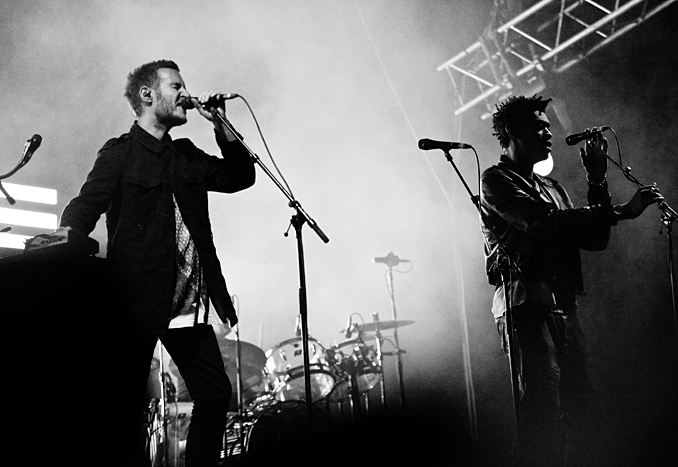
Massive Attack performed in Germany on June 6 and did not fail to impress: it felt more like a festival than a concert, with thousands of people in attendance in the historical surroundings of Berlin Spandau’s citadel.
Anyone who knows the band will know that their art is not exclusively musical – the show was also political and sparked a range of critical reactions and commentary, most notably from the German mainstream media. The evening kicked off with the supporting act, 47Soul, a Jordanian-Palestinian band that blends traditional Arabic music with modern influences. They chanted “Free Palestine” and were followed by Arab Barghouti – his father Marwan Barghouti has been imprisoned in Israel for the last 24 years. He gave a speech stating that his father frequently faced torture and has been denied family visits since 2023. He further told the (mostly) supportive and cheering crowd that it would have been his father’s birthday that day who was yet to meet his grandchildren.
Massive Attack are a band from Bristol, UK with members Robert Del Naja (3D), Grant Marshall (Daddy G), Adrian Thaws (Tricky), and Andrew Vowles (Mushroom). They formed in the 90s and developed their signature “trip-hop” genre inspired by a range of influences while always being politically and socially motivated. The band members attended left-wing demonstrations together and spoke out on topics such as climate change and the Iraq war. During the 1991 Gulf War, they briefly changed their name to “Massive” to avoid connotations with violence, and in 2003, 3D funded anti-war advertisements. They have consistently spoken out against Palestinian oppression and gained traction as an internationally renowned band at a time when western governments were heavily criticised for their involvement in genocide.
Their most recent song, “Boots on the Ground” (2026) addresses ICE raids and race riots in the US, using footage of police violence to create an unsettling documentary-style music video. It is perhaps not a song you would listen to on your commute, but it is certainly a memorable and creative approach to highlight modern-day imperialism and inequality.
Massive Attack’s Berlin performance consisted of video footage produced in collaboration with Adam Curtis, whose dark, collage-like documentaries explore social and political histories. The audience was not just confronted with the genocide in Palestine, but also resistance and repression in Korea, big tech surveillance, Trump, conspiracies, and Epstein. The show was cyclical that started and ended with footage of a chimpanzee who is linked up to a computer monitor to measure brain activity as it attempts to dispense food. We also saw a montage of footage from 90s fashion shows, police violence at protests, world leaders, quotes from Peter Thiel announcing the end of democracy, and floating headshots of members of the audience in imitation of Palantir’s surveillance technology.
I stood back in the crowd where more muted and reserved reactions are to be expected. I couldn’t help but notice some discomfort that seemed to arise when Palestine was brought to the forefront, for example when Del Naja shouted “Free Palestine”, or when the audience was directly confronted with disturbing statistics (made more direct through German translations) of the deaths and casualties in Gaza. There seemed to be a divide in the audience between those who shared the views being expressed, and those who were impatiently waiting for Tear Drop or Angel (I must confess – so was I). I left the citadel feeling a range of emotions: excited but angry, elated but numb. It was undeniably an incredible performance, the topics raised were important, and the reactions in the crowd were revealing.
Over the following days, I read several reviews and posts (mostly in German media outlets) heavily criticising Massive Attack’s Berlin show. One RBB review essentially argued that music and politics are mutually exclusive and Massive Attack’s attempt to confront such complex topics is immature and ignorant (“unmündig, unwissend”) and simplified (“mit einfachen politischen Slogans auf Deutsch”). The writer goes so far as to question the sources of some of the information on Gaza (or at least raised that there were no sources alongside the statistics). Meanwhile, fan groups on Reddit debated whether Massive Attack went “too far” with their political messaging, and some said they wanted their ticket worth 80 euros back.
This stir may prod the casual reader to place the onus on the audience here, that they knew well in advance how the band uses their platform and made a knowledgeable choice. But it is more than that. This is a perfect example of how art is intrinsically bound to politics and shows that those with a platform can make some difference and talk truth to power. Artists are operating in a world where the mainstream media has failed Palestinians. Looking for “Quellen”–as they say in German–is not the job of Massive Attack. It is the job of the journalists – both Palestinian journalists who have either been killed or targeted in the Israeli regime (at least 236 according to the latest estimates) and western mainstream media journalists who remain silent or ensure that a news cycle sidelines Palestinian suffering.
One can dislike and critique the artistic choices of the performance, but those facts should not offend anyone – maybe we should ask ourselves why we live in a world where some people feel uncomfortable being confronted with the realities of others. Despite my initial disappointment at some of the criticism, the resulting controversy and division is exactly the desired consequence as this has got people talking about Massive Attack’s political messaging. This process of learning and unlearning will inevitably feel uncomfortable even if you paid 80 euros to watch your favourite band.
You can find a full recording of the concert on YouTube here.