
The struggle against the Altenrnative für Deutschland (AfD) poses a difficult problem for socialists: how do we fight the far right without simultaneously defending the political and social conditions that produced its rise?
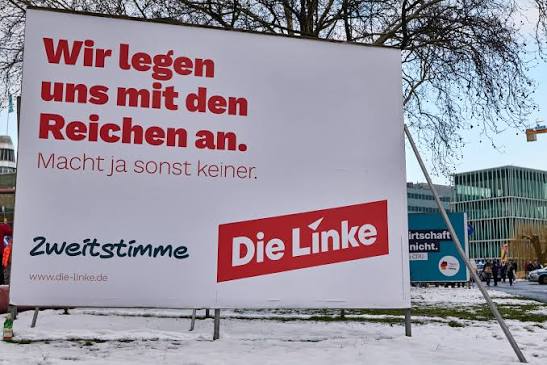
Campact’s campaign around the Saxony-Anhalt state election provides a useful example. Under the banner of fighting the AfD, the campaigning organisation Campact called on voters to cast their second vote strategically for the SPD or Greens in order to prevent the AfD from winning an absolute majority.
This goes beyond political education or social protest. An organisation presenting itself as part of civil society intervened directly in the distribution of parliamentary power, using professional campaign structures to influence the electoral outcome. Campact announced that it was spending €620,000 on the campaign, while its wider anti-AfD fund had already exceeded €2.5 million.
The issue is not that people are being mobilised politically, but how they are organised and around whose interests.
From mobilising protest to managing political outcomes
Campact does not merely tell people to oppose the AfD. It tells them how to vote in order to produce a particular parliamentary result. Its campaign therefore transforms political opposition into a strategically managed electoral intervention.
There is a difference between workers organising around their own interests and a professional organisation that decides on a political objective and mobilises people towards it. And for the latter, the questions arise: Who determines its political direction? Whose interests shape its limits? and, Does this type of mobilisation strengthen the independent organisation of the working class or channel popular discontent back into existing bourgeois institutions?
That is precisely where the history of the Colour Revolutions becomes relevant.
The colour revolutions and “democracy promotion”
The collapse of the Soviet regimes in Eastern Europe was followed by a vast industry of “democracy promotion”. Western governments, foundations, NGOs, think tanks and other international organisations funded projects devoted to building civil society, training activists, monitoring elections, supporting independent media and promoting democratic institutions.
The societies emerging from the former Eastern bloc were often treated as if they suffered primarily from a “democratic” deficit. They needed democratic institutions, democratic culture and democratic education. Western experts and organisations were ready to help them acquire all three.
Yet what Eastern Europeans actually experienced during the same period was not simply a transition to democracy. They experienced massive transformation through the emergence of a new neoliberal order, combining the restoration of capitalism with the institutionalisation of Western liberal democracy. Factories closed. State property was privatised. Unemployment exploded. Social protections were dismantled. Entire regions were deindustrialised.
It was never about teaching people democracy. Instead there was a struggle over who would control the new society and in whose interests it would be reorganised. The post-Soviet societies were not transformed from “undemocratic” to “democratic”, but rather were changed in a profound class reorganisation of society.
This became particularly visible during the so-called Colour Revolutions. In Georgia, Ukraine and elsewhere, people had genuine reasons to revolt. Corruption was real. Political elites were deeply unpopular. Elections were disputed. Foreign, pro-democracy NGOs played a key role in these movements, but were by no means responsible for inventing these grievances or manufacturing the crowds. But it would be equally mistaken to assume that every political organisation involved in the movements was neutral.
NGOs, foundations, and activist networks brought money, training, contacts, media infrastructure and professional expertise. They helped transform scattered anger into coordinated political action. But more importantly, they could help determine which political forces were best placed to inherit that anger once mobilisation succeeded. This is the crucial point – a movement can be genuinely popular and still be politically channelled.
This matters because political mobilisation is never separate from the question of class power. A society can be mobilised against an unpopular government without that mobilisation challenging the social relations on which the existing order rests. Workers, students and other sections of the population may enter a movement with their own grievances and demands, while different political forces compete to give those grievances a political direction. Organisations with access to funding, professional expertise, media networks and international institutions are better placed to shape that direction than people acting without such resources.
The crucial question, therefore, is not simply whether a movement is democratic or whether its participants are genuinely angry. What happens to that anger politically? Does mobilisation lead to independent organisation by working people, giving them greater control over the conditions of their lives? Or is their discontent channelled towards replacing one political leadership with another while leaving the underlying class structure intact?
The existence of mass participation does not settle the question of political power. People may take to the streets for their own reasons, while better-funded and better-organised forces compete to define what the movement should ultimately achieve. Popular mobilisation and independent political power are not the same thing. That is what happens when organisations with vastly unequal resources enter a political crisis.
Civil society is not politically neutral
Germany in 2026 is not Ukraine in 2004. Campact is not an American government agency in disguise, and its campaign in Saxony-Anhalt is not a foreign operation to overthrow a government. The comparison is more limited. It concerns the political function of organisations that stand between popular discontent and formal political power.
Such organisations do not necessarily create people’s anger. They organise it. They give it language. They decide which demands are realistic and which are not. They identify legitimate political partners. And they can direct diffuse opposition towards a specific political result.
In Saxony-Anhalt, Campact’s electoral answer to the AfD is not an independent political alternative. Its answer is, to vote strategically for existing parties. Protect the parliamentary order. Prevent the AfD from taking power. Again, that may succeed electorally. But it leaves a larger problem unanswered. Why has the AfD become strong enough to require this kind of emergency mobilisation in the first place?
You cannot educate away the social crisis
There is a persistent temptation to explain eastern Germany’s political discontent as a problem of political culture. People in the East of Germany – we are told – are particularly distrustful. They are more vulnerable to authoritarian ideas. They have not fully internalised the values of liberal democracy. This is a remarkable way to describe a society that has undergone one of Europe’s most dramatic economic transformations.
After reunification, eastern Germany did not merely acquire new democratic institutions. It was absorbed into a capitalist economy dominated by West German capital. Industries disappeared, millions experienced unemployment or insecurity, younger people left, and many regions suffered decades of demographic and economic decline.
Free elections did not make those social consequences disappear. This is the terrain on which the AfD has grown. The party exploits real anger while directing it against migrants, minorities, the political establishment and liberal institutions. But its appeal cannot be understood through domestic social issues alone. Foreign policy has increasingly become part of the social and political crisis.
The war in Ukraine, sanctions against Russia, rising military expenditure and the growing political emphasis on preparing German society for war have direct consequences for people’s lives. Energy costs, inflation and pressure on public spending are not experienced as abstract questions of foreign policy. They are experienced through household budgets, wages, public services and everyday insecurity. At the same time, the mainstream political parties have largely presented militarisation and support for Ukraine as questions of geopolitical necessity.
The AfD has exploited this opening. In Saxony-Anhalt, it campaigned against weapons deliveries to Ukraine, while 57 percent of voters said they supported stopping them. It means that the left cannot afford to leave questions of war and peace to the AfD while treating these questions as secondary to domestic social policy.
This creates an important contradiction. Campact seeks to defend the existing liberal-democratic order against the AfD, while the AfD presents itself as an opponent of that order. But if the respond to the growing costs and insecurities produced by the current political direction only by defending the status quo, it leaves the political interpretation of that discontent to the right. A socialist response has to connect opposition to militarisation and war with the struggle against austerity, falling living standards and social insecurity — rather than allowing these issues to be separated.
In Saxony-Anhalt, voters also expressed deep feelings of being left behind. Thus 51 percent said they received too little compared with other people in Germany, rising to 66 percent among AfD supporters. The AfD has consequently succeeded in presenting itself as the political “voice” of those who feel ignored. If the answer to the AfD is merely to rally behind the existing parties, then those parties are effectively presented as the only alternative. But for many people, those are precisely the parties associated with stagnating wages, cuts to public services, housing crises and a political system increasingly insulated from ordinary working people.
The choice is not AfD or status quo
The far right must be fought politically and organisationally. But defeating the AfD cannot mean defending the political order whose economic and social policies have helped create the terrain on which it has grown. The task is not to ignore the anger on which the AfD feeds. Nor is it enough to manage that anger more efficiently and redirect it towards the SPD or Greens. The task is to take it away from the right and give it a class direction.
A socialist response must combine opposition to racism and nationalism with opposition to social cuts, precarious work, low wages, militarisation and the policies of the capitalist parties. It means fighting for higher wages, affordable housing, strong public services, public investment and democratic control over economic decisions.
There is no common class interest between workers and capitalists simply because both are asked to defend a “democratic camp” against the AfD. The decisive division remains the division between classes. If the left merely defends the existing order, it leaves social discontent to the right. To defeat the far right, that discontent must instead be transformed into independent working-class power.