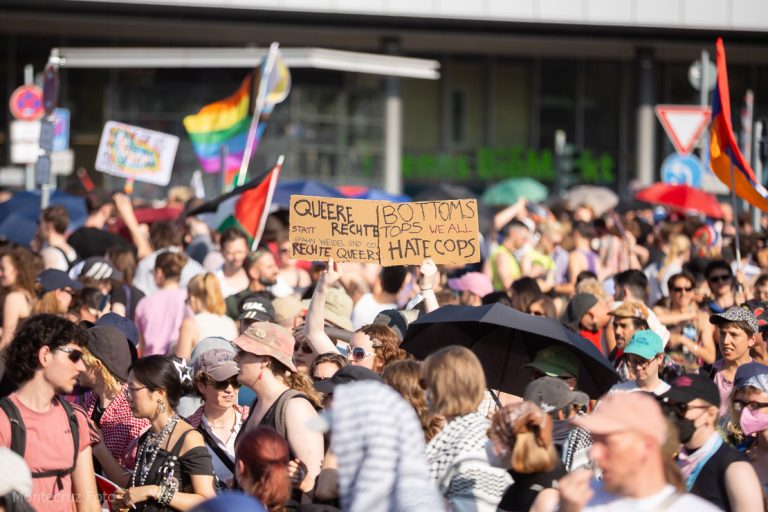
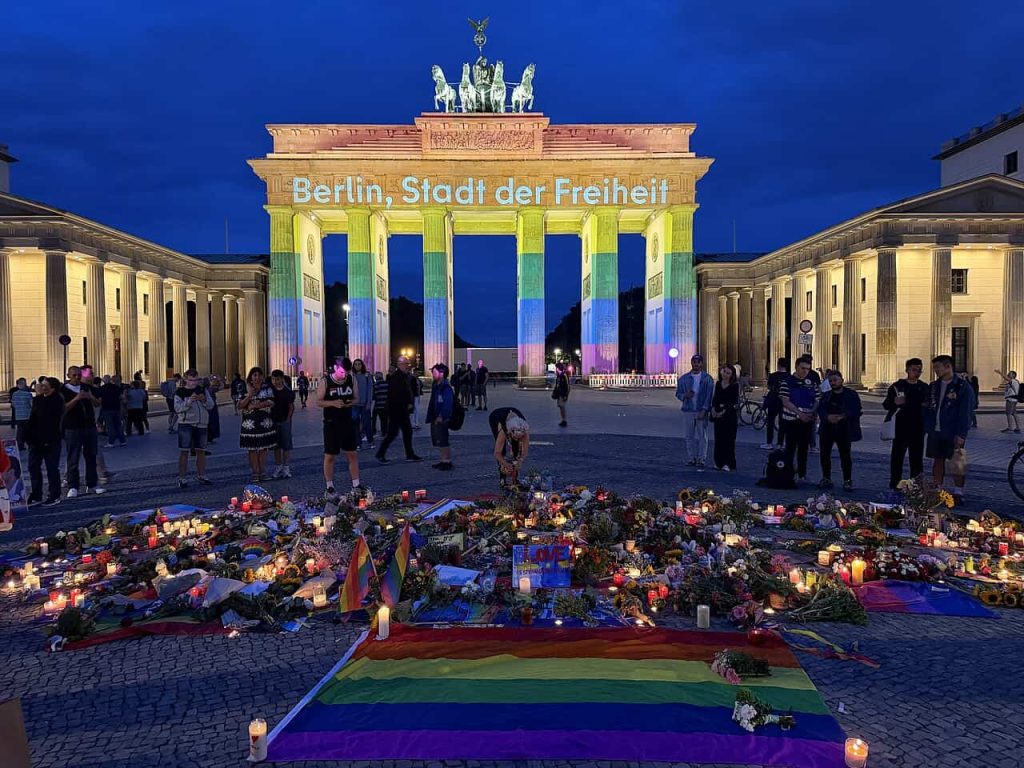
The attack on Berlin Pride on 25 July 2026 has become one of the biggest queer storylines of the twenty-first century and has made the news internationally. As a queer person of colour from Germany who has lived in many places, I had several friends from other countries check in on me the morning after. My feed was quickly filled with Berlin memes (We stand with Berlin. Love conquers hate!) and profile pics that had been changed to some kind of variation of love, hate, rainbows, and the Brandenburg Gate. In an ever-more fascist world, what happens in the city that brands itself as “Never Again” touches everyone.
In the German press, not known for its critical reflections on racism, the dominant response has been one of revenge. Journalists have loyally amplified the voices of politicians and police, who responded as they always do when confronted with spectacular violence from a non-white perpetrator, who is treated it as representative of an entire population—as opposed to a white individual who could be labelled crazy and thus as a deviation from an otherwise peaceful white norm. They called for faster, harsher sentences, especially for youth, and for deportation and denaturalization, including for those who have German citizenship only, and nowhere to go back to. Like Abdul B.
Less than 24h after the attack, Abdul B. was shot by police. His death has been widely broadcast but barely interrogated. Few ask if he needed to die, or if police should have incapacitated him first. Commentators are more obsessed with the irony that he died in the idyllic setting of a kleingarten, an ultra-German environment more properly home to white pensioners and the ancient German fonts embossed on the garden’s entrance. Given B.’s horrific actions, his death seems like a natural consequence. It seems too much to ask whether he should have had a trial or what this biggest queer story of recent times says about our much-invoked slide into fascism.
Abdul B.’s harmful actions are increasingly corroborated, not in any court but by a growing jury of journalists. Retold in intimate detail by the media, his life makes a perfect case for law and order. Born and raised in Germany, radicalized, still living with his mother and sisters, on unemployment, after odd unskilled jobs, he was on record as a gefährder (a “dangerous individual” deemed capable of committing politically motivated acts of violence and requiring surveillance). He was planning to join ISIS and received a juvenile sentence for this but was not incarcerated as the court gave him a form of probation. It is this latter fact that is riling up demands for easier punishment.
That Abdul B. was dangerous is apparent, yet we need to take a closer look at what the label gefährder does in our current climate of moral panic. Like other administrative labels such as the terrorist and the intensivtäter (chronic youth offender), the gefährder profile gives police wide-ranging power to surveil persons (and their networks) and deprive them of rights below the legal threshold, often before any crimes has yet been committed. In a recent reform of Berlin’s policing act (ASOG), police gained significant new powers over persons categorized as gefährder. These measures received public criticism and were still waiting to be tested in court. The very day of the attack, interior minister Alexander Dobrindt of the CSU party whipped out several of these measures from his drawer, interestingly without mentioning their legal origins. They include: electronic ankle monitors, preventive detention, and discontinuing probation and treatment under youth penal law for gefährder. Using the horrific attack, Dobrindt is now planning to increase the maximum length of preventive detention (again in the absence of any crime yet committed) from five days to two months, as is already the case in Bavaria. The Pride attack also gives rise to demands for increased surveillance of mosques and organizations categorized as Islamist. Surveillance is another contested measure in the policing act reform, which includes predictive policing and AI for CCTV analysis, particularly in areas defined as “high crime.” Given current debates around AI, this drew particular criticism, as high-crime areas are more often than not a euphemism for racialized areas. Ironically, the reformed act was celebrated as the first to outlaw racial profiling. Like AI itself, policing is generative and feeds itself on all that is made available—including critiques.
The Pride attack is the perfect occasion to manufacture consent for these measures. Less than a week after the Pride attack, four persons with the gefährder label were put in ankle monitors. There were vague allusions that this was due to the next big Pride in Hamburg the following weekend, which saw a doubling of police “protection.” One of the four was put in preventive detention.
This is not the first time that police and politicians have used violent events to push law-and-order agendas. State authoritarianism is increasingly coming out in its birthday suit. Stamping out youth crime (often behaviours that are categorized as developmentally appropriate in white youth but not youth of colour) has long been a staple of authoritarian agendas, whose proponents have spanned the political spectrum from right to left. In my book Queer Lovers and Hateful Others, I examine how in the early 2000s, a new figure was born, the homophobic Muslim, crafted to closely resemble existing carceral figures like the intensivtäter. Architects of the homophobic hate crime discourse took inspiration from experts of youth crime who had already found Muslim youth to be the most prone to violence due to their supposed religiosity and archaic cultural backgrounds. Not incidentally, one of the authors of the influential Pfeiffer study of youth violence, Dirk Baier, now gets to comment on Abdul B. in the media. In the same period, Muslim youth in the second and third generation of migration in particular got refigured as potential terrorist sleepers, justifying the rollback of immigration and citizenship rights and the supplanting of social-justice programs with programs to deradicalize Muslim youth. The same War on Terror allowed antisemitism and fascism to be converted from a German into a Muslim problem, rendering suspects of antisemitism, terrorism, youth crime, and homophobic hate crime basically interchangeable. In the early 2020s, this recipe for moral panicking was revamped in the reporting of riots during COVID-19 and New Year’s Eve. In 2025, Friedrich Merz of the CDU party was elected as chancellor on a platform of youth criminalization and “remigration” after targeting Arab elementary school boys, whom he branded “little pashas.” Following October 7, the German raison d’etat took hold of German schools, universities, art institutions and streets. Palestinian children and pro-Palestine youth are now officially folk devils of the nation. Again, the smallest have been the biggest targets. Education ministers across Germany, most infamously CDU politician Katharina Günther-Wünsch encouraged Berlin schools to call police on children who are pro-Palestine.
There is an unchilding happening and it has often spoken the language of queer diversity.
Youth are the prime target of invigorated calls for criminalization, remigration, and denaturalization. These trends are not aberrations from an otherwise tolerant and diversity-loving state but part and parcel of a fascistic tendency that haunts liberal democracy. This tendency cannot be reduced to far-right parties and electoral politics, yet elections remain a crucial battle ground. It is important to note that the AfD lead all the election polls and are treated as opposition-in-waiting and coalition partners. At the same time, policies and election campaigns on crime, migration, and citizenship by CDU, SPD, and Die Grüne have long mimicked and preempted those of the AfD.
The queer responses that have gained access to the German news have been more varied than during past iterations of the “Muslim homophobia” debate. Some queer contributors, oftentimes no strangers to the debate, have had no qualms in spelling out a subtext of Muslim disposability that many conservative politicians have only hinted towards. They blame intersectional queers and leftists for the attack, whose “apologism of Islamism” has empowered backward migrants and refugees to abuse “our German Welcome Culture.” The wokeness has gone too far, gotten too much power, resources, and attention, and allowed non-German homophobes who refuse “our civilizational progress” to get away with murder. Such queer perspectives, often but not always by white gay cis-men with media access, mirror broader anxieties over migration and diversity, equity and inclusion. If authoritarianism now often speaks the language of antiwokeness, it is important to note its specifically anti-intersectional cadence. We have moved beyond a simple liberal multicultural framework that pits “gays” and “migrants” as mutually exclusive and in competition over resources and recognition. The same voices who in the past had a monopoly on “the gay perspective” now feel their platforms dwindle, and present themselves as victims of queer feminists and queers of colour.
Indeed, progressive queers have also published, and publishers have taken care to solicit queer Muslim voices (a far cry from earlier years). Yet historical nuance has not been an editorial criteria, at least in newspapers and other outlets that gatekeep what can be said.
One word sums this up: “instrumentalization.” It recurs throughout the debate, sometimes along with the long-stigmatized term “homonationalism.” Its constant repetition gestures towards a history of injustice that is not, however, specified. Overall, instrumentalization remains an empty signifier—we hardly ever learn who is doing the instrumentalizing, when this all started, or what it even means. The implication is that far-right politicians are the instrumentalizers. But while the far right has been no stranger to homonationalism in Germany, it certainly was not its first architect.
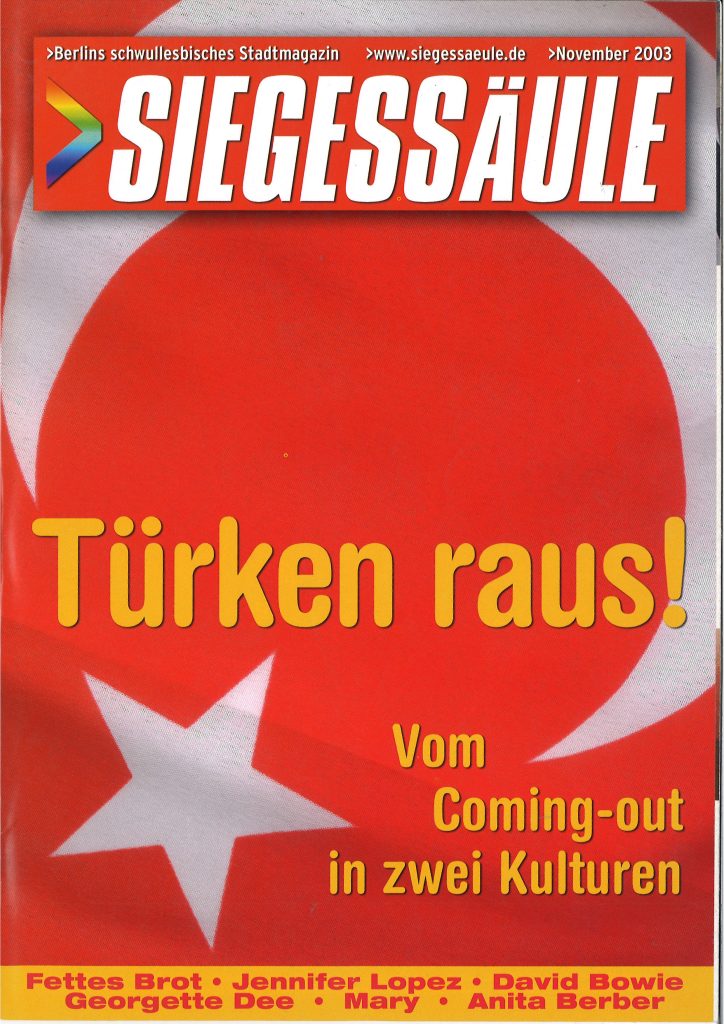
One of the contacts often forwarded as a source of grief counselling is that of the LSVD (Verband Queere Vielfalt, formerly Lesbian and Gay Association Germany). In its press release after the attack, the LSVD states “our grief cannot be instrumentalized” and “the community [should] not allow itself to be divided.” However, in the early 2000s, the LSVD was one of the midwives of a Muslim homophobia panic in Germany that treated Muslim communities as the origins of imported homophobia. The organization was not alone. Left-wing politicians and opinion makers, as well as more radical queer and trans activists, also fed the panic. Early examples included press statements by the LSVD that “migrants must clarify their relationship to homophobia”; kiss-ins staged in racialized “problem areas” by Maneo (“Berlin’s anti-violence project”); the infamous “Türken raus!” (Turks out!) issue by the queer magazine Siegessäule; a protest against a falafel and shawarma place called Habibi (under the rallying cry “Habibi ist nicht lieb”—Habibi is not lovely); demos to smash homophobia, counter hate and reclaim Kreuzberg and Neukölln by radical queer activists; a study by psychologist Bernd Simon “finding” a religious tendency of Muslim youth toward homophobia; action plans on supporting sexual diversity by Die Grüne and Die Linke; and, most iconically, the posters declaring Love Deserves Respect (in German, Turkish, and Arabic, multivalent pedagogy of Muslim unassimilability) that long covered the city. The latter were commissioned by the same LSVD that now warns of “instrumentalization.”
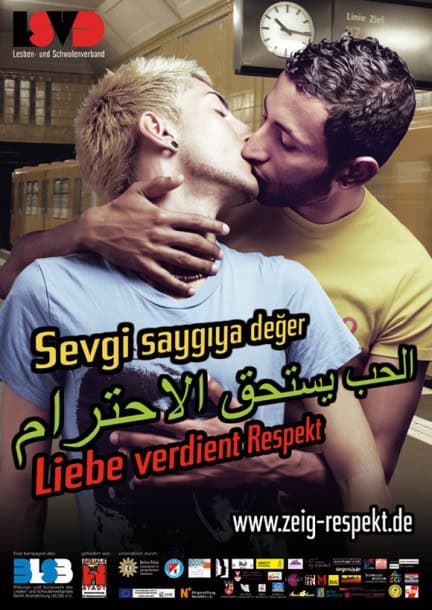
Berlin history is not short of graphically designed moral panic. In Abdul B., the panic has found an indisputable suspect after all.
The drama of queer lovers and hateful Others has long politically corrected carceral paradigms such as Pride policing and “hate crime” (both presented as key remedies after the attack, both long critiqued for rendering queers without race and class privileges, who are common targets of police violence, further vulnerable and unable to access spaces designated for queer community). It has rendered racism palatable beyond its typical constituency, and ushered into consent those who like to see themselves as on the right side of history. In the last chapter of Queer Lovers and Hateful Others, I take a tongue-in-cheek spin on childhood psychologist Winnicott’s theory of transitional objects such as teddy bears that get discarded once the child is able to fall asleep on their own. The queer lover, long the “teddy bear” of a diversity neoliberalism that desired colourful subjects while letting go of people of colour, is no longer needed to help upstanding citizens sleep peacefully amidst growing authoritarianism. In fact, since the book came out, reproductive rights, trans health care, sex education, and marriage and family have been reversed or come under attack across the world. Earlier attempts at assimilating into racial capitalism have already backfired, so feeding authoritarian forces that gleefully dehumanize all who are alien to white bourgeois cis-heteropatriarchy will not help queers now. While the losses for German LGBTQIA+ movements have been mainly symbolic and financial so far, the US precedent of homophobic and transphobic backlash could easily be adopted here.
If there’s one thing that gives hope now, it’s that many now call out the hypocrisy of German politicians who have hardly treated queers as worth anything. Examples abound, from chancellor Merz’s comments that gays are fine as long as they don’t come near him, break the law, bother children or try to become chancellor, to interior minister Dobrindt’s attempts to make a register for trans people, to education/family/senior/women/youth minister Prien’s statements that trans-inclusive language does not belong in the educational system, to Berlin mayor Wegner’s defunding of queer organizations, especially the ones serving and educating on intersections of race and sexuality, and aggression towards the other Berlin Pride, the Internationalist Queer Pride Berlin (IQPB) which, far from deserving police protection, is brutally punished every year for its support of Palestine.
Yet this is not simply a moment for noticing contradiction. It is a moment for shouting: The emperor wears no clothes! The teddy bear has already been thrown out. Continuing to cuddle up to these authoritarian forces will only hasten our demise. We need to come up with ways that keep all of us safe.