The term “terraforming warfare”, combines the latin word terra (“earth” or “land”) with forming, referring to the process of re-shaping or “reconstructing” the land.
It is basically part of the environmental warfare that describes the deliberate destruction, exploitation, or manipulation of the natural environment as a military strategy aimed at weakening a population by destroying the resources essential to its immediate survival and long-term existence.
In the case of Gaza and the occupied Palestinian territories, the relationship between military domination, territorial control, and the management of water resources represents a striking example of this form of warfare.
The destruction of this productive landscape is not merely a consequence of armed conflict; it is also about controlling the very conditions that make life possible. According to Shourideh C. Molavi in ‘’Environmental Warfare in Gaza: Colonial Violence and New Landscapes of Resistance’’ the expansion of military buffer zones, restrictions on access to farmland, the destruction of greenhouses, and the uprooting of orchards have transformed large areas into controlled, non-productive spaces.
Research conducted by Forensic Architecture has documented how the so-called “buffer zone” along Gaza’s border gradually expanded over the years, significantly restricting Palestinian access to agricultural land. In this context, the destruction of farmland functions not only as a military measure but also as a mechanism of economic dependency and social control.
From the Destruction of Land to the Destruction of the Ecosystem
Following the attacks of 7 October 2023 and the extensive Israeli military campaign in Gaza, environmental devastation reached unprecedented levels. Vast portions of the built environment have been destroyed, together with water supply systems, sewage networks, wastewater treatment facilities, and agricultural infrastructure.
The war has also generated enormous quantities of debris and hazardous waste. The rubble contains dangerous materials such as asbestos and chemical contaminants, while the destruction of sewage infrastructure has resulted in large volumes of untreated wastewater being discharged into the Mediterranean Sea. During certain periods, scientific reports documented the release of tens of thousands of cubic metres of untreated sewage into the sea on an almost daily basis. Epidemiologist Ahlam Abuawad stated in 2025 that the debris also contains approximately 800,000 tonnes of asbestos and other hazardous materials, posing significant risks to both the immediate health of residents and the surrounding environment.
Moreover, according to Reuters (2024), it is estimated that it would take approximately 14 years, using 100 trucks, to remove the unexploded ordnance from the affected areas.
The extensive use of explosives, munitions, and military vehicles has left a long-term environmental footprint on both soil and groundwater. Pollution from heavy metals, fuels, and chemical substances may persist for decades, affecting biodiversity, agricultural productivity, and public health. Mazin B. Qumsiyeh (2024) describes the war in Gaza as an environmental catastrophe in his article “Impact of Israeli Military Activities on the Environment.”
Terraforming Warfare: Reshaping the Land as a Strategy of War
The concept of “terraforming warfare“ refers to the systematic transformation of a territory through the destruction of its natural and social infrastructure. It extends beyond military conquest to encompass the deliberate alteration of the environmental conditions that enable a population to survive.
In Gaza, the destruction of water treatment facilities, sewage systems, waste-management infrastructure, and agricultural areas has been described as a key element of a strategy that undermines the Palestinian people’s capacity for recovery and long-term reconstruction in any possible way. Consequently, many scholars also employ the concept of ecocide to describe the extensive and long-term destruction of ecosystems.
The natural environment is therefore not merely another casualty of war; it becomes a battlefield in itself.
It is worth noting that these concepts have historically been recurring features of colonial systems of occupation. Throughout history, humanity has repeatedly witnessed extreme forms of violence, exploitation, and environmental destruction associated with colonial domination, often amounting to atrocities and war crimes.
“Making the Desert Bloom” and the Myth of the Barren Land
The slogan “Making the Desert Bloom” has long been central to Zionist nation-building narratives. According to this narrative, the land is portrayed as neglected, uncultivated, and barren prior to Jewish settlement, with the settlers presented as the agents responsible for its revival and development.
Historically, however, this portrayal is highly contested. Palestine formed part of the Fertile Crescent, one of the world’s earliest centres of agriculture, where ancient civilizations emerged precisely because of fertile soils and abundant water resources.
The scientific article ‘’Damage to and Destruction of the Natural Environment: Terraforming Warfare in Gaza and Accountability for Ecocentric Crimes” and other publications have used the term “ecocide” to describe the extensive environmental destruction, identifying pollution as a major driver of severe impacts on Gaza’s ecosystems and biodiversity.
By examining and observing this condition, the implementation of the desertification of Gaza can be interpreted as aligning with a central pillar of Zionist ideology — a biblical narrative that imagines the Jewish population transforming a barren, lifeless land into the Holy Land. This ideology, which is highly contested in relation to historical realities and developments, is based on the image of arriving in an entirely empty, “ghost” land with the purpose of reviving and restoring it. This idea forms the core of the Zionist vision of “Making the Desert Bloom”, a phrase rooted in the biblical passage of Isaiah 35:1:
“ The desert and the parched land will be glad;
the wilderness will rejoice
and blossom like the lily.”
Contrary to that narrative – which remains deeply embedded in the national narrative and which is often promoted in Israeli and Zionist public socio-political discourse, Palestine has never been a barren desert.
The fertility of the land has always been inseparable from a people’s ability to sustain political and economic autonomy. Consequently, control over land and water is not merely an economic issue but a fundamental question of sovereignty and political power.
Water as an Instrument of Power
Water resources lie at the heart of the Israeli-Palestinian conflict. Following the Six-Day War in 1967, control over the water resources of both the West Bank and Gaza came under Israeli military administration. Although Israel possesses agricultural lands beyond the framework of violent appropriation, the agricultural foundation of the Israeli state has been shaped in significant part by cultivated lands taken from Palestinian refugees through processes of dispossession, displacement, and the aftermath of their forced expulsion.
Military Order 158 required Palestinians to obtain Israeli permits before drilling new wells or constructing water infrastructure, substantially limiting their capacity to manage their own natural resources.
The principal groundwater source in the West Bank is the Mountain Aquifer, replenished primarily by rainfall. Unequal access to this shared resource has long been a central point of contention. Studies by international organizations have documented significant disparities in water consumption between Israeli settlers and the Palestinian population.
According to available data, excessive groundwater extraction not only reduces the availability of drinking water but can also lead to a permanent decline in groundwater levels.
Gaza’s Water Crisis
Long before the events of October 2023, Gaza was already facing a severe water crisis.
The issue of unequal water distribution and the lack of access to water in the occupied Palestinian territories has also been highlighted by the United Nations Development Programme (UNDP). According to UNDP reports, Israeli citizens consume significantly more water than the Palestinian population, with estimates indicating that Israelis consume approximately nine times more water, a disparity that remains disproportionate even when considering the number of settlers.
According to Eyad Yaqoub (2023) in ‘’The Handbook of Environmental Chemistry’’, which examines the drinking water crisis from 1948 to 2023, the primary management and control of water resources in the occupied territories of Gaza and the West Bank remain under external control, estimated at approximately 79%. Furthermore, Amnesty International has reported that, prior to 2009, around 450,000 Israeli settlers in the West Bank consumed an equal or greater amount of water compared to the Palestinian population, which numbered approximately 2.3 million people.
Over-extraction has also affected groundwater reserves. Furthermore, over-extraction by Israeli authorities in the region has contributed to the degradation of these aquifer systems. This issue has also been publicly acknowledged by representatives of the Israeli state. On 26 November 2008, during a public announcement in Jerusalem, the head of the Israeli Water Authority stated that excessive pumping over the previous five years (2003–2008) had caused damage that had become “irreversible.”
Years of over-extraction, combined with seawater intrusion into the coastal aquifer, have rendered most groundwater unsuitable for drinking or domestic use.
Moreover, in 2005, the Palestinian Water Authority (PWA) reported the operation of 328 wells in the area, compared to 774 wells in 1967. Due to the region’s geomorphological characteristics and the local population’s adaptation to its environment, Palestinians historically constructed wells for agricultural and domestic use. Israeli settlers also developed wells, often only a few hundred meters away from Palestinian wells. As a result of excessive groundwater extraction, water levels declined by approximately two meters per year, while salinity levels also increased.
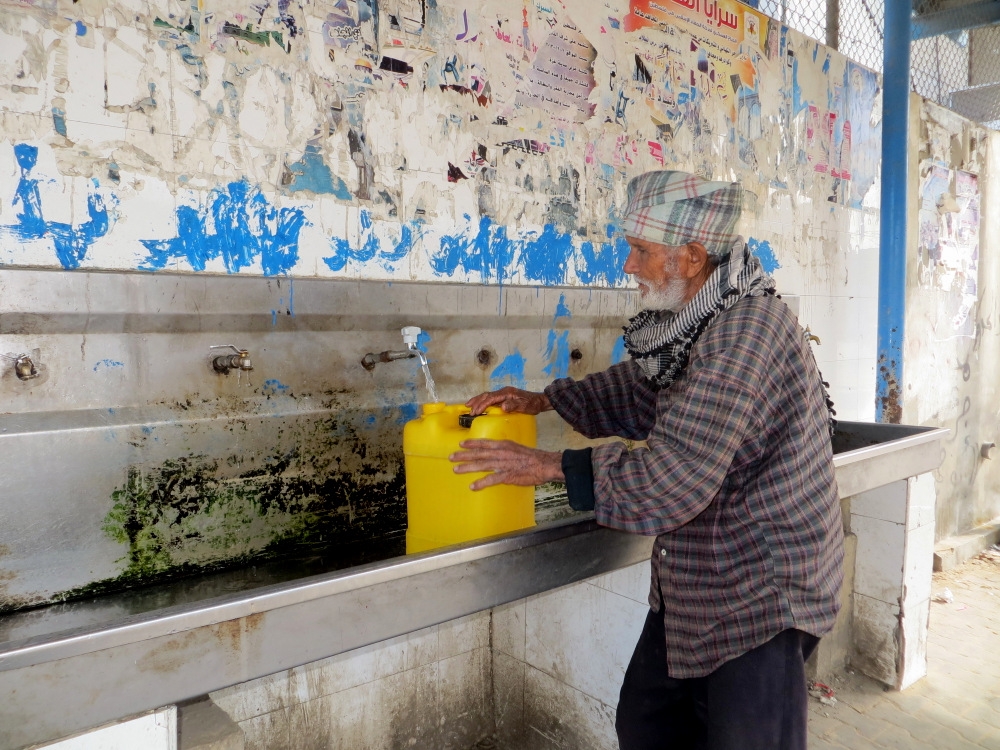
In summary, what can we understand from these clues is that the destruction of water infrastructure, restrictions on repairs, and dependence on water delivered by tanker trucks have further deepened this crisis. Water, a fundamental human right, has increasingly become a mechanism of dependency and control under the conditions of occupation.
International Law and Environmental Destruction
International Humanitarian Law recognises the need to protect the environment during armed conflict.
The 1976 ENMOD Convention prohibits the military or hostile use of environmental modification techniques. More specifically, the 1976 United Nations Convention on the Prohibition of Military or Any Other Hostile Use of Environmental Modification Techniques, establishes specific criteria that must be met in order for a violation to occur. The first criterion concerns widespread environmental modification, intervention, or destruction, while the second relates to the long-term effects of such actions. These conditions must be fulfilled cumulatively in order to constitute a violation under the Convention.
The use of white phosphorus, the destruction of water infrastructure, soil contamination, and widespread ecosystem degradation are all matters that warrant thorough international investigation. Such investigations should not remain merely symbolic or declaratory; they must be capable of producing meaningful legal accountability, even if delayed.
The Garden of Eden or the Graveyard of Eden?
The environmental destruction of Gaza is not simply about the loss of buildings or infrastructure. It concerns the destruction of the very conditions that make collective life possible. Land, water, and biodiversity form the foundations of any society. Once these are destroyed, the consequences extend far beyond the present conflict, affecting future generations for decades to come.
What was once symbolically imagined as a Garden of Eden—a fertile and life-sustaining landscape—has increasingly become a place of profound human and ecological devastation.
The struggle of the Palestinian people and the people close to the region demonstrate a profound aspiration for freedom, justice, and self-determination. With admirable resilience and determination, they defend their right to life, independence, and the ability to decide their own future and shape their own path. that societies subjected to such profound destruction often develop extraordinary forms of resistance. These forms of resilience deserve not only admiration but also careful scholarly examination. Collective trauma may endure for generations, shaping societies politically, psychologically, biologically, and culturally.
Environmental warfare remains a fundamental component of colonial domination, as history has repeatedly demonstrated. Equally significant is the responsibility borne by those who remain indifferent to the environmental consequences of the occupation, consequences that undermine not only the possibility of present survival but also the long-term prospects for ecological recovery, autonomy, and sustainable life.
Yet there is something enduring about the relationship between people and the land they inhabit—a truth that transcends all nations and cultures. Across centuries, what we call collective memory continues to flourish, rooted in deeply human bonds that are extraordinarily difficult to erase or uproot.
All factual information presented in this article is based on publicly available research, reports, and publications produced by recognised academic institutions and international organisations.