The sky is overcast. An intermittent wind moves through, dropping the felt temperature below the 20 degrees Celsius the thermometer records. The outdoor pool at the foot of the big stairs still holds its bright blue hue. A small boy launches himself out of the water and runs toward the stairs. “Papa, es ist kalt,” he yelps, shivering. His father, a young man in a wet swimsuit, drapes a hoodie-towel around him. He is also shivering. The boy sings and dances to “Macarena.” After his father lowers himself onto a step, he climbs onto his lap. They watch the blue water quietly for a moment. Then the father takes to his feet, peels off his wet swimsuit, and rummages through a pile of towels and clothes until he finds his underwear. He dresses without a particular self-consciousness, naked in public space, as one simply does here especially when it is sparsely populated. The boy layers up beside him. They walk away together, each carrying a bag and a pair of sports shoes, their feet leaving damp prints on the terracotta tiles. (Field notes, June 7, 2026)
Across four summers of ethnographic research at Berlin’s outdoor public pools located in neighborhoods with sizeable Middle Eastern communities, I witnessed dozens of affective scenes like this one. Moments in which unceremonious intimacy and easy bonding register something not merely personal, but also deeply cultural. This is how childhood memories are made on days like this, at a site like Freibad: inconspicuously, almost effortlessly, quietly accumulating into something elemental and lasting. From a sociological perspective, the pool is a space sheltered from the excesses of commercialism and overt commodification, a part of public infrastructure. Yet the pool also functions beyond its materiality as affective infrastructure, like a reservoir for shared feelings and fond memories. It hardly comes as a surprise then to grasp how the Freibad has come to occupy one of the quintessential sites of nostalgia in Germany. At the pool, it is not uncommon to overhear millennials casually remarking “childhood memories unlocked” while taking a bite of ice cream, or to encounter television crews interviewing visitors about the nostalgic tastes and sensations the pool stirs in them.
This nostalgia for carefree summers and a bygone past has been compounded by attachments to a postwar social world that, from the present, feels increasingly remote. The history of Freibad extends far back, but the institution is closely associated with Germany’s postwar decades in both East and West, when recreational infrastructure expanded as part of broader public investment. In the West, the Freibad served as a spatial expression of the social-democratic compact. In the socialist East, it embodied the promise that public resources would be directed toward shared leisure. In the Federal Republic, public pools offered a summer refuge for those who could not afford holidays abroad. In the GDR, they provided a bounded form of freedom for citizens legally prohibited from traveling beyond the country’s borders. As one lifeguard born and raised in the GDR told me, “The Freibad was our freedom.”
Now that the golden age of economic expansion and the strong yet conservative welfare state regime is widely understood to be over, pool numbers decline as municipal budgets contract. Nostalgia has, in some quarters, curdled. Political actors such as the AfD have folded it into an ethnonationalist backlash, harkening back to a past of ethnic homogeneity. One hears with uncomfortable regularity, in news coverage and informal conversation, the complaint that the pools have been taken over by “Middle Eastern people” or “Arab boys,” who cause security problems or commit sexual assaults. Yet, despite all of this, approximately six thousand pools remain across the country, roughly half of them outdoor Freibäder.
***
At a time when nostalgia for Freibad takes on new political valences in contemporary Germany, nostalgia for swimming pools is explicitly contested in another country, South Africa. A cultural marker of the racial segregation of the apartheid era, outdoor pools, along with beaches, were reserved for white use, their racial exclusivity enforced by the apartheid regime. The post-apartheid era saw profound transformations in society, changing the aquatic commons and their frequenters. In a 2009 documentary, “Sea Point Days,” director François Verster explores new pool scene shaped by the legacies of apartheid. It offers glimpses into the famous Sea Point Pavillion pool, right by the ocean, at the heart of Cape Town. Youngsters jump in the water, cashiers let visitors in, aging white residents long for old South Africa, some white politicians complain about the alarming security issues in the city. What slowly emerges is a reflective question Verster asks: What does it mean to be nostalgic about a past defined by racial segregation? The documentary, in an intimate and yet dispassionate way, asks whether white settler-colonial subjects, like the director himself, possess any legitimate claim to nostalgia about lands that were never theirs, and whose pleasures were purchased through the dispossession of others.
The question of how to relate to a violent history defines Germany’s postwar engagement with the project known as Vergangenheitsbewältigung, or working through the past. It began with Karl Jaspers’s 1946 lectures on the dimensions of German guilt, and developed through successive decades of public reckoning, legal process, memorial construction, and educational curricula. This project produced a distinctive moral-political culture in which the acknowledgement of historical responsibility was positioned as a precondition for legitimate civic and political life.
However, when Holocaust memory pleas are extended beyond ethnic Germans to immigrant populations, particularly those of Turkish and Middle Eastern backgrounds, ethno-racial erasures underlying memory culture come sharply into view. As Esra Özyürek argued in her Subcontractors of Guilt, the capacity to demonstrate an appropriate relationship to the Holocaust has increasingly functioned as a form of cultural citizenship test. It is a criterion by which the authenticity of immigrants’ Germanness is assessed. This dynamic has acquired a particular intensity in the context of German responses to the war in Gaza. The Staatsräson articulated at the level of official state policy to support Israel’s security constitutes a foundational principle of German foreign policy. It has meant that criticism of Israeli state violence is recognized as evidence of antisemitism. For Middle Eastern people living in Germany, the implication is almost unequivocal, they become suspects.
***
On that chilly summer day, Middle Eastern communities are largely absent from the pool. This is consistent with what I have observed on other visits and with what people have told me directly, the water is too cold for them. On a day like this, at the far end of the grounds, two security guards lie on a table tennis table, checking their phones. Today, there is not much for them to surveil. The security measures at the pool are quite recent, introduced in July 2023 by Berlin’s municipal pool authority (Berliner Bäder-Betriebe, BBB) following an incident at Columbiabad in Neukölln that was heavily sensationalized by the media. The episode, framed as unrest, was attributed to “young men from Arab families” who had violated the rules and “acted as a mob.” Since then, ID checks have been introduced at entry points, security personnel increased across Berlin’s pools, and video surveillance expanded across four specific pools. For people like me, a passport is the only valid form of identification for entry, a requirement that has led some to consider public pools as “internal borders.”
Security tasks are outsourced to private companies, which experienced a boom following the large migration wave of summer 2015. At the pool, it is mostly, if not exclusively, young migrant and asylum-seeking men from Middle Eastern countries who are employed as precarious security workers. They check everyone for their IDs, but they also surveil the very demographic group they belong to, members of which are seen as a potential threat. I have witnessed on multiple occasions security staff denying entry to groups of young men who appear to be Middle Eastern or South Asian, saying “we are full today” or “it’s family day today.” What the pool’s security design seems to offer to young Middle Eastern men is incorporation into security logic—either as suspects or as precarious security providers. When summer season ends, many seasonal security workers at the pool are rotated across shopping malls, night-time ATM surveillance, or to Heim, the temporary residential complexes accommodating asylum seekers awaiting processing of their refugee status applications.
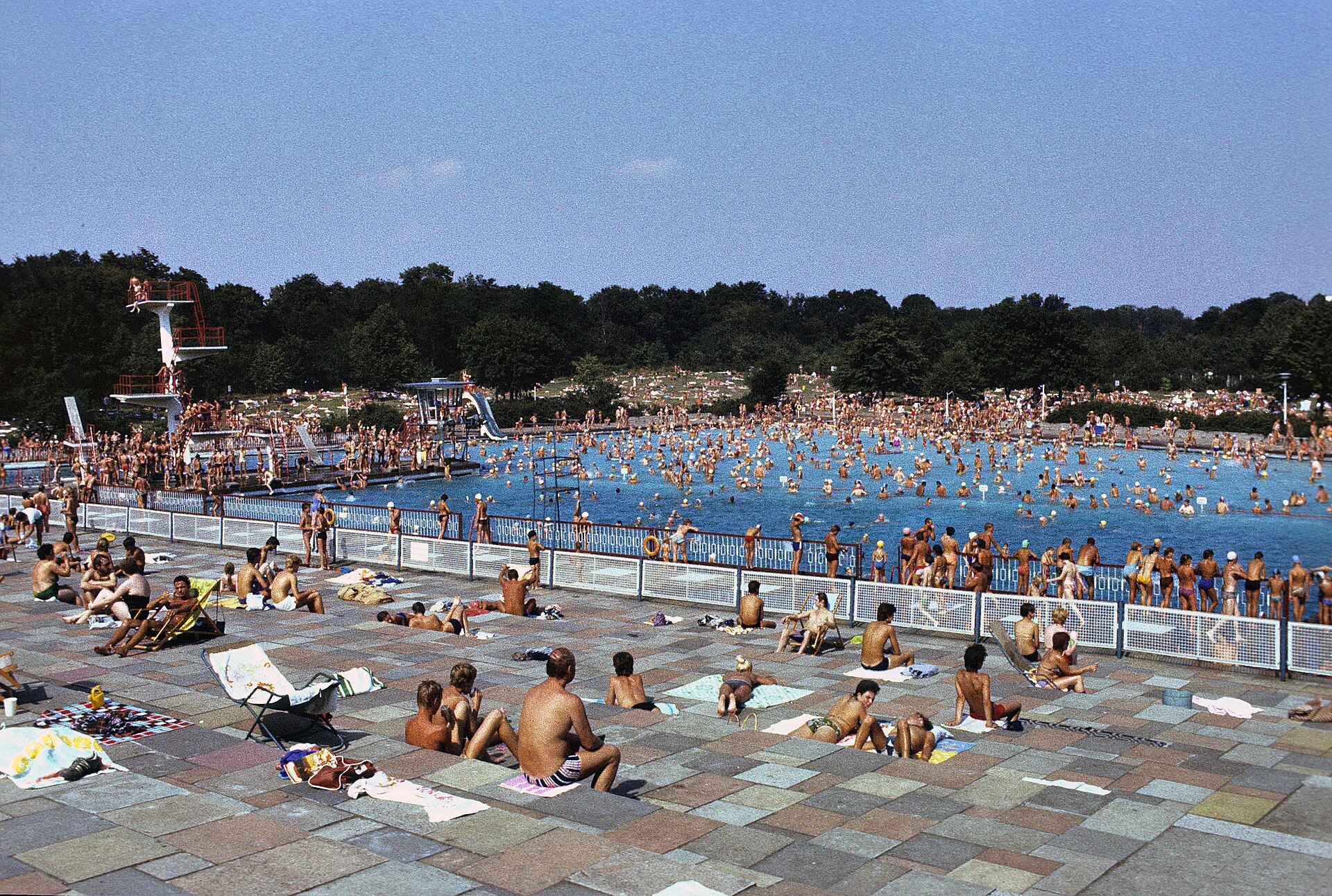
The pool as a media object and the pool as an ethnographic site are completely different places. What my ethnographic fieldwork reveals is a vision described by many visitors as “Freibad as a world in itself, a microcosm.” It is a vision that encompasses a father and son watching the water in silence; seasonal security workers with Al-Aqsa Mosque images on their phone screens checking the IDs of visitors at the entrance; Middle Eastern families unable to travel due to war sharing a picnic around the poolside; young asylum seekers awaiting decisions on their applications, stretched out on terracotta tiles. It is a vision in which the collective mood collapses entirely when an announcement is made that the French fries have sold out at three in the afternoon on a hot Saturday; in which teenagers hurl themselves into the water a thousand times over, pushing one another in a mixture of excitement and fear of being banned from the premises (Hausverbot). It is a vision in which the bikini and the burkini smoothly coexist. One in which social divides persist, with large Middle Eastern families congregating around the children’s pool, while queer communities and younger visitors occupy a different corner of the grounds. It includes conflicts that surface and are resolved face to face. It includes the unrecognized labor of pool employees managing disputes on site, working longer hours during heat waves, mindfully withholding information from media outlets eager to sensationalize. Pool employees overwhelmed with work, jumping into the water at the end of a long shift. People who lost their jobs to AI and found a new beginning as lifeguards. A woman who had hip surgery gazing at the water with melancholy, fearing she might never swim again. The pools are, in this sense, popular Wimmelbilder, those crowded, panoramic pictures in which a multiplicity of figures cohabit a shared spatial universe where everyone is doing something and no single story dominates. They are vibrant sites of social intimacy and of public happiness.
***
The notion of public happiness insists on the public character of happiness, which flourishes in non-commercial, non-securitized public spaces. They are spaces of diversity where people engage in unforced social intimacy and where no single person holds sovereign authority. Public happiness is a shared mood and sense of belonging that emerges from open, convivial interactions among diverse people, undominated by market or state power. It is animated by mutual respect, spontaneity, and egalitarian social rhythms. Happiness, in this framing, does not mean the absence of conflict or tension but develops alongside conflict-resolution methods that resist the logic of securitization. And if public happiness has a spatial register, the Freibad is its quintessential expression.
Matthias Lilienthal, the new director of the Volksbühne, one of Berlin’s political theatres, seems to sense exactly this. On August 7th, his team opens a Volksbad, a pool with no identity requirement, conceived explicitly as an inclusive public space. It is a protest, but even more importantly, it is a proposition, namely that the pool belongs to everyone, and that belonging is not something to be verified at the gate. The Freibad, framed this way, is not a monument to a bygone past but a clear reminder of what it remains today and a rehearsal of what it should be in the future. Something seems to be genuinely at stake in that shift from nostalgia to public happiness, a shift that brings the Freibad into focus. Not as a repository of the past but as a horizon of possibility, a reminder that other forms of collective life remain imaginable. Friederike Kötter and Anna Yeboah, who jointly lead the artistic project management of the Volksbad, described more modest ambitions when I spoke with them. For them, the project is a simple public gesture in a city where public infrastructure has been systematically eroded over recent decades, and where public spaces are increasingly commercialized, surveilled, and controlled.
The Volksbad is not the only intervention in Berlin’s pool landscape in recent years. When heightened security measures were first introduced, protests were organized at certain pools, an online petition titled Freibad für Alle gathered support, and political parties such as Die Linke launched campaigns advocating for more affordable access to public pools. Taken together, these initiatives can be understood as efforts to defend and expand the public pool spaces, where the everyday practice of sharing space with others becomes an experiment in community building and collective belonging.
To criticize the securitization of pools and the erosion of public infrastructure is therefore to defend more than the right to public space. It is to defend the possibility of public happiness, the tangible experience of sharing space, leisure, and ordinary pleasures with strangers. In the United States, the unfolding hollowing out of public life, alongside the decline of public institutions and spaces, offers a cautionary lesson. It reminds us that places such as public pools matter not because they are extraordinary, but because they make public happiness possible in ordinary and recurring ways. And in Freibad, despite its recent securitization, the pursuit of happiness in mundanely collective ways is not an aspiration at all, it is already a lived reality.