The Left Berlin News & Comment

This is the archive template

Banning the AfD targets a symptom, not the cause

Banning the AfD targets a symptom, not the cause


06/09/2025

Translation of the original article „Ein AfD-Verbot bekämpft ein Symptom, aber keine Ursache” by Sebastian Friedrich. Translated by Ciara Bowen.

Since the party’s founding, the left have debated how best to handle Alternative für Deutschland (Alternative for Germany, AfD), the first party to have successfully gained ground with the more right-leaning faction of the so-called “Union” of the Christlich Demokratische Union Deutschlands (Christian Democratic Union of Germany, CDU) and the Christlich-Soziale Union in Bayern (Christian Social Union of Bavaria, CSU). Neither broad or narrow coalitions against the right, blockades, discussion or lack thereof, Alexander Gauland having his clothes stolen, or East German identity politics have caused the AfD any lasting harm. In fact, current opinion polls show that between 23% and 25% of the public support them—they have continued to see substantial growth since their record result in the parliamentary elections.

Given the current circumstances, another strategy is clearly needed. Over the last two years, both left-wing and liberal circles have discussed a potential AfD ban. At their latest party conference, the Sozialdemokratische Partei Deutschlands (Social Democratic Party of Germany, SPD) voted to begin laying the foundations for a ban—and once the Bundesverfassungsschutz (German domestic intelligence service, BfV) officially updates its classification of the AfD, legally recognising it as “definitely right-wing extremist”, the call for a ban will likely gain significant traction. 

There are good reasons for the ban—the AfD has become drastically more right-wing since its founding. Political actors such as Björn Höcke in Thuringia, Hans-Christoph Berndt in Brandenburg or Matthias Helferich in Dortmund, as well as AfD-affiliated thinkers like Götz Kubitschek or Benedikt Kaiser, want more than just a marginally more right-wing, neoliberal version of the establishment. They seek a state and a society which is fundamentally different, authoritarian, unequal, and fulfilling the ethno-nationalistic fantasies of complete ethno-cultural homogeneity. The shadow of Nazi rule leads many to think that it is better to prematurely use every preventative method at our disposal, before it is too late.

The debate rages on. From a leftist perspective, is banning the party a sensible demand? And, anticipating the question: a clear yes seems just as impossible as a clear no. 

Could a ban actually work?

The first question is whether the AfD is a party that could indeed be banned. For many on the left, this goes without saying—for them, the AfD has long been Björn Höcke’s party at its core, dominated by right-wing radicals and even Neo-Nazis. However, characterising the AfD as such does not take internal opposition into account. While the AfD has undoubtedly radicalised and is especially extreme in comparison to other right-wing parties in Europe, there are those in the party who, despite this, see the party as continuing in the tradition of the national conservative wing of the old Union. 

Shifting towards the centre-right has been disparaged within the AfD as “Melonisation” (referencing Giorgia Meloni), but in recent months, talking points which had previously divided the fascist strand from the parliament-oriented wing have seen a certain convergence towards the centre. For instance, pro-Russia voices are quieter, while pro-West forces and those who emphasise a strong Europe are gaining influence. There are also indications that people such as  Maximilian Krah, member of the Bundestag, are distancing themselves from openly völkisch (ethno-nationalist) thinking. These developments, and the subsequent debates amongst the party and its supporters, are a direct result of calls to ban the party, as well as its imminent classification by the BfV as “definitely right-wing extremist”.

On the one hand, it could be assumed that debating a ban would, in itself, cause the party sufficient unease. On the other hand, we must consider that even the most recent attempts to soften the party’s image, by Krah or by party leaders, would be taken into account in the assessment by the Bundesverssaungsgerichts (Federal Constitutional Court, BverfG) — and it is this body who would decide whether or not to ban the party. The louder the voices of Krah and his ilk, the stronger the legal argument that the AfD is not an entirely ethno-nationalist party, grows. 

“Defensive democracy, which will be leveraged in the fight against the AfD, is based on extremism theory. (…) Formally, these rules target “all extremists”, not just those on the right.”

Even without this political shift to the centre, it is doubtful whether there would be conclusive proof of the AfD being unconstitutional. In their manifesto the party hardly strays from the Freie Demokratische Partei (Free Democratic Party, FDP) or the right-wing margins of the Union in their stances on sociopolitical issues, economical issues or immigration. Lawyers disagree about how the proceedings will play out, but those in favour must ask themselves, what would happen if the AfD survived the attempt to ban their party?

In this case, they would be confirmed as being constitutional, which would amount to political acquittal. This would have serious consequences. In the Union there have long been certain voices, mostly from eastern German national associations, urging for cooperation with the AfD, or at least encouraging the normalisation of dealing with the party. The dividing lines run less along substantive than formal differences. As long as the AfD is considered unconstitutional, cooperation with the “state-supporting” Union parties is practically unthinkable. A ruling by the Bundesverfassungsgerichts in favour of the AfD could change that in an instant, making such a collaboration only a matter of time. The parliamentary normalisation of the AfD would happen virtually overnight.

However, even if the ban is successful, the question remains as to how sustainable the fight against socially entrenched right-wing extremism really is. Alternative für Deutschland answers a call that began before they were founded. Studies vary, but social, political and educational sciences have assumed for decades that between a fifth and a quarter of the population hold firmly radical right-wing opinions. 

The strongest argument in favour of a ban is that it would severely disrupt the organised far-right’s formation process. After years of internal conflict and painstaking network building, a new political project would have to be established—but it runs the risk of simply being banned once again. 

However, historical examples show that banning a political party rarely works in the long-term. Twelve years after the ban of the Sozialistischen Reichspartei (Socialist Reich Party, SRP), the unmistakable reincarnation of the Nazi party, the Nationaldemokratische Partei Deutschlands (NPD) was formed. Similarly, twelve years after the Kommunistische Partei Deutschlands (Communist Party of Germany, KPD) was banned, came the Deutsche Kommunistische Partei (German Communist Party, DKP). Nowadays, thanks to more efficient means of communication, parties would be reformed even sooner.

A ban would indeed set the process back, but would likely not stop it completely. In Bremen in 2023, it became apparent just how fast this shift can happen—because the AfD were not allowed to run, the Bürger in Wut (Citizens in Rage) party reached almost 10% of the vote. Also Bündnis Deutschland (Alliance Germany), WerteUnion (Values Union) or Wir Bürger (We Citizens) are also on standby to fill the gap left by the AfD.

Beware of state anti-fascism

Additionally, a successful ban would be the most radical disruption of our so-called defensive democracy in its history. Leftists have historically been outspoken critics of the repression that accompanies state militancy, such as bans, surveillance by intelligence services and intimidation. This is for good reason—not least because during the Cold War, Neo-Nazis and communists alike were equally considered ‘enemies of the constitution’. Such fundamental criticism of concepts like ‘defensive democracy’, ‘enemy of the constitution’ and ‘defense of the constitution’ has become much quieter in recent years. 

This comes at a time when the much-invoked sharp sword of party banning finds a target with a much larger voter base than the SRP or the KPD had in the 1950s. Also notable is that more people are against a ban than in favour of it: a majority of the population, 52% according to a current poll by the Allensbach Institute, oppose a ban, while only 27% are supportive. Were the AfD to be banned, there is a risk that democracy would change overnight: the Damocles’ sword of party prohibition would hang over all who did not unequivocally support the status quo, and leftists forces who want to defeat capitalism could be more intensely scrutinised. The question of how much critique of the system is allowed would have a greater impact on political practice than it does today, for the right as well as the left. 

“(…) we know now that the KPD ban in 1956 served to legitimise the banning of the SRP.”

Yet this is not just an abstract threat—an AfD ban could also be used symbolically to ramp up repression of the radical left. Calls to ban “Antifa” stem not just from the AfD, but from the Union parties as well. Of course, there is no national German Antifa organisation, but rather symbols, local groups and networks, that a Bundesinnenminister (Federal Minister of the Interior) could outlaw. In the past, a ban of the Rote Hilfe (Red Aid) was also discussed; by the same token, the scope for structures like Interventionistische Linke (Interventionist Left) could narrow drastically. A look back at history shows that such a scenario has not been plucked out of thin air: we know now that the KPD ban in 1956 served to legitimise the banning of the SRP. 

This is also due to the internal logic of so-called state anti-fascism, that is often overlooked in leftist debate. Defensive democracy, which will be leveraged in the fight against the AfD, is based on extremism theory. This is reflected in regulations such as checks on civil servants’ allegiance to the constitution, or new rules for officials and state employees, as happened in Rheinland-Pflaz, where AfD members are now excluded from civil service positions. Formally, these rules target “all extremists”, not just those on the right. Therefore, the left could also be subject to the current tightening of restrictions. This is not a theoretical danger—rather, it is a reality, as proven by well-known instances of professional bans, such as the case of teaching student Lisa Poettinger in Bayern.

Some refer to the BVerfG’s ruling in the second NPD ban, which distilled the Freiheitliche Demokratische Grundordnung (the liberal democratic basic order, FDGO) of the German constitution into three core principles: democracy, rule of law and human dignity. Most leftists likely have no problem with this order, yet these concepts are malleable—could criticising capitalism or promoting a socialist society constitute an attack on this basic law?

Moreover, it remains unclear how the authorities will apply the new FDGO criteria. Even after the NPD ruling, leftists were still kept under surveillance; professional bans were still imposed; groups were still criminalised. Banning the AfD could reinforce this tendency. After all, what government wants to be accused of being “blind in the left eye”—that is, of downplaying or ignoring possible left-wing extremism?

Tackling the root of the problem 

It is difficult to determine whether the left should support the commencement of ban proceedings. The pros and cons must be considered, but first and foremost it comes down to fundamental, strategic questions: is the AfD on the brink of power? Is there a threat of the party reintroducing a form of the Ermächtigungsgesetz, the Enabling Act of 1933, thereby undermining democracy? Is another authoritarian state the goal, and if so, is it realistic?

Last but not least, the discussion about the right way to handle the AfD eventually leads us to consider the point of attack: should the symptom, the AfD itself, be the focus, or should we instead prioritise the social, economic and political causes that enabled the rise of such a party? Although hardly anyone expects a ban alone to stop the right, the question of priority is crucial—is the left primarily fighting against what this society creates, or fighting for a society that no longer engenders right-wing ideologies?

Banning the party may alleviate the symptoms, but the cause remains: capitalism will be in crisis and the allure of authoritarianism will be heightened as long as there is no viable alternative. The practical, technical approach of banning the AfD, in order to set them back a few years, may seem tempting given the left’s weaknesses. However, those in favour of pursuing it must also consider the possible side effects of such a move.

The sound of death and the white cat

Short story of survival, grief, and the fragile hope a boy shares with his cat

A white cat laying on stone

This is the second of a series of creative fiction pieces featuring voices from Gaza.

It was never easy to hear the sound of death and remain strong, as I always tried to be. The sound of death hisses like a serpent; it coils around your soul in terror simply by existing. I know snakes well, but seeing them fly through the sky is a horror I never imagined.

The war began, and my strength began to unravel. Death’s whistle echoed through the streets, chilling to the bone. I pretended to be brave so my children could feel safe. But it was never real safety—only counterfeit courage, the only fragile shield we had. I didn’t want my children to die a thousand times from fear.

You can see death, but I had never heard it until the fiftieth day of this war. I remember it vividly. A missile hissed overhead before crashing into my kind neighbors’ home. They died without ever hearing it. They died once, but we died twice: once from the sound, once from the fear.

When the noise faded, I saw my little boy running in all directions, panic written across his face. I knew what he was searching for. His fear for his things mirrored my fear for mine—my children. His cat was his treasure. When he finally found her, I watched his features soften as he gently stroked her back, like a father comforting his child.

“We have to run, Dad,” he whispered with a sorrow older than his years. “The cat will die.”

All the neighborhood cats were starving—except for his. He guarded her like an orphaned child. I don’t recall a single night she went to bed hungry. That’s the power of friendship; it can rival love. Love may die with betrayal, but true friendship resists even that. My son was a faithful friend to his cat.

That day, we had to leave our loyal home—the home that loved us more than itself. You can see love in the eyes of those who protect you. Our home sheltered us from a missile once, absorbing its death with a final smile. It let itself shatter so we could survive the cruelty of war.

We fled to a place that felt nothing like us. Everything there was harsh, harsh like death. To be displaced from your home is a slow dying. You keep breathing, but every breath feels tighter, every day more grief-ridden. I came to understand: not all killing ends in death. Some deaths keep you breathing while your loved ones vanish.

The hardest loss was a friend I made in the camp. Every evening we’d gather behind our tents—tents like prison sheets—talking about a homeland lost in a blink, remembering laughter that had become sadness soaked in shame. We lined up for water, our lives reduced to a queue.

He had survived a bombing, only he and his blind mother. He had lost his entire family in a single moment. Yet he laughed. And I would wonder: how can he laugh with so much grief in his heart?

When he died, I understood. He was laughing his way out of this world; the world that mourns a single flower but stays silent as a nation dies. His soul was already on its way to join his wife and children. That was his secret.

He died without resistance, completely content. An airstrike hit a car near him. The pilot didn’t care who else would die; he just wanted revenge. But he only gifted my friend the reunion he longed for. In the language of love, my friend had won.

When I got the news, I did not tell his mother. I stayed by her side, serving her quietly. One night, she called out for him. I rushed over.

“He’s gone,” she sobbed.

“No, he’s not,” I lied.

“Don’t lie to me,” she said firmly. “I’m blind, but I see with a mother’s heart. He kisses me every night. You don’t.”

She was right. Two nights later, she joined her family in heaven. Her passing was as bitter as war.

The next morning, my son told me his cat had stopped eating. She was sick and frail. His voice broke my heart. I tried to soothe him: “Maybe she didn’t like the food.”

“But it’s the same food she always eats!”

“Maybe she didn’t sleep well.”

He nodded, knowing I was evading the truth.

Cats, like people, fall ill when torn from home. Our house was hers too. To lose your home is to suffer twice.

The next day, my wife was baking bread. She grabbed some torn papers to light the oven; they were my handwritten manuscript. I had written my story by candlelight, powerless without electricity. I stared at the flames devouring my heart’s ink. My wife looked horrified. I smiled bitterly and said, “Don’t worry. Bread feeds them more than my words. Writing is a long poverty.”

Later at the market, I met an old man with a water jug. I helped him carry it. He had no one left—only his sick wife. She lay under a thin sheet, devoured by illness. I rushed home, grabbed our mattress and warm blanket, and gave them to him. It was enough for two. When they lay down, I felt like my parents had finally found rest.

The next morning, my phone rang. War changes even the sound of a ringtone; it felt like a trumpet announcing doom. I prayed for good news. God did not answer. My brother was sobbing. My uncle, his wife, and their children were buried under rubble.

He had refused to flee. He knew the safest place was not on earth—it was above. I closed the call, my heart screamed silently. In this war, there are no goodbyes. Only brief sorrows waiting for the next.

I went back to the market carrying the weight of death, and returned with food—the price of surviving another day in this slow death. We dream of a better way to die. Being crushed under rubble is terrifying. I wondered: did my uncle’s family die fast or slow? I hoped it was fast. Dying slowly means dying a thousand deaths—of fear, waiting, and pain.

I slammed the door on memory. That is the only way to survive here. Painful memories must be shut out forcefully. They don’t fade on their own. We are all dead here. The difference is who can still walk.

When I returned, I saw my son crying. His sorrow filled the air, a child’s grief darkens the world. There is treasure in a child’s heart—pure, healing innocence. His tears burned like fire. I knew what had happened.

The cat was gone.

“She died, Daddy,” he said in a broken voice before dissolving into sobs..

I held him in silence. Sometimes, silence is the only funeral prayer.

The cat, like us, hated exile. Home is not where you live; it is what lives inside you. And when a homeland is crushed, so are the souls that loved it.

Statement on TU Berlin’s response to scholasticide

How the Technical University Berlin ignored Gaza’s universities’ call under attack but praised complicit Israeli institutions

Dear members of the executive board of TU Berlin,

We are writing to express our profound disappointment at the statement issued on 8 August 2025 regarding the open letter from five Israeli university presidents.

For almost two years, since the beginning of Israel’s genocide, the facts have been widely available, reported by the Palestinian Ministry of Education, UN experts, and international media. They have been there for anyone to see—for those who care, that is. 

University presidents in Gaza have been murdered: Prof. Sufyan Tayeh, President of the Islamic University of Gaza, killed in an Israeli airstrike on 2 December 2023 with his family; Dr. Said Al-Zubda, President of the University College of Applied Sciences, killed in an Israeli airstrike on 31 December 2023 with his family; and Prof. Muhammad Eid Shabir, former President of the Islamic University of Gaza, killed in an Israeli airstrike on 14 November 2023 with family members. At least seven deans have also been killed, among them Dr. Ibrahim Al-Astal, Dr. Omar Farwana, Dr. Taysir K. Ibrahim, Dr. Ahmad Abo Absa, Dr. Nasser Abu Al-Nour and others—all targeted in their homes. According to the Palestinian Ministry of Education, 1,256 university students and 16,721 pre-university students have been killed in Gaza and in the West Bank, along with 222 university staff and 736 pre-university. All universities have been destroyed in Gaza. 

Despite all this, In May 2024, Palestinian academics issued a Unified Emergency Statement from Gaza and exile. Explicitly affirming their existence and collective determination to remain on their land and to resume teaching, studying, and researching in Gaza, at their own Palestinian universities. “The Israeli occupation forces have demolished our buildings but our universities live on”, they wrote, resisting all attempts that sought to erase Palestinian educational life. They described issuing this call “from beneath the bombs… as the Israeli occupation continues to wage its genocidal campaign against [their] people daily”, while their families, colleagues, and students were being targeted. 

If any moment deserved your recognition, it was this—a direct message from Palestinian scholars asserting their right to survive, teach, and learn. But you ignored it. As much as you might want to claim you “see” Palestinians, you only seem to see them when their killers are the ones speaking.

Instead of finally centering these victims and their own calls to action, you issued a statement praising the “courage” of Israeli university presidents—leaders of institutions deeply embedded within the Israeli military apparatus, which has for decades enforced occupation, apartheid and for the last two years, supported an ongoing genocide in Gaza. The Israeli letter you cite does not acknowledge Israel’s responsibility for the famine in Gaza. It speaks only of “intensifying efforts” to “address” hunger without ending the blockade that causes it. It restricts references to international law violations to future proposals, ignoring two years of massacres, sieges, and targeted destruction of civilian infrastructure, including universities, and 77 years of violent illegal occupation.

By portraying this letter as moral courage worthy of praise, you are not showing solidarity, you are providing cover for complicit institutions. You are appropriating Palestinian suffering to perform a false balance and to shield yourself and zionist institutions from criticism for two years of deliberate silence

The message to Palestinian students, scholars, and staff at TU Berlin could not be clearer: Their lives, their families, their murdered colleagues do not matter enough to be named. Only when Israeli individuals speak up do you say something—and even then, it is to praise their courage. A courage, by the way, you did not dare to show. Even those complicit in genocide have managed to speak, albeit through a weak and evasive statement, before you—an institution “equally committed to the well-being of all its employees and students”, where “freedom from discrimination, morals and ethics, as well as human rights, apply to all [their] members”—ever did. 

You write, “At TU Berlin, we listen and offer space for discussion. However, much as talking can be beneficial, it is clear that listening alone is not enough when it comes to some of the stories related between colleagues and at consultations”. Yet you have done nothing to help Palestinians. You have refused to cut ties with institutions directly involved in the genocide. You have refused to condemn the scholasticide. You have refused to answer the call from Gaza’s educational system, which was sent to you on 12.11.2024. That call was not abstract. It laid out concrete priorities: Public pledges to rebuild Gaza’s universities—immediate support to continue teaching through their own institutions with volunteer lecturers—online platforms and essential IT equipment—scholarships and debt relief—partnerships and fellowships to keep faculty and students within their universities rather than hollowing them out in exile—and research cooperation to aid recovery and long-term rebuilding. These were practical, urgent steps that any university serious about solidarity could have taken. You chose to do none of them. Instead, you continue in your active complicity in the genocide and other forms of oppression of the Palestinian people. And we will not stop until we expose all of it.

Red Flag: Anti-Irish repression shows growing authoritarianism

In his weekly column, Nathaniel Flakin covers Kneecap ban and Irish Berliner getting punched

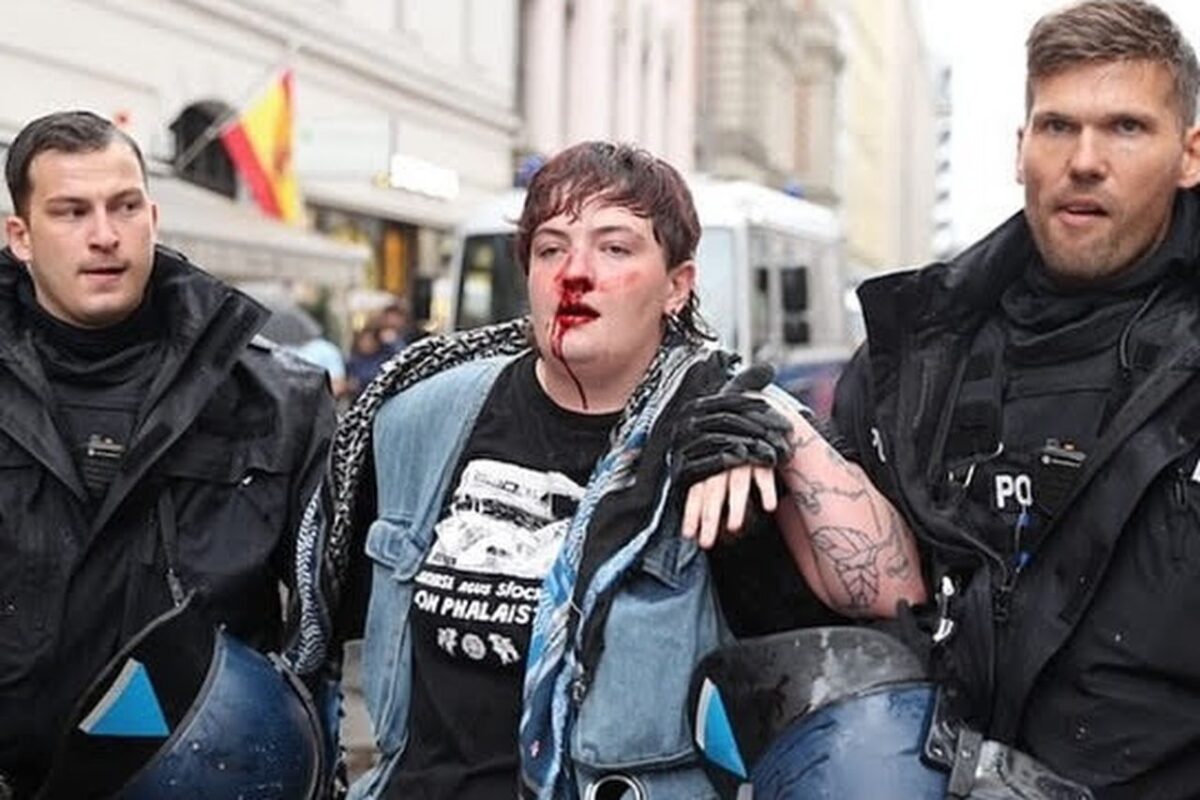
Kitty O'Brien with a bloody nose, being led away by two police officers.

As I write these lines, I should be at a Kneecap concert. The Irish hiphop group was supposed to play in Berlin on Tuesday night—but the gig was cancelled back in April without explanation. Of course we all know the reason: Kneecap’s German tour was scrapped after they said “Free Palestine” at Coachella.

Instead, they organized 15 sold-out shows across the US—which have all been nixed as well. This because Mo Chara, aka Liam Óg Ó hAnnaidh, has to appear in a London court facing terrorism charges.

It seems quaint now, but does anyone remember when the Right was warning of “cancel culture”? I can’t think of a single right-wing windbag who was actually cancelled. But now we have musicians being persecuted for speaking out against a genocide—and “free speech absolutists” like Elon Musk aren’t interested.

As the Western powers have supported genocide in Gaza, they’ve become more authoritarian at home. They say we need trillions of euros for weapons so they can protect our “freedom” and “way of life.” Meanwhile, they’re beating and arresting people for voicing opposition to government policy.

Mo Chara, Irish for “my friend,” is charged with supporting a proscribed terrorist organization after he draped a yellow Hezbollah flag over his shoulders at a show last year. The Lebanese group has certainly been responsible for violent actions—but so have the Israeli Defense Forces, which are currently carrying out genocide.

As of yet, no one in the UK has faced prosecution for using IDF symbols—and no one has been arrested for joining that particular terrorist group. The term “terrorism” is entirely political: it refers to violent political groups that a government doesn’t like. It can even refer to entirely peaceful groups like Palestine Action, who are guilty of nothing more than civil disobedience.

Who knows, really?

While we should have been listening to Kneecap, we were watching videos of other Irish activists. Kitty O’Brien, a 25-year-old, non-binary, Irish Berliner, was punched in the face twice by a black-uniformed cop. Their supposed crime was insulting an officer—and since German law mandates that police use “proportionality” and the “mildest possible means,” this means that nothing short of striking O’Brien’s nose and breaking their arm could have stopped this offense.

Every Irish media outlet took up the story. Within a few days, even the Taoiseach (prime minister) Micheál Martin said he was “deeply concerned” about such “unacceptable” violence.

Yet German media didn’t see what the fuss was about. Tagesspiegel waited a full day to publish a headline with a subjunctive formulation: a police officer “supposedly” punched a woman (sic!) in the face. Spiegel expressed the same uncertainty (though they did later correct the gender in their headline). Both articles acknowledge the numerous videos from different angles—but who knows, really? Maybe the fist stopped a millimeter before O’Brien’s face, whose nose started gushing blood spontaneously at that exact moment.

Germany’s bourgeois journalists are waiting patiently for the police to investigate. Yes, the thugs are supposed to look into their own thuggery. The same ones who clear the perpetrators in over 99 percent of charges.  

Germany’s ambassador in Dublin told the Irish Times: “I would like to stress that in Germany, peaceful demonstrations are not suppressed. Freedom of expression is a fundamental right and it is not under question in our democracy in Germany.”

Yet anyone with access to social media can see this is not the case. For two years, Berlin cops have been attacking basic democratic rights, often in violation of court orders. This is just a particularly appalling example caught by numerous cameras.

If you had the luck of the Irish

Ireland and Palestine share a history of British colonization, and even a few of the same oppressors: Arthur Balfour, who declared the British government’s support for Zionist colonization of Palestine in 1917, had previously been called “Bloody Balfour” for his violent repression of Irish self-determination.

So it’s no coincidence that Irish people are overrepresented in Berlin’s beleaguered but brave Palestine solidarity movement. The Berlin government tried to deport four activists—unsuccessfully, for now—and half of them were from Ireland. Berlin cops have banned the Irish language at protests. Even chanting “Saoirse don Phalaistín” (Free Palestine) in front of the Irish embassy is enough to get you arrested.

Liberal politicians claimed that Ireland had finally been pacified by a so-called “peace process,” with Western Europe’s last civil war ended and the legacies of colonialism buried under an intricate system of power-sharing and segregation. Globalization, we were told, would make partition irrelevant.

Yet, Irish opposition to the genocide in Gaza reminds us that the anti-imperialist struggle was never about one particular culture being suppressed. Rather, it is about a handful of capitalist great powers plundering the world and exploiting its people. That’s why it’s the same struggle, from Ireland to Palestine to Berlin.

In a video, you can hear Comrade Kitty telling those cops: “You don’t fucking scare us!” The German media might try to ignore police violence in Berlin, just like they ignore genocide in Gaza. But the whole world saw that punch—and everyone is trying to get tickets to Kneecap.

Red Flag is a weekly opinion column on Berlin politics that Nathaniel has been writing since 2020. After moving through different homes, it now appears at The Left Berlin.

News from Berlin and Germany, 3rd September 2025

Weekly news from Berlin and Germany

NEWS FROM BERLIN

Police officer strikes person – Irish Embassy expresses concern

A physical altercation between Berlin police and pro-Palestinian demonstrators becomes an international political issue. The Irish Foreign Ministry confirmed to the German Press Agency that it had been informed of a specific incident on 28 August in Berlin: several videos of the rally show a police officer punching a person from Ireland twice in the face, causing the victim to bleed from the nose. On 30 August, the Berlin police confirmed that they were aware of video recordings of the incident. The officer in question had been identified and the incident was being investigated, a spokesperson said. Source: web.de

Shocking findings from the Senate: rents in Berlin are too high

No other German city has seen rents rise as sharply as Berlin. For this reason, the Senate set up a rent review office in March. The review office, called “Sicheres Wohnen – Beteiligung, Beratung, Prüfung” (Secure Housing – Participation, Advice, Review), or SiWo for short, has now presented its figures for the second quarter of 2025 and came to some shocking conclusions: 93 of the 95 rental contracts reviewed exceeded the local comparative rent. Specifically, rents were on average around 50% above the local comparative rent. This once again confirms the suspicion that rent violations are by no means isolated cases, but rather a structural phenomenon. Source: berliner Zeitung

No responsibility for social media posts

Palestinian activist Majed Abusalama was acquitted by the Berlin District Court on 27 August. The public prosecutor’s office accuses the co-founder of the group “Palestine Speaks” of condoning criminal acts. He is alleged to have glorified the terrorist acts of Hamas on October 7, 2023, in two social media posts. Judge Regina Schlosser justified Abusalama’s acquittal on the grounds that it could not be proven that the defendant had written the posts. The group “Palestine Speaks” is involved in many pro-Palestinian demonstrations in Berlin, addresses human rights violations by Israel, and criticizes German policy on Israel and Palestine. Source: taz

Police operation on Rigaer Strasse: 700 officers deployed

On 28 August, police searched a building on Rigaer Strasse with a court-issued search warrant, according to a statement by the authorities on „X“. The house in question is the residential building at Rigaer Straße 94, considered one of the last partially squatted houses in Berlin and a stronghold for the extreme left-wing scene. Rigaer Strasse was closed for the duration of the operation, according to the police. A total of 700 officers wewre deployed through out the city to secure the area. The residents are allowed to remain in the building for the time being. Source: msn

NEWS FROM GERMANY

New Rheinmetall plant

The defense contractor Rheinmetall has opened a new plant in Unterlüß, Lower Saxony. It could become the largest ammunition plant in Europe. The DAX-listed company is responding to increased demand from the German Armed Forces, other Western armies, and the Ukrainian armed forces. “This marks a new chapter in the history of our company and our Unterlüß site in terms of artillery production,” said Rheinmetall CEO Armin Papperger. Rheinmetall is also building a factory for rocket engines and possibly warheads at the site. Another plant for RDX explosives and possibly ammunition charges is also being planned. Source: taz

Number of unemployed exceeds three million mark for the first time in ten years

The number of unemployed in Germany rose by 46,000 in past August compared to the previous month. With this, the number sums up to 3.025 million unemployed in the country with the unemployment rate at 6.4%. Despite a new high in unemployment, the Institute for Employment Research (IAB) sees nevertheless the first signs of hope. For the labor market barometer, experts survey all employment agencies monthly about their expectations for the next three months. In August, for the first time in three years, it is expected that rises in unemployment should come to an end. Source: Welt

Merz does not rule out conscription for women

Chancellor Friedrich Merz (CDU) has not ruled out the possibility that women could also be conscripted into military service in Germany in the long term. If the new model for military service, which is based on voluntary enlistment, proves insufficient, “then there will have to be a mechanism for returning to conscription,” Merz told French broadcaster TF1. However, this would not be easy. The constitution does not currently allow women to be conscripted into military service. On 27 August, the federal cabinet approved a draft law that would increase the number of soldiers in the German Armed Forces by several tens of thousands. Source: msn

Anti-war demonstration in Cologne: brutal police kettling

After a six-year hiatus, the “Kölner Lichter” festival took place again in Cologne on 30 August. An estimated 150,000 people watched the €1.2 million fireworks display. Meanwhile, the media interest in the closing demonstration of the “Disarm Rheinmetall” camp remained low – even though pyrotechnics also played a significant role. During the demonstration, which was conceived as a parade with around 3,000 participants, also on 30 August, the police struck back. Already after the short opening rally at Heumarkt, the procession was prevented from setting off. The reason given was the presence of some metal flagpoles and masks in the revolutionary block, which was mainly made up of communist groups. Source: nd-aktuell