The Left Berlin News & Comment

This is the archive template

News from Berlin and Germany, 31st December 2025

Weekly news round-up from Berlin and Germany


31/12/2025

NEWS FROM BERLIN

Banks terminate “Rote Hilfe” accounts

“Rote Hilfe e. V.” is a nationwide left-wing solidarity organization with around 19,000 members that has been in existence for over 100 years. It supports people who are affected by state repression because of their political activism. Within a few days, two banks ended their cooperation with the association, the Sparkasse Göttingen, followed shortly by GLS Gemeinschaftsbank. Sparkasse banks are required by law to provide public services. GLS Bank is not only a socially and ecologically oriented banking institution, but a cooperative bank, as well. According to “Rote Hilfe”, the terminations are directly related to the decision by the US government under Donald Trump to list the so-called “Antifa Ost” as a foreign terrorist organization. Source: rote hilfe

Public transportation in Berlin and Brandenburg will become more expensive in 2026

From January 1 on, prices in the Berlin-Brandenburg Transport Association will increase. Single tickets in fare zone AB in Berlin will then cost 4 euros for the first time. For 2026, the Berlin-Brandenburg Transport Association (VBB) will implement price increases for public transportation in the average of 6%. In the cities of Brandenburg an der Havel, Frankfurt (Oder), and Cottbus, single tickets will increase by 20 cents. The nationwide “Germany Ticket” will also rise, with the price for its monthly subscription going from the current €58 to €63 – an increase of over 8%. Source: tagesspiel

Sharp increase in racism in Berlin

The recently published Anti-Discrimination Report 2023/2024 by the Anti-Discrimination Network Berlin (ADNB) shows a significant increase in racism in the German capital. There were almost 20% more cases of racist discrimination recorded compared to 2021 and 2022. “This sharp increase exceeds the trend in reports in the years prior to 2023,” says the report, which has been published since 2003. This was mainly due to cases of racial discrimination in the context of demonstrations in solidarity with Palestine, which were reported to the ADNB. A total of 1,957 people contacted the ADNB in 2023/2024, and 891 cases were registered. In 2024, the ADNB recorded the most official cases with the police. Source: nd-aktuell

Fewer demonstrations in Berlin in 2025 than in the previous year

Significantly fewer people demonstrated in Berlin in 2025 than in 2024. At the same time, there were more demonstrations related to the Middle East. Between January 1 and December 1 of 2025, the police counted a total of 6,501 demonstrations and gatherings in the capital, as they reported to the Evangelical Press Service (epd). Last year, there were 7,212, which is about 700 more gatherings. In 2025, 865 demonstrations were related to the Middle East. That was 100 more than in the previous year. The largest demonstration (500,000 participants) was Christopher Street Day. In second place, there was the one “For Democracy/Firewall”. The police counted around 160,000 participants, while the organizers, up to 250,000. Source: rbb

NEWS FROM GERMANY

German cabinet replacing “Bürgergeld” with “Neue Grundsicherung”

The German federal cabinet have agreed to scrap the “Bürgergeld” long-term unemployment benefit and replace the payment with “Neue Grundsicherung” (“New Basic Support”). The change still needs to be approved by the Bundestag. If it passes, it will apply from July 1, 2026. The government’s aim in doing so is to limit the number of people who claim long-term unemployment benefits, and such change is expected to demand more requirements from claimants. For instance, those who miss two appointments at Jobcentres might have their support money cut by 30%. Social organisations such as the Diakonie and the Paritätischer Gesamtverband (Parity Association) criticise such benefit sanctions. Source: iamexpat


Oury Jalloh Family Campaign

That was murder


30/12/2025

January 7, 2026, marks the 21st anniversary of the murder of Oury Jalloh in cell no. 5 at the Dessau police station. Commemoration without clarification and change is used by the state as appeasement and theater. We refuse to go along with this and will continue to fight.

That is why we are traveling to Dessau on January 7, 2026. For 21 years, this day has been a tradition of remembrance and resistance. People are mobilizing nationwide. Come to Dessau and join the calls for action.

The Oury Jalloh Family Campaign remembers Oury Jalloh and all those who lost their lives through police violence and in state custody. On January 7, we will be on the streets of Dessau for Oury Jalloh. We insist on the truth, not as a favor, but as a duty. Where institutions fail, public pressure builds: in solidarity, informed, persistent.

Support and solidarity are needed for the relatives. A full investigation and consequences are needed. There must be no impunity. There must be acknowledgment of guilt, an official apology, and compensation. De-escalation is needed instead of armament, and clear limits on police force and powers.
Redress and reparations now.

Come to Dessau in large numbers. Bring flowers and banners. Carry the names and photos. Also bring empty lighters as a sign against lies and manipulated evidence. We stand together, walk together, stick together, and leave no one behind.

If you can’t travel to Dessau, join us online, light a candle, and share the official material. Please do not organize any parallel demonstrations on this day.

Let’s come together in Dessau in 2026, strengthen the family, and make this day visible. Dessau remains the central place of remembrance and resistance.

Share facts, research, voices of those affected, and experiences. Talk to the people around you. Every city can be an echo, every square a space for remembrance, every voice a piece of pressure against the wall of silence. No closing the book.

For Oury Jalloh.
For truth, justice, and consequences.

January 7, 2026 · 2:00 p.m. · Dessau Central Station
See you on the streets.
No Justice No Peace

Follow @ouryjallohfamilycampaign and the official fundraising campaign.

In addition to Dessau, other actions are taking place.

Femicides in Germany

Racist instrumentalization of violence against women and actual pathways to Women’s security

This year in Germany, at least 132 women and two girls were killed in femicides. While using women’s security to push its racist agenda, the CDU is only endangering women even more.

As the end of December approaches, and about one month after the International Day for the Elimination of Gender-based violence, it is time to look back at the situation for women in Germany this year. One thing has not changed compared to previous years: women are still killed for being women—this year, at least 134. 

While the CDU claims to defend women’s rights, it simultaneously endangers women by cutting the very budgets meant to protect them and by instrumentalizing women’s rights to justify racist policies. Fighting femicide is only possible by increasing funding for women’s projects and finally paying women (fairly) for the (unpaid) work they do.

In Germany, there is no legal term for femicide. It is however described by the Istanbul Convention, signed by Germany in 2018, as the killing of a woman because of her gender. Under this definition, two different kinds of femicides are sometimes distinguished: when women are killed for a sexist motive—for example, because they do not follow typical gender roles—and when women are killed because their position in society makes them vulnerable to such killings—for example, because of their lack of financial independence or their care duties.

The definition of femicide is still broad and leads to different ways of counting femicides, as there are different ways of identifying the motivations behind the killings. The quickest way to shed light on femicide is to look at press reports and count the cases of women killed by someone they knew. This is what onebillionraising.de does, and this is where the number of 134 girls and women comes from. 

Another way of getting statistics on femicides is to use criminal and police statistics. This allows access to more cases than press reports but has the drawback that the waiting time to get the data is a bit longer. In the “Femicide in Germany” report, the German Institute for Human Rights analyzed criminal and police statistics in order to quantify and analyze femicides in Germany. 

What the authors find is that in 2024 in Germany, 824 women and girls were victims of attempted femicides. This means that in 2024, there were more than 2 attempts per day to kill a woman. 300 of these attempts were perpetrated by the victims’ partner or ex-partner. In Germany in 2024, almost every day a woman or a girl was the victim of a killing attempt by her partner or ex-partner. Moreover, 144 perpetrators were family members of the victims.

This means that more than 50% of attempted killings of women come from the close circle of the victim. By comparison, less than 15% of attempted killings of men were perpetrated by their (ex-)partner or family members. This indicates that the place where women are least safe is the private space and contradicts the racist uses of feminism by right-wing actors, who argue that the real threat to Western women comes from immigrants in public spaces. The most dangerous people for women are their (ex-)partners or family members. In Berlin, however, CDU mayor Kai Wegner decided to close the Görlitzer Park at night after an accusation of rape in the park. He did so while reducing the budget for women’s projects and spaces, spaces that are crucial in fighting femicides, as they offer an escape to the outside for women who are victims of violence in the private sphere. Moreover, in 2024, the CDU closed two girls’ projects in Berlin Kreuzberg-Friedrichshain because of the private engagement of some of its workers against the genocide in Palestine, a genocide in which thousands of women are killed with German weapons. 

Indeed, a recent study on femicide in Germany shows that the lack of places in women’s shelters (buildings dedicated to women who are victims of domestic violence) is decisive in femicide: several cases analyzed occurred because of failed attempts to secure a place in a women’s shelter. According to German law, the country should have 21,000 places in women’s shelters to protect women against domestic violence, but it currently only has 7,000–8,000. Moreover, other spaces are crucial to protect women from domestic violence and femicides, such as cultural spaces or (legal) advice centers, as they allow women to maintain connections with the outside world while being at risk in the private sphere. Education and support programs for violent men are also needed, as well as educational programs for children, to combat sexist violence. By cutting the budget for women’s spaces—including shelters and associative projects that provide women with a connection to the outside—the CDU thus decides to endanger women and put them even more at risk, while using their security as a fake argument to pursue its racist agenda and criminalize people of color living in or spending time in Görlitzer Park at night.

At the national level, a new law introduced by the Greens and the SPD has been passed with the support of the CDU. It will provide more funding for women’s shelters and new rights for women who are victims of domestic violence. This, however, will only come into effect in… 2032. In the meantime, men continue to kill women: this year, at least 134.

Finally, women’s shelters and women’s projects won’t do the job alone: women will only be safe once they are financially independent from men. This is only possible by achieving economic equality between men and women. Currently, women are paid 16% less than men in Germany. This gap is even larger for women of color and does not take into account the reproductive work that women do for free. It also does not capture the full extent of economic inequality, as other factors play a role, such as the unequal distribution and taxation of money in heterosexual marriages. Providing fair wages for care and reproductive work, which is disproportionately performed by women, often migrant women and either unpaid or poorly paid, is one of the many necessary steps to achieve economic equality between men and women, and, with it, to protect women from violence by men This, however, is only possible by changing the structure of the capitalist system, which relies on the exploitation of women, and especially women of color, in order to persist.

We won’t achieve security for women by racist measures, and the CDU won’t defend our rights. Moreover, we want more than the weak law pushed by the SPD and the Greens. What we wish for in 2026 to fight femicide in Germany is therefore an immediate increase in the budget to protect women when they are at risk by creating more places in women’s shelters and financing women’s projects instead of cutting their budgets. But also, and perhaps even more importantly, we want women to finally get paid (fairly) for their work so that they are independent from the greatest danger they face: the men in their private spaces. 

1 January 1994: Zapatista Uprising

This week in working class history

On 1 January 1994, the presidents of the USA, Canada and Mexico launched the North American Free Trade Agreement (NAFTA). NAFTA removed trade restrictions and opened up Mexico to exploitation by the so-called “free” market. Mexican president Carlos Salinas had prepared the way with a massive privatisation plan four years earlier. In 1992, Salinas repealed Article 27, which had enabled peasants to use disused land.

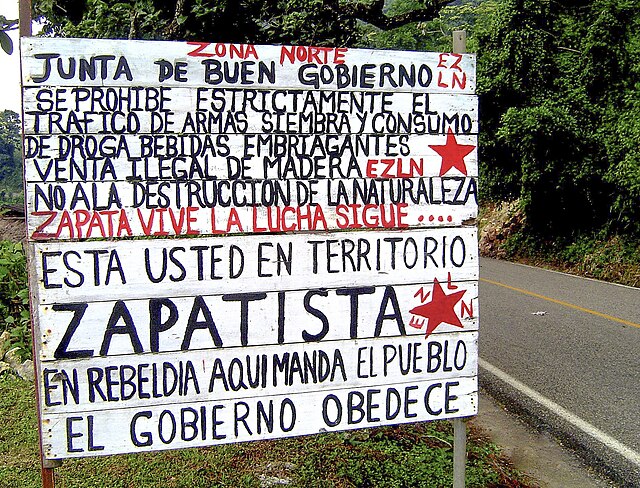
1 January also saw the Zapatista uprising in Chiapas. Mayan Indigenous people took control of four cities, including San Cristóbal de las Casas. They demanded land reform, Indigenous rights and democracy. The EZLN, which led the uprising, was named after the Mexican revolutionary Emiliano Zapata. The spokesperson for the movement was its masked leader, Subcomandante Marcos, who announced that the EZLN were fighting not only for Mayan rights, but against global neoliberalism.

Addressing movements in other countries, Marcos issued a statement declaring:
“We are you. Marcos is gay in San Francisco, black in South Africa, an Asian in Europe, a Chicano in San Ysidro, an anarchist in Spain, a Palestinian in Israel, a Mayan Indian on the streets of San Cristóbal, a Jew in Germany, a Gypsy in Poland, a Mohawk in Quebec, a pacifist in Bosnia, a single woman on the streets of the metro at 10pm, a peasant without land, a gang member in the slums, an unemployed worker, an unhappy student.”

The Zapatistas became a symbol of the international struggle against globalisation. They organised the first major defeat for Western capitalism after the fall of the Eastern Bloc in 1989. They forced the Mexican government to make concessions, including improved healthcare and sanitation and increased farm prices. However, following pressure from multinational corporations, most of these agreements were never respected.

As a result of the Zapatista uprising, the PRI ruling party lost its first presidential election in seven decades. It was replaced by the right-wing PAN. When the PRI returned to government, it continued to impose cuts and privatised the national oil company, PEMEX, in 2013. The Zapatistas said they were building autonomous spaces and were not interested in taking state power. Unfortunately, this left neoliberal capitalism firmly in control of Mexico. We should celebrate their victories and learn from their mistakes.

The currency of celebrity loyalty, from Minaj to Reiner

The responsibility (and cost) of wielding influence with empathy


28/12/2025

Michelle Singer Reiner and Robert Reiner posing at an event.

Rap star Nicki Minaj officially joined the ranks of MAGA during Turning Point USA’s America Fest convention. Accompanying Charlie Kirk’s widow Erika onstage, she heaped extravagant praise upon President Donald Trump and Vice President JD Vance. Not so long ago, Minaj was heartily critical of Trump, particularly in response to his attitude towards immigrants; then, during the pandemic, she began spouting anti-vaccination rhetoric—an indicator for the descent into an alt-right grifting career. While Minaj following this path isn’t totally surprising, listening to her dub Trump as a “dashing, handsome […] role model” was not on my 2025 Bingo Card.

Many online have—probably accurately—designated this as Certified Broke Behavior. Some have posited that she’s cosying up to the Tangerine Man in the hopes he will pardon her husband for crimes including attempted rape and failure to register as a sex offender. It’s shudder-inducing to watch anyone fawn over Trump, and the sheer transparency of it is cringeworthy. Even worse is that he laps it up. Trump, a man who ought to operate with a modicum of class and decency and sophistication—as any President should—preens and poses and rewards loyalty of any kind with oily words and metaphorical head-pats. He doesn’t even care if loyalty and praise stems from an authentic place. What he expects is a bend of the knee and a toe of the line. Bend to his power and submit to his regime, and you’re in with MAGA. 

In 2025 the topic of celebrity endorsement was dwelled-on with vigor. Some consider it to be the duty of the rich and famous: their privilege and exposure give them the unique power to step to the government in a tangible way. Others push back against this, insisting that pop stars and actors should stick to their own sphere and restrain themselves from attempting to sway the political landscape. Taylor Swift received both criticism and defence when she did not speak out against the official White House Tiktok using one of her new songs for the United States Immigration and Custom Enforcement (ICE) agency. The anger towards her silence was exacerbated by the fact that younger pop girls Olivia Rodrigo and Sabrina Carpenter both swiftly and angrily denounced the usage of their art for such a cause. Be it complacency or a lesson in emotional intelligence, the incident drove an extra-charged train of discourse through the planes of the entertainment industry’s overlap with politics. 

I can understand that acknowledging Trump and his administration’s antics can sometimes only stoke their flames. Like a typical schoolyard bully, they prod incessantly with the intent to provoke frustration, fury, despair. They don’t just like to make bruises, they want to press at them until their opponent yelps. That being said, with the Trump administration wheeling out any celebrity who is willing to lay at its feet for a chunk of change, it feels important to have equally powerful counterparts who signal resistance. Even when that resistance can feel fluffy, or a trifle performative, it can do wonders for a cause. Pop Princess and Wicked star Ariana Grande shared a link to the Palestine Children’s Relief Fund on her instagram story in 2024, which reportedly saw a significant spike in donations. Grammy darling Billie Eilish called out billionaires for their excessive greed in an impassioned speech at the Wall Street Journal Innovator Awards before donating $11.5 million to charities focused on food security and climate justice. The late actor Robert Redford staunchly endorsed the Democrats and opposed Trump’s reelection until his death this year. And the recently deceased director Robert Reiner and his wife, photographer and producer Michele Singer Reiner, were deeply entrenched in politics for decades, prompting comments from the President so loathsome and classless that even his Republican peers have recoiled. 

The aforementioned Erika Kirk, whom Minaj joined onstage, lost her husband Charlie on 10 September 2025. The right-wing influencer was assassinated during an outdoor campus debate at Utah Valley University. Rob Reiner’s politics could not possibly have further diverged from Kirk’s; they stood firmly on opposite ends of the political spectrum. And yet, during an interview on Piers Morgan Uncensored, Reiner was horrified by the murder, unequivocally condemning the assassination: “that should never happen to anybody. I don’t care what your political beliefs are.”

The Singer Reiners were discovered in their California home and their cause of death was pronounced as homicide. Their son Nick was accused of murdering them and is currently being held in custody. The news was the sort of tragedy that can barely be approached with words. The stark dreadfulness of it; the shocking, relentless surrealness. The chronically online are usually a verbose set, but when the story broke, the comment section was dumbstruck. Instead of platitudes, there were remote, helpless comments, unable to grasp the immensity of reaction. 

I expect very little from Trump. Few who lean my way politically do. He has shown himself to be a power-hungry, vulgar buffoon, boasting narcissistic tendencies and an insatiable hunger for oppressing those who question the status quo. His response when questioned about the death of the Reiners, though: it still had the power to startle me. 

Taking to Truth Social, he described Reiner as “a tortured and struggling, but once very talented movie director and comedy star, [who] has passed away, together with his wife, Michele, reportedly due to the anger he caused others through his massive, unyielding, and incurable affliction with a mind crippling disease known as TRUMP DERANGEMENT SYNDROME, sometimes referred to as TDS.” Friends and admirers of Reiner, including celebrated director James Cameron, met the comments with undistilled anger. The Hill reported that almost two-thirds of Americans considered the statement “inappropriate.” I briefly visited conservative forums online—whose users often play Devil’s Advocate for Trump et. al.—and even those threads were unable to see such a reaction in a positive or neutral stance. 

I prefer to refrain from weaponizing therapy-talk, but I don’t think you could conjure up a more fitting case-study for projection than the President of the United States. Alleging that Reiner caused others anger and suffered from derangement? I doubt anybody this year has caused more fury and shown themselves to be more unhinged than Trump. In every public address, every interview, every post made online, he provokes without the slightest whiff of subtlety, he meanders alarmingly, he presents us with baffling word-salads instead of simple answers to questions. He’s shown himself to be reactive, snarling at a reporter who asked an Epstein-related question to “quiet, piggy.”

A lot of Trump’s outrageous antics this year seem to be deliberate attempts to distract from the release of the Epstein Files. It’s a role well-suited to Trump, even if it didn’t come about by design but necessity. Since day dot of his initial bid for Presidency, Trump employed the crude tactic of diversion and subtraction to tremendous effect. Seeing as the tranche of files are being released—slowly and with a high volume of redactions—his diversions may become even wilder. Regardless of whether he really meant it or not, though, what he said probably rings true to what he feels. I won’t say believes, because I don’t think anybody as abjectly cruel and egomaniacal as him really holds beliefs. But I do think he feels, fundamentally, that those who oppose him—and anyone who cannot be of immediate use to him—are disposable. Those who see him for what he is—Rob Reiner declared Trump as “mentally unfit” to serve as President—are to be disassembled, shunned, and slandered without a shred of empathy or humanity. We should expect so little from Trump, but his post reverberated around the world nonetheless. That such a needless, fathomless, abyssal tragedy was incapable of permeating Trump’s viciousness underlined what many already knew: empathy is to the US President what sodium is to water.

The Singer Reiners seemed to have empathy by the truckload. While many celebrity endorsements begin and end with a fat cheque and a photo-op, the couple were steadfast in their philanthropic and political efforts for much of their careers. They put their money and their time where their mouths were. Rob was instrumental in overturning bans on same-sex marriage; he later said that Michele was the driving force behind his passion for the cause. Together the couple propelled forward a tobacco tax in California providing funding for early childhood programs. In her final years, Michele worked with those who had been wrongfully convicted via the Innocence Project, showing a commitment to a fair and equitable justice system. By all accounts, the pair felt deeply and used their humanity and conscience to guide their lives. It would have been possible for them to live a charmed and superficial life, perched atop of Hollywood amidst the glitz and glamour. They could have avoided the residue of a burning world around them and become engulfed in their own privilege. But they didn’t. And while they left too soon and in a manner deserved by no-one, they left a legacy that matters, and reminds us that change can come from the force of belief and determined, consistent action. 

I don’t think that talent is a virtue. Bad people can make good art and good people can make bad art. I also don’t think we should treat the Hollywood elite like royalty. That being said, it takes empathy and humanity to craft the kind of films Reiner directed, and that talent ought to be celebrated. When Harry Met Sally, The Princess Bride, Stand By Me: while all different, they are stories brimming with love and longing, friendship and affection. Whether under the rusty canopy of Central Park or the desolate countryside of a childhood, they are worlds formed with warmth and care. Even Misery, the psychological horror thriller featuring a chilling performance by Kathy Bates, is evocative and frighteningly moving, a sinister foray into the psyche of an obsessive fan-girl. The magic of these films is probably lost on Trump and his cronies, the feckless billionaires who deal only with unfettered power, explosive, havoc-wreaking fuels, and ever-rising bank accounts, who see art as easily replaced by AI slop.

Not every celebrity or high-profile individual will be capable of, or inclined to, embrace political and social issues as Rob and Michele did. What they have left behind them shows the power of those with higher profiles engaging with causes beyond solitary donations (although of course donations should not be sniffed at). Maybe it shines a light on the question of duty that many grappled with this year: maybe it confirms that, yes, while pop stars and Oscar winners and Grammy darlings and producers and filmmakers should not decide a vote or a stance for you, their inextricable link with the culture should be harnessed for good. That any artist worth their salt should have the compassion so sorely lacking by the billionaire bigwigs, and not only use it to create works that allow us to transcend, but use it to drive social change and remind us that there is more than one regime. 

In the end, the question isn’t whether celebrities should endorse or abstain. It’s whether power is exercised with any sense of responsibility to others. Trump’s orbit thrives on empty loyalty: praise given for proximity to power, devotion rewarded without conviction, empathy treated as weakness. Minaj’s turn toward MAGA is jarring not because it is unique, but because it exemplifies how easily influence can be stripped of meaning and repurposed for self-preservation.

Rob and Michele Singer Reiner offered a different model. Their politics were not costumes donned for attention or leverage, nor were they contingent on applause. They were sustained, imperfect, deeply human commitments to fairness, dignity, and care. In a culture increasingly shaped by spectacle, grievance, and transactional allegiance, their legacy reminds us that influence is not measured by proximity to power, but by what (and who) it ultimately serves. Empathy may not win elections, curry favor, or trend online. But without it, no amount of talent, fame, or authority means anything at all.