Since 7 October 2023, Germany’s unabating support for Israel’s genocide in Gaza is mirrored by a sweeping crackdown on Palestine solidarity at home. This ranges from protest bans and police violence, to lawfare, smear campaigns, cultural de-platforming, workplace reprisals, and the instrumentalisation of migration and asylum law. The state has been aided by most of the media and even parts of the NGO system and the political left., These measures illustrate the emergence of a repressive infrastructure in Germany, based on the intentional conflation of antisemitism and anti-Zionism. This criminalises almost any effective form of solidarity with Palestine and threatens broader civil liberties.
I don’t feel safe at all, actually. I try not to really leave the house alone unless I’m meeting someone or going somewhere in particular. I’ve found it that I’m just exposed to a lot more Islamophobia and aggression when I’m trying to navigate things alone.
Hebh Jamal, Palestinian journalist and activist living in Germany
And already then, it was clear that Germany is particularly difficult for a Palestinian. I was always asking myself, why am I moving to the hardest place? It’s one of the hardest places in the world for a Palestinian to live. Actually, I think it is the hardest place in the West.
Jamila (a pseudonym), a Palestinian activist based in Berlin
At the time of writing, the Gaza ‘peace deal’ has just entered its second month and has been rubber-stamped by the United Nations Security Council. But far from anything resembling peace, the illegal Israeli occupation of Palestine, backed, armed and facilitated by the US and European states continues, as does the genocide. Since the fragile agreement came into force, Israel has violated it with near daily attacks, killing more than 312 Palestinians. This includes killing almost two children per day – and injuring more than 760. The total number of confirmed victims in Gaza since 7 October 2023 is more than 69,000. The number of aid trucks allowed in cannot combat the engineered famine. Israel’s arbitrary restrictions on more than 350 essential food items makes the situation even more dire. Meanwhile in the West Bank, violent settler attacks, often backed by the Israeli army, are at an all-time high, while Israel’s parliament has officially approved the colonial plan to annex the territory. Palestinians continue to be prisoners in their homeland.
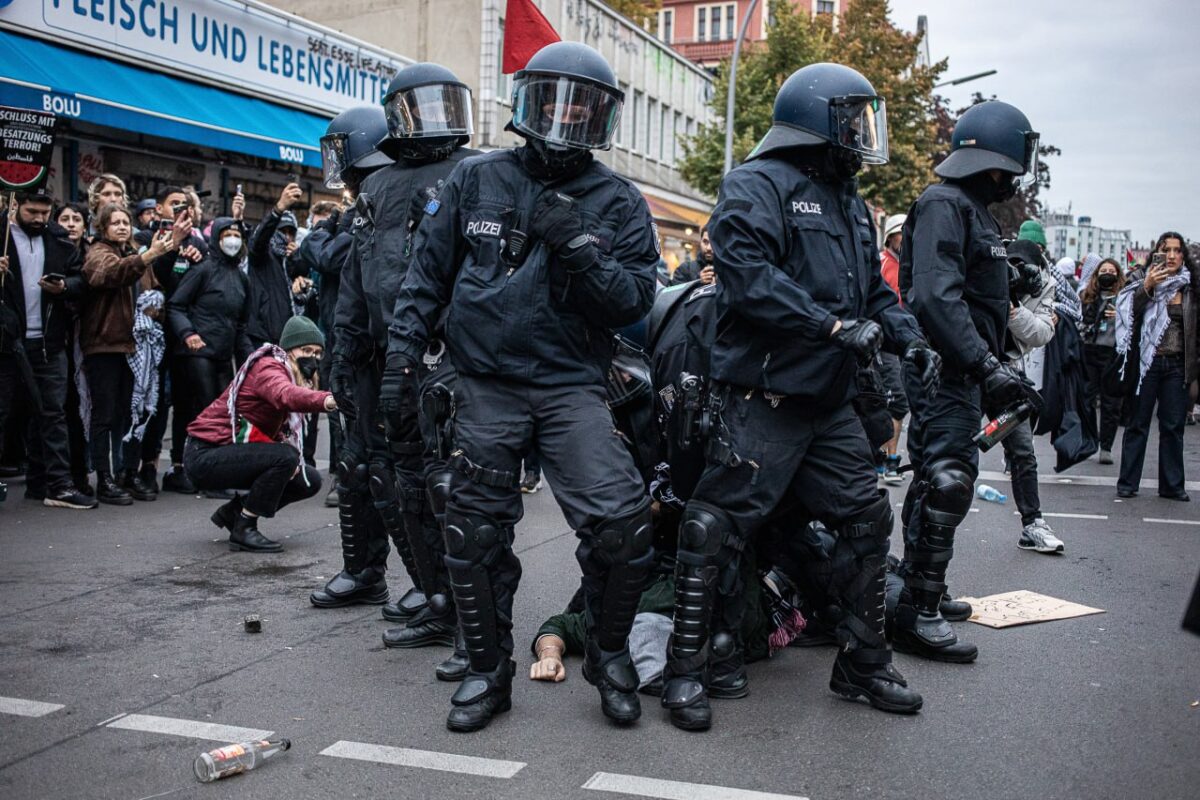
Regardless, Germany’s Chancellor Friedrich Merz has officially declared the crisis is over. In an interview on 9 October 2025, he said that ‘there is no reason anymore to demonstrate for Palestinians in Germany. There will be peace in Gaza and that’s the good news’. Defying his words, tens of thousands of people came out on the streets of Berlin on 11 October to protest against German complicity, for accountability for the genocide and an end to apartheid and settler colonialism. They were met with police violence, such as punches to the head, chest and abdomen, pain grips, choke grips, and arbitrary arrests, including of at least three minors. As a new report published this week by the Transnational Institute has shown, far from being an exception, this is ‘the new normal’ for anti-genocide protestors.
From Staatsräson to Street Control
By 19 October 2023, Israel’s military onslaught had killed close to 3,500 people in Gaza, the Strip’s only cancer hospital verged on shutting down. Israel’s Defence Minister Yoav Gallant had publicly ordered a ‘complete siege’ of Gaza, declaring ‘there will be no electricity, no food, no fuel, everything is closed’ – and referred to Palestinians as ‘human animals’. Still, after committing full solidarity to a genocidal onslaught, Germany’s former Chancellor Olaf Scholz declared in parliament that the country would show ‘a clear edge’ against antisemitism and ‘the glorification of violence’. This already included a blanket ban on anti-Israel protests in Berlin and a violent crackdown on any form of solidarity with Palestinians. That was just the start. The German government entrenched the former Chancellor Angela Merkel’s‘Staatsräson’, or raison d’état – namely unconditional support for Israel. This doctrine has been weaponised in Germany against domestic dissent., Germany provides arms used in a genocide abroad and criminalises those who oppose it at home.
Palestinian-US lawyer Noura Erakat’s ‘boomerang’ analysis describes how the United States (US) applies equally to Germany. Since October 2023 we see Aimé Césaire’s ‘boomerang’ flying from the colony to the metropole. Germany’s support for Israel’s apartheid regime and war crimes abroad is translated into repressive policies, mass surveillance, police brutality, and shrinking free expression at home. Germany is not merely absorbing this violence, but is refining, institutionalising, and exporting it. The country has become a laboratory for the criminalisation of solidarity with Palestine. It tests how far it can go in suppressing free speech, banning protest, and bending the constitutional framework. What happens in Berlin today is becoming the pattern for other countries tomorrow.
Globally, the Palestinian cause has become a lightning rod for repression. In 2024 alone, according to the international non-government organisation (NGO) Civicus, Germany accounted for over 10% of all documented restrictions on free speech worldwide. But Germany’s repression stands out in its scale and intensity. The Civic Space Report 2025 by the European Civic Forum singles out Germany as one of the most repressive EU Countries when it comes to Palestine advocacy. he European Legal Support Centre’s Index of Repression has documented more than 700 incidents in Germany since 2019 (most of these since 7 October 2023), affecting thousands across the population.
Central to the repression of the Palestinian solidarity movement is the deliberate conflation of antisemitism and anti-Zionism. Germany’s historic responsibility for the Holocaust (or Shoah) is routinely used to justify another genocide and the repression of those who try to stop it. Critics of Israel, many of them themselves Jewish, are labelled as antisemitic and the Palestinians who mourn their dead and demand justice are cast as threats to public order. Hunting supposed antisemites will soon be conducted with Artificial Intelligence (AI). The real drivers of Germany’s alliance with Israel are material. Germany’s foreign policy aligns with US geostrategic interests, and arms companies like Rheinmetall have seen their profits rise by over 2,000% in a decade. As James Baldwin wrote in 1979: ‘The state of Israel was not created for the salvation of the Jews; it was created for the salvation of Western interests’.
The Infrastructure of Repression
We felt like we were dealing with settler soldiers, colonial soldiers, but with German clothes. The beginning after the 7 October has been completely about misconceptions and about reproducing images of us as terrorists, as antisemites. Before 7 October we were potential antisemites. After 7 October we were antisemites. Before 7 October, we were potential terrorists. After 7 October we were terrorists. So, this is the kind of collective punishment that migrants and Palestinians experience.
I started feeling personally that all those police who raid our house – that’s only gangs. The use of force, excessive force, and violence against protesters has been extraordinary and overwhelming and also illegitimate. And it’s not just about the brutality, but it also shows the kind of legitimacy the police have to actually practise such brutality without any accountability.
And that felt extremely dangerous. As a father, I felt like I might not be able to protect my daughters, and I might be the next one who is actually imprisoned with my daughters. Many families who have kids started to be very scared to go demonstrate on anything to do with Palestine, because of the extreme violence and brutality and the way that our areas became very militarised. As if we are actually dealing with checkpoints everywhere. German police have been stopping and interrogating Palestinians. They’re demanding IDs from people of colour, but not from people who are white. And it became increasingly accepted, and this kind of acceptance is not talked about, that it is actually fine to police and racially profile everyone who’s not white.
Majed Abusalama, Founder of Palestine Speaks
The past two years show the domestic costs in Germany of that salvation. There have been bans on demonstrations, police violence, mass arrests, loss of employment, academic suspensions, bank account closures, deportation orders, surveillance, censorship, and threats to legal residence. This illustrates an emerging repressive infrastructure in Germany. It criminalises almost any effective form of solidarity with Palestine and threatens broader civil liberties.
Media outlets play a direct role in manufacturing consent for a genocidal war. They by consistently minimise the genocide in Gaza and the violence inflicted upon Palestinians. Domestically, they uncritically echoe political and police narratives, dismissing inciting violence against the anti-genocide movement, ignoring the rapidly shrinking space of civil society. Liberal civil society actors, self-police and disinvite Palestinian speakers, cancel events, and remain silent . Many sectors of the German left and social movements, fearing reputational damage or funding cuts, fail to resist Germany’s authoritarian shift. Often they actively enable it.
The crackdown targets the movement in support of Palestine, and tests a broad transformation towards authoritarianism, particularly in relation to Germany’s migration policy. In a general climate of increasingly deadly and harmful migration policies, immigration law has also become a tool of political control. The state has refused visas, effected deportations or blocked people’s naturalisation for such minor issues as social media posts or attending protests. Residency status, citizenship, and asylum rights are now contingent on ideological conformity. State actors continue to single out rising antisemitism, while racism, particularly Islamophobia, surge,. The 2025 Grundrechte-Report (Basic Rights Report), a civil society alternative to the German government’s annual report on the protection of the constitution, states that ‘[the] exercise of civil liberties is being offensively obstructed or prohibited with unprecedented intensity’. It emphasises that migrants are most affected.
The crackdown is part of a shift towards the hard-right and the securitisation and militarisation of various domains in German and global politics. What we witness is not only complicity in a genocide, but the remilitarisation of German society. This redefines dissent as extremism, and equates liberation movements with Nazism. The filmmaker Dror Dayan notes: ‘While Germany has never broken away from its Nazi past, it is now equating all its enemies – be it Palestinian freedom fighters or Russia – with its own Nazis. While Germany is propping up its own neo-Nazis in the AfD and CDU, it attempts to sell the world an image of itself as fighting Nazis. It simply lies about who those Nazis are’. Police powers have expanded under the guise of public security. As a recent Junge Welt article put it, ‘the state is warming up for a war-readiness that will target any opposition’.
The consequences are deeply personal:
“So just that you have an idea of how it is to be a Jew nowadays in Germany, where everybody wishes to protect you by basically silencing you, beating you up, and doing everything they can to make sure you don’t feel safe in the public sphere of Germany. And then saying it’s all done in the name of anti-Semitism. Udi Raz, Member of Jewish Voice for Peace”
For many Palestinian, Arab, Muslim and anti-Zionist Jewish residents in Germany, daily life is now violence and fear, (See above quotes”. But there is also a political awakening for a new generation of activists in Germany. Many are migrants, Muslims and/or racialised together with white non-Muslim Germans. The threat of being labelled antisemitic has split almost every movement from climate to anti-racism. The wave of criminalisation, defunding and the broader authoritarian shift, for now, weakens the left. But it offers the chance to break from a state-funded, NGO-dominated scene and to become more radical and honest. This means to call for system change not cosmetic reforms; to name capitalism, colonialism and genocide for what they are, and to fight unapologetically.
People continue to resist. While the media echo state narratives, ever more Germans are seeing through the official lies. In a May 2025 poll, over 80% of Germans said they believe that Israel’s actions in Gaza are unjustified, up 11 percentage points from March 2024. In another poll, 70% rejected German military support to Israel. Protests continue, even in the face of police violence. Palestinian voices remain defiant. The lawyer Nadija Samour reminds us, paraphrasing Gandhi: ‘First they ignore us, then they laugh at us, then they fight us – and then we win’.
Internationalistisches Bündnis Berlin (International Alliance Berlin) is organising a launch event for the report at bUm Berlin on the 9th of January 2026, starting at 18:30pm. The event, titled Solidarity under Siege, will analyse the increasing repression of the Palestine solidarity movement in Germany, the instrumentalisation of migration and asylum law against activists, and look at ways to resist Germany’s authoritarian shift. Save the date and follow Inter_Bündnis Berlin for updates.
This is the first longread in a series of five based on the Transnational Institute’s report Solidarity under Siege: Germany’s Repression of the Palestine Movement. The report draws on the insights of interviews with seven activists from the Palestinian solidarity movement, including Palestinians and German, Muslim and Jewish people, among other (overlapping) identities, who shared their trust, stories and time with the author. At their request, pseudonyms have been used for some of these activists.