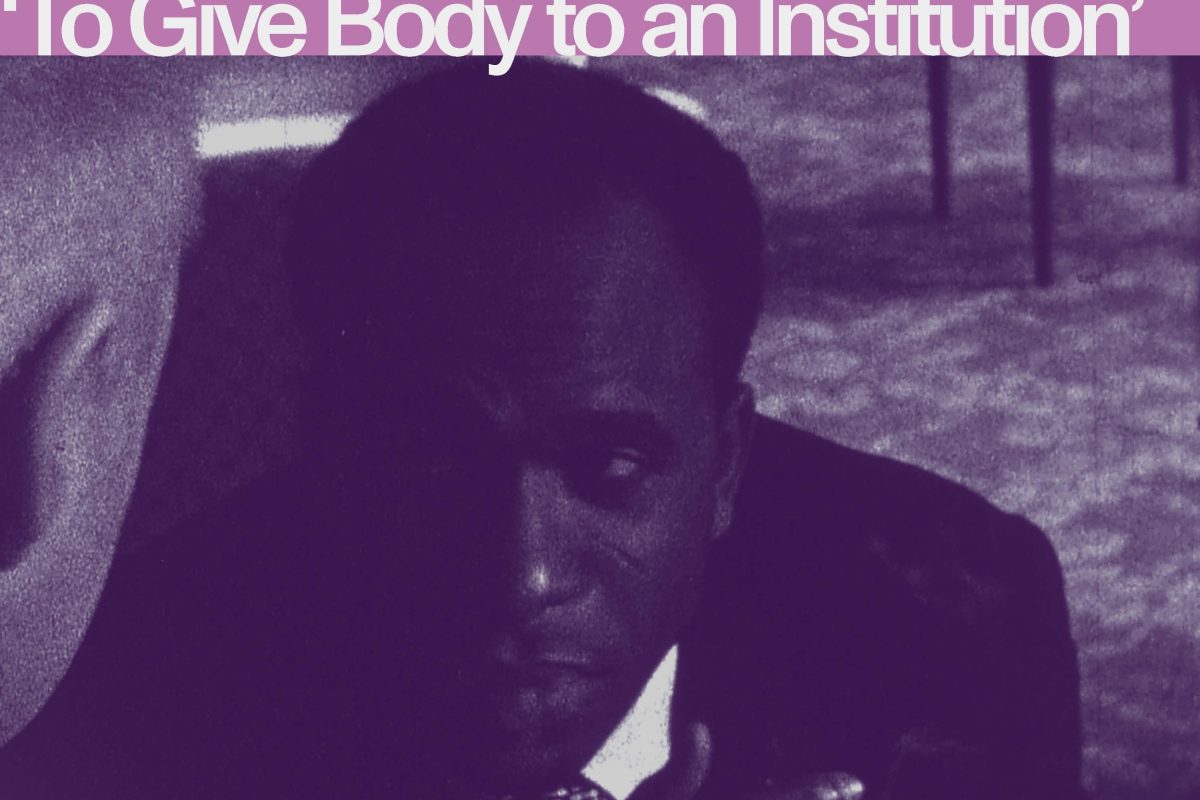
International Symposium at ICI Berlin, January 29–30, 2026
The symposium Frantz Fanon’s Social Therapy: ‘To Give Body to an Institution’ explores Frantz Fanon’s political, clinical, and aesthetic approach to institutions along three interrelated lines. First, it delves into the impact of Saint-Alban on Fanon’s conception of madness and the institution as both in need of a cure and capable of curing—a sociogenic and phenomenological perspective attentive to embodiment, subjectivity, and history. Second, it turns to his work at Blida-Joinville and Charles-Nicolle, where colonial alienation thwarted the implementation of social therapy, yet where Fanon and his collaborators experimented with media, spatial, and aesthetic practices to propose new forms of collective life. Finally, it considers the legacies of Fanon’s clinical practice, tracing how his insights into the entanglement of psychiatry, politics, and colonial violence continue to inform contemporary understandings of trauma, resistance, and institutional life in postcolonial and neocolonial contexts.
In the 1955 editorial of Notre Journal—the intra-hospital newspaper published by patients and staff of the Blida-Joinville Psychiatric Hospital in Algeria—Fanon confronts the question of the institution and the dangers of its vitiation: “Does not every attempt to give body to an institution [donner corps à l’institution] risk taking directions that are fundamentally opposed to the open, fecund, global and nevertheless qualified character of the institution?” His answer unfolds, tracing an embodied idea of the institution: “You have to place yourself at the heart of the institution and interrogate it.” For it is the entangled social and material sensorium that mediates the institution’s therapeutic efficacy. Fanon’s emphasis on the constant reactivation of the institution from within—as a social body, a ‘movement’ that fosters “interminable and fruitful encounters”—points to the transmission of experience from the Saint-Alban clinic in the French Lozère to Blida-Joinville. In the 1940s, the Catalan psychiatrist, anarcho-syndicalist Francesc Tosquelles prompted, in a collective effort, to transform the psychiatric hospital into a “place of exchange.” Institutional psychotherapy integrated psychoanalysis, Marxism, and Gestalt psychology in its practice, aiming first at curing the institution—its “milieu,” “atmosphere,” and “ambience”—before any individual treatment. In Tosquelles’s words, its process entailed a “disalienation of the total fact of madness: the sick person, the asylum, and the psychiatrist at once.” Saint-Alban became the point of departure for an environmental approach to the cure, a géo-psychiatrie fostering “migrant work” and opening the clinic to its social and human geography. Between studying medicine in Lyon and his psychiatric work in Algeria and Tunisia, Fanon worked at Saint-Alban (1952–1953) together with Tosquelles. This experience shaped Fanon’s psychiatric approach and his understanding of the institution as an “experimental milieu.” Instituting such a milieu meant actively engaging both patients and staff through social therapy, film, and media practices, all designed to work in concert with medical treatment.
With Kader Attia, Camilla Caglioti, Christopher Chamberlin, Sara El Daccache, Carles Guerra, Tobi Haslett, Samia Henni, Samah Jabr, Jean Khalfa, Brigitta Kuster, Karima Lazali, Wietske Maas, Paul Marquis, David Marriott, Marlon Miguel, Marianna Scarfone, Wanderley Santos, Saniya Taher, David Ventura, Elena Vogman, Robert J. C. Young.
Organized by Camilla Caglioti, Marlon Miguel, and Elena Vogman as part of the Research project “Madness, Media, Milieus. Reconfiguring the Humanities in Postwar Europe”‘” (Bauhaus-Universität Weimar, funded by Freigeist Fellowship of the Volkswagen Foundation) in collaboration with ICI Berlin.
Taking place at ICI Berlin, Christinenstraße 18–19, 10119 Berlin, Germany on 29–30 January 2026.
The full programme is available on the website of the ICI Berlin. To attend, please register using the form on the website. All places are taken, but a waiting list is in operation.
You can find further information on the Freigeist project ‚Madness, Media, Milieus‘ here.
The Left Berlin News & Comment
This is the archive templateMonth: January 2026
Palestinian refugees among the victims of criminalization of asylum seekers in Greece
On Wednesday, 21st January, Ziad from Gaza will face a 25-years-long sentence in a court on Rhodes, Greece. He is one of the many asylum seekers criminalised by the Greek state – with EU’s full complicity – as a “smuggler”.
“I managed to leave Gaza for Egypt, and then to Turkey. I did my best there to obtain residency and family reunification, but I was unsuccessful. So, I continued my journey towards Europe, searching for safety for my family.” – writes Ziad in his statement.
In August 2024, he managed to reach Rhodes Island on a rubber boat together with other desperate people seeking safety. Once apprehended by Greek coast guard, he was accused of having held the rudder and put in pre-trial detention in a criminal prison in Athens. He has spent the last 17 months there. The day after tomorrow, he will face trial back on Rhodes, in which he can be sentenced to 25 years of prison for “smuggling”.
The government in Athens – as part of its migration deterrence policy – has been practicing criminalization of those fleeing wars, conflicts, the genocide, as well as extreme poverty and lack of any future at home. Upon their arrival “to safety”, a few random persons from every boat reaching Greek shores are arrested – usually without any evidence, access to translation or legal counsel – and put in prison.
Months and years pass. When a trial finally takes place, people are often offered a plea bargain (a plea deal) – an arrangement between prosecutor and defendant, in which the defendant pleads guilty in exchange for a more lenient sentence. Some of the criminalised in Greece accept it in fear that the “evidence” produced against them will condemn to the maximum punishment – 25 years of prison. Ziad has decided not to go down this way and face his destiny instead.
“From the moment I arrived in Europe, instead of finding justice, I was subjected to the greatest injustice. I was accused of a crime I did not commit and imprisoned. Every day in prison feels like a year, and I live in constant fear and anxiety for my family, whom I left behind under bombardment and suffering in Gaza.” – writes Ziad.
Ziad’s story is heart-breaking from its start. Back in Gaza, his eldest daughter fell sick and needed medical treatment not available there. Ziad was fighting to get her out of Gaza, but the Israeli regime did not allow it. She passed away in pain. He buried her and decided to leave to secure a better future for his remaining two daughters and his wife. He succeeded after months of trying – just days before the outbreak of the genocide.
“I visited Ziad in the prison in Athens. I have never met him before. He is a short, solid man in his 30s. He looks older than his age. A very gentle and calm person, a kind heart. He was smiling sadly in integrity and dignity as we exchanged about his upcoming trial” – says Eirini, an activist who has been supporting criminalised asylum seekers as part of Alma Community and ’50 out of many’ Initiative.
Greece’s law makes facilitating unauthorised entry a felony resulting in a ten-year prison sentence, with up to an additional 15 years for each person transported whose life was allegedly endangered. These measures “against” smuggling are in fact targeting those they claim to protect as great majority of the accused are people on the move.
Some of them steered or navigated a boat – for a short while or a whole journey – because they were coerced to it or simply to get themselves and others out of danger. In the absence of legal pathways of arriving and seeking asylum in the EU, driving a boat to Europe is an act of despair and an act of solidarity: no driver, no survivor.
“Ziad has been locked for 17 months. It is enough time to understand the reality. He is not in denial of the risk he will face on Wednesday” – continues Eirini. “Ziad is an asylum seeker from Gaza who wanted to find safety for his family. He should have never been criminalised”.
Ziad’s wife and two daughters remain in Gaza – they live in a tent in harsh winter conditions. Only a few days ago their tent collapsed on them.
To attend the trial or to support otherwise please contact: 50outofmany@gmail.com
Supporting groups:
- Alma Community in Athens
- Asylum4GazansNOW! Initiative
- de.criminalize
- ‘50 out of many’ Initiative
News from Berlin and Germany, 21st January 2026
Weekly news round-up from Berlin and Germany
NEWS FROM BERLIN
4 million kilos of potatoes for free in Berlin
A farm in Saxony, Germany, ended up stuck with a harvest of potatoes that had been ordered by a trader. Due to this year’s unusually high supply that affected the market price of potatoes, selling them was no longer profitable for the trader. The order was financially settled, but the potatoes were left in storage. A collaborative initiative between Ecosia and the Berliner Morgenpost newspaper was organized, with the potatoes being distributed for free. More about the initiative (including a map of Berlin, with places where one can go and get them) is available at https://www.4000-tonnen.de/. Source: dw
“Liberation comes from below”
On January 17, many people demonstrated in Berlin in support of the oppressed people of Iran. In contrast to the demonstration on the next day, however, many here spoke positively about the Shah’s son Mohammad Reza Pahlavi, the United States and Israel. On January 18, around 1,500 people in Berlin took to the streets to protest against the mullah regime, rejecting at the same time military intervention threats by the US. In the latter rally, there were slogans such as “No Turban, no Crowns”. The speeches were mainly given by women. A representative of the initiative “Socialism from Below” (SvU) affirmed that “Liberation comes from below, not from outside!” Source: nd
Al-Sharaa cancels visit to Berlin—the cancellation should have come from Merz
Ahmed al-Sharaa is not coming to Berlin. The Syrian ruler cancelled his visit, due to the tense domestic political situation and his troops’ military offensive against the Kurds in Syria. Al-Sharaa was appointed transitional president in January 2025 after the Islamist militia Hayat Tahrir al-Sham (HTS), led by him, overthrew long-time dictator Bashar al-Assad in December 2024. He has no democratic legitimacy. The allegations against al-Sharaa and HTS are serious and well documented. The cancellation came from Damascus, but it should have come from Berlin. The cancellation of the visit gives the German government some breathing space, and it should use this time to rethink its policy on Syria. Source: bz
Berlin’s Justice Senator calls to Combat Extremism
Berlin’s Justice Senator, Felor Badenberg (CDU), is calling for more personnel and power for security authorities to be able to take stronger actions against extremism. In an interview with rbb24 Inforadio, she said that intelligence services need a bigger investment, with a focus on the digital sphere, necessary to “uncover networks.” As Badenberg explained, security authorities should have tools to “automatically recognize images.” From the Justice Senator’s perspective, the fight against left-wing extremism is being downplayed, because of themes it deals with such as the climate. She states that “there’s no such thing as good extremism.” Source: rbb
NEWS FROM GERMANY
Deutschlandticket should be priority
The German Rail Passenger Association (DBV) has written a press release, where it criticises the government for failing to prioritise the Deutschlandticket policy and recognise its achievements. Currently, 14 million people have a Deutschlandticket subscription. The DBV pointed out that, because annual expenditure for the ticket remains constant at 1.5 billion euros but tax revenues will rise, maintaining the ticket will only get more cost-effective. According to figures from the Federal Finance Ministry, only 0.32% of the federal budget currently goes towards funding the Deutschlandticket. “The ticket promotes the transport transition (Verkehrswende), relieves households and reduces CO2 emissions,” the DBV added, calling for the ticket to be “maintained and improved—independent of political priorities.” Source: iamexpat
SPD wants to stabilise price of basic foods in Germany
The SPD has announced a plan (the Deutschland Korb—Germany’s basket) to stabilise the consumer cost of basic foods produced in Germany. With that policy, certain products, namely basic foods like milk, bread, vegetables and meat products, but also washing powder, soap and other household goods, would be sold at stable prices. A similar policy was introduced in Greece in late 2025, when the government and supermarket chains came to an agreement that supermarkets would reduce the cost of more than 2,000 products by an average of 8%. So far, some supermarket organisations haven’t been so sympathetic to the idea. Source: iamexpat
Do German job centres discriminate against citizens from the EU?
Titled “Wir behandeln alle gleich” (“We treat everyone equally”), a recent working paper by the German Centre for Integration and Migration Research (DeZIM) has shed light on institutional discrimination informally exercised against EU migrant citizens claiming social security benefits at job centres within the country. For example, the researchers found that, for non-German EU citizens, knowledge of the German language and how the German social system works was “more significant” when it came to claimants being able to “assert their social rights.” Researchers eventually concluded that the current lack of support for non-native German speakers in the unemployment systems raises “moral questions”. Source: iamexpat
Public sector: ver.di wants to expand warning strikes
The trade union ver.di wants to significantly expand their warning strikes in the public sector of the federal states. In the collective bargaining round for the public sector in the federal states, employers did not present a concrete offer for wage increases. The unions reacted with disappointment after the two-day round of talks and announced an expansion of the warning strikes. Regionally affected are university hospitals, road clearance services and some employees in schools and tax offices. The next round of negotiations is scheduled for 11 to 13 February. Around 2.2 million public sector employees are affected by the collective bargaining round. Source: n.tv
Digital socialism or extinction
The Lesson of Venezuela and the Conflict of Capitalism in its Most Ferocious Phase
Rezgar Akrawi
20/01/2026
In the dawn of an ordinary day at the beginning of January 2026, the world awoke to shocking news: a brutal U.S. military aggression and the kidnapping of Venezuelan President Nicolás Maduro and his wife in a complex operation executed with supreme military and intelligence precision. Despite the direct military attack and intensive bombardment, the operation relied heavily on a massive employment of digital technology (as reported by Defense One, NBC News, and Just Security). Media coverage focused on political aspects without real attention to the pivotal role played by advanced technology. It was not just a traditional military intervention, but rather a comprehensive digital war that preceded the arrest by long months of planning and monitoring.
Before continuing, I would like to point out my reservation regarding the policies of the Maduro regime in suppressing dissenters, restricting freedoms, and tightening the grip on leftists and labor unions. Our critique of American capitalist intervention and the use of technology as a weapon for hegemony does not mean justifying the repressive practices of the Maduro regime against progressive forces and the labor movement. What we are highlighting here is the technological and strategic lesson that this incident provides to all leftist and progressive movements.
In this operation, the most advanced American satellite surveillance systems were used to track the movements of the Venezuelan leadership via satellites. Big data analysis extended to drawing accurate maps of government communication networks with all their complexities. The hacking of electronic systems was precisely planned to disable them at the decisive moment, making the Venezuelan leadership completely isolated from its bases. The employment of advanced digital techniques in analyzing millions of calls and messages was not just traditional espionage, but rather a complex operation to pinpoint the locations of leaders accurately and predict their next moves. The programmed manipulation of media and social media networks was an organized campaign to shape public opinion in favor of the intervention, and to portray the operation as “liberation”, not an aggression against the sovereignty of an independent state.
These are not scenarios from science fiction movies, but a documented reality we live today. The U.S. National Security Agency possesses the PRISM program, which was revealed by Edward Snowden and which monitors global communications without discrimination. Companies like Palantir Technologies provide highly advanced data analysis systems to the American intelligence establishment. The capitalist technological system today is capable of comprehensive surveillance and systematic tracking of political movements and political actors. The most dangerous thing is that there are many digital technologies and weapons that are still within secrecy, as was the case with the internet itself, which was not revealed to the public until years after its military and security use.
Technology as a Tool for Capitalist Control and Hegemony
What happened in Venezuela is not an isolated incident. It is an essential part of a comprehensive digital capitalist strategy that we have seen repeated in many places in the world. The clearest lesson from the incident of Maduro’s arrest is that capitalism in its current stage no longer relies only on traditional military force. It has developed a complex digital system capable of penetrating geographical borders, monitoring individuals and groups with amazing accuracy, and manipulating information and shaping public consciousness in ways that were not possible in any previous era. It is an invisible war, its battles take place in cyberspace and data servers, having proven more effective and less expensive than bombs and planes.
This reality poses a fateful question to the forces of the Left: how can liberation movements that still rely on traditional meetings, distributing paper leaflets, using unencrypted phones, and harnessing the internet in a primitive way, face a digital capitalist system with this level of development? The answer is clear and painful: it cannot, unless it decides to enter seriously and strategically into the technological field, not as passive consumers of capitalist technology, but as developers and innovators of independent digital alternatives that protect the struggle from penetration and suppression.
What we are witnessing today is a reproduction of historical class exploitation by more advanced and hidden means. This exploitation is no longer confined to factories or farms, it has extended to include the digital space itself. The algorithms of digital companies exploit manual and intellectual workers in ways more cruel than any human manager. These algorithms determine wages based on supply and demand at every moment, impose exhausting working hours without regard for health or family status, and issue automatic penalties without the possibility of appeal.
In the field of consciousness: the algorithms of giant platforms are used to shape the consciousness of billions of people. These algorithms systematically promote the ideology of capitalist consumption and the culture of individualism, while fighting leftist and progressive content through techniques of “reach reduction” and “shadow banning.” The consciousness of millions of young generations is shaped not through reading and critical thinking, but through algorithms that decide what they see and what they do not see.
In the field of surveillance and control: digital technologies are used today to deepen political and social control in ways that were not previously possible. Recognition and analysis systems allow tracking political activists and monitoring their behavior and networks with high accuracy. These technologies are exported to authoritarian regimes, transforming digital and public space into a permanent field of surveillance.
The Historical Stake for the Left, Toward a Liberatory Digital Revolution
The technological factor is no longer just a secondary addition in the Left’s battle against capitalism. It has become an essential condition for survival, effectiveness, and influence. Facing this reality cannot be limited to criticism, but requires specific positions and policies, transcending the exposure of capitalist hegemony to working on dismantling it and redirecting technology toward serving the general masses. Developing leftist capabilities in the technical field is a vital necessity no less important than developing political and organizational capabilities. Just as the forces of the Left cannot rely on capitalist media and seek to build their independent media, they must also work on building their independent technological alternatives, whether in social networks or digital tools and others.
What the current digital revolution reveals is that we live in a historical moment in which the contradictions between the massive development of the productive forces and capitalist social relations, which are no longer capable of containing this development, become clear. The struggle in digital space must transform into an organic extension of the socialist struggle on the ground, and not just a separate arena. Linking the technological struggle and the class struggle is essential, because digital hegemony is just an extension of the hegemony of capital.
The possible solution now is to develop open-source, transparent systems, managed democratically with societal controls, in addition to pushing toward enacting international laws that regulate the work of digital technology and ensure its service to society as a whole. But this is not enough. The radical solution is building real leftist technological alternatives with progressive orientations and societal ownership, through which this technology is snatched from the grip of the market, and employed in dismantling relations of exploitation, and contributing to building a new, more just and humane society.
The Left’s use of current digital technology must be accurate, deliberate, and cautious. Applications developed within a capitalist environment cannot be trusted without deep critical awareness. Extreme caution must be taken when dealing with sensitive data and information, for the unstudied exploitation of these tools may lead to a security breach or information leak that exposes leftist organizations to danger. Therefore, it is necessary to develop advanced digital security protocols, adopt more independent open-source applications, and train members on digital security practices.
The Decisive Historical Moment for the Left
While what happened with Maduro is not a singular event, it is a sharp warning to all progressive regimes and leftist movements in the world. It is a practical announcement that the digital battle has turned into a central arena of class struggle. What happened in Venezuela reveals that digital capitalism has come to rely on technical vulnerabilities that grant it the possibility of influencing the stability of progressive regimes, attempting to paralyze their leaderships, and betting on engineering the consciousness of their societies digitally. The danger does not affect Venezuela alone, but it could extend to threaten every leftist and progressive experience. We are in front of a new stage of class struggle, in which technology and artificial intelligence are used as a strategic weapon to strike leftist movements in their cradle. The global socialist struggle today is directly targeted by digital penetration, comprehensive surveillance, and the prior drying up of any potential revolutionary act.
The basic question: Are we, as leftist and progressive forces, really ready to fight this digital war? Do we have the courage to rebuild the Left intellectually, organizationally, and technically? Are we ready to overcome fragmentation and division, and understand that the fate of every progressive experience has become linked with the fate of others? The historical moment does not forgive, and digital capitalism does not wait for our hesitation. Either we engage with awareness and struggle in this battle, and reformulate an alternative socialist project capable of facing the digital age, or we are left on the margins of history. Accepting the latter fate is inevitable extinction. The true historical stake for the liberation project is that it transforms into a digital project with awareness and organization.
Digital technical knowledge must become an integral part of contemporary leftist culture, and here the vital role of youth emerges as a vanguard for this transformation. We must build leftist technical cadres, investing the energies of young generations in developing alternative digital tools, and social networks that are not subject to the algorithms of capital. We must understand the programming code as we understand the political text.
This effort requires coordination and common action globally through building digital internationals and alliances whose goal is to develop the digital struggle of the Left in the whole world. Building these independent technological alternatives is fraught with dilemmas: the dilemma of depending on knowledge developed in the bosom of the capitalist system itself, the dilemma of the massive resources required, and the dilemma of coordination between feuding leftist forces. Therefore, this project must be a strategic tactic that starts from the critical use of available tools, building technical solidarity networks, and striving to develop an alternative core in the spaces provided by open-source technology, with the recognition that it is a long-term cumulative project.
The Left that had the noted role in promoting freedoms, equality, and justice can overcome this current state. Let this digital battle be a moment of new birth for an electronic digital Left merged with field struggle, more daring and radical and scientific. The battle for control over digital technology is not a technical battle only, but a battle for the future of humanity itself. Digital socialism, in this sense, is not a choice among choices. It is the existential condition for the survival of the socialist project itself in the twenty-first century.
Australian literary festival collapses after axing Palestinian author
McCarthyite censorship leads 180 writers to withdraw from Adelaide Writers’ Week
Leon Whitehead
19/01/2026
A fortnight ago, Australia’s biggest literary festival rescinded its invitation to Palestinian Australian author and academic Dr Randa Abdel-Fattah. In the time since, the furore of anti-authoritarian outrage and a successful boycotting campaign has made this year’s Adelaide Writers’ Week untenable.
The Adelaide Festival board, which oversees the Writers’ Week, justified their decision with a statement on 8 January citing ‘cultural sensitivity’ at a time ‘so soon after Bondi’. Their vague reference to ‘her previous statements’ egregiously associates the writer’s criticism of Israel’s genocide with the horrific Bondi massacre.
Abdel-Fattah slammed the board for this ‘despicable’ conflation, condemning her removal from the program as a ‘blatant and shameless act of anti-Palestinian racism and censorship.’
Since the ISIS-inspired attack on a Hanukkah celebration late last year, right-wing politicians, alongside the capitalist class and their media empires, have gone on the offensive. Well before the motivations of the gunmen were revealed, they seized on the tragedy to assail immigration and slander the Palestine solidarity movement.
The ruling Australian Labor Party capitulated to the onslaught. Their state government in New South Wales—which encompasses Sydney’s Bondi Beach—immediately introduced an omnibus bill of repression. It allows the authorisation of all public assemblies to be banned for up to three months following a declared terrorist incident. The legislation is an effective ban on all protests, allowing police to arrest participants for obstructing traffic and to ‘move on’ those obstructing pedestrians.
Moreover, Labor has proposed extensive federal hate speech laws that dangerously lower the threshold for offence to potentially criminalise criticism of Israel. Organisations can be designated as hateful and banned without procedural fairness, and visa applications can be denied for supporting the aims of such a group.
The Right in Australia have for years looked with envy at countries like Germany and the UK, where the brutalisation of Palestine solidarity protests is the norm, where activists opposing genocide are unjustly jailed under terrorism legislation, and where false charges of antisemitism are used to ruin the academic prospects and careers of anyone who dares speak up for humanity. The Bondi massacre has finally given them the confidence to go on the offensive.
It is within this context that Abdel-Fattah was axed from the Adelaide Writers’ Week program. Nick Feik, writing at independent news site Crikey, indeed points out that the campaign against Abdel-Fattah’s appearance by Zionist lobbyists and politicians preceded the Bondi massacre by months. Bondi became the ‘convenient, even opportunistic justification,’ Feik writes.
If anything, this makes the resistance to Abdel-Fattah’s disinvitation all the more heartening. After five days and more than 180 resignations, the Writers’ Week director, Louise Adler, born to Jewish Holocaust survivors, herself resigned via a brilliant op-ed in the Guardian Australia. She writes:
‘In the aftermath of the Bondi atrocity, state and federal governments have rushed to mollify the “we told you so” posse. With alarming insouciance protests are being outlawed, free speech is being constrained and politicians are rushing through processes to ban phrases and slogans.
‘Now religious leaders are to be policed, universities monitored, the public broadcaster scrutinised and the arts starved. Are you or have you ever been a critic of Israel? Joe McCarthy would be cheering on the inheritors of his tactics.’
Since the collapse of Adelaide Writers’ Week, the Adelaide Festival board has been renewed to save face. On 15 January, it issued an apology to Abdel-Fattah. ‘Intellectual and artistic freedom is a powerful human right,’ it stated. ‘Our goal is to uphold it, and in this instance Adelaide Festival Corporation fell well short.’
It is a shame that this free of charge, open-air writers’ festival cannot proceed in 2026 due to the Adelaide Festival board’s extreme authoritarian overreach. However, the mass backlash shows that silencing the movement that generated the largest anti-war protest in Australia’s history will be no easy task. It is a win for the Palestine solidarity movement here, one of the largest in the world, in an increasingly repressive climate.
With war criminal Isaac Herzog, president of Israel, set to arrive in Australia at an unknown date in the near future, the fightback to this new McCarthyite era has only just begun.