The Left Berlin News & Comment

This is the archive template

“Even when there is the worst kind of repression, it’s laying the seeds for opposition”

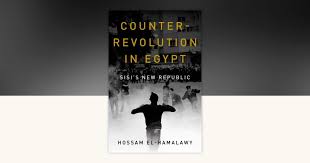
Interview with Hossam el-Hamalawy, author of Counterrevolution in Egypt: Sisi’s New Republic


18/01/2026

Hi again, Hossam. Since the last time we spoke, you’ve become a doctor.

That’s true. I finished my dissertation, and now it will be published by Verso. I’m really honoured to have a book with them that will come out this May.

Maybe you can explain what the dissertation and book are about.

It’s based on research that I’ve conducted from 2018 till 2023, but in practice, it’s based on over two decades of my involvement in the dissident movement in Egypt – as a journalist, as a photographer, as a labour organizer, and also as a researcher who’s been interested in the repressive apparatus of the modern Egyptian state. 

The main argument of this book is that, contrary to the general belief that a counter-revolution restores the old order, actually, the old order has failed. This is not a failure around governance and human rights and social equality and what have you. In the eyes of the counterrevolutionaries, the old regime has failed because it failed to repress the revolution. This is why the kind of regime that evolves out of a victorious counter-revolution is usually one that tries to avoid the mistakes of the past. It is even more repressive and more efficient at repression. 

This is not uniquely an Egyptian phenomenon. When the German revolution failed, you didn’t get the Kaiser; you got Hitler. When the Italian revolution failed, you didn’t get a constitutional monarchy; you got Mussolini and Fascism. When the Egyptian revolution failed, we didn’t get Mubarak; we got Sisi.

Are you arguing that Sisi is objectively worse than Mubarak?

Objectively worse, but also different. And this is what’s more important. My book tries to explain how this regime is different from the previous regime. I mainly focus on a couple of things. One is how the security apparatus was organized before the coup, and how it is organized now. 

The modern Egyptian repressive apparatus was born after the 1952 coup. It was fragmented by design. In 1952, we had a coup by a group of eclectic nationalist army officers who called themselves the Free Officers. They were led by Colonel Gamal Abdel Nasser, and they overthrew the British-backed monarchy, and declared a republic a year later.

There was a lieutenant colonel among the conspirators. His name was Zakaria Mohieddin, and he was dubbed as “Nasser’s Beria”, in reference to his role in restructuring the security establishment. He was Nasser’s right-hand man, like Beria under Stalin.

Mohieddin organized the Egyptian modern security apparatus, and he fragmented that apparatus by design, because the immediate concern of the officers at the time was simply a counter coup. This was very fashionable. There was a joke at the time in the Arab world, for example, that the officer who wakes up the earliest usually stages a coup. Coups were the order of the day at the time. 

If your dominant perceived threat is a military coup, you fragment your apparatus. You create organizations with overlapping mandates in competition with one another. They hardly exchange information, and the communication channels are not horizontal. Only the ruler would have the bird’s-eye view. 

When it comes to the security sector, the interaction between the components of the Egyptian repressive apparatus for decades, whether it’s under Nasser, Sadat, or Mubarak, shaped Egyptian politics. This formula basically continued up until 2011. 

Someone would naturally ask, were the rulers only worried about a military coup? What about the people on the streets rising up? Now, it’s natural that any autocrats, if they want to stay in power, have to protect themselves from all sorts of dangers and threats. However, at the same time, there is always one dominant perceived threat. And they organise their apparatus according to that dominant perceived threat. 

Up until 2011, the Egyptian ruling class never took us seriously. They knew that every now and then, you could have riots here, some protests there. But they never imagined, even in their worst nightmares, that a revolution like 2011 could take place. So now you had a revolution, and for two and a half years, the gallows haunted the dreams and the nightmares of the Egyptian ruling elites and generals, until the coup happened in 2013.

The generals who led the coup, together with el-Sisi, who was the minister of defense back then, regarded Mubarak as too weak, too lenient,  someone who gave so much room for the press and NGOs to criticize him. If it wasn’t for his leniency, they said, we wouldn’t have had this catastrophe of 2011.

So they opted for a new model, which rested on two main things. One is that they unified the security apparatus for the first time since 1952. The components of that apparatus are mainly the military, the police, and the General Intelligence Service. For the first time, they were forced to coordinate and to unite these three components and to exchange information in order to face this existential threat of a revolution. 

In the book, I trace how Sisi reorganized that apparatus. It wasn’t an easy job. This wasn’t just an automatic transition that the security services had opted for. There were those inside those organizations who resisted, and they had to be purged. 

That is one thing. I argue that the other thing that distinguishes the Sisi regime is that while it is true that Mubarak was a dictator, he presided over a vibrant civil society, and this civil society acted as a buffer to protect society from the excessive intrusions of the executive state. 

It also protected the state against a potential uprising. Let me give you a concrete example. If atrocities flared in Gaza, Mubarak was worried that this might trigger riots and mass protests in Egypt. But he had the Muslim Brotherhood, a mammoth organization that existed in almost every province in Egypt. They were reformists and were more than happy to play the game with the regime, and Mubarak would turn a blind eye and allow the Muslim Brotherhood to hold protests, which never chanted against Hosni Mubarak, never left the university campus to go into the streets, and never left the premises of the professional syndicates. These protesters never chanted against the police. They never clashed with the security forces. And if things got out of hand, Mubarak would send in the Central Security Forces, which is our version of the riot police.  

If there were rising frustration in society over the deteriorating living conditions. Mubarak had a network of Salafi sheikhs who could use their Friday sermons to start blaming unveiled women, or Christians, or Shia, for the economic malaise. To divert attention, they could tell everyone it’s a moral crisis before it is an economic crisis. 

If there were industrial actions flaring, Hosni Mubarak had the state-backed General Federation of Trade Unions, which was a pyramid-like structure dominated by state bureaucrats. They had a presence in almost every workplace. 

Mubarak would strike a bargain with those bureaucrats, together with striking a bargain with the legal left-wing organization, the Tagammu, which was our die Linke more or less, or with the Egyptian Communist Party. These bargains defused the industrial militancy in exchange for some seats in parliament.

More importantly, there was something called the ruling National Democratic Party, a mammoth organization that existed in almost every neighbourhood in Egypt. These guys were not just thugs for the regime. They were bureaucrats who were the product of generations of experience from the Nasser time—the Arab Socialist Union days. This was the one party of the regime. And they all transformed themselves and metamorphosed into the National Democratic Party. 

These guys had 20 or 30 or 40 years of bureaucratic experience. They knew how to wield power. So, if you had a problem in your neighbourhood with the police or with the authorities, before you go and set yourself on fire in front of the police station, you would go to your local NDP guy. You would talk to him, and in exchange for a small bribe, or even for free, he would act as a mediator between you and the state to solve the problem. 

Now, Sisi and the generals saw this as one of the reasons for the “catastrophe” of 2011. So the kind of regime that they built after 2013 rested on unifying the security apparatus and completely destroying civil society. Egypt is now being ruled without a ruling party, without opposition, without NGOs, without independent trade unions, without even the old power structures that Hosni Mubarak had. 

Instead, you have the state micro-managing society on a daily basis, without any buffer in the middle. You have the repressive arm of the state, meaning the military, the police, and the intelligence service, who are cannibalizing the civilian organizations of the state. 

So, for example, many of the responsibilities of the various ministries and civil agencies were transferred to the military. It is true that since 1952 and especially under Mubarak, the regime used to pump in retired officers into the bureaucracy. This is not new, but what’s new here is, first, that it’s being done on steroids at this point. And secondly, officially, the military institutions are now replacing the civilian institutions. 

If you want to know which military agency is running what sector in Egypt, simply go to the Facebook page of Sisi’s presidential spokesperson, where the guy posts daily pictures of whatever meetings Sisi is having. Look at any picture at any point of the day, and examine the attendees. Each civilian official would have a military counterpart. The latter has the upper hand.

For example, when he tells you that today, Sisi held a meeting to discuss the agricultural sector, on Sisi’s right will be the Minister of Agriculture and the Minister of Irrigation. On the other side will be Colonel Bahaa el-Ghannam, who is now running the Future of Egypt agency, which is the business arm of the Air Force. The Air Force is now in charge of our agricultural sector, believe it or not. 

If Sisi is having a meeting to discuss education policy in Egypt, you would find the Minister of Education sitting on one side of the table. On the other side would be the director of the Egyptian Military Academy. So it’s the Egyptian Military Academy that is now running the education sector.

Starting from 2023, every single applicant for any civil service job has to be vetted by the Egyptian military academy. I’m talking here about every single civil service job, where, after you pass your exam, you go to the Egyptian Military Academy for six months, where you go through an ideological indoctrination boot camp

You wake up in the morning, and you practice sports just like a conscript. You do physical training, and then you take courses and classes on national security, on the conspiracies to bring down the state, and what they’re calling “Fourth generation warfare” – a crackdown on internal dissidents who are serving foreign powers without even knowing.

You’ve talked a lot about how the state has restructured itself and tilted towards more naked repression. The history of Egypt and the history of the region show that naked repression of its own will not sustain itself indefinitely, that there will always be discontent. I presume there is discontent about Palestine and about living conditions. What’s the state of our side? You’ve explained well what their side is doing. Is there any organised attempt to counter this? 

At the moment, the situation is bleak. I will not try to paint it as rosy. First, after the coup, Sisi started cracking down on the Islamist opposition, mainly the Muslim Brotherhood, but also the Salafis and the Jihadis. And then he started cracking down on the secular opposition, whether they are on the left, liberals, or youth groups. He dismantled all of them, killed scores of activists, and imprisoned tens of thousands of others.

From 2011 to 2021, 43 new prisons were built. The prison population is very difficult to estimate because there is no transparency whatsoever. Some figures ran as high as 60,000 political prisoners at some point. Now, I think that the number has gone down to anywhere between 10,000 and 20,000.

The Egyptian left, meaning our side, has been largely neutralised and destroyed. And this happened through mass arrests, through drying up the funding of these organisations, through security crackdowns. Then the regime also adopted this revolving door detention technique called Tadweer in Arabic, which means recycling.

They will arrest you today and hold you in pre-trial detention for, let’s say, a couple of years. on some bogus charges. Then, before you go on trial, they will release you on paper, but accuse you of the same things in a new case. So you stay in this revolving door forever. You have people who have been recycled for over seven years. No trial, just getting in and out on paper.

At the same time, this is not a reason to despair. I always say this, there is a saying: “The Darker the Night, the Brighter the Star”. We are Marxists who understand the dialectics. This means that even when there is the worst kind of repression, it’s laying the seeds for opposition.

What’s been the reaction of the Egyptian street to the ongoing attacks on Gaza?

It’s been largely muted compared to the previous decade. I am 48 years old. I got radicalised through the Palestinian cause. My political upbringing was always through solidarity with the Palestinians, and it’s through this solidarity that I got into radical leftist politics. 

But what has happened is that under the sheer level of repression that the country has seen, most of the organisations have been destroyed, and there is also fear among the public. It would be suicidal to have a protest for Palestine. 

Despite all of that, with the outbreak of the war on Gaza, spontaneous protests did take place on the campuses. These were probably the first protests that the campuses had seen in almost a decade since Sisi pacified them. There were also sporadic protests in mosques and public squares, but the state cracked down and arrested hundreds. As I’m talking to you today, there are at least 120 people who have been in prison in pre-trial detention since 2023.

At the same time, the regime was spreading through the media that Sisi was doing its best to disrupt the transfer scheme and the expulsion of the Palestinians into Sinai, and that we’re doing our best to help our Palestinian brothers, even though, at the end of the day, Sisi was completely complicit in this war. 

That’s why it didn’t translate into mass protests in the streets, but it revived this sense slightly, and solidarity with the Palestinians was expressed through other forms, especially the boycott campaign, which spread like wildfire in Egypt.

What has been the reaction in Egypt to the recent developments in Iran? 

It’s been mixed, depending on the kind of news they are receiving. There will definitely be a section of the Egyptian public who would buy into the propaganda that the whole thing is solely about Israelis bringing down a regime that’s anti-Israeli. But I would say that the majority of Egyptians would find parallels between themselves and the Iranian protesters.

What triggered this mass wave of protest in Iran is the deteriorating economic condition and sheer brutality of the state, which is something that the Egyptians know quite well. So I think Egyptians will be watching closely and also contemplating whether something similar could happen in Egypt.

Of course, you cannot predict the future, but what could happen next in Egypt?

I am hopeful for a very simple reason. Sometimes, a counter-revolution could diffuse the factors that led to the outbreak of the revolution in the first place. Some counter-revolutions are successful, not just because of repression, but because they also address those problems. This is not the case in Egypt.

To put this in clearer terms, the 2011 uprising did not happen simply because activists or opposition figures decided to mobilise. Individual action and political agitation matter, but they are never enough on their own. Revolutions emerge when broader structural conditions make society combustible, and when organised political forces are able to intervene at the right moment.

In Egypt, two such objective conditions came together. The first was pervasive political repression and routine police brutality. The second was social injustice, particularly the unequal distribution of wealth and the steady deterioration of living conditions. These factors created a society primed for explosion.

What was missing for long periods, and what briefly materialised in 2011, was what Marxists call subjective intervention. By this, I mean the presence of organised actors, networks, and movements capable of translating popular anger into sustained collective action. The counter-revolution did not resolve any of the underlying structural problems. On the contrary, repression intensified, and economic conditions worsened. This means the objective conditions remain firmly in place. What remains absent, for now, is that organised political intervention capable of turning discontent into a mass challenge to the regime.

Did the counter-revolution provide answers or solutions to these problems? No, they actually made it even worse. Today, when it comes to political repression, Hosni Mubarak is a human rights activist compared to Sisi. When it comes to the economic conditions, many people are yearning for the Mubarak days. I don’t blame them when they say: It wasn’t that bad under Mubarak. 

The existence of these two factors means that there will always be an environment that’s fertile for resistance. What’s missing here is the subjective intervention. And over the past few years – and this got accelerated by the genocide in Gaza – there’s been a slight revival in left-wing activity. It’s still very confined to the margin. But this margin did not even exist a few years ago. 

Simultaneously, there is an increased wave of industrial actions, not on the same level as the waves in 2006 or 2011, which was our winter of labour discontent that made the road to the revolution. But an incremental increase is happening. In 2025, at least 100 labour protests were recorded, and these are the ones that we know about. There will definitely be other wildcat strikes that we couldn’t know of. 

These strikes are triggered by low salaries, and by the management refusing even to implement Sisi’s decrees of raising the national minimum wage. So, managements are not even sticking to that bar that the government is setting. Amid this industrial action, this creates an audience for people like you and I to start talking socialism again.

Does the fact that things are now worse than they were before 2011 mean that the Arab Spring was a failure? 

I’m not a fan of dichotomies or of binaries, saying that something failed, or something didn’t. That wave of the Arab Spring, or whatever you want to call it, as some people don’t like that term, has been defeated; there is no question about that. But this is not the end of the story. I would disagree with the kind of narrative that sees defeat as the end. There are people who have seen this revolution, and they are still alive. 

In the 1990s, when my comrades and I were starting in underground cells trying to talk about revolution against Mubarak, people treated us like lunatics, like extraterrestrial aliens. What are you talking about? We never had a revolution in this country, or the last time we had a revolution was in 1919, against the Brits.

Today, you can tell an 18-year-old to look at YouTube, in order to find footage of what happened. This makes the revolution an actuality, something concrete, and not just something abstract that you read about in books. You’ve seen it happening. 

This is one of the positive things that came out of the Arab Spring. At least when we are talking about a new revolution, there is something concrete that we’re based on. But I would say that this first wave definitely got defeated. But let’s learn from it, build on it, and take the movement forward. 

Is there anything that you haven’t said that you’d like to add?

One last thing is that comrades here in Germany have a role to play. You are in the belly of the beast. Sometimes people romanticise the global South. They say: “That’s where the repression is, so that’s where the revolutions will happen. We will never see it here in Germany”. That’s not true. 

The entire capitalist system is getting into a crisis, and we’ve already started to see symptoms and signs of it, whether it’s here in Germany or in the industrialised West. People here in Germany and in Europe and in the West have a role to play. This role is number one: you reign in your own governments from supporting and endorsing our regime. 

One of the main reasons why the counter-revolution prevailed in Egypt was that it was endorsed by regional and global allies, and that would include Germany. So you have a role to play in pressuring the local government here into stopping support for Sisi.

On the other hand, there will be a rise in social dissent here in Germany. There is no question about it. This is not because Germans are left-wing or right-wing, but because the economic situation is deteriorating. If you are not organised enough, people will start looking to the far right for answers if the radical left is not ready with those answers.

Any local fight that you engage in here in Germany is helping us in Egypt. It’s not just about protesting in front of the Egyptian embassy. If you win a fight against the privatisation of the S-Bahn, you are helping the Egyptian revolution. If you win a fight here against the cuts in social spending, you’re helping the Egyptian revolution. If you bring a halt to this militarisation drive here in Germany, you’re helping the Egyptian revolution.

The entire capitalist system is like a matrix. You weaken it in one spot, and that helps all the other ones. 

Your book is now available for pre- order. How can people order it? You can pre-order on the Verso website. You can also order via any book-selling platform, including Amazon, but I would prefer that you buy from Verso directly.
Power and powerlessness

What next, after Gaza broke the art world?


17/01/2026

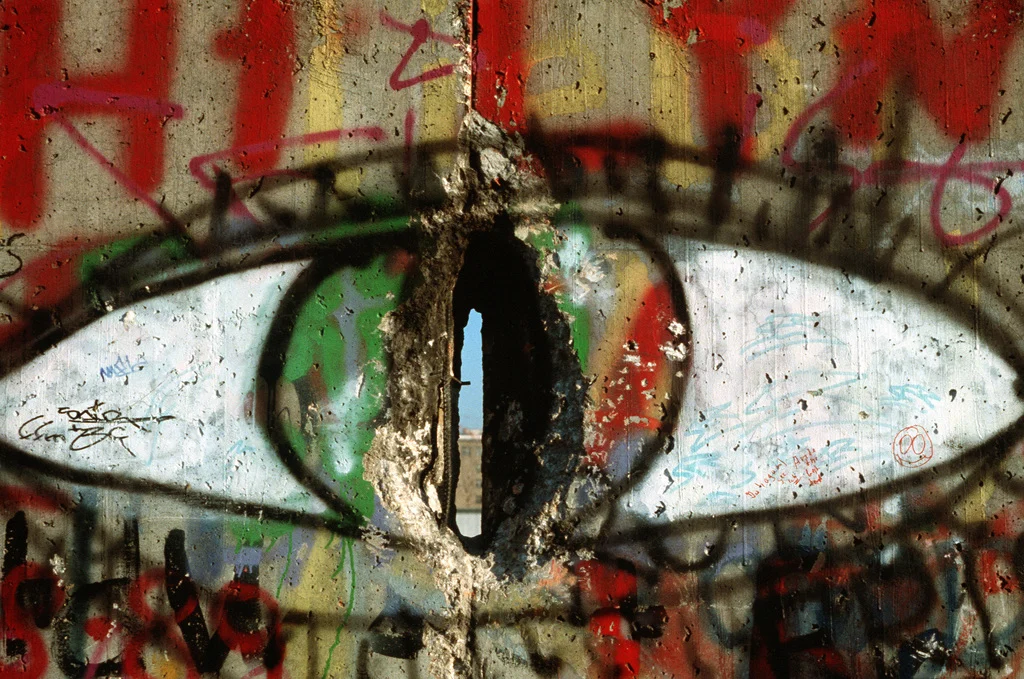
Graffiti eye with red and green iris. There is a huge gash cutting right through the eye and showing view of something on the other side of the wall.

At the end of 2025, three articles once again articulated—from different perspectives—the silence and failure of political discourse in the art scene. David Velasco, long-time editor-in-chief of Artforum, the US “North Star” of art criticism, reflected on and recapitulated the past two years of “division, fear, and silence” in Equator, the British online magazine for politics, culture, and art. In October 2023, a few weeks after the Hamas attack in Israel and the publication of a letter of solidarity on the Artforum website signed by more than 8,000 people calling for Palestinian liberation and a ceasefire, Velasco was fired without notice. Bonaventure Soh Bejeng Ndikung, who had been director of Berlin’s Haus der Kulturen der Welt (HKW) for just ten months at the time, summed up shortly before Christmas that he did not want to get drawn into political debates, but rather “talk about humanity in the coming years and decades, perhaps for the rest of my life […] so back to those Christian values we always talk about.” A few weeks earlier, Berlin-based artist and activist Adam Broomberg had published a scathing critique of the “Global Fascism” exhibition at the HKW.

At the end of his essay, Velasco writes that he has spent the last two years in an “unofficial hiatus” from the official art world. His final sentences: “It’s increasingly hard to care about the fate of an art world narcotised by money and self-regard. We had a chance to at least try and make a difference. We had a chance to not sell ourselves out. We had a chance, and we blew it. This did not end well, and still we can choose to begin again, tilting—collectively, contingently—toward the pitch of liberation.” He does not elaborate on his optimism. I would like to share it, because capitulating to the power of the market and the violence of power has also mentally catapulted me out of a “scene” that I always wanted to understand as a left-liberal seeking a self-critical public sphere. This basic trust in a shared world, which uses artistic work to address the dilemma of subjectification and subjugation, of deviation and form, has been shattered. Definitively after October 7, 2023. In recent decades, during which I was involved in the art world as a writer, researcher, and curator, there have been various phases in which momentous political events—such as the imposition of martial law in Poland in 1981, the first Iraq War in 1990, the Tiananmen Square massacre and the fall of the Berlin Wall in 1989, and the crushing of the so-called Arab Spring after 2011—during which I was unable to find the peace of mind to turn my attention to individual works. But art also participated in all these events, albeit with a delay. Without the work of artists, the discussion about the colonial basis of power in the Western world would probably have remained confined to academic circles in Europe for a long time. In this very world, there is now—once again—talk of the “end of the West,” of democracy, of the transatlantic alliance. In 2003, an important congress was held at the HKW: “Former West” (March 18-24). From the flyer: “Although the events of 1989 shook the world to its foundations, the West stubbornly clung to the fiction of its own superiority. Former West examines how contemporary art can unhinge this fiction and at the same time rethink the future.” The fiction is gone. Which art points to the future?

In his text, Velasco reconstructs how—not so much why—Gaza broke the art world. The means and methods were repressive: staff dismissals, cancellations of exhibitions and award ceremonies, criminalization, and legal prosecutions. In the context of art, it was (almost) always just about language and images—not about violence, sabotage, or self-interest. It was about words and works demanding justice for Palestinians (including the right to mourn) and an end to Israel’s internationally supported armed violence, which killed tens of thousands of Palestinians in a very short time. In the “cultural nation” of Germany, “reasons of state” became a tool to intimidate and silence criticism of Israeli policy (see archiveofsilence.org). According to Velasco, grandiosity “is one of the art world’s key features, the soil for its spectacular financialisation—its unparalleled ability to transform radicalism into capital. This grandiosity was inflected in much of the bright and lofty material that we published. The stakes were high; we believed we were writing history, and we often were.” During the crackdown on the Gaza protests, it was the collectors, galleries, and institutions that demanded ‘calm,’ not the artists. “Some collectors are calling up individual artists who signed, threatening to sell off their works or stonewall exhibitions by refusing to lend to museums. […] I am aware that much of the sentiment is divided by class: the letters’ signatories are mostly artists, the letters’ detractors are mostly their dealers and collectors. This is not a new rift in the art world, but Palestine seems to have deepened it beyond repair.”

What was striking in Germany after the Hamas massacre and the subsequent sanctioning of Palestinian solidarity was the role of curators and directors of art institutions, who positioned themselves hierarchically and firmly above the “opinion” of artists. Velasco highlights a prime example of this: Klaus Biesenbach’s distancing speech at the opening of Nan Goldin’s exhibition at the Neue Nationalgalerie. In the spring of 2024, however, two artists, Bank Cenetoglu and Pirvi Takala, confidently canceled their exhibitions at the Neuer Berliner Kunstverein because, in their opinion, its director did not distance himself clearly enough from Israel’s war policy. No artists, no exhibitions. Marius Babias then published a cryptic statement: “We are seeing increasing attempts to instrumentalize conflicts for personal agendas and reject the adoption of predetermined political positions.” It becomes apparent in that and his interview with the Berliner Zeitung, that his understanding of art is as the pure language of the works versus a political language and which politics lies behind this idea. “For us, the artwork is in the foreground; the messages should be codified in it.” (Spiegel) It is about the detachment of the work from everything: from the author, from an external artistic public, in principle also from its time, in order to propagate concepts such as autonomy, independence, and institutional self-determination—but only within the framework of the White Cube. This is the place where art is negotiated and nothing else. The institution exists precisely to maintain this fiction. To the point of self-appeasement, when Babias says: “In practice, the Bundestag’s resolution on the BDS is irrelevant to us. That was and is symbolic politics. […] We deliberately did not sign GG 5.3.1, like many other institutions. As it now turns out, the initiative further politicized the debate and polarized the arts instead of defusing it. […] The anti-discrimination clause in its originally proposed form would have had just as little impact on us as an institution as the BDS resolution.” One can only hope that such wishful thinking will not be followed by a rude awakening… Babias’ concept of art refers to the Enlightenment and fascism, mentions postcolonial discussions, but does not mention that all of this could also have an impact on the concept of art, the art system—if it were not immediately absorbed by the cunning of capital (see Velasco). Curators are a new profession that cultivates and encloses art. Previously, only art historians held leading positions. 

The Berlin art bubble is international. Many artists who live here have fled repressive and violent regimes. Many also refer to the knowledge and experiences of non-Western and indigenous practices in their art. Why is criticism of “our art system” not becoming louder and more radical? I often recall a conversation I had with London-based Roma artist and curator Daniel Baker in 2020 on the occasion of the FUTUROMA exhibition in the Venice Biennale program. The exhibition attempted to transfer the impulse of Afrofuturism—namely, to retell history from a subject position—to the discriminated community of GRT (Gypsy Roma and Traveller). Among other things, he said: “The idea of a closer connection between the practices of art and life also has implications for reclaiming art from the privileged arena of the museum and an art world focused on market interests and knowledge hierarchies—on a separation of intellectual, cultural, and financial capital.

“You live in Florence, the birthplace of autonomous art, and encounter the meaning, power, and joys conveyed by Renaissance artworks on a daily basis. At their core, however, these objects remain instruments of the power of the state and the church. The audience is convinced of the transcendental nature of art, of its beauty and skill, which serve to promote ideas and narratives that point away from everyday life and toward the deeply spiritual and intellectual. This model of separation is how the modern museum is still understood, and from my perspective, there seems to be little appetite for approaching things differently.”

Returning to Ndikung’s interview with Deutschlankfunk, he suggests that he can work freely as a curator without taking a position in political debates: “My only position is humanity. I will not compromise. […] I don’t care who is holding the gun. That’s why I won’t get drawn into this debate. And my job is to keep the spaces open, to keep the art spaces open. People from Palestine, from Israel, from Syria, from Haiti, from Myanmar, and elsewhere will always have a place in [the HKW] to present their artwork.” That sounds confident, as if it were possible to stay away from power constellations, even to free oneself from them, even when working within them. 

In his aforementioned text about the “Global Fascism” exhibition at the HKW, Broomberg mentions the necessary, subtle “anticipatory obedience” of a state institution in its concrete exhibition policy, and reminds us that its director also had to clearly distance himself from BDS before taking office. In 2014, Ndikung allegedly wrote on Facebook: “You will pay millions for every drop of blood in GAZA! Palestine must be free […] come rain or shine!” and signed the open letter from the “Initiative GG 5.3 Weltoffenheit” (Initiative GG 5.3 Cosmopolitanism), followed in 2021 by the open letter “Palestine Speaks,” which called on the German government, among others, to withdraw its support for Israel. Yet in the 2025 interview, Ndikung speaks for “humanity.” Meanwhile, Broomberg criticizes how “Not one work in the [Global Fascism] exhibition acknowledges the world burning just beyond the door.” The only Palestinian artist in the exhibition is represented with a work from 1974, which is described in the exhibition guide as “a possible allegory about the burden of Palestinian existence under occupation.” Broomberg’s bitter conclusion: “What were once our most progressive institutions and artists have become instruments of that silence, helping the genocide to proceed politely. When an institution reaches this level of corruption, it neutralizes any political potential of the art it shelters. Every work becomes a prop in the pretense of inclusion, queerness, Indigeneity, and postcolonialism. This theater serves the institution’s simulation of anti-fascism. […] The fact that these institutions—apparently in full seriousness—engage with ‘global fascisms’ while blithely enabling it at home is salt in the wound of the German cultural scene’s demise.”

In public institutions, one can assume a direct relationship of dependency between management and the state, i.e., obedience. In so-called “grassroots democratic” institutions such as the numerous German art associations, power is exercised through the rules of representative democracy: the members elect a board of directors. And this board is usually not made up of artists and citizens, but of potential sponsors (savings bank directors, private patrons, collectors). On the surface, it is often said that they alone are in a position to personally absorb the financial risk of failure—although this has long since become an industry for insurance companies. I never wanted to work in “powerful” institutions, perhaps because I took the pressure to represent too seriously. But in both art associations where I worked as director, I learned how fragile the protection of artistic freedom is. When I wanted to exhibit Hans Peter Feldmann’s cycle “Die Toten” (The Dead) at the Badischer Kunstverein 25 years ago (the independent book publication was already available), the board blocked the exhibition preparations and invitations could not be sent out. The work “Die Toten” documents, used previously published media images: 100 people who died between 1967 and 1993 in connection with the RAF—victims of the RAF as well as RAF members. After extensive discussions, in which Feldmann also participated with written statements, the conflict finally culminated in a meeting at City Hall and the question: Is the art association free in its work or should it be closed down? The conflict did not escalate further, the exhibition took place, and the art association was able to continue its work. However, if the representation of artists in art associations becomes too strong structurally—precisely as association members—this is often stopped, off the record, of course, as happened in the second association I headed. A tacit agreement then prevails between the financial backers (in this case, the state) and the board: it is better to remain among ourselves and retain control. There would be much to discuss…

Who decides what is permitted and in whose name? Is the political sphere limited to “state and civil society representatives, parliaments, global courts, organizations such as the United Nations or the UN Security Council,” as Babias told the Berliner Zeitung? It is not the controversy over “autonomous” art and activism that is decisive, but the recognition of power over (artistic) publics.

Now, at the latest, after Gaza broke the art world (Velasco), the upcoming discussion should be devoted to a retelling of recent art history and to searching for infrastructural relationships that can give space to the intimacy and intellectuality, the passion and sensuality of art in a self-determined way. It is time for a self-critical assessment: can we in the art scene really still assume that we live in the best of all possible (state-subsidized, highly professionalized) worlds? Can we only fight to preserve our vested interests? Shouldn’t the discussion about inclusion and exclusion concern not only the “others,” but above all our own systemic narrative? What trap have we fallen into? What went wrong? Do we also work with double standards and hypocrisy? Should we re-read and reinterpret our own past, that of the so-called rehabilitation of modernism after fascism and during the Cold War—as was done, at least retrospectively and to some extent, with Documenta2?

  1. The GG 5.3 Weltoffenheit initiative was an appeal in 2020 by numerous public cultural and scientific institutions in Germany, which spoke out in favor of freedom of art and science, research and teaching (Art. 5.3 Basic Law) and commented on the possibility of political abuse of the accusation of anti-Semitism in the BDS resolution of the German Bundestag. ↩︎
  2. Documenta. Art and Politics. German Historical Museum, (June 18, 2021 – January 9, 2022) ↩︎

The Government Cuts, Patagonia Burns 

Amid escalating wildfires, examine the government policies further fueling environmental destruction in Patagonia


16/01/2026

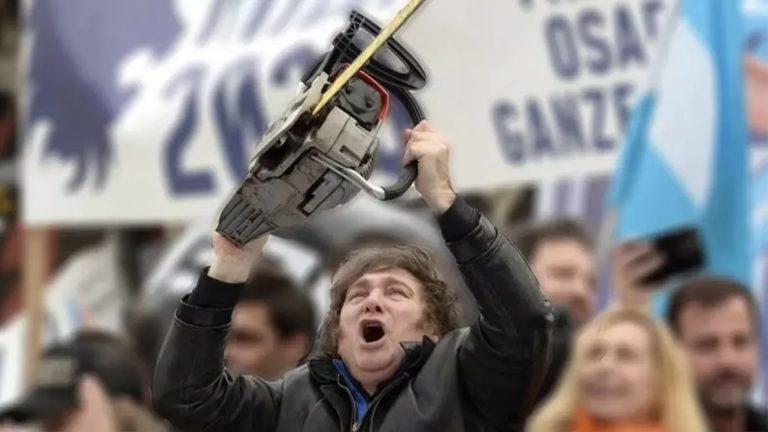
As has been the case for years, the Patagonian region faces its annual wildfire emergency. With each passing year, the toll becomes heavier. Entire provinces and regions are scorched by flames, families left without homes or land, animals burned along the roads, and the unquenchable shadow of real estate and mining speculation looms over the region. Undoubtedly, a significant portion of the responsibility can be attributed to climate change, but it is not the only factor at play. In this article, I will shed light on an issue that unites the two most pressing problems of the ultraliberalism touted by Milei: privatization and wild liberalization—practices intrinsically linked to environmental devastation. Specifically: what do we mean by “real estate and mining speculation”? What are the government’s responsibilities? 

When we talk about real estate and mining speculation, we refer to the measures the government intends to adopt to facilitate the entry of foreign capital by sacrificing the rich natural heritage preserved in these lands. In the government’s political agenda for 2026, the intention to repeal two crucial pieces of legislation regarding these matters is enshrined: the Ley de la Tierra (Land Law, 26.737) and the Ley del Fuego (Fire Law, 26.815). These laws are presented, in the final document drafted by the Consejo de Mayo, as obstacles to foreign investment. It is the Chief of Cabinet, Gabriel Adorni, who states it clearly in an official communiqué: “The prohibition on changing the productive activity of the land for 30 or 60 years after a fire will be eliminated,” concluding that the current measure “directly undermines production.” 

To delve into more detail, the first law sets a 15% cap on the total rural land that can be purchased by foreign agents. With the repeal of this law, this limit is removed, paving the way for unrestricted land sales and rampant real estate speculation. As for the second law, Articles 22 bis and 22 quarter are targeted. The first refers to native or planted forest areas and protected natural zones. It establishes a 60-year period, starting from the extinction of the fire, during which no change in land use or subdivision into smaller plots is allowed. Meanwhile, Article 22  quarter, sets a 30-year limit for all other areas of high ecological vulnerability. This means that no new economic activities (such as construction, cultivation, or industrial projects) can take place in these lands, to avoid further harm to biodiversity and natural resources. The joint repeal of both laws brings disastrous consequences, opening the door to land sales, real estate speculation, and environmental devastation by foreign interests. 

The people on the front lines fighting the fires are labeled heroes by the government. Milei posts on X his solemn thanks: “I want to send a special thank you to all the brigadistas, firefighters, and each of the volunteers,” concluding that there is “nothing more heroic than risking your life to save that of others.” Similarly, Chief of Cabinet Gabriel Adorni, also on X“I want to especially thank the firefighters and all those who risk their lives to save those of Argentinians.” These words, when compared to the measures taken by the government over the years, highlight the full hypocrisy that characterizes Milei’s management. The heroes the president speaks of are the very same ones whose salaries have been cut by more than 50% since December 2023. Today, a firefighter in Argentina struggles to make ends meet, with salaries that do not even reach 500 euros annually and working conditions that are precarious, on the verge of unsustainable. But the cuts haven’t only affected the salaries of those fighting the fires; in 2026, according to data provided by organizations such as FARNthe government plans to cut the budgethttps://farn.org.ar/documentos/ for the National Fire Management Service (SNMF) by 71.6% compared to the previous year (2025). Therefore, aside from the purely political propaganda posts praising the heroism of firefighters, the issue doesn’t seem to be a priority for the government. It’s no surprise that Milei is also one of the most vocal climate change deniers, another key figure in this theater of horrors. 

The government’s line is once again clear: Sell, cut, deny. All of this at the expense of one of the richest natural heritages in the world, considered expendable by the very people who claim to love these lands. Once again, ultraliberalism reveals its enormous destructive force. Even more so when intertwined with the consequences of climate change. Patagonia, however, is not only an enormous natural treasure. With its glaciers, lakes, and rivers, it represents the largest freshwater reserve in the Americas, and one of the largest in the world. Preserving it is the responsibility of all humankind. Selling it to the highest bidder is a crime against humanity. 

“A lot of our narrative as non-white people is rendered invisible”

Interview with Usayd Younis, co-director of a new film about Satpal Ram

Hi Usayd, great to meet you. Can you start just by introducing yourself? Who are you and what do you do?

I’m a British documentary director. I mainly make films about the global majority and improving the representation of People of Colour on screen. I’m currently based in Berlin.

What brought you here?

Nothing glamorous, really. My partner is studying here.

You have a film coming up in the British Shorts Festival. What’s that about? 

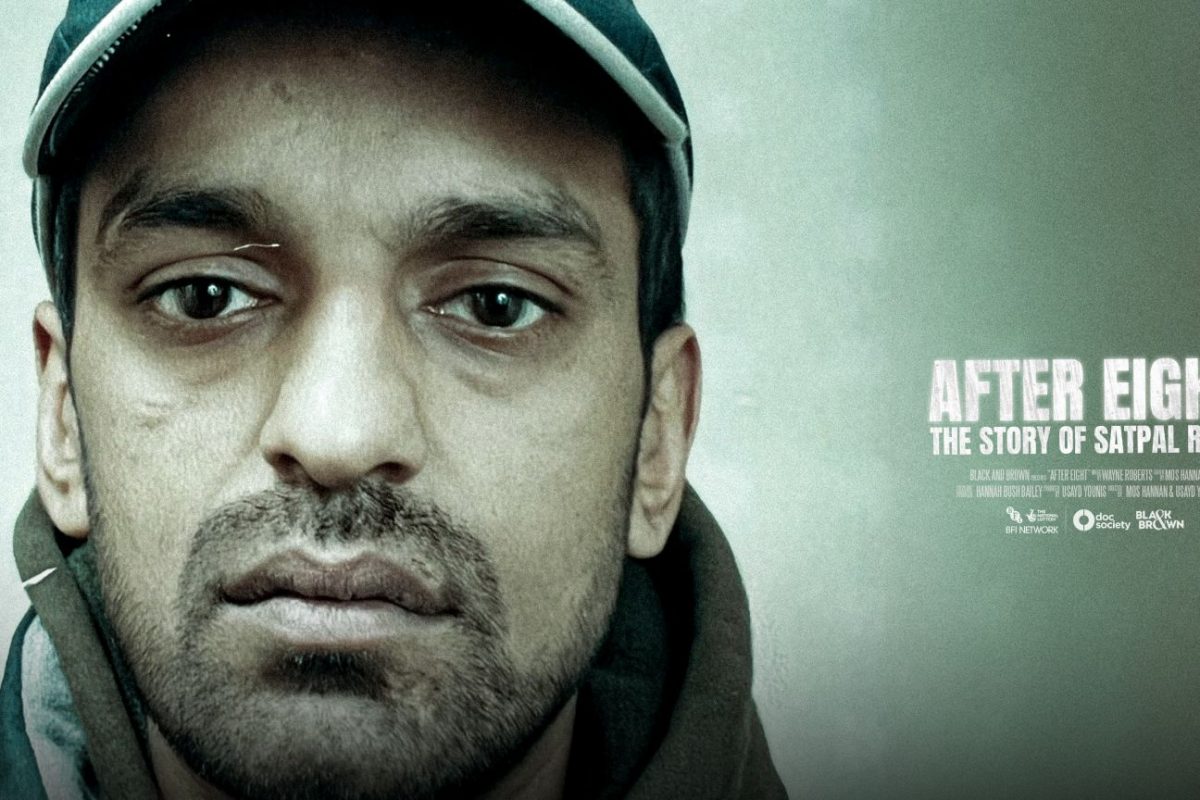
After Eight – The Story of Satpal Ram is about a British Asian man who went to jail in 1986 for defending himself against a racist attack. It’s set against the backdrop of Britain’s post-pub curry culture. From the 1970s to the 2000s you had this thing where a lot of British people would ‘go for a curry’. It was a cheap meal, but many people arrived inebriated and primed for confrontation.

Sometimes that transpired into violent racism, which is what happened here: Satpal was having a meal with some friends, and there followed an altercation where these guys were racially abusing the waiters and saying they didn’t want this “Paki” music on. Satpal objected, and he was cut in the face by this white diner. Satpal defended himself with a pocket knife.

Both of them ended up in hospital, and the assailant ended up dying of his injuries. Due to a series of failures by the judicial system, Satpal was not able to plead self-defence and got convicted of murder by an all-white jury.

Why was Satpal not able to plead self-defence?

A lot of the evidence was not taken into account. There was a presumption of guilt. It is important for the wider context of this project that still today there’s this assumption of guilt when certain types of people are arrested.

In Satpal’s case, this man had sustained multiple injuries. Satpal’s state-provided barrister had not really done his homework, and saw an autopsy saying that the man had sustained multiple injuries. He thought that no-one would believe that it was self-defence.

But most of the injuries were likely from falling on glass. Only two of them were sustained by Satpal’s knife. This completely changes the trajectory of what happened next, because once you change your plea from self-defense to provocation, you’re immediately admitting some degree of guilt. 

Other miscarriages took place in the trial itself. The Bangladeshi waiters who witnessed the event were not provided with interpreters. So the jury only got one side of the picture, with no mention of any provocation or violence. The testimony of the people who work in this restaurant and witnessed this racism was completely dismissed. In the film you’ll see how the jury were laughing when the judge said  he was going to translate himself.

So Satpal served 24 years in prison?

Exactly. This happened when he was 19 years old. He came out a much older man. We get to see him in the film grappling with the consequences today. It charts this incident, but also what actually happened in prison. The racism and injustices didn’t stop at the trial. 

In a world of ever increasing incarceration, it is important to reckon with what is actually going on behind these high walls and metal bars. In Satpal’s case, there was a lot of violence and racism. He experienced many beatings at the hands of the prison guards.

As a result, he was left with the condition of Parkinson’s disease, which is something that you might associate often with boxers, who’ve been beaten around the head a lot. 

Like Mohammed Ali…

Exactly. Satpal had a doctor’s note to prove that his condition was clearly brought on by contusions to the head, which would have been the result of violence by prison guards. 

He became known for standing up for the rights of other people. He wasn’t just trying to get himself free from the injustice he’s experienced, but also witnessing what was happening to his comrades in prison. He was very vocal about that, and the guards really didn’t like it, and tried to make an example of him. He resisted throughout, and as a result, his sentence was elongated. His appeals were rejected. 

But there is an upbeat side to this narrative. His friends and family led a campaign on the outside. This grew into something  much bigger. One of the campaigners, Helen McDonald, is a jazz musician. She said ‘we need to do something bigger here, and get some musicians involved’. 

She got a number of groups, including Asian Dub Foundation, who were up and coming at the time. Their song Free Satpal Ram reverberated around the globe. Suddenly, people all over the world were singing his name, and he was on the news. He gained a degree of fame that could no longer be ignored by the powers that be in parliament. 

Bringing it into today’s context, where we’ve got so many political prisoners, so many people who are in prison explicitly for standing up against injustice. I think that there is a real strength in showing the story of a man who was freed from prison because of extreme pressure from the outside.

The fact that there was so much solidarity: people would visit him in prison and send him letters from all over the world. He said it himself – it kept him alive. One of the things I’d really like people to take away from this is what can we do to support our comrades who are currently experiencing something similar, perhaps even more pernicious.

It’s now become legalized. It’s less miscarriages of justice, and more that this is what justice looks like – with arrests and convictions for people standing against a genocide or against climate catastrophe.

You say the campaign was huge. I’m from Bradford, one of the UK cities with the most people with a South East Asia background. Asian Dub Foundation played Free Satpal Ram at the Bradford Mela – a multi-cultural festival – and the place was buzzing. Then yesterday, I spoke to a friend, a politically aware British Asian, and she hadn’t heard of Satpal Ram. How could such a massive campaign disappear from our consciousness?

This is exactly why we’ve done this project. As a documentary filmmaker, my goal is to bring to light stories that haven’t been kept alive or have been silenced. Ultimately, I think a lot of our narrative as non-white people is rendered invisible. A lot of the time we are presented from a very particular lens. 

What really stood out to me about this story is that he didn’t take this thing lying down. He did not say: “Yeah, it’s fine, just be racist and attack me”. He stood up against it, and it cost him in many ways. That’s so important for us now. We’re seeing so much violence towards our communities. So much is reminiscent of a time that people had thought was behind us. 

But the race riots in the UK last year, where asylum hotels were attacked, are exactly the same kind of things that happened then. You’ve got Asian restaurants being set alight by arson attacks today. This is all happening now. It’s even more important that people are aware that it has a history. It has a context.

You’ve mentioned two reasons why the film is relevant today. On the one hand, there are the ongoing cases like Palestine Action, on the other active racism on the streets. How can a film change this?

A film is just a cultural piece that aims to galvanize people. It’s part of the wider movement of coming together and being able to draw solidarity from each other. 

When we’ve done screenings we’ve had the opportunity to have conversations with people who were involved in the campaign – to gain inspiration and feel recharged. Educating people so that these things are not forgotten is important, but it doesn’t end there. 

The film is part of a wider campaign to draw attention to what’s happening now and how you can utilize some of the techniques that people used back then that were actually really innovative at the time. The Internet was barely a thing, but people were flooding the Home Office fax machines. How can we translate that to today’s context? It’s so important to learn from our history, especially a history that may be otherwise completely forgotten.

How much chance will you have at the British Shorts Festival to discuss issues raised by the film?

One of the challenges with making a 30 minute film like this is that it stands alone, so having to program it alongside other films has been a challenge. We’re available to do a Q&A and hopefully there is a chance to have a conversation. I’m going to be there with  my co–director, so there will be at least the opportunity to talk to us. 

We do have the tools now to be able to take something that you see in a physical environment and carry that conversation on. Some showings will be accompanied with a Q&A, but in some instances, like the Shorts Festival, just being part of the festival makes a lot more sense. It’s quite hard to get programmed as a single short film.

But as you’re based in Berlin, the possibilities of organizing further screenings will still be there?

Of course. This is not just a British experience, though there are some uniquely British elements to this film. The UK has a much bigger South Asian population, for example. But I think Germany has some serious reckoning to do when it comes to racism and the right.

Germany has a lot to gain from learning from experiences of other parts of Europe, and thinking about how you treat your own non-white people who live here. I saw a staggering study recently saying that one in four people who come and live in Germany consider leaving. As someone who has been living here for 2 years I can fully understand that.

The racism here is even more blatant and direct. In the UK, they learned the language of shrouding some of that racism. And maybe it’s not always as blatant, but  here It’s really transparent, Germany will gain from learning from these stories as well.

Do you think things are getting worse in Germany at the moment?

Absolutely. You can’t ignore the fact that for more than two years, there’s been a genocide that Germany has taken an active role in. We have had to reckon with the fact that many of our compatriots here are not willing to advocate for the rights of people who don’t look like them, and are actually happy to allow their country to fuel extreme violence towards the Palestinian population. 

Germany has many facades about reckoning with the past, but justice is not the agenda here. A lot of people have just been trying to make themselves feel better about their history.

Do you think there’s a direct link between the demonization of Palestinians and racist attacks?

Yes. It would be a lie to say that this isn’t something that’s been here all along. When you constantly and consistently claim that one particular community are the villains, that is the pretence that can be used to recreate many of the conditions that already existed here in another context,

Let’s get back to your film. When and where can people see it? 

After Eight is screening on 24th January at 5pm in Sputnik Kino next to Hasenheide as part of British Shorts. If you can’t make that, then look at our website and Instagram page where we’ll have future screenings listed. We are also planning to get the film available online. We’re in talks with some fairly big online platforms, but that will be later in the year. Keep an eye out.

If someone sees the film and is appalled by what they see, what can they do?

Firstly they should spread the word about the film itself. It’s important that people know this story. But ultimately, it is about questioning in your context, how does this narrative apply? 

In Germany so many have been arrested with spurious charges just for daring to speak out. It’s important to think about what we can do to help. Can you offer material or emotional support for these people? What did you take from this film in terms of the strategies, the organizing and the collectivizing?

I think the individualization of struggle makes you feel small. But one of the things that stands out is that this really was a campaign. The way we found Satpal is a good example. We found him through somebody in Canada, even though we were in the same country as him. It ‘s all about the strength in numbers. 

So it’s not just a film for British Asians? 

No, definitely not. 

Is there anything we haven’t covered that you’d like to say?

One thing. As a documentary filmmaker here, I think it has been a challenge for me to figure out how to do this kind of work here, which is really directly challenging the status quo in Germany and in Berlin. It doesn’t seem like there is an environment which encourages independent work.

I think that is why organizations like The Left Berlin are so important, because it seems like most cultural production is tied to institutions. This became very apparent post October 7, where funding was being cut left and right. Why are so many people dependent on the state, when the state itself is what should be challenged? 

The work I’m trying to do is to be directly challenging and to reset the narrative. And to be able to do that, you have to be independent.

You can see the trailer for After Eight – The Story of Satpal Ram here. You can buy tickets for the screening in Sputnik Kino on 24th January here.

Red Flag: Greenland doesn’t belong to Denmark either

In his weekly column, Nathaniel Flakin takes aim at European hypocrisy in the face of Trump’s imperialism.


14/01/2026

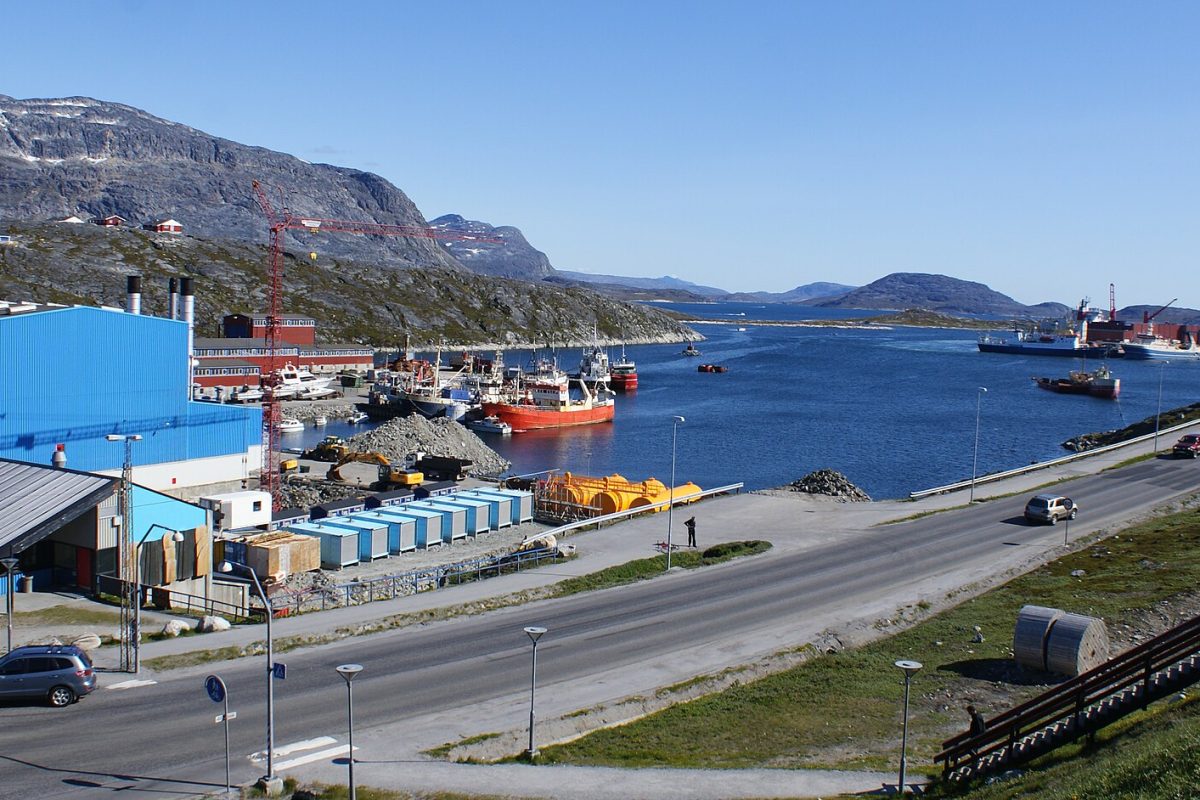
Nuuk

As soon as Donald Trump had finished kidnapping the president of Venezuela, he once again set his sights on Greenland. Trump advisor and fascist ghoul Stephen Miller said on TV that the island should “obviously … be part of the United States.” Channeling Hitler, Miller continued: “We live in a world, in the real world … that is governed by strength, that is governed by force, that is governed by power. These are the iron laws of the world since the beginning of time.”

Bourgeois Europe was shocked by Trump’s “unbridled imperialism,” in the words of Spiegel magazine. The leaders of France, Germany, Italy, Poland, Spain, the UK, and Denmark put out a joint statement: “Greenland belongs to its people,” they recited. “It is for Denmark and Greenland, and them only, to decide.”

But why is it for Denmark to decide, even before Greenland? Miller has a point when he asks: “By what right does Denmark assert control over Greenland?”

Imperialism

Imperialist powers want Greenland as climate change opens up the Arctic to shipping and mining. They don’t even feign interest in the well-being of the indigenous people of Kalaallit Nunaat. Danish colonialism has been particularly brutal, ripping hundreds of babies away from their mothers, while sterilizing thousands of women without their consent. U.S colonialism would be no less devastating, turning the island into a staging ground for World War III. 

A supposed leftist like Chris Cutrone, the founder of the odious Platypus Society, claims that the imperialist conquest of Greenland would be a continuation of the American revolution. But the peoples of Puerto Rico or Guam can say whether the U.S. today represents a democratic alternative to European colonialism.

If the U.S. army were to invade Greenland to seize its resources, that would be pure barbarism—but the Danish “claim” is based on violent conquest several centuries earlier. No one has any democratic mandate. Miller stated very openly that Greenland has just 30,000 inhabitants (in reality, 57,000) and he doesn’t care what they think. But EU policy has just as little interest in self-determination.

While EU leaders say Greenland belongs to its people—and to Denmark, apparently—France still denies self-determination to the Kanak people of New Caledonia. Spanish imperialism clings on to Ceuta and Melilla. The UK keeps a navy base on the Malvinas Islands. etc.

The European statement talks about “sovereignty, territorial integrity and the inviolability of borders”—but these principles didn’t stop NATO from attacking Afghanistan, Iraq, or Libya. Denmark’s imperialist military participated in all these crimes.

“Territorial integrity” didn’t apply when the EU backed independence for Kosovo or South Sudan. Many European governments recognize Palestine—but have done nothing at all to defend that state’s sovereignty.

Fellow Imperialists 

Trying to appease Trump, Danish politicians are emphasizing they are fellow imperialists. “We’re Already on Your Side,” one social democrat screamed in the direction of the White House. They also want to use Greenland for military buildup, to control the Arctic, and to extract rare earths. 

The European Union likes to present itself as a bastion of liberal values and international law. Yet as they continue to support the genocide in Gaza, they are showing the whole world that the “rules-based international order” is, at most, window dressing to cover up their own imperialist interests. Despite all the propaganda about the dangers of Russia and China, NATO remains one of the deadliest organization in the history of humanity.

The only people who should decide on Greenland’s fate are its indigenous population. In the age of growing inner-imperialist tensions, only socialists are defending such an elementary democratic right. Anyone serious about democracy and self-determination needs to call for the break up of NATO and the end of imperialism.   

Red Flag is a weekly opinion column on Berlin politics that Nathaniel has been writing since 2020. After moving through different homes, it now appears at The Left Berlin.