The Left Berlin News & Comment

This is the archive template

The alliance of Widersetzen” (“Resist”)

Is it possible to expand an anti-fascist action alliance?


01/02/2026

What has “Widerstzen” achieved? 

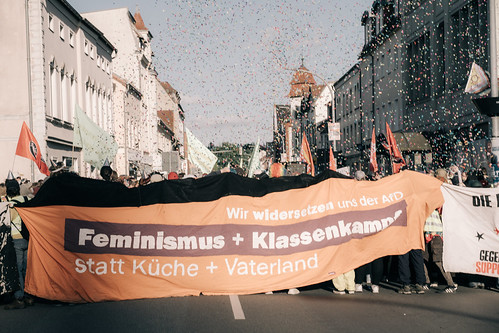
After Giessen comes Erfurt. For over a year and a half, the alliance “Widersetzen” (Resist) has been organizing acts of civil disobedience against AfD party conventions and the founding of the new AfD youth association. Previously in Essen (June 2024), Riesa (January 2025), and Giessen (November 2025), they succeeded in disrupting and delaying travel to and the staging of party meetings on a massive scale. With great media coverage, the message was: no room for the right wing. 

“Widersetzen” operates locally at a high level of logistical expertise. This must coordinate the nationwide arrival of buses and the traffic blockades of the various “fingers” / demonstration groups despite the police presence. [editor’s note: the Fünf-finger Strategie (five finger strategy) involves several demo blocks trying to break through police lines simultaneously. It was developed at anti-capitalist protests such as that against the G8 in Heiligendamm in 2007)].

At the same time, they use a high level of social competence in the preparation and follow-up to train the participants’ awareness and give them a sense of security in collective structures. “Widersetzen” thus generates self-efficacy in times of fear and “action gridlock.” ‘Widersetzen’ sees itself as part of “movement building” with its “networks of solidarity.” Its “campaign logic” and focus on the AfD (Alternative for Germany) triggers both criticism and discussion.

Widersetzen does not organize demonstrations, but rather it organizes civil disobedience by means of blockades. This means that participants need a dose of courage to physically position themselves on streets and intersections and thus literally resist the large contingent of AfD personnel and police. They also have to put up with hours of night-time travel in all kinds of weather. The group focuses on coalition politics, bringing in activists, trade unionists, for example Omas gegen Rechts, among others. This has to do with the urgency of the motivation, but also with the way the action alliance addresses, welcomes, and supports them. 

Widersetzen is a relatively new action alliance that has carried out three campaigns in less than two years, but has had—with quite spectacular results. Fifteen thousand people traveled to Riesa and Giessen, significantly delaying the AfD events. Eighty-five thousand people now follow “Widersetzen” on Instagram. Around a hundred local groups have been activated nationwide., and sStrategic discussions are being held in specific working groups. For example: “How can an anti-fascist movement in Germany grow and act efficiently without falling into rituals of exclusion?”

Especially – after the brief mobilization following Correctiv’s investigation into the secret plan (early 2024) and the Brandmauer discussion in winter 2025. – grow and act efficiently without falling into rituals of exclusion?

How does ‘Widersetzen’ organize itself and its supporters?

Anyone who wants to participate takes part in action training. This instructs  a large group of people, both precisely and kindly, on the various legal aspects and strategies of joint protection and resistance behavior. Those who attend these meetings learn and are prepared for joint action. The collective preparation leads to joint action and allows a follow-up, both personal and political. Such interactive care behavior is unusual for a political initiative, especially since it involves thousands of people, some of whom have no experience of resistance. The introductory meetings are about imparting experiential knowledge, care, and practical training. This is not a theory course nor one on the   history of civil disobedience, nor to debate strategies for anti-fascist resistance. This makes it easy to get started immediately without arguments between different political positions. The focus is on the obvious action: no room for the right wing. Many can agree with that. 

The homepage “Widersetzen” (resist) suggests neither an anti-fascist theoretical organ nor a militant left-wing project. In April 2024, the first online-meeting took place with 170 participants, who decided after 90 minutes to organize a nationwide resistance. After only 10 weeks of mobilization, around 7,000 people took part in their first actions.But the group also acknowledges its own weaknesses. Initially insufficient resources led to “unstructured work to defend against repression.” There was a lack of systematic legal review of the protests and clear agreements. Almost all processes were improvised spontaneously (www.widersetzen.com).

Learning from this, six months later, preparations for the blockades of the AfD federal party conference in Riesa were more thorough., Many, many preparatory action trainings took place nationwide, in union rooms, left-wing centers, and social spaces. They drew on the experiences of a network of movement-oriented action trainers in the run-up to and during the 2007 G8 summit in Heiligendamm.

On the website skillsforaction.noblogs.org, they offer their knowledge in the form of workshops, comprehensive manuals, and handouts. This knowledge transfer increased individual and collective capacity for action, and reduced fears and new things were learnt collectively. Anyone who wanted to board the buses to Riesa at 2:00 a.m. at the Berlin bus station had the chance to be prepared. They knew about the idea of civil disobedience; communication structures among themselves; mutual protection during the action; how to behave in the event of police intervention; the contact numbers of the investigative committee; practical equipment, and the action sticker. These preparatory meetings, some of which were attended by 60 to 80 interested people, already generated a feeling of group spirit, reliability, solidarity, and resistance “at home.” 

Widersetzen is a network in the making. An activists’ conference was held in Leipzig in October 2024. Thereafter structures became more professional, large digital planning meetings were introduced, and a clearer division of labor was established within the nationwide network. In addition to the network of local groups allowing decentralized anti-fascist initiatives, working groups meet to discuss awareness, repression, press, etc. 

Formally, “widersetzen” has no legal form; it is a donation-based alliance. Almost 100,000 euros were raised for the action in Giessen. In terms of press law and accounting, the VVN / Association of Victims of Nazi Persecution – Federation of Anti-Fascists e.V. is listed in the imprint. In Berlin, a group of about 80 people now meets weekly forming.As Mila from the Berlin group reports, it is: 

“a completely separate local group with its own understanding of political work. Like many other local groups from Mecklenburg-Western Pomerania, Rostock, Hamburg, and Greifswald, we supported the protest against the Nazi march in Demmin, but also last fall’s migrant-led We’ll Come United caravan from Thuringia to Berlin… “Widersetzen is an action alliance of groups that work in very different ways and have different political analyses, but nevertheless say: we can at least agree that we see the AfD as a great danger to democracy, to social cohesion, to solidarity, and that with the AfD, fascism is becoming increasingly likely. Mass civil disobedience is important because demonstrations alone no longer have any effect. There are a lot of people who no longer know: what can I actually do? Widersetzen offers them a collective space.”

How have “Widersetzen” activists assessed the organisation themselves? 

Back in June 2025, Raul Zelik asked in an article “Drivers of Fascism” whether fascism stems from fascist movements, or whether it “represents a deepening of existing power relations, in which the self-restraint of sovereign power (…) is lifted in the face of a crisis?”

However in issue 720 from last November, Antifa AG of the Interventionist Left warned against underestimating the independent danger of organized fascism, and sees Widersetzen as more than just as a one-off campaign.

 “Through its reach and networking, ‘Widersetzen’ is more than an action alliance. It is a place for discussion, strategy development, and anti-fascist (initial) organization. (…) An anti-fascist movement must be able to build social counterpower. But that takes time and movement building.” 

In December, the group “Demos neu denken” (Rethinking Demos) criticizes that the greatest strength of ‘widersetzen’ is also its limitation, namely its “campaign logic”. It calls instead for demonstrations to be understood as “movement publics” and “spaces for collective opinion-forming,” promoting self-organization and small groups. On January 20, Mine Pleasure Bouvar writing for a&k 722 summarizes these critiques with a 1932 quote from the German communist Ernst Thälmann:”The Anti-Fascist Action was too focused on demonstrations, conferences, and the offensive against Nazi terror, which undoubtedly has a good revolutionary side; but the Anti-Fascist Action was not sufficiently oriented toward strategic work in the factories and at the stamping stations.”

What is the current focus of work?

January 26, 2026: Just seven months before the state elections, the AfD in Saxony-Anhalt presented a 156-page draft of its election program, which is to be adopted at the state party conference in April.The party wants to counteract the alleged “extinction of the German people,” as it says verbatim, and to no longer provide state support to churches. A proposed “voluntary citizens’ watch” is to be introduced, subordinate to the public order office. Authorities are no longer to check the political views of gun owners. The State Agency for Civic Education is to be abolished as a “left-wing indoctrination institution.” Inclusion is to be ended, and children with disabilities are to be placed in special schools. History lessons are to teach the origins and “success story of this state.” The “normal family consisting of a man and a woman, from which children are born” is to be the model, and rainbow flags will be banned in schools. Associations should only receive funding if they have made “a credible commitment to the democratic order and a patriotic attitude.” Etc.

The AfD currently enjoys 40% voter support in Saxony-Anhalt. Regardless of differing analyses of fascism and capitalism, resistance – Widersetzen is necessary: now!
Between the nation-state and the citizenship state

A leftist reading of the Kurdish national project

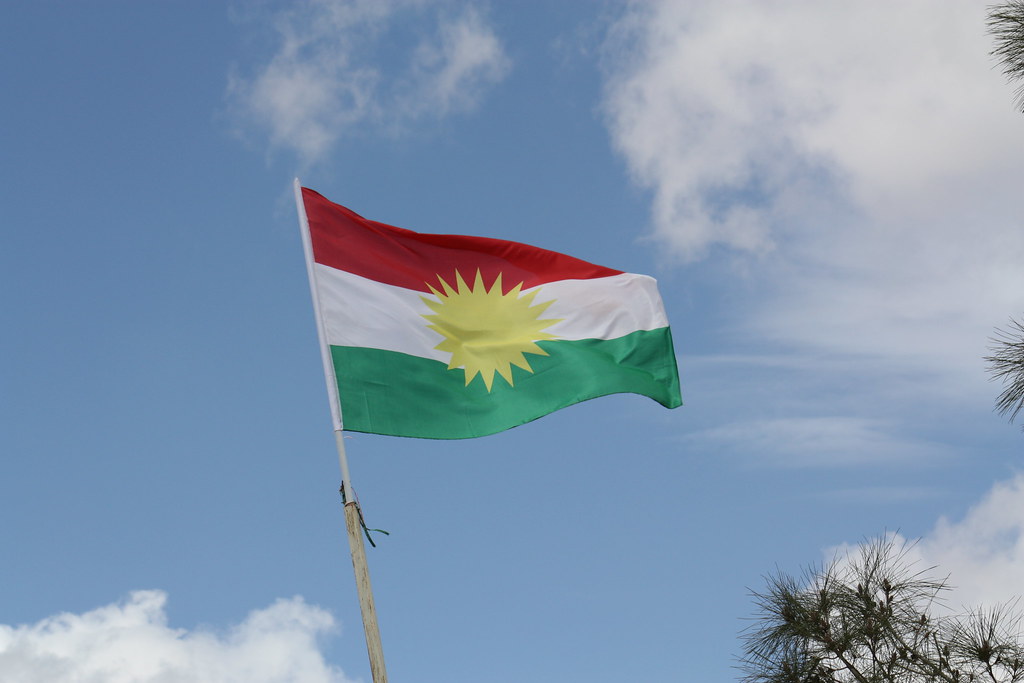
A Kurdish flag in front of a blue sky.

Introduction

The Middle East has witnessed bloody national conflicts that have left millions of victims and displaced persons. The Kurdish question represents one of the most important of these conflicts, as Kurds are distributed across four countries: Turkey, Iran, Iraq, and Syria. The fundamental question is: What is the possible solution now? Is it in building separate nation-states, or in struggling for a citizenship state with equal rights?

There has been and still is blatant national oppression against the Kurds. In Iraq, brutality reached its peak with the Anfal campaigns, the chemical weapons bombing of Halabja, and “Arabization” policies. In Syria, the Arab Belt and the 1962 census that stripped hundreds of thousands of their citizenship, and today in January 2026, this path is renewed through military attacks on areas led by the Kurdish Syrian Democratic Forces (SDF). Turkey has classified Kurds as “mountain Turks” and destroyed thousands of villages. In Iran, compound repression, executions, and economic marginalization continues.

However, these policies did not target Kurds alone; the dictatorship that crushes Kurdish identity is the same one that oppresses all citizens. The struggle against national oppression is part of the general struggle against tyranny. Confronting real oppression is not achieved by replacing one dominant nationality with another, but by dismantling the foundations of the exclusionary nation-state itself and building a democratic state based on equal citizenship.

From “Oppressed Nationality” to Ruling Authority

In the Kurdistan Region of Iraq, the “oppressed nationality” transformed into a ruling authority facing accusations of repressive practices and organized corruption. The two main parties established familial-tribal rule. A bloody civil war erupted (1994-1998) in which thousands of Kurds were killed, caused by the struggle for influence and resources. To this day corruption is rampant, salaries are cut off, and demonstrations are suppressed, while the two parties continue to monopolize wealth.

In Syria, the SDF transformed into an authority with a centralized character, with limited margin for pluralism. Despite progressive reforms in social aspects and women’s participation, these remained governed by a certain class and political ceiling. Human rights violations were recorded, including child recruitment and arrest and suppression and torture of opponents.

The nationalist discourse transformed into an ideological cover to justify tyranny and reproduce relations of domination. Historical national victimhood does not grant any authority absolution to practice oppression. The transformation of “oppressed nationality” into a “tool of oppression” represents the great moral defeat of the liberationist project, and proves that the flaw lies in the structure of the exclusionary nation-state itself.

Marginalizing Class Struggle and the Danger of Civil Wars

National conflicts push societies toward fanaticism and civil wars, in which the toiling masses become fuel for conflicts that do not serve their interests. Exclusionary nationalist discourse transforms the conflict from a class conflict between the toiling masses and the ruling classes into a false national and identity conflict. National conflicts are a tool for weakening class struggle and distracting the masses from their daily issues related to rights, work, wages, services, and social justice.

Under the cover of defending nationality, class struggle is marginalized, exploitation is justified, and authorities are immunized from accountability. The left’s mission is to rely on human and internationalist identity and solidarity with the suffering of all civilian victims of dictatorship and wars, regardless of race or religion. Selective solidarity is inhumane thinking which contributes to entrenching fanaticism and weakening any liberationist project.

Is the Nation-State Possible Now?

Objective conditions are not suitable for a Kurdish nation-state project. Kurdish areas are surrounded by hostile regional powers, and national movements lack real international support. American support is circumstantial and linked to immediate interests. Even if a Kurdish state were achieved, what guarantees its survival or prevents its transformation into a new dictatorial model? The experience in the Region and Syria is evident: tribal-partisan rule, tyranny, corruption, and human rights violations.

It is necessary to speak clearly about a demographic reality: many areas do not have a single national majority. How can a national project be built on lands where part of the population is from other nationalities? This problem creates acute tensions and opens the door to accusations of practicing “Arabization,” “Kurdification,” and “Turkification.” It is difficult to build a nation-state in multi-national areas without creating new national injustice.

Betting on America

Some Kurdish national movements have built their projects on American support. America, as the largest capitalist power, supports reactionary regimes and has never been on the side of oppressed peoples. Its alliance with Kurdish forces came to fill a vacuum resulting from the absence of large American ground forces. Recently, the alliance in Syria shifted toward Ahmed al-Sharaa and the central government, despite him being on the terrorism list, revealing that America cares only about its interests.

American policy stems from its strategic interests, as shown by experiences of abandoning its allies: the Kurds in 1975, and the Afghans after the Soviet withdrawal. Betting on major capitalist powers is betting on a “political mirage.” These powers see national movements as “pawns” on a geopolitical chessboard.

Citizenship State and Rights with Human Identity

A distinction must be made between demanding cultural, linguistic, and administrative rights, and demanding a separate nation-state. These rights are legitimate demands that every leftist should support. Struggling for them is more appropriate within the framework of an equal citizenship state transcending nationalities and religions. Today’s possible alternative lies in a citizenship state that neutralizes nationality and religion from power, and restricts the formation of parties on national or religious bases.

This transition is a gradual path requiring clear constitutional mechanisms. The model of geographical federalism emerges as an alternative to national federalism, whereby regions are granted broad powers, which empties the conflict of its ethnic charge. This must be coupled with “comprehensive constitutionalization of identities” and building supervisory institutions and an independent judiciary.

International experiences prove the possibility of building this model; Switzerland succeeded in accommodating four official languages, South Africa chose citizenship, and in India, Bolivia, and Spain there are attempts to manage diversity. These examples confirm that the alternative is not a utopian dream.

It may be said that the citizenship state is a utopian dream, but the separate nation-state project is more utopian. Talk of an independent, stable Kurdish state surrounded by hostile states, without international support, and in multi-national areas, is a distant dream. The citizenship state is a gradual project that begins with concrete steps: constitutionalizing national rights, building democratic institutions, applying decentralization, and enhancing the rule of law.

Right to Self-Determination and Realistic Rationality

While fully supporting the legitimate right of the Kurdish people and all peoples to self-determination including secession, I do not see that conditions are suitable now for declaring new nation-states. We must reject forced unity and support voluntary unity based on equal citizenship, while supporting the right to self-determination if it will provide more rights, equality, and better life.

This position is not hostility to Kurdish national liberation, but rather a defense of the essence of liberation from the distortion inflicted by bourgeois national projects. In current circumstances, the toiling masses are dragged into wars and national conflicts, and will face deeper crises for entities that may face the danger of transforming into another authoritarian model.

As Marxists and leftists, we must deal with scientific rationality and study conditions, power balances, and realistic possibilities. We must avoid dragging the masses into losing and destructive wars. Reliance on rationality is necessary, not on “national heroism” and “national pride.” This discourse drags the masses into more wars and destruction.

The Left’s Tasks

Our mission as leftists is to separate our line from all parties to national conflict, and struggle for a state based on citizenship, equal rights, and social justice, not on national or sectarian basis. The road is long and difficult, but it is the only road to reach a real and sustainable solution.

The left can organize itself practically by building cross-national and cross-sectarian organizations, starting from the shared interests of workers, linking the struggle for national rights with the social battle against exploitation, corruption, and tyranny. This requires complete independence from bourgeois forces with nationalist discourse.

Peoples are not in a state of innate conflict, but are victims of organized national mobilization, where masses are pushed into bloody conflicts, so that popular sacrifices become fuel for consolidating the thrones of bourgeois cliques. Our main battle is to dismantle the shackles of tyranny and exploitation, and build a democratic socialist human space. The path to the Kurd’s rights and freedom passes through the rights and freedoms of his Arab, Turkish, Syriac, and Iranian neighbor, under a state that does not ask the citizen about their origin, guarantees them bread and freedom, and respects their human dignity.

Rezgar Akrawi is a Kurdish Leftist from Iraqi Kurdistan.