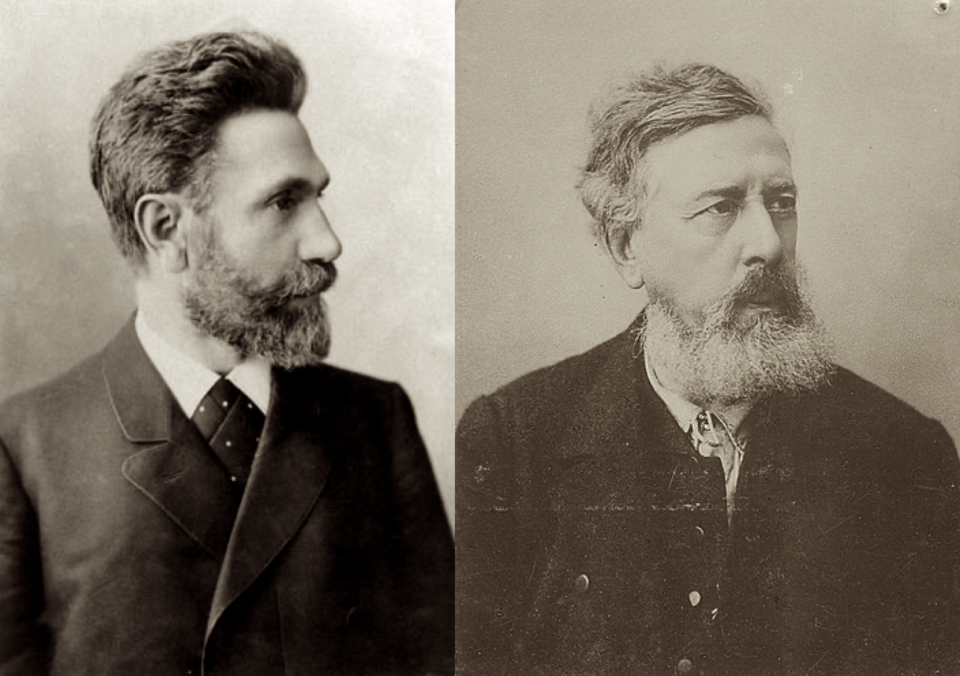
As German politics today seeks to erode workers’ rights, we remember May 22, 1875: a day on which the first “Socialist Workers’ Party” (SAP), was founded in Gotha. A predecessor of today’s Social Democratic Party of Germany (SPD), the SAP was the merger of two workers’ parties, while the driving force behind it were revolutionaries Wilhelm Liebknecht and August Bebel. The consolidation prompted the then Chancellor Otto von Bismarck to enact the “Socialist Law”, an attempt to destroy the labor movement.
Wilhelm Liebknecht, a supporter and associate of Karl Marx, lived most of his life in poverty. The staunch anti-militarist met August Bebel in Leipzig in 1865, where the two went on to found the SDAP four years later. Liebknecht and Bebel campaigned against the Franco-Prussian War and opposed the war loans of the time. Both were subsequently put on trial and sentenced for high treason in 1872 (Leipziger Hochverratsprozess). In the courtroom, which was filled with members of the SDAP, Liebknecht read out the entire Communist Manifesto and other writings in his defense. This trial marked the peak of international attention on Wilhelm Liebknecht and elevated him and Bebel from local figures to national leaders of the labor movement.
In contrast to Liebknecht and Bebel’s SDAP, which adhered to Marxist principles and advocated for a Greater Germany, the other workers’ party, the ADAV (General German Workers’ Association), espoused a “Small German” and Prussian perspective. This difference on the national question was less significant than the pressure of widespread rejection and mistrust from the authorities and in the new Reichstag. With Wilhelm Liebknecht as a motivator, the workers’ parties decided to merge into the SAP, which increased interest in the labor movement.
In response, Chancellor von Bismarck enacted repressive measures in the form of the Socialist Law: a “Law Against the Dangerous Endeavors of Social Democracy”. Bans on and fear of trade unions in the working class have persisted to this day. Currently, the Bundestag is considering abolishing the 8-hour workday and the 4-day workweek—rights that workers had to fight hard for over 100 years ago. The aim today is to wear down the working class by any means necessary, just as it was in 1875 when Bismarck banned all party activities for the SAP. Only the right to vote stayed intact.
The repression forced the party into hiding for 12 years, during which it continued to organize secret meetings even outside Germany, thereby expanding its reach, popularity, and ideology from the underground and, despite the ban, remaining a community. This made it the strongest party in Germany in 1890. That same year, the SAP became the “Social Democratic Party of Germany” (SPD), which still exists today. How much of Liebknecht and Bebel’s ideology remains is debatable. Social democracy means that social equality is a prerequisite for democracy; to this day, there is neither such equality nor a fair distribution of wealth in Germany.