Thanks for talking to us. Could you start just by introducing yourself?
I’m Zoya from the AFG activist collective. We’re a self organized, horizontal collective that is composed of first and second generation diaspora from Afghanistan. We are fighting for the cause of a free Afghanistan, from the neighboring countries to the asylum seekers here in Germany. We also express/foster cross solidarity on an intersectional level with other Global South movements.
Could you say something about the current situation in Afghanistan, particularly for women?
Since August 2021, many people have said that the Taliban régime is different now. It’s not going to be the same black hole of 1996 to 2001. As if it is an upgraded version 2.0, more modernized. This is deceiving though. As the international media have left Afghanistan, and with a general ban on non-government media or any outlet which is not led by the régime, news doesn’t come out to the international community and people as it does to us with links and relations in the community. We still have some awareness of what is really happening through information sharing on social media and our collective tries our best to share this and make it more accessible.
Every week, there are stricter developments towards women, including what they are allowed to wear. Women are not allowed to go to parks, or work in most fields. Students have had to stop going to university, and girls cannot go to school after the sixth grade. One of the latest and frankly, ridiculous, restrictions is that women should not even hear the sound of another woman’s voice. For example, if a woman prays her voice should not be heard. People instrumentalise the Taliban for their Islamophobia, yet this fundamentalism does not represent Islam – it is rather used as a tactic of oppression. More so, it goes against our cultural habits, the Taliban do not practice or represent the vast and diverse culture of Afghanistan. Women in Afghanistan were allowed to vote before women in the UK, or before the creation of the Taliban. Therefore, the people of Afghanistan see the Taliban as a war on our culture and heritage and so much more.
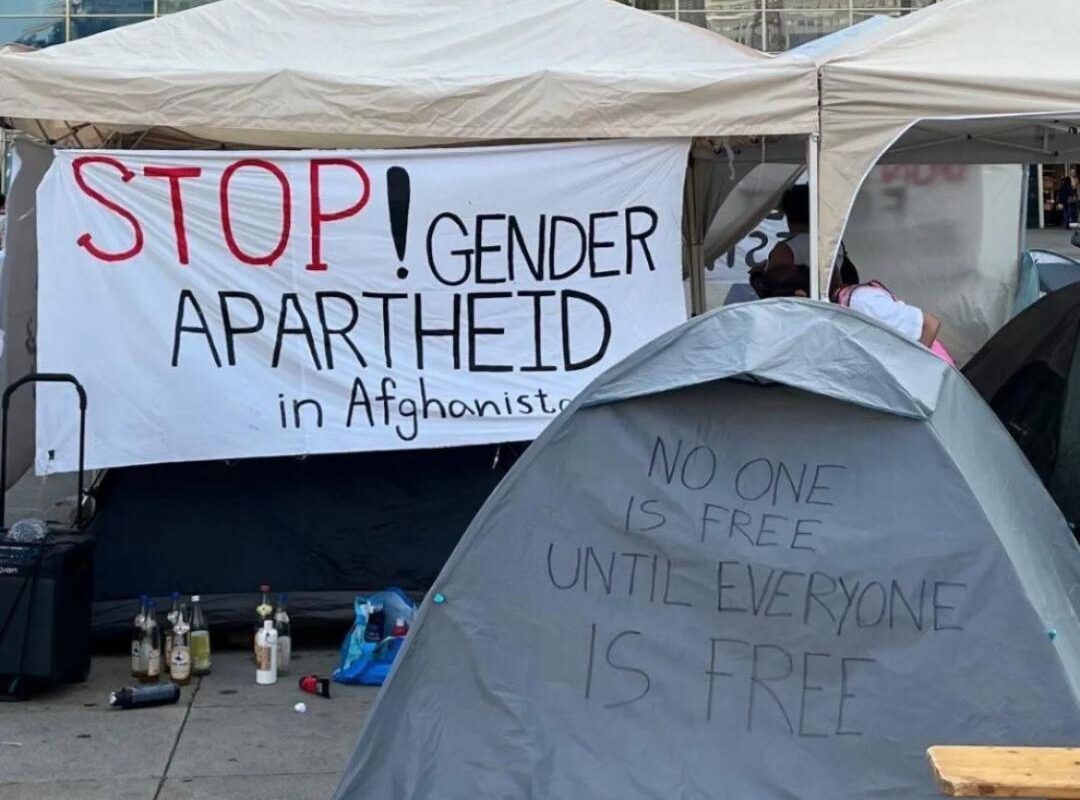
So a lot has changed. The social fabric is completely dissolving—like the female gender inside of it—which is why we talk about gender apartheid in Afghanistan.
How is the population reacting to this?
In the beginning, there were many protests where women went to the streets. They had to face open fire from the Taliban into the sky, and they were lashed. The lashes were so strong that you could become disabled from them.
There were many campaigns around Afghanistan. Boys started campaigns saying “I’m not going to school without my sister”. Men didn’t go to university or refused to do their medical exams.
All these actions have faced repression. There were a lot of forced disappearances of people that spoke up, especially men like YouTubers and famous educators who publicly advocated for opening schools for girls. These are typical silencing tactics. People with leadership positions were also disappearing or even killed for their advocacy.
People still take it to the streets but after three years without support, it becomes harder and harder.
How much support does the Taliban have? Is it just ruling by repression, or does it have any popular support?
It’s hard to understand how much support the Taliban has because, in the current state, you’re not able to express your opposition. If you were interviewed in Afghanistan and asked if you support the Taliban, most people would probably say yes, just because they fear being exposed.
Now, a lot of female activists have gone inside and are protesting indoors with their faces covered and holding signs, demanding for their rights. This makes it harder to identify who they are, but that is the current state of affairs.
We also have to understand that after 40 years of war, 90% of Afghanistan is uneducated, and people are tired from being caught in the crossfire. Many have lost friends and family members, seen the explosions first hand; or are injured from them. So if you ask a farmer at this moment if they support the Taliban, they will only know the crossfire which prevented them from feeding themselves over the years, so they are probably going to say yes. But is this an informed answer which understands the geopolitical context? The answer is no.
Does the current terrible situation mean that people think that life under US occupation was good?
It’s always nuanced to understand what is good and what is bad. From one side, you have the corruption in the previous government, but to us they’re all the same because they collaborate with each other. We call it a handover. We don’t call it a Taliban takeover because they literally sat down in Doha, Qatar with the US and the international community.
They’re the same people, NATO is made up of the same people who were there for 20 years. One is the main initiator and the others back it up. For them, it didn’t necessarily make sense any more to stay and exploit when they can leave, have fewer expenses, and still gain from exploitation.
Could you say a little more about the Doha agreement? What was involved, and what has changed?
One of the demands from our collective is to have full disclosure of the Doha agreement, which is not public. Qatar played a big role in being a hub for the Taliban headquarters, which opened over 10 years ago. There has been a lot of criticism of the collaboration.
A lot of people say that 15th August came as a surprise, but at that point a large percentage of Afghanistan was already controlled by the Taliban. Even if the Taliban wasn’t officially governing, they had the land under their control.
The Doha agreement involved no Afghan civil society representation. At the end, it was a trade agreement that made them hand over Afghanistan.
At the end, we the people of Afghanistan are wondering: why did you bomb us for 20 years if you would handover the country to the Taliban anyway?
Recently, Germany declared Afghanistan to be a safe country and has started deportations again of Afghan people. How precarious is life for people from Afghanistan who are living in Germany at the moment?
I don’t think Germany declared that Afghanistan is a safe country, but they are definitely going with the propaganda in the mass media. Since an Afghan refugee killed a policeman in the south of Germany, there are stronger calls for criminals from Afghanistan and also from Syria to be deported. We see that the “center left” adopts right wing rhetoric.
They say they’re only deporting criminals, but the label criminal is used for a lot of men, also at the borders. You really see how much this is fuelled not only by what’s happening in Afghanistan, but also in Palestine. You see the dehumanization, or that the words “terrorist” and “criminal” are used for anyone that is especially from the SWANA region who are standing up for their rights and that they can be criminalized.
They’re saying that they’re only going to deport criminals, but if it’s criminal to stand up for justice and speak for people’s freedoms, or to stop an occupation or a genocide, then what is a criminal? It’s very much like the brainwashing that Arab or Afghan men are violent which has been systematically done since before 9/11.
On top of that, it seems that there are only calls for deportations to some countries and not others.
Exactly. We saw that Europe and the West were trying to manipulate the Iranian Revolution some years ago, while keeping quiet on Afghanistan—even on the topic of women. We see how geopolitical interests play a role, as well as the alliances that are formed between countries. This is the reason why some things get funding, and certain other things don’t. You can have a positioning that stands against all oppression- you don’t need to be polarized as they push you to be.
In Germany, or Europe more broadly, you really saw the strategy behind certain decolonial, anti-racist, or anti-deportation topics. “The Left” in Germany wants to express that they have an interest in this but only if they can set the storyline. You’re denied as an Afghan to share solidarity with Palestine, even though you are degraded and dehumanized the same/similar way.
There was a recent ruling by the German government only to deport men to Afghanistan and not women. What’s the implication of this ruling?
Women are now able to not go through all of the asylum processes that they have had to over the last years. In Germany, they pass the interview immediately and get protection. Of course, you are relieved about this- not happy, but you’re glad for the safety of the people who will not have to live in extreme repression. It’s much harder for women to exist in Afghanistan. They cannot exist at all, as they don’t have any rights or prospects in life.
But at the same time, it’s frightening because it reinforces the narrative that Afghan men are only abusers, and Afghan women should be protected from Afghan men. This narrative implies that they’re safe in the West, but would not be back in Afghanistan. When you understand the implications of such a ruling, the feelings become much more complex.
Can you say something about what your collective is doing in Germany?
Our collective is not registered so that we can freely express ourselves without putting anyone in specific danger. Our slogan at demos is “Ob NATO oder Taliban, raus aus Afghanistan”, which translates to “NATO or Taliban – get out of Afghanistan”.
During the 20 years of NATO’s presence in Afghanistan, the amount of money that was flowing into Afghanistan that ended up in officials’ back pockets is astonishing. It created a lot of infrastructural issues, also through the large NGO presence there. Their food programs, for example, created dependencies for a lot of people who were not previously used to these dependencies. It disrupted the self-sustaining infrastructure, increasing the cost of land and making farming harder. Once the Taliban arrived, all these NGOs left, creating a state of shock for people. Now over 95% of people in Afghanistan are dealing with food insecurity. This is a huge number— of a nation of 40 million people.
There are also huge issues at the border with Pakistan and Iran. There are millions of Afghan refugees in both of those countries that are currently being pushed back in masses in the hundreds of thousands. There are also extremely racist campaigns. People are unable to even buy bread in Iran. Then you try to start a life in Germany, and the bureaucratic process does not give you a break time to reflect and process all of these things on all of these things.
Additionally, we see how much politics are moving towards the right all over Europe. You also see how the topic of refugees is approached and the laws that are getting passed that ensure that the only thing that they experience is violence.
So Afghan people – whether in Afghanistan or outside – cannot catch a break. We need and want to create the space to speak about conflicts within ethnicities and religions, gaps between gender which, of course, affect the entirety of civil society over the last 40 years. You don’t have space to think about or deconstruct things so easily when you’re thinking about your survival and dealing with ongoing trauma. Our collective wants to express and reflect on all the complexities, not only around the political arena, but also the dynamics within the Afghan community. Essentially, we want self-determination for Afghanistan and its people.
Are you able to link up with other campaigns fighting for Syrian refugees?
We have a lot of networks between different activists and activist collectives. As the issues have intensified and we have ongoing genocides, we are well connected between the different social and activist groups, and we support each other’s struggles, even though Afghanistan has been seen as a side topic for a lot of the general masses.
But as activists, we support each other. It’s tough to do so because it’s non-stop – in fact it’s increasing. Syria, Sudan, Congo, Lebanon, Eritrea, Palestine, and countries, all over the Global South, are facing so many conflicts and wars. The only thing that we can do is to inform each other and to give each other the space to collaborate or to share information.
And what about the German Left? The German Left does do some good work on refugees, but as you’ve said, a lot of it does have a Palestine problem, which translates into a general difficulty with the Global South.
For sure. I definitely saw a shift starting last year, whenever certain German leftist organizations or NGOs, or some activists or so-called feminists would support us. This support was not genuine, to be honest. They would take a lot of space in groups about who they would support and silence us. And then when the genocide in Palestine started, we would see how those NGOs were somehow getting funded through public money, and wouldn’t share their solidarity or take a stance. So we took a stance and distanced ourselves from them.
On the social level for me personally, having grown up in Germany when 9/11 happened, I’m having a lot of deja vu. On the social level, there was this extreme taboo in schools to be from Afghanistan. You were seen as a terrorist. You would have kids bully you, or teachers brainwash you in class about being Muslim, or for coming from Afghanistan. All of these things were socially acceptable.
For a while, this was less, or there were some improvements, at least on a social level. These racist notions were not as socially accepted. And now we’re back there again. Actually, we’re not even at that standard, but much worse. The amount of dehumanization is seen through the apathy of the society of war crimes and mass destruction.
Do you think things will continue to get worse?
I don’t know. You wake up every morning and think that things will get worse, and it gets worse.
Most people just want to not have to see people die in either of these ways. But that is the reality for all people in the Global South including Afghanistan, Syria, Iraq and Palestine. Western society at this moment still refuses to understand this.
How can people find out more about your collective and what you’re doing?
We have an Instagram page, AFG activist collective, where we post our protest camps, share news, make demos, create positioning, share speeches and so on. We also organize events, sometimes by ourselves other times other groups organize and invite us. If other people want to create alliances with us that’s also supportive, that’s great. We support underground illegal schools for girls and women in Afghanistan. This is a very small thing that we’d like to continue to support because it’s very necessary.
You can also buy our tote bags at our events, or create items for us that we can sell them in markets. You can create your own actions, where we are able to just come and speak or share information. We’re not that many, and we definitely need support. We’re also not trending, so it also gets hard to get that support from outside of this activist bubble network that we have.
We also have a Telegram support group, which is where we can add you if you contact us. We like it when people come with their ideas.
Is there anything you’d like to say that we haven’t covered so far?
What’s important is being open to listening to different perspectives.Try to formulate a nuanced view. At this point, a lot of people do not have the interest to hear about things that are presented in a different way. I just hope that we will continue to be able to express and digest and deconstruct.
People should really start researching a little bit more about these geopolitical issues, and learn about anti-capitalism. People should think critically and be reflective and conscious about movements that they support. At the end it’s our working hours, our taxes here that support these destructions and exploitations over there and we do have the power to make a change. We believe in the power of the people.