What do you understand to be the main lessons from the summer’s electoral process? Given Marine Le Pen’s Rassemblement National (RN) won the greatest number of votes (more than 10 million) in each round of the election, despite failing to win a majority of parliamentary seats, do you consider the outcome of the second round a defeat for the forces of the far right?
You have to look at the dynamic of the situation. What looked like the unstoppable rise to government of the fascists was pushed back by the biggest mobilization against them for decades.
The second round was an important tactical victory for the Left and for the working class. Consistent polls predicted that the RN would win more seats than any other group, and might even secure an overall majority in parliament, but they ended up in third place. However, the far right will only remain on the back foot for a short period.
Four parties of the Left formed a coalition—the Nouveau Front Populaire, the New Popular Front (NPF), comprised of the Communists, Socialists, Greens, and La France Insoumise (France in Revolt)—and agreed on a fairly radical minimum program for government in record time. They were, it is true, under tremendous pressure from below (outside the building where negotiations happened, hundreds had gathered to chant slogans of unity). The result is that we do not have a fascist government.
Those political groups who were (and are) opposed to the coalition, one must imagine, consider that it changes little or nothing who is in government. Given that Marine Le Pen’s party has declared it wants the hijab to be banned in all public places, social housing to be reserved to French nationals, and certain public sector jobs to be forbidden even to people with dual nationality, one can imagine there are few Muslims or people from ethnic minorities in France who are quite so relaxed about this prospect. Even a minority government controls the police and the schools, and fascist ministers in charge of these domains would be a demoralizing nightmare for our class.
The reason I speak of a tactical victory is that the fascists remain very strong. They have 140 or so MPs (several dozen more than before) and they garnered ten million votes. The need for a mass anti-fascist movement to go onto the offensive against them is clear.
For the moment, the National Rally is very weak indeed on the ground. In many towns they have practically no party structure, and they have not organized a street demonstration of more than 10,000 people for decades. At its annual conference the NR leadership noted that, in addition to continuing the long march through the institutions and their obsession with respectability, they absolutely must build locally. It would be quite possible for antifascists to stop them with broad campaigns of education and harassment.
Because the NR has concentrated on a parliamentary strategy, hoping to win power in the institutions to then permit a mass of street fighters, it is particularly the wrong time to argue that elections have no importance.
Earlier this month, President Emmanuel Macron, himself a figure of authoritarian neoliberalism, ignored historical precedent in overseeing the creation of the new government after the election. Macron facilitated the creation of a new government led by a prime minister (Michel Barnier) from the traditional center-right party, The Republicans,which had come in fourth place. In doing so, Macron refused to allow the NFP, with the largest number of parliamentary seats, to seek to form a government. How do you assess the stability of this government and the role that now has to be played by the NFP, La France Insoumise, and the forces of the revolutionary left, respectively? What has been the response of the Left, as well as the working-class, to Macron’s decision?
Although the present crisis is a slow-burning one, it is the deepest in the country since 1968. The constitution forbids repeat parliamentary elections until next June, so we will see weak minority governments, rapidly changing alliances, and significant space for extraparliamentary revolt.
Barnier’s government is stuffed with reactionaries who are copying ideas from the RN. But Macron would have preferred a more stable left-right coalition, and is unhappy that (so far) the left coalition, the New Popular Front, has held.
Every political organization and political alliance in the country is fragile, including the Barnier government. It took a long time for him to choose ministers, and apparently he had to threaten to resign to make Macron accept his list. The ministers are already bickering publicly about whether RN is a legitimate democratic party or not.
The NFP has reacted by insisting that Macron is in contempt of democracy and that Lucie Castets, the agreed NFP candidate for prime minister, should have been appointed. Nevertheless, nearly half the Socialist Party National Committee wanted to break the left alliance, and voted to support a compromise PM, Bernard Cazeneuve.
It seems to me essential that the whole of the Left should defend the very limited democracy we have under capitalism. It does matter whether Macron respects elections or not. La France Insoumise (but not the rest of the NFP) is campaigning for Macron to be impeached for not respecting democracy. This is a healthy, popular demand. The reactions of the revolutionaries have varied, but sadly almost none of the groups have supported the campaign for impeachment.
On other important questions of strategy, the far left organizations are very far from unanimous. One of the bigger groups, Le Nouveau Parti Anticapitaliste—The New Anticapitalist Party (NPA), has joined the NFP as a minor player. Others are busy denouncing it.
At very short notice, the NFP was able to build an electoral coalition, one that mobilized broadly across the Left, and within working-class, immigrant, and Arab and Muslim communities, to win the largest plurality of seats. What, if any, is the ongoing impact of these mobilizations in the face of the right-wing government? Can this coalition be the basis for ongoing struggle against the Right?
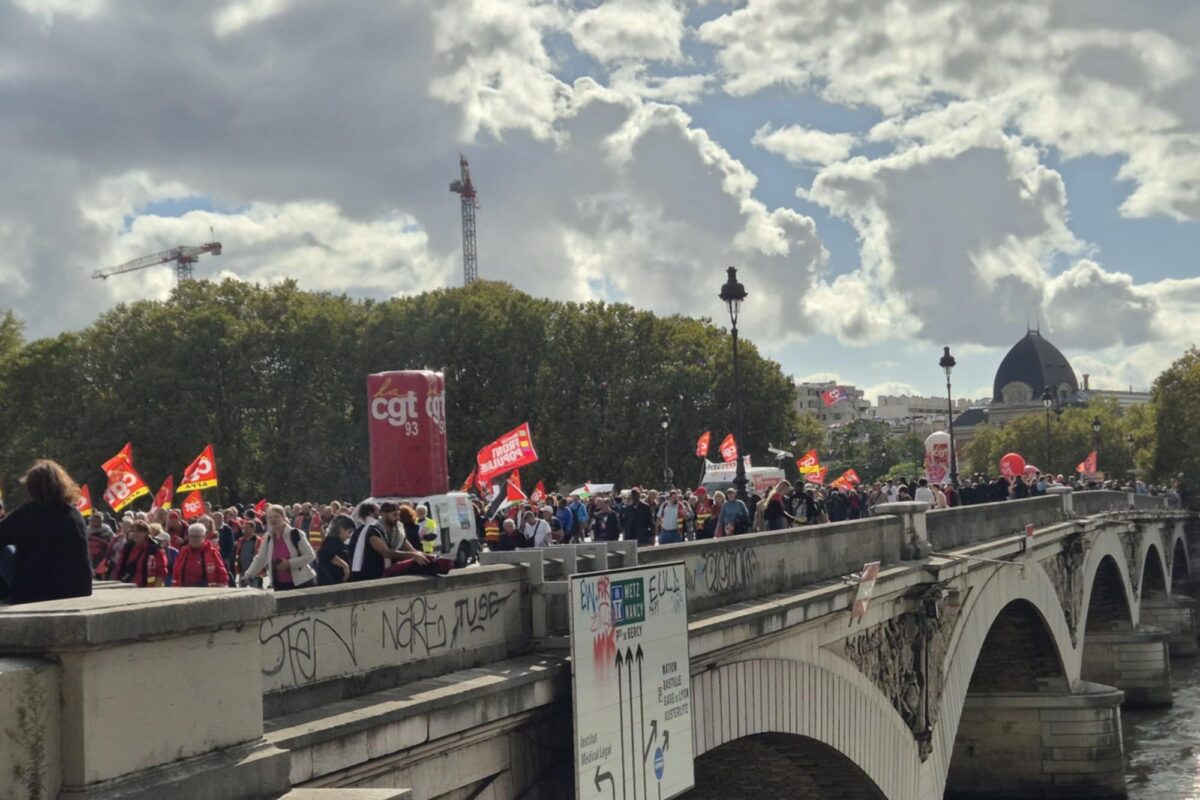
To some extent. On September 7, demonstrations led by youth organizations and La France Insoumise, and looked on favorably by the leadership of the main left trade union confederation, the Confédération Générale du Travail—General Confederation of Labour (CGT), took place in some 150 towns across France. The Green party and the Communists called for people to get on the streets, but the Socialist Party did not. On September 21, there was a similar mobilization, but it was considerably smaller. La France Insoumise is at the center of this dynamic, with other parts of the NFP sometimes agreeing to join in.
It is impossible to say what will come out of a situation which sees both dynamic mass activism and plenty of discouragement on the Left. No doubt the key result on the ground is the 60,000 new people who have asked to get involved with La France Insoumise and the many hundreds who have joined the different revolutionary organizations.
The more parliament is paralyzed, the more mass action outside parliament is crucial.
There is a lot of criticism and skepticism of the NFP from sections of the revolutionary left based on the participation of the historically social liberal, and pro-NATO Socialist Party. How do you respond to this line of criticism? And how do you understand the balance of forces within the NFP between its constituent parts? How stable do you expect it to be in the face of the Barnier government?
You form coalitions with people you do not agree with. If the La France Insoumise leadership had said, “We will not ally with the social-liberals,” there would be a fascist-led government in France today. Every day gives good reason to mistrust most of the leadership of the Socialist Party (as well as the Communist Party), but it is critical that their leaders were pressured from below to sign on to a radical program to block a fascist government.
Like every political force in France today, the coalition is unstable and the right-wing of the Socialist Party are getting organized in case the alliance falls apart. Among other crises, a small group of four or five La France Insoumise members of parliament has split off to its right, accompanied by acres of joyful newsprint from the right-wing media. Some of the less right-wing of Macron’s MPs have left his grouping, and the Greens are also having fierce internal debates.
The good news is that Macron’s plan A and plan B both failed. Plan A was the lightning speed election which was supposed to knock out a divided left and leave Macron as “our only defense against fascism.” Plan B was to split the left alliance and set up a “national unity” government with the Right and with sections of the Left outside La France Insoumise.
The huge movement of strikes and street mobilizations, which is necessary and likely, stands more chance against this weak Barnier government.
Insofar as the forces of the far right, led by Marine Le Pen’s RN—which won the greatest number of votes in each round of the election—are essentially giving support to the Barnier government, how do you assess the impact of the new government on the growth of the far right?
This support could be very temporary indeed. But obviously the fascists are hoping to advance in the crisis. Firstly, they want to gain respectability outside their own electorate, particularly in upper-middle-class circles. Secondly, they want to pretend they are the realistic alternative to discredited Macronism. Lastly, they need to encourage their fascist core with red meat racist rhetoric. It’s a difficult balance. In addition, they want to build local party structures everywhere. So, they have real strengths, but lots of weak points that antifascists can attack. There are some signs of antifascist activity increasing around the country, including in La France Insoumise.
Given the role that La France Insoumise has been playing, and its undisputed mass support within left-wing and antifacist sections of the working-class and immigrant and Arab and muslim communities, it seems clear that revolutionary socialists should relate to this in some way. At the same time, there is some criticism of its inability or failure to create a “democratic membership organization.” In what ways can the revolutionary left relate to LFI?
I was a member of revolutionary organizations in France for more than 30 years. If I am no longer a member now, it is because I think they are wrong on crucial questions and their attitudes to the French new left is at the center of this.
The emergence of La France Insoumise over the last eight years represents a remarkable success for mass left reformism, which must be clearly understood if revolutionaries are to react appropriately.
This is an organization that secured more than 7.5 million votes in 2022 and that speaks of “a citizen’s revolution.” Its leader, Jean-Luc Mélenchon, calls it “an anticapitalist force, aiming at ecological planning of the economy.” Tens of thousands of people have flocked to the movement over the last couple of months. La France Insoumise organized a summer school with 116 meetings and more than 5,000 people in August 2024. It has set up regular educational courses for activists, including “Introduction to Marxism” classes, and is taking the accumulation of cadre seriously.
La France Insoumise was the driving force behind the coalition that pushed back the fascists—and it is the force attracting the best young activists now. The organization has succeeded in transforming public debate and breaking the reigning “there is no alternative to neoliberalism” atmosphere. It has brought opposition to islamophobia into the mainstream of left politics, from where it had been absent for several decades (even though both La France Insoumise and the revolutionary left in France have some distance still to go on this question).
The organization is organizationally independent of the old reformist left (unlike, say, mass Corbynism in the United Kingdom). It now publishes books, organizes weekend schools and lectures, and seems to be becoming hegemonic on the radical left.
In sharp contrast to left reformist groups in several other countries, La France Insoumise’s leadership has held firm on the two issues on which the establishment pressure has been strongest: Palestine and police violence. Two of its leaders, Mathilde Panot and Rima Hassan, were called into the police station, accused of the crime of “supporting terrorism.”
Mélenchon had an official police complaint lodged against him by the Ministry of Higher Education because he criticized the disgusting attitude of the Chancellor of Lille University who banned the group’s lecture on the genocide in Gaza. A far-right police trade union organized a demonstration in front of La France Insoumise’s headquarters some time back. In short, La France Insoumise is the center of gravity of radical left politics.
Its emergence is the result of two phenomena. Firstly there is the generalization of political class consciousness in France after the mass political strikes of 1995, 2006, 2010, 2013, 2019, and 2023 (against attacks on pensions or on labor protection legislation) and the popular revolts of 2005, 2018, and 2023 (against police violence or rural poverty). Secondly, there was the weakness and division of the revolutionary left, which we would have liked to have become hegemonic. The result is a mass left reformism, seen as an open-ended determination to rethink the whole of society.
It would be disastrous for revolutionaries to primarily see this new force as unwelcome competition. Seeing tens of thousands of new activists flood in to defend a “citizens’ revolution” and “spectacular change” should delight every Marxist. “Debate, debate, debate” should be the priority—not “denounce, denounce, denounce!” It is essential to take as a starting point what the relation is between La France Insoumise and workers’ interests, not to start with what effect the rise of the FI will have on our small organizations.
It is easy to read online what the main newspapers of the French revolutionary left have written about La France Insoumise in the last few years. The organization is almost never mentioned, except to denounce selected actions, tactics, or slogans. You find almost no debates with its representatives, nor do you find fraternal in-depth articles explaining agreements and disagreements. I think these two kinds of articles should have been present in every issue of every publication.
Mélenchon has written seven books in the last ten years. I have been unable to find a review of any of them in the main far left publications in France.
This tendency to assess other parties of the Left in a sectarian manner has led to some serious mistakes, cutting the far left off from the most promising new masses of activists. I will mention three examples.
In the presidential elections in 2022, two separate Trotskyist candidates stood against Melenchon, obtaining 0.56 and 0.77 percent of the vote (as against Mélenchon’s 21.95 percent). What is more, the campaign of the least unpopular, Philippe Poutou, mostly spoke of radical reforms, not of revolution.
Then, two months ago, a few La France Insoumise MPs split off from the party, after having prepared a new organization (L’Après—L’Association pour la République écologique et sociale). It is becoming clear that this formation will, in fact, be less left-wing. Much of the far left supported the split and continues to support the small organization born from it, citing worries about democracy within La France Insoumise.
And, third, the far left has refused, with occasional honorable exceptions, to contradict and fight against the horrific smear campaigns against Mélenchon and other La France Insoumise leaders, which are similar to those run against Corbyn in the United Kingdom a few years ago, that he is an antisemite and “friend of Vladimir Putin” and so on.
Concerning the kind of organization La France Insoumise is building: unimpressed with the results of traditional radical left parties in France, which are frequently bogged down in endless faction fighting, its leadership wanted to try something different. The party has no formal membership, no one can be expelled, representatives at national delegate meetings are chosen by lottery, and local action groups are very much autonomous. The program is meant to hold the organization together.
Revolutionaries may agree or disagree with these methods (though no one is asking our opinion, to be clear), but they give rise to a situation that has advantages for Marxists. You can be an activist in La France Insoumise and a member of another organization. You can openly publish your own paper and have your own meetings.
Personally, I can’t see why revolutionaries won’t work openly inside La France Insoumise. Two or three Trotskyist groups do, keeping their independent voice. But even groups that prefer to stay outside should be ten times more interested than they are in debating with La France Insoumise people on the many crucial questions thrown up by the present crisis.
Despite its important work building up movements, the revolutionary left is a small player, and needs to recognize this. Mostly, what we have to offer is ideas, analysis, history.
Many debates are in progress inside La France Insoumise. How should we understand women’s oppression? How can a radical program be implemented? What should we think of the animal rights movements, privilege theory, the crisis of imperialism, or left patriotism? Marxists have a huge contribution to make to these discussions.
There are also numerous serious disagreements between Marxists and the leadership of La France Insoumise over French imperialism, the role of parliament, the potential for constitutional reform, and so on.
But in La France Insoumise, we have an attractive, dynamic mass organization looking for a “citizens’ revolution.” We Marxists want a workers’ revolution. But in a situation in which 90 percent of the working class do not see a clear difference between the two, it’s better to be inside the hall discussing the way forward than standing in the bus shelter across the road, searching through lists of tactical decisions by La France Insoumise looking for one to denounce.
This interview first appeared on the Tempest website. Reproduced with permission.