The Left Berlin News & Comment

This is the archive template

Recognition of Palestine: Germany supports the right wing Israeli government’s prevention tactics

Interview with Nimrod Flaschenberg from Israelis für Frieden


10/06/2024

Recently Norway, Spain, Ireland and Slovenia recognized Palestine as a state. What do you think of the decision?

The recognition of the State of Palestine by 4 EU member states was a courageous and important decision that should lead to a wave of recognition by other Western countries. Considering Israel’s endless war of destruction in Gaza following the October 7th attack, the Palestinian issue has returned to the center of international politics. While there is a global consensus regarding the need for the establishment of a Palestinian state, in practice the Western powers are backing Israel’s rejectionist position. They are, in effect, aiding Israel in preventing a process that will lead to true Palestinian independence and statehood.

Recognition by European countries, alongside the cases promoted against Israel and Israeli officials in the ICJ and ICC, might indicate a fracture in the impunity Israel has enjoyed by rich countries. It is yet to be determined if this is indeed a watershed moment, but there is a chance for a diplomatic avalanche that will isolate Israel’s far-right government.

Recognition is not a new practice. Most countries in the world and a vast majority of the Global South already recognized a Palestinian state. The current resistance to Palestine’s full membership in the UN comes from Western powers who have an ideological as well as a geostrategic interest in upholding a firm alliance with Israel. From this global perspective, it is not surprising that countries from Europe’s “political periphery” are the ones who promoted this significant act of recognition.

Israel reacted indignantly and angrily to the decision and even refused to allow Spain to open its embassy to people in Palestine. Why is the Israeli government so angry?

In recent years, and even more so since October 7th, Israeli public diplomacy, or Hasbara, has been radicalizing its messages constantly. According to Israel’s official line, every act that refers to Palestinians as equal human beings, let alone as deserving political rights, is deemed either terroristic or antisemitic, or both – even when it is based on non-violent practices such as diplomacy. The treatment of recognition is no different. Israel’s leading line states that recognition is a prize for terrorism after the October 7th attack. This reaction highlights the Israeli tunnel-vision focus on the events of October 7th as a frozen moment in time. Israeli politicians and the Israeli media constantly repeat and retell the goriest details of that awful day while generally ignoring the carnage Israel has since committed in Gaza. Therefore, Hasbara falsely positions recognition in the context of Hamas’s attack and not in that of the Palestinian catastrophe experienced since, nor as an obvious answer to 57 years of brutal military occupation and 76 years of dispossession and displacement.

But the Israeli rage does indicate a substantive risk. If recognition gains momentum, it will endanger Israel’s foreign policy strategy. If only small or medium level international actors recognize Palestine, this recognition does have political significance but not an overwhelming one. But if one of the permanent members of the security council – U.K., U.S., or France (Russia and China have already recognized) – or if Germany, the strongest country in the EU, recognizes – this will bring about significant isolation and possibly further legal action against Israel. Israel’s aggressive response to the recognition should be seen as an attempt to deter these powerful countries – all of them major Israel backers, from following the example of Spain, Ireland, Slovenia, and Norway.

Germany and the USA refuse to recognize until Israel and Palestine reach a settlement. Given the Israeli government’s position, this means that it will be pushed back forever. Are both states not interested in an independent Palestine? Or how can their position be explained?

Both Germany and the U.S. are supposedly backers of the Two State Solution. But in practice, they are the two strongest backers of an Israeli government that is led by fascists and whose paramount aim is to prevent a Palestinian state. The cold facts are that Germany and the U.S. are supporting an Israeli government that commits ethnic cleansing, starvation, and war crimes with the stated objective of preventing Palestinian self-determination.

The argument promoted by Germany and the U.S. against recognition is that a peaceful resolution could only be reached through negotiations. This is true – negotiation must take place at a certain point. What is also true is that Israel has been refusing any negotiations for a decade. In the light of this, and to eventually reach Israeli-Palestinian negotiations for a peaceful settlement, powers that are genuinely in favor of Palestinian independence must set up an uncompromising political line that the Palestinian right to self-determination in the Palestinian territories occupied in 1967 is unnegotiable. Recognition before negotiations will not harm the chance for negotiations. It will only set minimal terms for those negotiations into which Israel will eventually be pressured.

But we also need to look at the American and German positions in a structural frame. The hypocrisy of refusing to recognize Palestine and the unconditional support for Israel is rooted in imperialist and capitalist interests. There is a solid ideological foundation for the support for Israel in both the US and Germany – the “common values” rhetoric in the U.S. and the Staasträson formulation of the German political elites. This is the center of heated conversation in both countries. But just as important are profit-seeking and geostrategic interests – be it in arms sales to Israel, in reliance on the Israeli cyber industry, in Israel’s position as a Western “aircraft carrier” for the Atlantic powers in the center of the volatile and energy-rich Middle East, or in Israel’s role in policing the region as a counterweight to Iran. For all these less-discussed reasons also – German and American leaders are tolerating Israel’s crimes.

These interests could be challenged through political action. The movement in solidarity with Palestine and against the war is making significant gains despite wide repression. Suppose this movement adds to its mainly negative demands a positive call for Palestinian statehood and recognition. In that case, there is a real possibility that one of the major powers will make the truly transformative act of recognizing.

It should be stated that out of the four powers I mentioned before—the U.S., U.K., Germany, and France—the best chances for recognition are in France and perhaps in the U.K. after Labour’s expected election victory in July. But pushing for recognition should also be incorporated into the movement in the U.S. and Germany since “a domino effect” of recognition that will transform the Security Council or the European Union, is definitely possible.

Many in the global solidarity movement with Palestine think that the demand for recognition is part of a two-state illusion. They support the solution of one democratic state. Do these demands stand in contradiction?

It is essential to distinguish between the recognition of a Palestinian state and the “two state solution,” which has almost become an empty mantra repeated by global leaders who are not promoting it. I am personally in favor of the two state solution, while other members of “Israelis for Peace” support different solutions. Yet we agree that the demand for recognition of a Palestinian state is relevant to the promotion of all peaceful solutions – two states, confederation, or one democratic state. It is, first and foremost, a question of political tactics and reachable goals in the struggle between the forces of peace and those of forever war.

The most broadly shared assertion about Israel/Palestine globally is that the Palestinians have a right to self-determination and that the Israeli occupation of the West Bank and Gaza is disenfranchising them of this right. It follows that this Israeli occupation is illegitimate. These shared assertions mean that the demand for Palestinian statehood is the diplomatic low-hanging fruit and the tactically unifying demand in a drive for peace.

Human rights groups describe the Israeli structures as apartheid. This system will not give Palestinians rights without a collective political struggle by the Palestinians themselves, with the diplomatic and political support of the international community. This struggle might end in different ways, but the consolidation of diplomatic power must be centered around an overwhelming agreement that Palestinians deserve a state.

The primary way to challenge and isolate the extreme-right powers in Israel is to deem unacceptable their ideological belief that only Jews have national rights in the land. We must hit them where it matters the most, in what they fear the most – and that is a Palestinian state. It is time to shift the focus from the two state solution to the imminent demand of Palestinian statehood. We’ll see what happens next.

How do the recognitions of Palestine change the balance of power?

While it is a significant step forward, we need to remember that power still resides on the side of Israel. The most obvious example is Netanyahu’s invitation to speak in front of both houses of Congress in Washington, DC. This man, a war criminal who might soon be unable to travel to Europe for fear of being arrested, is honored in the center of global power. This invitation not only reminds us where power lies but is an act of active discrediting and destruction of the entire edifice of international law – by the U.S. and Israel. 

The confrontation between Israel and international law can and should be where Germany differentiates itself from the US and says clearly – we stand with international law. The Federal Republic needs to say that the heritage of Nuremberg, as prosecutor Karim Khan described the ethical weight of the ICC, is at least as important for it as the Staatsräson, a pre-democratic concept. This discussion – on the fundamental values that Germany holds dear, on the centrality of universal rights to German post-war political ethos – is what the question of recognition can bring to the German discourse.

An extended version of this interview first appeared in German in the website Die Freiheitsliebe

Tall tales of the UK NHS: “spare capacity” and private health care sector “straining to help”

The private sector health sector remains small and its activities opaque


09/06/2024

Shadow Health Secretary Wes Streeting has no doubt that greater investment in the private sector by utilising its ‘spare capacity’ will  help ever lengthening NHS waiting lists. He presents this policy as a progressive measure to help working people. The argument is that any who oppose such a plan simply wish for ideological reasons – to deny poor people access to the private health care that they themselves enjoy.  Streeting enthusiastically repeats Nigel Lawson’s derogatory characterisation of the NHS as a ‘religion’, implying that ‘liberals’ view it as beyond criticism and it defies rational understanding. 

The total number of NHS hospital beds in England has more than halved over the past 30 years, from around 299,000 in 1987/88 to 141,000 in 2019/20. However, the private sector remains much smaller with 8,900 beds, and relies almost entirely on senior doctors who already work for the NHS. Claims of “spare capacity” in the private care sector are common and made to appear as self-evidently true. But as one private health care website puts it: ‘facts and figures about the private health sector in the UK are surprisingly hard to come by’. 

A recent article in the British Medical Journal (BMJ) called for private providers to be required to report the same data as NHS hospitals. We just do not have the information (on private sector workforce, hospital capacity, outpatient services, and prices required) to understand the effects of boosting private sector activity on the healthcare workforce, demand for services, and healthcare quality. The paper argued that this information is crucial to policy making because the NHS and the private sector both fish in the same limited pool for health care staff. If you expand work and staff in one, the other will suffer. 

NHS-funded work in the private sector continues to increase. Almost 10% of elective procedures such as hip and knee operations were outsourced to the private sector in 2023, up 50% from pre-covid levels. Staffing problems and pressure to reduce the 7.6 million care backlog increasingly force health service trusts to send patients on their waiting lists to private providers. To put this in another way, government failure to invest in NHS staff and facilities drives the growth of the private sector

Why policy makers should be cautious

Recent experiences of using the private sector to ‘help’ the NHS should make any rational policy maker cautious.  For example, during Covid there was the disastrous privatised ‘Test and Trace’ system; the unusable PPE scandal; and the contract with private hospitals for providing additional capacity. However the contract meant the private sector portion of patients from the NHS, actually went down by 43%, while numbers of fee-paying private patients increased. Moreover no more than one private hospital bed was occupied by a Covid infected patient during 59% of the contract. All these examples underline that by their nature private providers in general are profit maximisers rather than ‘helpers’ or cost minimisers for the NHS. 

Demand for private health care other than from the NHS is far from booming, despite the industry statements. Even the numbers of NHS consultants engaging in some private practice has fallen, going from 16,000 in 2000 to 9000 in 2023. No wonder the sector is keen to offer ‘help’ to the NHS in return for a guaranteed income. It is no surprise to see a Conservative prime minister reflexively turning to the private sector for an NHS recovery plan. But when Labour does the same it suggests heavy lobbying and a failure to critically examine evidence. Other possible explanations are incompetence, or an ideological aversion to the NHS.

What does ‘spare capacity’ actually mean?

The bosses and cheerleaders for the private sector usually like to present it as “lean and efficient” in contrast to the “plodding and wasteful” public sector NHS. We are expected to believe that the private sector has ‘spare capacity’ with staff sitting twiddling thumbs in empty facilities, just waiting to be called upon. If this is true, this waste of resources tells us that the private sector is not such a well-run business model after all. What ‘spare capacity’ really means is that when guaranteed an income stream by the NHS, the private sector can rapidly increase capacity for certain health conditions deemed profitable. Some suggest increased use of private providers is temporary until waiting lists fall. But it seems unlikely that such contracts would be commercially attractive and probable that the NHS would find itself locked in for a longer period.

This played out in ophthalmology, where the majority of cataract surgery is now performed in the private sector and paid for by the NHS. Waiting lists may have been brought down but at the same time the outsourcing has undermined NHS services. Cataracts are the bread and butter for eye surgeons in training, but are now done in private clinics . They are no longer available for junior surgeons to learn their craft. Nurses attracted by better pay leave the NHS. Consultant surgeons and anaesthetists who would have been working in the NHS now opt to work some of their time in better paid private clinics. These also weed out complex (and costly) cases and leave these to the NHS. 

‘Supplier induced demand’ undermines NHS services

The threshold for offering an operation has been reduced. Hence the numbers of operations has risen (termed ‘supplier induced demand’). Since the NHS now pays for this increased volume of cataract operations, it then has less money left to deal with complex conditions. Such as those causing blindness (e.g. glaucoma, macular degeneration, retinopathy) which the private sector rejects. Since the vast majority of consultants engaging in private work are almost always employed by the NHS, they must adapt their NHS work plans but always adapt their work plans to make time to work in the private sector where they are employed on a freelance basis. They inevitably spend less time in the NHS. Team work and training are undermined.

The Centre for Health and the Public Interest (CHPI) found that the percentage of NHS cataracts delivered by the private sector increased from 24% in 2018/19 to 55% in 2022/23. The proportion of the total NHS budget for ophthalmology spent on cataract services has increased from 27% to 36% while 78 new private for-profit clinics have been opened over the past five years. Over this time, surgery for ‘complex cataracts’ has increased by 144%, by the NHS. This increase is almost all in the for-profit-sector – despite its’ policy of screening out complex patients and leaving these to the NHS. This means that simple cases are being wrongly reported as complex in order to charge more to the NHS. There is some worrying but predictable evidence that waiting times for assessment of conditions causing preventable sight loss have increased.

What do the experts think?

A Health Foundation report pointed out that it is relatively easy for the private sector to scale up provision for simple high volume procedures like cataract surgery, but less so for other procedures such as in orthopaedics. For example, for hip replacements, an increased number were carried out in private hospitals – as the number declined in NHS. That left total numbers unchanged, but much more cash flowed out of the NHS into private pockets. The Health Foundation report concluded that the private sector would play only a limited role in fully recovering services and cannot substitute for addressing the major problems facing the NHS. The King’s Fund examined strategies used in the past for successfully reducing waiting lists for non-urgent care, and concluded that increasing funding and NHS workforce capacity both played a key role. 

The Nuffield Trust observed that more spending on the private sector meant more competition for consultant time and outsourced services like imaging. This made it harder to expand care paid for by the health service. Private services do not have emergency and intensive care services and are located in wealthier areas. This favours white and more affluent patients and is less likely to be able to provide care to sicker people in poorer areas.

The NHS Confederation represents health service managers, and stated that the private sector does not have the capabilities, workforce or capital to take on the more complex and urgent cases left to the NHS. Many trust bosses (NHS Providers) are sceptical about private providers, pointing out that access is not uniform across the country and emphasising the potential to increase health inequalities.

Dismissing objections to use of the private sector as simply ideological is disingenuous

David Rowland, Director of CHPI, highlighted the concerns about Streeting’s plans in an opinion piece in the Guardian. Nearly all the doctors working in the private sector do it on a part time basis and work for the NHS the rest of the time. The main blockage on clearing the NHS backlog is not a lack of operating theatres but a lack of consultant surgeon and anaesthetist time. There is only one pool of such healthcare professionals in the UK. Unless that pool expands significantly and quickly, pushing patients into the private sector will have little impact on the overall waiting list. 

Real risks for patient safety

Pushing patients to the private sector will however, expose patients to greater risk. This has been shown in many reports and inquiries including a recent Panorama programme focusing on deaths. These risks are because  private hospitals are small, lack intensive care facilities, and have poor medical cover at night. 

In reality, it is the NHS that ‘helps’ private hospitals, by providing trained staff. Training costs borne by the NHS are estimated at around £8 billion. In addition, there are also around 6,600 patients that have to be transferred to NHS facilities from the private sector each year at an estimated cost of £80 million. Despite the scandal surrounding the breast surgeon Ian Paterson needlessly operating privately on women, neither the Government nor the private sector have implemented the recommendations of the subsequent inquiry. Currently the NHS is treated as a ‘safety net’ by the private sector, and left to pick up the pieces and the costs when private treatment fails or if private providers carrying out NHS work collapse.

Conclusions

The long-term problems facing the NHS are the lack of capacity from chronic understaffing and underfunding to balance current demand. No amount of ‘reform’ will solve these issues without significant investment. This was was demonstrated under the Blair-Brown government. Previous experiments by Labour in using the private sector through Independent Sector Treatment Centres increased costs while undermining NHS services and contributing little in the way of greater capacity. 

The key flaw in Labour’s plans to use ‘spare capacity’ is that the private sector depends on staff who already work in the NHS. If they spend more time working for private providers, they spend less time in the NHS. The impact on waiting lists of ‘holding the door open’ for the private sector is marginal at best. But increasing reliance on the private sector will undoubtedly undermine NHS services as has been clearly demonstrated recently in ophthalmology. Given the distribution of private facilities, such a policy will increase health inequity with white and better off patients being the most likely beneficiaries, while exposing some patients to increased risk. 

Growth of the private sector is not simply due to market forces. It is the product of government policy over the past two decades.  Any government can, if they choose, reverse this trend by sustained investment in the NHS and removing subsidies which promote the growth of for-profit care in the UK.  Labour must have a radical re-think of its policies. Alternatively it must share the evidence for its’ claims that investing in the private sector helps the NHS.

The current situation is sufficiently serious for the next government to declare a national health emergency. Then, a policy option to seriously consider would be to requisition any real spare capacity in private health care facilities and use it for the benefit of patients. Much better is for Labour to commit to investing in rebuilding a strong NHS based on its founding principles.

As European elections are held

Macron and Le Pen – not a duel: more like a duet!


08/06/2024

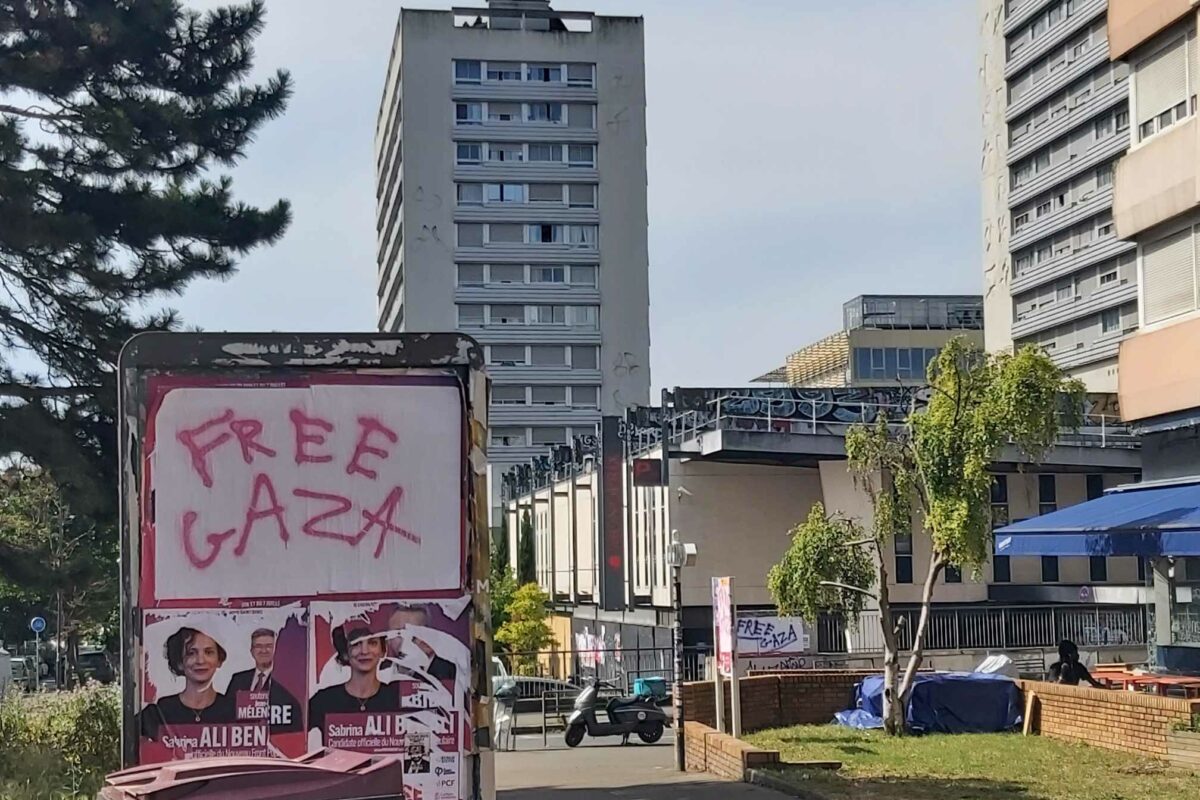
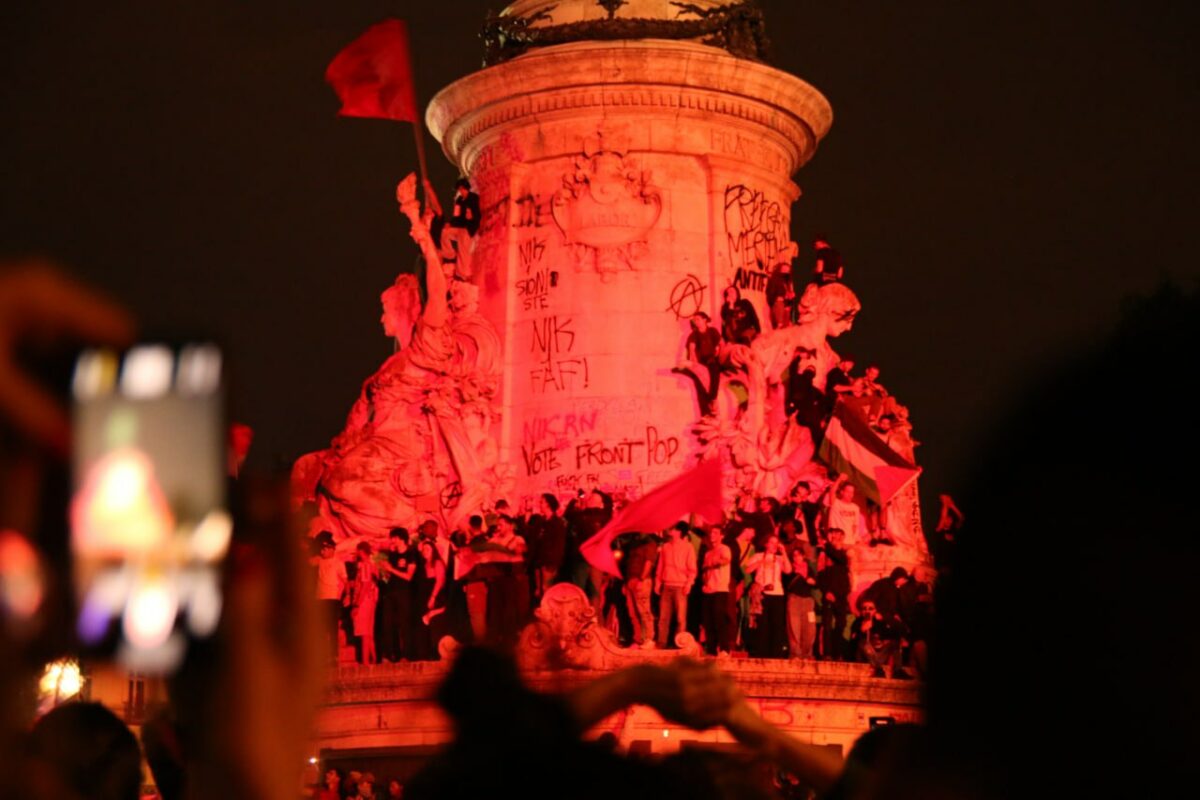
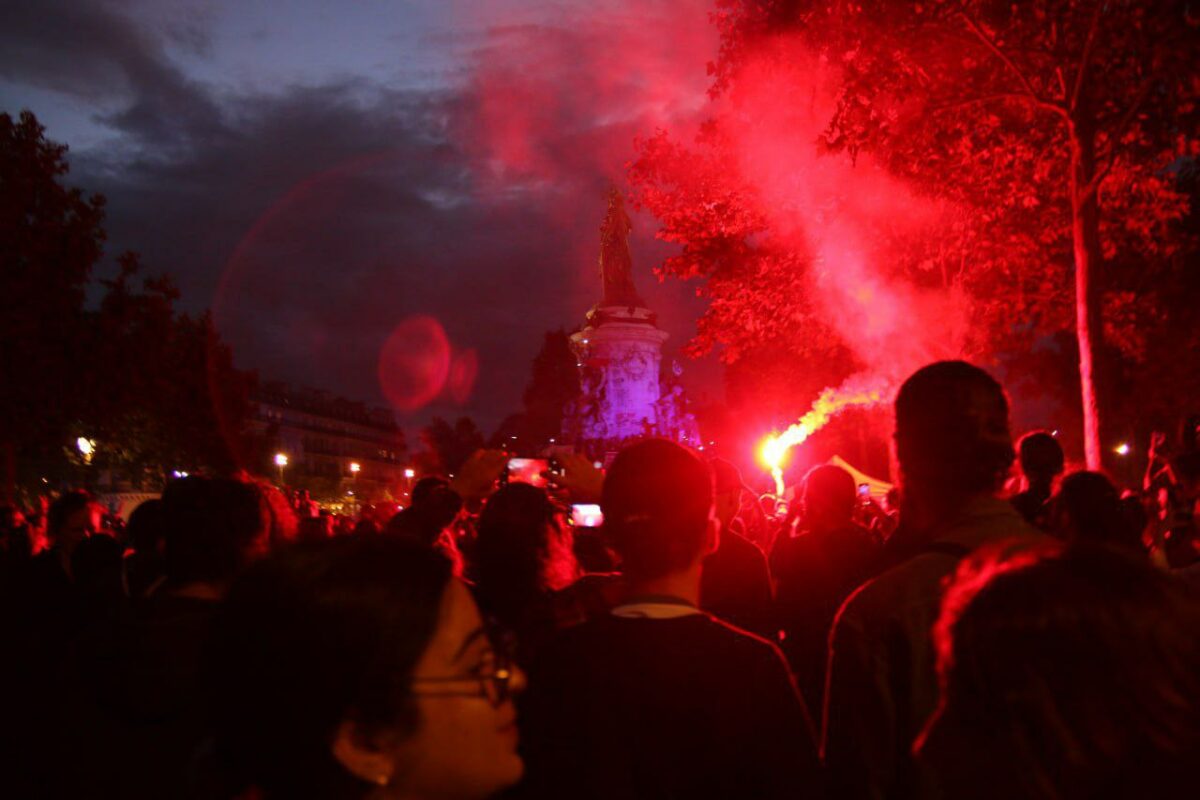
European elections are going ahead on 9th June and shedding a sharp light on political crisis in France. The far right National Rally (formerly the National Front) is leading in the polls. Macron is claiming his candidates are the only alternative to the far right, while the radical Left France Insoumise (France in Revolt) is hoping the Palestine issue will mobilize many of those who usually stay at home.

Because most people have the feeling- not unjustifiably-  that the European parliament has little power,  European elections tend to be more based on general national politics than on specifically EU issues. The elections work by proportional representation, but any party with less than 5% of the votes gets no seats. These are the first significant elections since Macron won a second term as president but lost his absolute majority in the parliament (in 2022). They are also the first elections since the historic explosion of creative class struggle in 2023, in opposition to the raising of the retirement age, a movement which despite its dynamism and huge popularity went down to defeat as national union leaders refused to organize a general strike.

At the last European elections in 2019, there were 47 million people registered to vote. Twenty four million stayed home. Five million voted for the fascists, five million for Macron and his allies, 2 million for other right wingers, 3 million for the ecologists, one and a half million for the radical left France Insoumise, one and a half million for the  Socialist Party and its allies, and  a million ballot papers were spoiled.

Polls now suggest that the far right could get well over seven million votes this time, if abstention rates do not change. National Rally is running at over 30% in the polls. Macron’s list is around 16%. The alliance around the Socialist Party is around 13%, and the France Insoumise is around 9%, but hoping for a last minute spurt by motivating those who generally stay home. The traditional right wing Republicans are estimated at 7%. The Communist Party is around 3%, the ecologists around 6%. Another fascist group, Reconquest, led by Eric Zemmour, and openly to the right of Le Pen, is on 5%.

The left campaign 

On the left, the Socialist Party is slowly trying to rebuild from its historic collapse due to its time in government organizing neoliberal attacks on workers. In 2022, it was down to under 2% of votes in the presidential elections. Present polling gives its joint list with smaller social liberal groups 13% in next Sunday’s vote. The lesson for us is no doubt that Blairite politics can always bounce back, particularly if mass social movements do not bring clear victories. Its vision of society is strongly supported by the mainstream media, and voters are tempted to be satisfied with a slower, less harsh version of the dictatorship of the market, rather than any real alternative.

By far the most valuable left campaign is that led by Manon Aubry of  the France Insoumise,  radical left reformers calling for “a citizens’ revolution”. A dynamic campaign of door to door canvassing around the country (not a habitual part of French electoral politics) has involved many new activists. Successful mass meetings have often needed to open overflow halls, as was the case in the multiethnic working class suburb, Garges les Gonesse, last week. Candidates are touring the universities, while regular education weekends are training a new generation of political leaders. The FI campaign slogan is “the strength to change everything”, and key proposals are a rise in the minimum wage, a return to retirement at 60, a price freeze on basic foodstuffs and other necessities, and a ban on arms sales to Israel.

Most importantly, the FI leadership (with whom Marxists like myself have plenty of disagreements), has held firm on key questions in the last year or so and is on a sharply radical path. When young people rioted in dozens of towns after a racist police murder last year, Mélenchon, principal leader of the FI, declared, “We have been told to appeal for calm. We appeal for justice!”. Secondly, despite tremendous pressure, with meetings banned and leading members sued, the organization has held to a clear position of support for Palestine and has refused to dismiss attacks on Israel organized by Hamas as “terrorism”.  Two FI MPs waved Palestinian flags in the parliament in the last couple of weeks and were suspended for it, while one FI candidate for the present elections, Rima Hassan (who was born in a Palestinian refugee camp), is being officially investigated for “supporting terrorism” and is attacked in the media for “antisemitism” since she has dared to denounce genocide in so many words. Finally, the FI has maintained a principled anticolonialist position on the present crisis in New Caledonia.

Le Pen

The far right National Rally, Marine Le Pen’s party, is hoping to build around a racist idea of defending French values against  the supposed danger of immigrants and Muslims. Just recently, Le Pen said that the Muslim headscarf should be banned in all public places. Nevertheless, in the last few years the National Rally, now presided over by young well-dressed fascist, Jordan Bardella, has been very successful in persuading most people that it is just a political party like any others. To portray this image, Marine Le Pen’s father, Jean-Marie, was thrown out of the organization, and the 82 MPs the RN has are, in general, tremendously careful to avoid controversy (while attending every car boot sale in town, shaking hands and trying to look normal). Recently the RN, pretending to be shocked, broke most of its links with the AfD party in Germany, after one of its leaders made positive comments about the SS.

The RN is claiming to defend the ordinary people of France, despite having voted against raising the national minimum wage in 2022 and against a rent freeze in 2023. Its elected representatives have voted against easier access to abortion (2015) and against increasing resources to help victims of domestic violence (2016). They have voted against many green regulations and against reinforcing business responsibility to avoid environmental damage (2021). Its MPs have supported most of Macron’s neoliberal reforms. The RN campaigns in favour of nuclear energy and against wind power. It promises to slash inheritance taxes for the rich and reserve social housing for people of French nationality. It aims at increasing prison sentences and making it even harder to prosecute killer cops.

A duet

The rise of the RN has been crucially helped by Macron repeatedly supporting its vision by passing Islamophobic laws, banning Muslim legal defense organizations, as well as by supporting vicious police repression. Macron’s ministers, screaming about universities being “controlled by Islamo-leftists”, and Macron’s trigger -happy cops killing young Arab men are just what the fascists need to build their influence further.

These days, endless government training courses for civil servants on “defending secularism” aim at making mistrusting all Muslims a national sport, and they mostly help the far right. Macron further pushed Marine Le Pen into centre stage last week by agreeing to a one-on-one TV debate between his Prime Minister, Gabriel Attal and RN leader Jordan Bardella, thus pushing the idea that the left doesn’t matter, it’s just Macron’s band against the extremists. In the debate, Attal carefully avoided mentioning racism or fascism.

The result of all this could be seven million votes for the RN on Sunday, perhaps as many as 32% of French voters, more than any other slate. The organization is still having great difficulty building a party machine, and throughout the European elections campaign has had only eight public meetings, far fewer than other parties. But the urgency of a large scale national antifascist campaign is ever more evident. The march of 800 open fascists through the streets of Paris three weeks ago served as a vital reminder.

As Die Linke Slowly Collapses, What Is to Be Done?

More than 15 years after its founding, Germany’s Left Party has split and is staring into the abyss. Many socialists supported the party — but Nathaniel Flakin from Klasse Gegen Klasse argues a new course is needed


07/06/2024

European elections are less than a week away — the first vote in Germany since the split in Die Linke. In October of last year, Sahra Wagenknecht and nine other MPs resigned from the Party and launched a competing formation: the Sahra Wagenknecht Alliance (BSW). At the moment, polls vary wildly, making it impossible to say whether Die Linke or the BSW have more support. Since Germany has a 5% threshold to enter the national parliament, but no such threshold for EU elections, it is conceivable that both Die Linke and BSW could get a couple of seats in Brussels, while both failing to win seats in the Bundestag next year.

It has been more than 15 years since Die Linke was founded. The fusion of the PDS (the former ruling party of East Germany) and the WASG (low-level bureaucrats who left the SPD) won the support of numerous revolutionary socialist groups, who saw the new party as a path to reach wider influence. (It’s worth remembering that Wagenknecht once considered herself as a Marxist on the far left wing of the party, even though she was always inspired by Stalinism.)

Die Linke is now in the throes of a likely terminal crisis, and it’s time to draw a balance sheet. A number of articles have been published in English, including from Christine Buchholz in ISJPhil Butland in The Left Berlin, and Loren Balhorn in Jacobin.

Which Is Worse?

Sahra Wagenknecht was recently able to present her project to an international audience with an interview in New Left Review. Since 2017, she has been raising the flag of social chauvinism: social justice, but only for people already living Germany. Wagenknecht describes her politics as “left conservatism— in the English-speaking world, she might be part of the so-called “anti-woke Left.” She not only opposes immigration, which she blames for deteriorating public services, but also defends right-wing positions on a wide range of culture war issues, including even vaccine skepticism.

Her party, the BSW, voted alongside the right-wing CDU and the far-right AfD to limit state support for refugees by forcing them to use debit cards. They again formed a bloc with CDU and AfD to vote against the Self-Determination Act granting basic rights to trans people. Wagenknecht has said that BSW is open to forming governing coalitions with the CDU in East German states. While international audiences might have trouble believing how far she’s moved to the right, it has been more than a decade since Wagenknecht has made any reference to socialism, anticapitalism, or Marxism. Her goal is to strengthen Germany’s medium-sized companies, by opposing “greed” and encouraging “competition.” The candidates and leaders of the BSW include millionaire capitalists and neoliberal SPD politicians.

This might sound like a clear right-left split, with Wagenknecht breaking from Die Linke’s fundamental principles. Yet Wagenknecht’s main selling point in the current election campaign is Frieden, or peace. She presents herself as an opponent of the German government’s relentless drive for war against Russia. A BSW MP, Sevim Dağdelen, was the only German politician to support Nicaragua’s case against Germany in The Hague for complicity in genocide. Yet Wagenknecht is no anti-militarist: she is essentially a German patriot who wants a somewhat independent foreign policy, breaking from the German bourgeoisie’s slavish submission to Washington.

Die Linke, in contrast, has aligned itself with German Staatsräson of unconditional support for Israel’s genocidal assault on Gaza. At the press conference announcing her departure, Wagenknecht made a brief reference to the fact that Gaza is an “open-air prison.” Dietmar Bartsch, Die Linke’s main leader, “distanced [himself] in the sharpest possible terms” from that phrase — the only criticism he made of Wagenknecht. In Berlin, Die Linke’s main leaders Klaus Lederer and Elke Breitenbach called for the ban of the Palestine Congress in April — and their wish was fulfilled by the governing parties CDU and SPD. Last year, the party voted, along with all the other parties in the Bundestag, to ban the left-wing Palestinian organization Samidoun.

So which side of the split is worse? As Lenin liked to say, “in our opinion, they are both worse.” We have two parties whose goal is to make the German imperialist state a bit more humane — and only end up administering this inhumane system. 

Integration Into the State

The different balance sheets of Die Linke tend to agree that the party was born out of social movements and subsequently degenerated. Christine Buchholz, for example, says:

The party was founded on the back of a wave of struggles and social movements: ­workers’ struggles, the movement against neoliberal globalisation, the ­anti-war movement and so on. When these struggles declined, the orientation on ­parliamentarism got stronger and stronger, and Die Linke accommodated to the political system.

This is true — but it ignores how thoroughly Die Linke has always been integrated into the capitalist state. In the Federal Republic of Germany, parties form coalitions not only at the national level, but in the states, the cities, and small towns, meaning that in practice everyone governs with everyone (with the partial exception of the AfD, so far). Die Linke has never been — not for a single day — totally outside of government. The PDS was part of multiple state governments before 2007. So even before it was founded, the new party was led by government ministers carrying out neoliberal policies. In Berlin, for example, die Linke has been in government for most of the last 20 years, and its members were directly responsible for privatizing hundreds of thousands of public apartments and introducing precarious, non-union jobs in state-owned companies — more or less the exact opposite of the party’s stated program.

Phil Butland points out that Bodo Ramelow of Die Linke, who for years has been prime minister of Thuringia, deported more than 300 people last year. This is true — but we would need to add that every major politician in Die Linke has similarly been responsible for deportations. This makes the party’s “position on open borders and an anti-racist policy,” which Buchholz counts as a positive element, ring hollow. What use is a “socialist” minister who defends “open borders” on paper while deporting people every day?

Die Linke attracted many activists from social movements — but it also directed thousands of them into cushy jobs in the state apparatus and the countless para-state bureaucracies that make up the enormous superstructure of German capitalism (NGOs, foundations, union apparatuses, etc.). The party never had more than 70,000 members, with over two thirds of them past retirement age. It’s fair to say that at any given time, no more than a few thousand members were active in any meaningful sense — and several thousand had full-time jobs for reformist bureaucracies.

As Lenin and Zinoviev explained during the First World War, these bureaucracies of the workers’ movement formed the social roots of opportunism.

Thus, Die Linke was never a party of socialist opposition. Its stated goal was to administer the German imperialist state in a more social way.

Of course there were always genuine anticapitalists in Die Linke — sometimes they were even able to take over a neighborhood branch, such as in Berlin’s Neukölln or Wedding districts. But anticapitalist forces always had extremely little structural influence. There were never more than a couple of anticapitalists in the Bundestag group or in the party leadership.

In 1940, Trotsky wrote that the labor bureaucracy “is independent of the workers, but in return, completely dependent on the bourgeois state.” In the epoch of imperialist decay, revolutionaries need to fight for the independence of the workers movement from the state — instead of leading activists into these state-financed bureaucracies.

Revolutionary Left

When Die Linke was founded in 2007, numerous revolutionary socialist groups joined the new party. This included the German affiliates of international tendencies like the CWI, the ISA, the IMT, the IST, and the USec. Their strategic hypothesis was that a new “broad left” formation would help them reach a mass audience. The irony was that while these “entryists” sought to take advantage of the larger organisation and played a huge role in the party’s election campaigns, they had little influence on policy — they were usually campaigning for policies they disagreed with. 

The most enthusiastic builders of the new party were the German supporters of the International Socialist Tendency (IST), who founded the network Marx21, as described by Buchholz in the interview mentioned above. The members of Marx21 were rapidly drawn into the party apparatus and other bureaucracies, leading to a rapid process of corruption, political degeneration, and more recently, a three-way split.

As I’ve written previously alongside my comrade Lennart Schlüter, the right wing of this split, which kept the name Marx21, is continuing their careers in the different bureaucracies. The left wing, Revolutionary Left (RL), has called for a break from Die Linke. And the center, Socialism from Below (SvU), which is closest to the IST leadership in London, has one foot inside the party and one foot outside.

Reading the articles by Buchholz, Butland, and Joseph Choonara of the IST, many readers feel like the entire project of building Die Linke was a mistake and a failure. That is certainly what the numbers would indicate: without exception, all the revolutionary groups that joined Die Linke are weaker than they were 15 years ago, with fewer members and less influence.

Yet SvU remains part of Die Linke, with no perspective for a clear break. This is a shame, because SvU comrades are doing excellent work in the Palestine solidarity movement, defying state repression. Yet they continue to encourage people to vote for a party committed to German Staatsräson. To give a concrete example: at the trade union demonstration on May 1 in Berlin, a Class Struggle Bloc with hundreds of workers and leftists expressed solidarity with Palestine. This bloc was attacked by union bureaucrats and police, yet managed to defend its place at the demonstration. SvU was unfortunately marching with Die Linke alongside pro-Zionist bureaucrats like Lederer. I mention this not to cast shade on the comrades — quite the opposite! We think they are holding themselves back with an orientation to a moribund, structurally reformist party. We would like to stand more closely with them in a front independent of and in opposition to Die Linke.

Early last year, a big chunk of Die Linke’s youth organization in Berlin carried out a Revolutionary Break from Die Linke, which we supported wholeheartedly. We think this is the way forward for everyone.

An Alternative

Germany’s revolutionary Left has been weak since 1933. We were crushed by fascism, and further repressed by both capitalist “democracy” and Stalinist “really existing socialism.” This weakness has often led leftists to seek shortcuts, trying to ride on the coattails of reformist parties. I’ve written how in 1968, West Germany’s Trotskyists largely missed the boat of the youth radicalization because they had been hiding inside the SPD.

At the moment, revolutionaries have nothing at all to gain by supporting Die Linke — or equally bad, the BSW. The strategic hypothesis that many defended in 2007 was wrong — 15 years of work in Die Linke has done nothing to strengthen socialist ideas in Germany. With national elections set to take place in a bit more than a year, it is time for a revolutionary break. We think that socialists can join together in an anticapitalist front, presenting ourselves in elections as an alternative to reformism, and not just as a more “left-wing” version of the same.

We do not, in the current situation, expect an enormous electoral breakthrough for the radical Left. Yet there are enormous contradictions in Germany’s political regime: surveys show that 61% of people do not support Israel’s genocidal assault on Gaza, even though 99-100 percent of MPs reject any criticism of Israel. That represents a huge space for bold anti-imperialist policies — but these can only be seriously defended outside Die Linke.

We think it is our duty to present an independent banner and try to gather support for a socialist alternative based on class independence. Socialists need to do this together, without hiding our disagreements. Klasse Gegen Klasse, of which I am a member, is currently discussing with different left groups to take such a step. Right now, Trotskyists in Spain are running for the EU elections with an independent revolutionary slate.

It is a disgrace that a chauvinist like Wagenknecht can present herself as an alternative to Die Linke for people who are worried about war. It is also a disgrace that Die Linke can present itself as an alternative to Wagenknecht’s anti-immigrant policies — while the party deports people every single day.

Local branches of Die Linke, such as in Berlin’s Neukölln and Wedding districts, or the Internationals Working Group, have many good policies. But every time elections come around, they campaign for right-wing government politicians. We think it’s time to set a new course

Artists withdraw from Major Group Exhibition of Contemporary Photography from Ireland in Berlin

Withdrawal is a response to the call from STRIKE GERMANY


04/06/2024

The artists Kate Nolan, Mark Curran, Clare Gallagher, Ruby Wallis, Sara McCarroll, Caleb Daly & Luke Ryan, Dragana Jurišić, Miriam O’Connor, Mandy O’Neill, Emer Gillespie and others have formally announced their withdrawal from a major group exhibition featuring contemporary photography from Ireland to open in June at Haus am Kleistpark in Berlin. The exhibition titled, ‘Changing States: Ireland in the 21st Century’, is organised by Photo Museum Ireland, IKS Düsseldorf and Haus am Kleistpark. The exhibition is part of the Government of Ireland’s year long programme of cultural events in Germany – ‘Zeitgeist24’.

This comes following months of exchange with Photo Museum Ireland, regarding the ongoing repression and violence in Berlin and Germany and cancellations of voices stating opposition to the ongoing horror in Gaza and the violence in the Occupied West Bank. The group of artists then recently wrote directly to the three institutions involved with a formal statement and request and received no response.

All the artists wish to state that the reason for their non-participation is in response to the call by STRIKE GERMANY (see below) for international cultural workers to withdraw from participating in any cultural institutions in Germany due to the ongoing violent repression, intimidation and cancellation of individuals who express any support for the calling to an end of the ongoing “plausible genocide” (International Court of Justice) in Gaza and brutal violence in the Occupied West Bank. Many of these incidents are documented by the project, Archive of Silence (see below).

Berlin is home to the largest Palestinian community in Europe while Germany is the second largest supplier of weapons to Israel after the United States, accounting for 47% in 2023 (Stockholm International Peace Research Institute (SIPRI)). The weekly reports of violence and brutality at demonstrations in Berlin in support of Palestine extending to the arrest of activists, raiding of homes and media profiling including members of the Palestinian and Jewish communities for no apparent reason other than their support for justice.

In such a context and with little possibility of a ceasefire in sight, the artists as activists state clearly that they can no longer participate and their withdrawal is an act of full solidarity with all those experiencing this violent and brutal repression within Germany and centrally, those suffering the continuing horrific attacks in Gaza and the Occupied West Bank.

The artists had requested that Photo Museum Ireland, IKS Düsseldorf and Haus am Kleistpark:

  • formally acknowledge the absence of their work, including the names of all artists, including those who withdrew prior to May 20th, 2024, to be physically and publicly displayed in the physical exhibition space and in all online and published media in relation to the exhibition.

  • publicly display in the physical exhibition space and in all online and published media in relation to the exhibition these three paragraphs which outline the reasons for their withdrawal:

All the artists wish to state the reason for their non-participation is in response to the call by STRIKE GERMANY for international cultural workers to withdraw from participating in any cultural institutions in Germany due to the ongoing violent repression, intimidation and cancellation of individuals who express any support for the calling to an end of the ongoing ‘plausible genocide’ (ICJ) in Gaza and brutal violence in the Occupied West Bank. Many of these incidents are documented by the project, Archive of Silence.

Berlin is home to the largest Palestinian community in Europe while Germany is the second largest supplier of weapons to Israel after the United States, accounting for 43% in 2023. The weekly reports of violence and brutality at demonstrations in Berlin in support of Palestine extending to the arrest of activists, raiding of homes and media profiling including members of the Palestinian and Jewish communities for no apparent reason other than their support for justice.

In such a context and with little possibility of a ceasefire in sight, the artists as activists state clearly that they can no longer participate and their withdrawal is an act of full solidarity with all those experiencing this violent and brutal repression within Germany and centrally, those suffering the continuing horrific attacks in Gaza and the Occupied West Bank.’

  • That the three institutions acknowledge the ongoing repression in Berlin and Germany and Germany’s substantial involvement in the ongoing ‘plausible genocide’ (ICJ), by publicly displaying in the physical exhibition space and in all online and published media in relation to the exhibition, the text below from STRIKE GERMANY and ‘Archive of Silence’.

All the requests are in the context of the exhibition titled, ‘Changing States’, that seeks to be ‘politically engaged’, and as artists from Ireland, knowing how the island suffered the direct experience and devastating impact of settler-colonialism.

One hundred years ago, the British Government stated that their goal was for ‘Palestine to become a ‘Second Ireland.


STRIKE GERMANY

‘STRIKE GERMANY is a call for international cultural workers to strike from German cultural institutions. It is a call to refuse German cultural institutions’ use of McCarthyist policies that suppress freedom of expression, specifically expressions of solidarity with Palestine.

STRIKE GERMANY withholds labour and presence from German cultural institutions. Until the demands below are met, participation will be withdrawn from festivals, panels, and exhibitions.

STRIKE GERMANY upholds a commitment to liberationist struggle and against Germany’s embargo on internationalist solidarity.

Archive of Silence

Archive of Silence is a crowdsourced archive documenting silenced voices. Their mission is to chronicle the alarming waves of erasure and violence directed at Palestinian advocacy in Germany. There has been an uprise of bans, cancellations and censorship. Many, including Jewish people, have lost their jobs. Events have been canceled and people have been defamed. Archive of Silence refuses to accept this condition.

Mark Curran – ‘Untitled, Gowning Room, Building 7, 11.02 a.m., Monday, November 11th 2003 (Leixlip, Ireland) from The Breathing Factory (2003-2006).