The Left Berlin News & Comment

This is the archive template

Freedom Walks Through the Cemetery

Text written for the Anti-War Congress in Prague, Czech Republic, May 2024


03/06/2024

I’m on a tram. I see a guy buying a ticket, but suddenly a ticket inspector grabs him. The inspector asks the guy to show his ticket, but it’s still in the machine. Then the inspector hits the guy in the face and demands a fine. At the next stop, he drags the guy out of the tram and 4 ticket inspectors start beating him up. Would you react?

Most people would only step in if it’s really serious. But when is something serious enough to make the average person react? It’s when someone is punished unfairly and way too harshly for what they’ve done. Here on the tram that is the case; the punishment is unfair and too harsh. When we talk about forced mobilization and prison for refusing to join army, we should see it as the nasty beating of a whole nation, but we don’t.

Most people don’t see forced mobilization as a crime because the government shifts how it presents its values to the people. When the military beats up some guy who doesn’t want to join the army, the government tells people through official media that the soldiers are just following orders, and that guy is to blame for not fulfilling his duty to defend his country. The government tells us things aren’t so simple, and therefore good citizens watch a fight between 4 soldiers and a civilian, and see it as law enforcement instead of a crime. That’s why people just keep going their own ways.

During wartime, the government won’t tell you that it’s wrong to force someone to risk their life against their will.

The government won’t tell you that being a soldier is a profession, not a punishment. Yes, in Ukraine today, getting a draft notice is a punishment.

The government won’t tell you about the unexpected power that the military and those who are not subjected to mobilization gain over those who are vulnerable to it. This creates room for manipulation. This is where businesses are built.

Of course, the government won’t tell you that mobilization should only be voluntary, and the army should only be under contract.

The government won’t tell you this because they need you, cheaply and in large numbers.

One British politician once said that war is not killing, but suicide. I would add that it’s forced suicide. A French politician said that war is too important to be left to the military. Was he joking? I don’t think so.

But they are politicians, and I’m just a regular guy. Speaking as a regular guy, I want to say: State, I’m tired of being flexible. Your desire to see flexibility in me is breaking me, instead of benefiting both of us. Yesterday you wanted me to be a businessman, a factory worker, or an office clerk, bringing you taxes, and now you want to turn me into a shooter and a guardian of your territories. Who will you want me to be tomorrow? I’m tired, State. Your persistence makes me not only forget your protection but also start protecting myself from you.

State, why do you think I only have two purposes: to kill and to work? And why are you so confident that I can easily switch between them?

Society, if you know that men can be taken out of Ukraine for money, despite the border crossing ban, then why do you donate money for weapons that bring death, but not on saving us?

Doesn’t the very existence of war indicate that a large number of people among us don’t love life but suffer from it, and that’s where they gather the energy needed to sustain the fire of war?

So maybe war doesn’t end with peaceful negotiations? Maybe war continues as long as there is one  person dissatisfied with life left? How many more will emerge later when they stop shooting?

I love walking in cemeteries. Most people enjoy reading the news and don’t understand my love for cemeteries. Interestingly, what scares most people in a cemetery scares me in the news. Essentially, we’re both repulsed by the same phenomenon, just find it in different places.

My love for cemeteries has given me the desire to control my own death. My sadness outweighs the will of the state. Ukrainian officials may think differently, but fortunately, the sky is higher than state borders.

Recently in Ukraine, plans to mobilize 500 thousand more men were released. If the war continues at the same pace, soon there will be no one left to come to the cemetery for them. Perhaps we should remember our dead to appreciate our lives more? With this in mind, I went to the cemetery by tram today and witnessed a horrific beating.

When I was beaten by a soldier in a Ukrainian army uniform in front of a passive crowd for refusing to take the draft notice, the Ukrainian army made it clear to me that it not only wouldn’t protect me but also posed an immediate danger to me.

It’s a suspicious thing that while you can volunteer to go to war, you cannot voluntarily leave it. Attempting to do so results in imprisonment. This alone makes me think that the state and the individual do not make an equal contribution to the fight. Therefore, today it’s important not only to speak out against forced mobilization but also to help demobilize those who want it.

The way I was beaten by the military in the early days of the war in Ukraine, I describe in my novel THE MINING BOYS. It amuses me when people are outraged by my book because it simply depicts my ordinary life, meaning they are outraged by my life itself. It amuses me when people say I’m wrong to fight against forced mobilization because they are essentially saying I would be better off dead.

I’ve seen many guys in Ukraine forcibly taken to the military enlistment office. I was one of them. Women and the elderly can intervene with little consequence but usually choose not to. The story of a guy being beaten for a tram ticket somehow outrages many more people than the lawlessness of military enlistment office staff. In both situations, people suffer for no reason, with the only difference being that in one case, this guy was beaten, and in the other, thousands of moreu lose their lives. So why are you so outraged by the damn ticket?

When the ticket inspectors were beating up the guy at the bus stop, a huge raven flew past the bus with a 20-Hryvnia note in its beak. Nobody paid any attention to it. I’m writing this with one goal in mind: to make you pay attention to what’s happening.


This piece is a part of  a series, The Mining Boy Notes, published on Mondays and authored by Ilya Kharkow, a writer from Ukraine. For more information about Ilya, see his website. You can support his work by buying him a coffee.


Germany’s repression of the Palestine solidarity movement increases even further

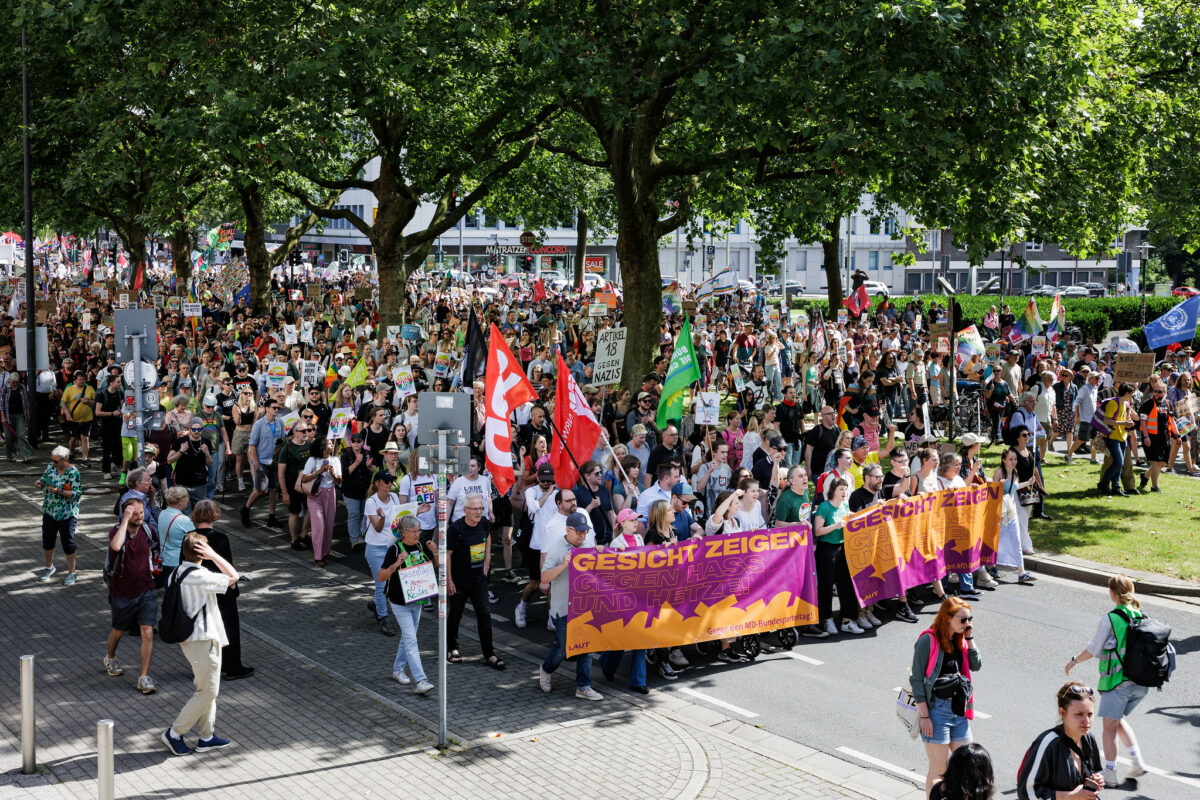
As racism grows in Germany, politicians and the police are more interested in attacking anyone protesting against genocide in Gaza


02/06/2024

For almost 8 months now, repression has increased in the pressure cooker that is Germany. The extreme right grows unabashed, and on the eve of the European elections, different positions are taken. Politicians, the media, the police and a large part of German society are more offended by people shouting ‘Free Palestine’ in a televised genocide – than by people partying on a high-class tourist island chanting ‘Foreigners out, Germany for Germans’.  These latter were making the Nazi salute with one hand and wearing Hitler’s ridiculous little moustache with the other. The incident was uploaded to social media by the participants themselves. Although it has created controversy around it, more old videos and imitators chanting the same thing have emerged all over the country. Clearly racist slogans are safely spoken and uploaded to their networks.

The strategy of the government and the media, both public and private, is twofold. To misinform, underreport or not to report at all. Furthermore to increasingly target activists, linking the pro-Palestinian movement to violent antisemitism and jihadist terrorism. An increasing number of stories in the press and on television single out activists  by name, and if possible by their social media accounts and places of work.

In fact, it is not only known activists who are targeted, but anyone who shows solidarity with Palestine solidarity.

A few weeks ago the students of the misnamed Free University of Berlin camped there. This followed students around the world, and the camp-out, in which many of them had participated in front of the German parliament. The university presidency immediately sent in the police. Riot police trucks closed off access to that part of the campus, separating the camped students off from the people who came to support them. That included the many students and professors coming out of the first hour of classes. They closed the cafeteria, from which the police action could be seen, and sent the teachers either home or to their offices. The police then evicted and detained the students with extreme violence and without prior provocation. The presidency wants to open a file on them and follow with ex-matriculation. This is at the same university, which now honours Rudi Dutschke, having demonised him in his life. Using the same arguments now to attack its students, shows that history is repeating itself.

The night of the eviction of the camp, horrified by the attack on the students, hundreds of professors from various universities signed a letter of support for the students. Not for their cause per se, which is to stop the genocide and all economic and academic links of the university with Israel, as well as to acknowledge the colonialist past of this country. More out of concern that it is within their job to protect their students. The signatories were publicly condemned by Federal Minister of Education and Research Bettina Stark-Watzinger of the Free Democratic Party (FDP). The Minister called the statement ‘shocking’ and accused them of ‘trivialising violence’.  Later Bild, Germany’s best-selling newspaper, a racist, right-wing tabloid, published the names and places of work of all the teachers and the picture of some of them on its front page. It include a Palestinian teacher who has lost family members in Gaza.

In the face of this police brutality the student union took a stand in favour of police action, calling for some ‘restrictions’. Der Spiegel reports: “‘The pro-Palestinian demands are again and again supplemented by propagandistic disinformation. An actively anti-Israeli attitude prevails, characterised by widespread antisemitic rhetoric,’ says Debora Eller, fzs expert on anti-fascism, anti-racism and emancipation. For example, the suffering of the people of the Gaza Strip is also being instrumentalised for ‘antisemitic incitement’ during university protests.’ This shows that even the young people of this country are not immune to the one-size-fits-all thinking imposed by the government.

Society was again divided, the political class in general wants to continue the politically motivated ex-matriculations, which endangers the residence permit of thousands of students in this country. Since then, however, encampments rose on dozens of German campuses, including universities of Frankfurt, Cologne, Bonn, Munich and others. some of which were evicted, but others remain. None have managed to stop their university from collaborating with Israel.

At a press conference called by the government on Tuesday 21 May, Michael Wildt, a renowned Holocaust scholar who was a signator of the open letter in ‘Bild’, calls for debate not policing: “Anyone who now demands mainly repressive measures is paving the way for an authoritarian conception of the state”. Clemens Arzt, a professor at the Berlin School of Economics and Law, warned against restricting the right to freedom of assembly, and saw no legal justification for the eviction of the Free University camp.

Berlin students, without missing a beat, last week occupied a building of the Humbold University, and renamed it the Jabalia Institute. The administration negotiated. After 30 hours of occupation, the administration promised the people in the building that there would be no repercussions if they left. Calling this a lack of ‘forcefulness’ on the part of university president Julia von Blumenthal, Berlin’s SPD senator for science, health and care, Ina Czyborra, and CDU`s mayor Kai Wegner demanded that the police clear the building. ‘Our universities are places of knowledge and critical discourse, not lawless spaces for antisemites and terror sympathisers,’ Wegner tweeted. With riot police sent in from other federal states, the police presence for the 150  people inside the building, and 200 outside, was comically excessive. Blocks of central Berlin were cut off by rows of police trucks. Warned that there was at least one accredited journalist, a lawyer and medical personnel inside the building to treat the wounded, videos show that, in true Israeli style, the police went after the press, the medical and legal personnel. These people were among the first to be arrested.

There was bloodshed that day, including that of the journalist Ignacio Rosaslanda of the Berliner Zeitung. In a video recorded by himself, he can be seen being attacked by the police. Rosaslanda claims that the police denied him medical attention for hours. It has to be said, that we have only the testimonies of the arrested students, as the police conveniently turned off their cameras during the eviction.

The Berlin authorities have also closed down day centres Alia and Phantalisa. They were especially important for migrant and lgtbia+ teenage girls. All the workers on the street were left on the street, because some showed solidarity with Palestinians in demonstrations and on the networks. The dismissal letters mention giving likes to posts in solidarity with Palestine and sharing posts on Instagram stories with the phrase ‘From the river to the sea’. It now looks like the authorities are keeping an eye on more centres and their staff.

The demonisation of students, social workers, teachers and anyone who steps out of line with the established Israel is Germany´s raison d’état is constant and increasingly violent. The police rarely let a demonstration reach the end of its route without arrests and lately even bloodshed. This feeds back into the press which classifies the demonstrators as violent antisemitic nutcases. Articles are then used to try to ban events and demonstrations and close social centres, due to the participation of workers in these demonstrations. Letters announcing the bans on demonstrations and the closure of the centres quote these articles, sometimes literally. The state, its bureaucratic institutions, the armed forces and its press function like a machine in perfect continuous feedback motion. The sole function is to crush all criticism.

This is creating a two-headed monster: One the release of guilt for the holocaust from the German people, because now the new Nazi genocidal people are the Palestinians, and the problem of anti-Semitism is imported, something extremely dangerous in a country where an Alternative for Germany politician, Maximilian Krah, recently claimed that not everyone in the SS was guilty. And xenophobia in general, Islamophobia in particular, and especially against Palestinians is being not only tolerated by the state, but encouraged, with a majority of Germans now finding Islam one of the main threats in this country. This is why violence on the streets against Jews and Arabs is on a dangerous rise, but contrary to what the media whips up, the perpetrators are mostly white Germans, both civilians and police, and not foreigners.

“Representation is Key” : An Interview with Dr. Fazila Bhimji

Interview with Fazila Bhimji about Art and Colonialism and her coming workshop “Namibia in Films”


01/06/2024

The Left Berlin sat down with Dr. Fazila Bhimji to discuss her upcoming workshop on Namibia in film. Below is the transcript of our conversation.

Hi Fazila. Thanks for talking to us. Could you first start by introducing yourself?

Thanks for being here. My name is Fazila Bhimji. I do some teaching at Evangelische Hochschule Berlin (Protestant University of Applied Sciences, Berlin). I lived in England for a long time, and I taught film and media studies at a university in England. And then two years ago, I moved to Berlin.

Today we’re talking about a workshop you’re going to be giving soon on Namibia in Film. Why Namibia?

The Museum Neukölln currently has an exhibition depicting the genocide that Germany was engaged in in Western South Africa – at that time, there was no Namibia – against the Ovaherero and Nama. It was about land and colonial rule, and they decided to resist. And Germany, of course, didn’t like that, and between 24,000 and 100,000 Hereros and 10,000 Nama were killed in the genocide by Germans. There was also widespread famine.

This is very nicely explained in the museum. There are a lot of texts in German, but if you don’t speak German, you can hold your phone against the text and use Google Translate. It is a very, very well detailed exhibition.

The museum has a series of collaborations with the Volkshochschule. Different people from the community are doing different things. One person is giving a tour of the colonial history of Neukölln, and there are several other projects that are ongoing in collaboration with this exhibition.

How long is the exhibition going on?

It’s been going on since last year and will carry on until 21st July.

German memory culture talks a lot about the Holocaust, but there is very little talk about Namibia and the genocides in Africa. Why do you think this is?

I think there must be an agenda. If you make visible a European Holocaust, and not something that was done to Africans, perhaps there’s an element of racialization here. And then there’s a broader agenda about sustaining Israel. I don’t want to go into the reasons for this here, but it’s fairly obvious.

This has been obscured, and unfortunately even the exhibition has been obscured. There hasn’t been much publicity on the U-Bahn platforms. Usually when there’s an interesting exhibition there’s always some advertising in the U-Bahns in Rathaus Neukölln and Hermannstraße. But there’s nothing about this exhibition other than the website of the museum itself.

So it’s a wonderful exhibition with different collaborations including with the Volkshochschule Neukölln. I would encourage everyone to go because this genocide is considered the first genocide of the 20th century. It was very brutal, but for various political reasons and agendas, it’s been obscured.

You’re going to be talking about Namibia and film. What films are you going to be using? Are they films that people will know?

Yes, people will probably know some of them, like The Gods Must Be Crazy. This is a film which became popular, not only in the US and Europe, but also in the Global South. I remember at that time, I was a teenager in Pakistan. And that film just ran and ran and ran in the theatre for maybe a year or so. Everybody found the film funny, although it’s full of abstractions and stereotypes. I begin with this very popular film because I’m most familiar with it.

After that, I move on to some German soap operas, which also depict Namibia, and doctors and nurses as saviours in the region. Then I talk about independent films produced by Namibians themselves.

In one of the films I talk about, Horse Without a Name, which is set in Namibia, a monument comes to life. It is a hilarious take on former German colonisers who are worthless. He’s just walking around and looks really out of sync in present day Namibia. These Namibian films are very different to the stereotypes depicted in European and US films.

In the last few years, there have been a couple of German films about colonialism in Africa, to which I’ve had simultaneous and contradictory responses. On the one hand, there is finally an acknowledgement that there was such a thing as German colonialism. On the other, the films still have a paternalistic attitude.

I agree. There was Measures of Men, which was produced in Germany in 2023. It had this paternalistic representation, and didn’t really unpack anything in a serious way. It just glossed over the history. In a way, it was problematic. It wasn’t considered a very good or powerful film.

I think the most interesting film I saw recently was Dahomey. It is more related to France, and was about the return of a few museum pieces to Benin. This film was produced by the Senegalese-French director Mati Diop, who has also produced some other very good films. Dahomey was more complex and showed the transnational aspect and the current situation more.

The recent German films feel like for primary school children. They don’t go beyond some of the basic atrocities that Namibia experienced, and they don’t question imperialism in a serious manner.

But the films made in Namibia confront imperialism?

Some of them do. Horse Without a Name does it in an ironic way. A monument of this German person comes to life and his position is reversed. Namibia is now independent, and this guy is walking around. In one clip he’s told: “Get off the road, white guy, you don’t belong here”.

It also shows all the complexities of Namibia and doesn’t essentialise all Namibians. It shows the poor; it shows sex workers; it shows the middle class. Even in this very short film, it shows that Namibia is not a monolithic state. Even if it doesn’t contest imperialism, it shows present day Namibia in a more complex way.

I guess that unlike most Western films, it is more about people who have been colonized than the colonisers?

Exactly.

Is your workshop just going to be about German colonialism, or will it go wider?

We have just an hour and a half for this workshop, so I can only limit my part to German colonialism, but in the discussion section, the audience is totally free to talk about wider issues and link this first genocide of the 20th century with the current present day genocide happening in the Middle East.

Have you observed any changes over the years in the way that film has dealt either with Namibia specifically or with colonialism in general?

Mainstream films are still lagging behind on the question of imperialism. You now see some films in the Berlinale, but they have yet to reach mainstream theatres. But we have certainly seen a change in independent films. Technology has become much more accessible. So there are many more independent films.

Second-generation children of people who experienced colonialism have grown up in the Global North and now have some resources to make films which are ready to confront some of these difficult questions.

Mati Diop, who I mentioned before, made a beautiful film which dealt with the disappearance of men in the Mediterranean. I regard this as a form of ongoing decolonialism. Many African countries are still controlled by France, and there’s a lot of resistance. If you think about mobility as resistance and about people disappearing and dying in the Mediterranean, this is a form of colonial oppression. The film used metaphors and a little bit of surrealism to bring up these complex issues.

There was also an Indian film made two decades ago, called Lagaan, which means tax in English. It was a bit of a Bollywood film, but it did touch on this idea of how the imperial powers in India would unfairly collect taxes. They had a game of cricket, and obviously, being a Bollywood film, the Indian team won. But it touched on these issues very nicely and made them accessible to the general public.

So in the diaspora, they’re making films about these issues, and then outside the diaspora within the Global South, people are making films about their colonial experience now and historically. Film is a very important medium which can reach a lot of people. Also, the visual experience is different than reading a text. So it’s great that there are more films about these issues.

I have noticed that, particularly in France, a number of second-generation directors are emerging who are making very interesting films about their experience of being a minority within France. Many of these are women like Alice Diop [no relation to Mati]. We are also seeing film’s like Dev Patel’s Monkey Man, which I didn’t think was a great film, but was at least an attempt to talk about India’s colonial history within a mainstream Hollywood action film. Is this something to be welcomed?

Well it is a start, and it’s better than nothing or completely erasing colonialism. Complexities can come later as the film industry develops around this topic. So it should be welcomed, even if it’s at a very basic level. Because people start talking about it. It starts a conversation.

And although there is still way too little diversity in film directions, particularly concerning who wins awards, we’re starting to see more women and minority filmmakers.

Definitely. Because technology is so accessible now, you don’t need as many resources. It’s less expensive to make a film these days. So in Berlin, every second person is a film maker.

In France, Algerians who are second generation are making films about their colonial past and their history. They are so racialized in France that I can imagine a lot of topics which would be of interest to second and even first generation people – and even to the French themselves.

Let’s go back to your workshop. Why should people come, and what will they learn?

I think representation is key, because it has to do with ideology. Film makers represent certain parts of the world, and there’s all these complexities involved. When you see something over and over again, things get normalized. And that is very dangerous.

So it’s important to see films – especially mainstream films – and deconstruct them, so that the idea of how people are doesn’t get normalised, and people begin to see complexities and think about these films in a more critical way. For me, it’s very important that people deconstruct mainstream films, It’s nice to show some Namibian films, just to compare how things should be versus how things are in the mainstream.

The film I mentioned at the beginning, The Gods Must Be Crazy, was so popular. And by virtue of it being so popular, ideas about how certain people live, or about colonialism and imperialism, get normalized. It’s very important to break down and deconstruct these notions.

So your workshop is not just for filmmakers or critics. It’s for anyone who goes to the cinema?

Yeah. I just break the films down and ask people why they found this clip funny, and to reflect on if it’s really funny. What kinds of stereotypes are involved? This film is from the 1970s, and we’re now in 2024. What has changed?

I think people have come a long way and they will immediately pick up on the stereotypes of the time. It’s important to look at another period in another context and see what was popular.

If someone wants to know more about your workshop or wants to know more about the other work you’ve been doing, where can they find out more?

They can e-mail me at bhimjifazila@gmail.com. I’m looking forward to hearing from them.


Workshop: Namibia in Films with Dr. Fazila Bhimji: Tuesday, 18th June. Museum Neukölln.

Open letter by Gaza academics and university administrators to the world

We call on our supporters to help us resist the Israeli campaign of scholasticide and rebuild our universities


29/05/2024

We have come together as Palestinian academics and staff of Gaza universities to affirm our existence, the existence of our colleagues and our students, and the insistence on our future, in the face of all current attempts to erase us.

The Israeli occupation forces have demolished our buildings but our universities live on. We reaffirm our collective determination to remain on our land and to resume teaching, study, and research in Gaza, at our own Palestinian universities, at the earliest opportunity.

We call upon our friends and colleagues around the world to resist the ongoing campaign of scholasticide in occupied Palestine, to work alongside us in rebuilding our demolished universities, and to refuse all plans seeking to bypass, erase, or weaken the integrity of our academic institutions. The future of our young people in Gaza depends upon us, and our ability to remain on our land in order to continue to serve the coming generations of our people.

We issue this call from beneath the bombs of the occupation forces across occupied Gaza, in the refugee camps of Rafah, and from the sites of temporary new exile in Egypt and other host countries. We are disseminating it as the Israeli occupation continues to wage its genocidal campaign against our people daily, in its attempt to eliminate every aspect of our collective and individual life.

Our families, colleagues, and students are being assassinated, while we have once again been rendered homeless, reliving the experiences of our parents and grandparents during the massacres and mass expulsions by Zionist armed forces in 1947 and 1948.

Our civic infrastructure – universities, schools, hospitals, libraries, museums and cultural centres – built by generations of our people, lies in ruins from this deliberate continuous Nakba. The deliberate targeting of our educational infrastructure is a blatant attempt to render Gaza uninhabitable and erode the intellectual and cultural fabric of our society. However, we refuse to allow such acts to extinguish the flame of knowledge and resilience that burns within us.

Allies of the Israeli occupation in the United States and United Kingdom are opening yet another scholasticide front through promoting alleged reconstruction schemes that seek to eliminate the possibility of independent Palestinian educational life in Gaza. We reject all such schemes and urge our colleagues to refuse any complicity in them. We also urge all universities and colleagues worldwide to coordinate any academic aid efforts directly with our universities.

We extend our heartfelt appreciation to the national and international institutions that have stood in solidarity with us, providing support and assistance during these challenging times. However, we stress the importance of coordinating these efforts to effectively reopen Palestinian universities in Gaza.

We emphasise the urgent need to reoperate Gaza’s education institutions, not merely to support current students, but to ensure the long-term resilience and sustainability of our higher education system. Education is not just a means of imparting knowledge; it is a vital pillar of our existence and a beacon of hope for the Palestinian people.

Accordingly, it is essential to formulate a long-term strategy for rehabilitating the infrastructure and rebuilding the entire facilities of the universities. However, such endeavours require considerable time and substantial funding, posing a risk to the ability of academic institutions to sustain operations, potentially leading to the loss of staff, students, and the capacity to reoperate.

Given the current circumstances, it is imperative to swiftly transition to online teaching to mitigate the disruption caused by the destruction of physical infrastructure. This transition necessitates comprehensive support to cover operational costs, including the salaries of academic staff.

Student fees, the main source of income for universities, have collapsed since the start of the genocide. The lack of income has left staff without salaries, pushing many of them to search for external opportunities.

Beyond striking at the livelihoods of university faculty and staff, this financial strain caused by the deliberate campaign of scholasticide poses an existential threat to the future of the universities themselves.

Thus, urgent measures must be taken to address the financial crisis now faced by academic institutions, to ensure their very survival. We call upon all concerned parties to immediately coordinate their efforts in support of this critical objective.

The rebuilding of Gaza’s academic institutions is not just a matter of education; it is a testament to our resilience, determination, and unwavering commitment to securing a future for generations to come.

The fate of higher education in Gaza belongs to the universities in Gaza, their faculty, staff, and students and to the Palestinian people as a whole. We appreciate the efforts of peoples and citizens around the world to bring an end to this ongoing genocide.

We call upon our colleagues in the homeland and internationally to support our steadfast attempts to defend and preserve our universities for the sake of the future of our people, and our ability to remain on our Palestinian land in Gaza. We built these universities from tents. And from tents, with the support of our friends, we will rebuild them once again.

Signatories:

Dr Kamalain Shaath, Vice Chairman of the Board of Trustees, Islamic University of Gaza (IUG)

Prof Omar Milad, President of Al Azhar University Gaza, Al Azhar University Gaza

Dr Mohamed Reyad Zughbur, Dean of the Faculty of Medicine, Al Azhar University Gaza

Dr Nasser Abu Alatta, Dean of Students Affairs, Al Aqsa University

Dr Akram Mohammed Radwan, Dean of Admission, Registration, and Student Affairs, University College of Applied Sciences – Gaza

Dr Atta Abu Hany, Dean of Faculty of Science, Al Azhar University Gaza

Prof Hamdi Shhadeh Zourb, Dean of the Faculty of Economics and Administrative Sciences, Islamic University of Gaza (IUG)

Dr Ahmed Abu Shaban, Dean of the Faculty of Agriculture and Veterinary Medicine, Al Azhar University Gaza

Dr Ahmed A Najim, Dean of Admission and Registration, Al Azhar University Gaza

Dr Noha A Nijim, Dean of Economics and Administrative Science Faculty, Al Azhar University Gaza

Prof Hatem Ali Al-Aidi, Dean of Planning and Quality, Islamic University of Gaza (IUG)

Dr Ihab A Naser Dean of Faculty of Applied Medical Sciences, Al Azhar University Gaza

Eng Amani Al-Mqadama, Head of the International Relations, Islamic University of Gaza (IUG)

Dr Mohammed R AlBaba, Dean of Faculty of Dentistry, Al Azhar University Gaza

Dr Rami Wishah , Dean of the Faculty of Law, Al Azhar University Gaza

Prof Basim Mohammad Ayesh, Head of MSc Programme Committee and Professor of Molecular Genetics, Al Aqsa University

Prof Hassan Asour, Dean of Scientific Research, Al Azhar University Gaza

Khaled Ismail Shahada Tabish, Head of Salaries Department, Islamic University of Gaza (IUG)

Prof Mazen Sabbah, Dean of Faculty of Sharia, Al Azhar University Gaza

Dr Ashraf J Shaqalaih, Head of Laboratory Medicine Dept, Al Azhar University Gaza

Dr Mahmoud El Ajouz, Head of Food Analysis Center and Lecturer at the Faculty of Agriculture, Al Azhar University Gaza

Dr Mazen AbuQamar, Head of Nursing Department, Al Azhar University Gaza

Eng Abed Elnaser Mustafa Abu Assi, Head of Engineering Office, Al Azhar University Gaza

Dr Ahmed Rezk Al-Wawi, Vice President of the Islamic University Workers’ Union, Islamic University of Gaza (IUG)

Shareef El Buhaisi, Head of Administration Office at the Faculty of Applied Medical Sciences, Al Azhar University Gaza

Dr Saeb Hussein Al-Owaini, Director of Employees, Islamic University of Gaza (IUG)

Dr Mai Ramadan, Director of the Drug and Toxicology Analysis Centre, Al Azhar University Gaza

Dr Mohammed S M Kuhail, Director of Libraries, Al Azhar University Gaza

Eng Emad Ahmed Ismail Al-Nounou, Director, Technical Department, Al Azhar University Gaza

Eng Ismail Abdul Rahman Abu Sukhaila, Director Engineering Office, Islamic University of Gaza (IUG)

Osama R Shawwa, Director of Administrative Office in the Department of Political Sciences, Al Azhar University Gaza

Adnan A S El-Ajrami, Director of Administrative Office at the Faculty of Medicine, Al Azhar University Gaza

Hashem Mahmoud Kassab, Director of Public Relations and Media Department, Al Azhar University Gaza

Mazen Hilles, Director of Administration of Diploma Programme, Al Azhar University Gaza

Adel Mansour Suleiman Al-Louh , Services Manager, Islamic University of Gaza (IUG)

Hammam Al-Nabahen, Director of IT Services, Islamic University of Gaza (IUG)

Maher Haron Ereif, Audit Department Assistant Director, Al Azhar University Gaza

Khalid Solayman Alsayed, Information Technology Administrator, Al Azhar University Gaza

Dr Amani H Abujarad, Assistant Professor of Applied Linguistics Department of English, Al Azhar University Gaza

Dr Ayman Shaheen, Assistant Professor in Political Sciences, Al Azhar University Gaza

Prof Alaa Mustafa Al-Halees, Faculty of Information Technology, Islamic University of Gaza (IUG)

Prof Basil Hamed, Faculty of Engineering, Islamic University of Gaza (IUG)

Dr Mohamed Elhindy, Assistant Professor in Veterinary Medicine, Al Azhar University Gaza

Prof Bassam Ahmed Abu Zaher, Faculty of Science, Islamic University of Gaza (IUG)

Prof Fakhr Abo Awad, Faculty of Science – Department of Chemistry, Islamic University of Gaza (IUG)

Prof Saher Al Waleed, Professor of Law, Al Azhar University Gaza

Prof Kamal Ahmed Ghneim, Faculty of Arts, Islamic University of Gaza (IUG)

Prof Khadir Tawfiq Khadir, Department of English Language – Faculty of Arts, Islamic University of Gaza (IUG)

Dr Marwan Saleem El-Agha, Assistant Professor of Business Administration, Al Azhar University Gaza

Dr Mona Jehad Wadi, Assistant Professor of microbiology, Al Azhar University Gaza

Dr Mohammed Faek Aziz, Deanship of Quality and Development, Islamic University of Gaza (IUG)

Dr Muhammed Abu Mattar, Associate Professor in Law, Al Azhar University Gaza

Prof Abdul Fattah Nazmi Hassan Abdel Rabbo, Faculty of Science, Islamic University of Gaza (IUG)

Dr Saher Al Waleed, Professor of Law, Al Azhar University Gaza

Dr Sari El Sahhar, Assistant Professor in Plant Protection, Al Azhar University Gaza

Dr Nidal Jamal Masoud Jarada, Law, University College of Applied Sciences – Gaza

Dr Sherin H Aldani, Assistant Professor in Social Sciences, Al Azhar University Gaza

Dr Wael Mousa, Assistant Professor in Food Technology, Al Azhar University Gaza

Prof Mohamed I H Migdad, Faculty of Economics and Administrative Sciences, Islamic University of Gaza (IUG)

Prof Alaa Mustafa Al-Halees, Faculty of Information Technology, Islamic University of Gaza (IUG)

Prof Usama Hashem Hamed Hegazy, Professor of Applied Mathematics, Al Azhar University Gaza

Prof Basil Hamed, Faculty of Engineering, Islamic University of Gaza (IUG)

Prof Tawfik Musa Allouh, Professor of Arabic Literature, Al Azhar University Gaza

Prof Bassam Ahmed Abu Zaher, Faculty of Science, Islamic University of Gaza (IUG)

Prof Zaki S Safi, Professor of Chemistry, Al Azhar University Gaza

Prof Fakhr Abo Awad, Faculty of Science – Department of Chemistry, Islamic University of Gaza (IUG)

Prof Kamal Ahmed Ghneim, Faculty of Arts, Islamic University of Gaza (IUG)

Prof Khadir Tawfiq Khadir, Department of English Language – Faculty of Arts, Islamic University of Gaza (IUG)

Prof Khaled Hussein Hamdan, Faculty of Fundamentals of Religion, Islamic University of Gaza (IUG)

Prof Ata Hasan Ismail Darwish, Professor of Science Education and Curriculum, Al Azhar University Gaza

Prof Hazem Falah Sakeek, Professor of Physics, Al Azhar University Gaza

Prof Mohammed Abdel Aati, Department of Electrical Engineering and Intelligent Systems, Islamic University of Gaza (IUG)

Prof Nader Jawad Al-Nimra, Faculty of Engineering, Islamic University of Gaza (IUG)

Prof Nasir Sobhy Abu Foul, Professor of Food Technology, Al Azhar University Gaza

Dr Rawand Sami Abu Nahla, Lecturer at Faculty of Dentistry, Al Azhar University Gaza

Prof Hussein M. H. Alhendawi, Professor of Organic Chemistry, Al Azhar University Gaza

Prof Ihab S. S. Zaqout, Professor in Computer Science, Al Azhar University Gaza

Dr Rushdy A S Wady, Faculty of Economics and Administrative Sciences, Islamic University of Gaza (IUG)

Dr Abed El-Raziq A Salama, Assistant Professor in Food Technology, Al Azhar University Gaza

Dr Ahmed Aabed, Admin Assistant in Administrative and Financial Affairs Office, Al Azhar University Gaza

Dr Ahmed Mesmeh, Faculty of Sharia and Law, Al Azhar University Gaza

Dr Emad Khalil Abu Alkhair Masoud, Associate professor of microbiology, Al Azhar University Gaza

Dr Alaa Issa Mohammed Saleh, Lecturer at the faculty of Dentistry, Al Azhar University Gaza

Dr Ali Al-Jariri, Continuing Education Department, Al Quds Open University

Dr Arwa Eid Ashour, Faculty of Science, Department of Mathematics, Islamic University of Gaza (IUG)

Dr Hala Zakaria Alagha, Assistant Professor in Clinical Pharmacy, Al Azhar University Gaza

Prof Marwan Khazinda, Professor of Mathematics, Al Azhar University Gaza

Prof Moamin Alhanjouri, Associate Professor in Statistics, Al Azhar University Gaza

Prof Sameer Mostafa Abumdallala, Professor of Economics, Al Azhar University Gaza

Dr Bilal Al-Dabbour, Faculty of Medicine, Islamic University of Gaza (IUG)

Dr Nabil Kamel Mohammed Dukhan, Faculty of Education – Department of Psychology, Islamic University of Gaza (IUG)

Dr Jamal Mohamed Alshareef, Assistant Professor, Linguistics Department of English, Al Azhar University Gaza

Dr Sadiq Ahmed Mohammed Abdel Aal, Faculty of Engineering, Islamic University of Gaza (IUG)

Dr Khaled Abushab, Associate Professor in Applied Medical Sciences, Al Azhar University Gaza

Dr Abed El-Raziq A Salama, Assistant Professor in Food Technology, Al Azhar University Gaza

Dr Emad Khalil Abu Alkhair Masoud, Associate Professor of Microbiology, Al Azhar University Gaza

Dr Hala Zakaria Alagha, Assistant Professor in Clinical Pharmacy, Al Azhar University Gaza

Dr Jamal Mohamed Alshareef, Assistant Professor, Linguistics Department of English, Al Azhar University Gaza

Dr Khaled Abushab, Associate Professor in Applied Medical Sciences, Al Azhar University Gaza

Dr Suheir Ammar, Faculty of Engineering, Islamic University of Gaza (IUG)

Dr Waseem Bahjat Mushtaha, Associate Professor in Dental Medicine, Al Azhar University Gaza

Prof Ali Abu Zaid, Professor of Statistics, Al Azhar University Gaza

Dr Zahir Mahmoud Khalil Nassar, Faculty of Science, Islamic University of Gaza (IUG)

Abdul Hamid Mustafa Said Mortaja, Faculty of Arts, Department of Arabic Language, Islamic University of Gaza (IUG)

Abdul Rahman Salman Nasr Al-Daya, Associate Professor at the Faculty of Sharia and Law, Islamic University of Gaza (IUG)

Ayman Salah Khalil Abumayla, Officer – Student Affairs Department, Al Azhar University Gaza

Abdullah Ahmed Al-Sawarqa, Library, Islamic University of Gaza (IUG)

Ashraf Ahmed Mohammed Abu Mughisib, Faculty of Science, Islamic University of Gaza (IUG)

Mohammed Abdul Fattah Abdel Rabbo, Deanship of Engineering and Information Systems, University College of Applied Sciences – Gaza

Basheer Ismail Hamed Hammo, Faculty of Fundamentals of Religion, Islamic University of Gaza (IUG)

Bssam Fadel Nssar, Faculty of Engineering, Islamic University of Gaza (IUG)

Eng Mohammed Awni Abushaban, Teaching Assistant IT Department, Al Azhar University Gaza

Etemad Mohammed Abdul Aziz Al-Attar, Faculty of Science, Islamic University of Gaza (IUG)

Fahd Ghassan Abdullah Al-Khatib, Engineering Office, Islamic University of Gaza (IUG)

Ibrahim K I Albozom, Administrative Officer Faculty of Arts, Al Azhar University Gaza

Abdullah Ahmed Anaqlah, Faculty of Information Technology, Islamic University of Gaza (IUG)

Ahmed Abdelrahman Abu Saloom, Radiologist at the College of Dentistry, Al Azhar University Gaza

Feryal Ali Mahmoud Farhat, Administrator, Islamic University of Gaza (IUG)

Fifi Al-Zard, Campus Services, Islamic University of Gaza (IUG)

Manar Y Abuamara, Secretary, Al Azhar University Gaza

Hani Rubhi Abdel Aal, Graduate Studies, Islamic University of Gaza (IUG)

Ahmed Abdul Raouf Al-Mabhouh, Faculty of Science, Islamic University of Gaza (IUG)

Ahmed Adnan Al-Qazzaz, Faculty of Information Technology, Islamic University of Gaza (IUG)

Sfadi Salim Abu Amra, Supporting Services Department, Al Azhar University Gaza

Hassan Ahmed Hassan Al-Nabih, Department of English Language – Faculty of Arts, Islamic University of Gaza (IUG)

Hassan Nasr, Information Technology, University College of Applied Sciences – Gaza

Hatem Barhoom, Islamic University of Gaza (IUG)

Tamer Musallam, Lecturer in Business Diploma Programme, Al Azhar University Gaza

Ahmed Adnan Mahmoud Mattar, Information Technology, Islamic University of Gaza (IUG)

Ahmed Jaber Mahmoud Al-Omsey, Islamic University of Gaza (IUG)

Ahmed Khalil Ibrahim Qadoura, Administrator, Islamic University of Gaza (IUG)

Hussein Al-Jadaily, Faculty of Nursing, Islamic University of Gaza (IUG)

Ibrahim Issa Ibrahim Seidem, Faculty of Fundamentals of Religion, Islamic University of Gaza (IUG)

Ezia Abu Zaida, Secretary, Al Azhar University Gaza

Khaled Mutlaq Issa, Faculty of Engineering, Islamic University of Gaza (IUG)

Khalil Mohammed Said Hassan Abu Kuweik, Faculty of Economics and Administrative Sciences, Islamic University of Gaza (IUG)

Ibraheem Almasharawi, Instructor at the Faculty of Agriculture and Veterinary Medicine, Al Azhar University Gaza

Maher Jaber Mahmoud Shaqlieh, Information Technology Affairs, Islamic University of Gaza (IUG)

Mahmoud Abdul Rahman Mousa Asraf, Department of English Language, Islamic University of Gaza (IUG)

Ahmed Mohammed Said Abu Safi, Islamic University of Gaza (IUG)

Ahmed Omar Ismail Al-Dahdouh, Faculty of Information Technology, University College of Applied Sciences – Gaza

Ahmed Salman Ali Abu Amra, Faculty of Sharia and Law, Islamic University of Gaza (IUG)

Ahmed Saqer, Faculty of Science, Department of Mathematics, Islamic University of Gaza (IUG)

Ahmed Younes Abu Labda, Personnel Affairs, Islamic University of Gaza (IUG)

Alaa Fathi Salim Abu Ajwa, Islamic University of Gaza (IUG)

Mahmoud Said Mohammed Al- Damouni, Central Library, Islamic University of Gaza (IUG)

Ghasasn Alswairki, Adminstration Officer at Faculty of Pharmacy, Al Azhar University Gaza

Mahmoud Shukri Sarhan, Faculty of Education, Islamic University of Gaza (IUG)

Mahmoud Youssef Mohammed Al- Shoubaki, Faculty of Fundamentals of Religion, Islamic University of Gaza (IUG)

Majdi Said Aqel, Faculty of Education, Islamic University of Gaza (IUG)

Muahmmed Abu Aouda, Security Department, Al Azhar University Gaza

Majed Hania, Faculty of Science, Islamic University of Gaza (IUG)

Majed Mohammed Ibrahim Al-Naami, Faculty of Literature, Islamic University of Gaza (IUG)

Mamoun Abdul Aziz Ahmed Salha, Information Technology, Islamic University of Gaza (IUG)

Emad Ali Ahmed Abdel Rabbo, Administrator, Islamic University of Gaza (IUG)

Imad Alwaheidi Lecturer in Livestock Production Al Azhar University Gaza

Manar Mustafa Al-Maghari, Medical Department, Islamic University of Gaza (IUG)

Mohammed Bassam Mohammed Al- Kurd, Campus Services, Islamic University of Gaza (IUG)

Marwa Rouhi Abu Jalaleh, Information Technology Department, Islamic University of Gaza (IUG)

Yousif Altaban, Security Department, Al Azhar University Gaza

Hala Muti Mahmoud Abu Naqeera, Student Affairs, Islamic University of Gaza (IUG)

Marwan Ismail Abdul Rahman Hamad, Faculty of Education, Islamic University of Gaza (IUG)

Mohammad Hussein Kraizem, Health Sciences, Islamic University of Gaza (IUG)

Mohammed AlAshi, Faculty of Economics and Administrative Sciences, Islamic University of Gaza (IUG)

Mohammed Hassan Al-Sar, Faculty of Engineering, Islamic University of Gaza (IUG)

Mohammed Ibrahim Khidr Al-Gomasy, Faculty of Education, Islamic University of Gaza (IUG)

Mohammed Juma Al-Ghoul, Faculty of Sharia and Law, Islamic University of Gaza (IUG)

Mohammed Khalil Ayesh, Information Technology, Islamic University of Gaza (IUG)

Faiz Ahmed Ali Hales, Computer Maintenance Department, Islamic University of Gaza (IUG)

Mohammed Taha Mohammed Abu Qadama, Administrator, Islamic University of Gaza (IUG)

Yousef Fahmy Krayem, Lab Technician at Faculty of Agriculture and Veterinary Medicine, Al Azhar University Gaza

Nabhan Salem Abu Jamous, Department of Supplies and Purchases, Head of Storage Section, Islamic University of Gaza (IUG)

Nihad Mohammed Sheikh Khalil, Faculty of Arts – Department of History, Islamic University of Gaza (IUG)

Tamer Nazeer Nassar Madi, Faculty of Information Technology, Islamic University of Gaza (IUG)

Rami Othman Mohammed Hassan Skik, Faculty of Information Technology, Islamic University of Gaza (IUG)

Salah Hassan Radwan, Information Technology, Islamic University of Gaza (IUG)

Salem Abushawarib, Faculty of Economics and Administrative Sciences, Islamic University of Gaza (IUG)

Salem Jameel Bakir Al-Sazaji, Faculty of Information Technology, Islamic University of Gaza (IUG)

Abed Alraouf S Almasharawi, Administrative Officer in the Library, Al Azhar University Gaza

Samah Al-Samoni, Public Relations, Islamic University of Gaza (IUG)

Wafa Farhan Ismail Ubaid, Faculty of Nursing, Islamic University of Gaza (IUG)

Tawfiq Sufian Tawfiq Harzallah, Admission and Registration Department, Islamic University of Gaza (IUG)

Walid Zuheir Aidi Abu Shaaban, Finance and Auditing Department, Islamic University of Gaza (IUG)

Yasser Zaidan Salem Al-Nahal, Faculty of Science, Islamic University of Gaza (IUG)

Youssef Sobhi Abdel Nabi Al-Rantissi, Computer Technician, Islamic University of Gaza (IUG)

Tiny changes could reduce deaths on Berlin’s streets

Berlin’s government does little to prevent dozens of people from being killed by cars every year. A Kiezblock could change this

Last year, a dozen cyclists and a dozen pedestrians were killed by cars in Berlin. Just two months ago, a mother and her four-year-old son were run over by a speeder. The courts tend to see vehicular manslaughter as a petty offense: a driver who breaks the law and kills someone often gets nothing more than a suspended sentence. As one father said after his 11-year-old daughter was run over: »Every driver gets one dead child for free.«

Berlin’s government doesn’t seem to care. While other cities have a Vision Zero, aiming to stop all murder-by-car, Kai Wegner’s Senate is working in the opposite direction, attempting to dismantle bike lanes and raise the speed limit.

And yet: There are small signs of progress at a local level. Three years ago, Neukölln’s district council voted to create Kiezblocks. This is a system to reduce through traffic in residential neighborhoods. In recent years, the problem has gotten far more severe, as Google Maps sends drivers on shortcuts through once-peaceful streets.

I live in Rixdorf, an 18th-century Bohemian village that became the core of Neukölln – you might know it for its charming, non-commercial Christmas market. Thousands of cars rumble down the cobblestone streets every day, trying to get around the near-permanent traffic jams on the neighboring thoroughfares Karl-Marx-Straße and Sonnenallee.

The Kiezblock Rixdorf will block off just three streets with bollards – little red-and-white poles – and make an additional one-way. These small changes should make it impossible to cross through the neighborhood, even while every address can still be reached by car. This has already been implemented in Reuterkiez and is currently expanding to other parts of Neukölln.

Cars are fundamentally undemocratic: a minority of people gets to monopolize the majority of public space. Imagine how wide Berlin’s streets used to be, before each one was packed with two rows of metal boxes that sit idle for 23.5 hours each day. Streets used to be for strolling and hanging out.

In 2019, less than ten meters of road were blocked off at Böhmischer Platz near my house. Suddenly, this Bohemian Square was full of life: throughout the day, children eat ice cream and play with chalk, while adults drink beer and play pingpong. This is urbanity – and it was completely impossible before, just so an occasional car could pass.

It’s been more than a year and a half since I last wrote about the plans for a Kiezblock around my home. The bureaucracy in Neukölln, under the supposedly »green« transportation councilor Jochen Biedermann, continues to drag its feet – they have been »working« on a bike lane on Hermannstraße for more than four years now! My kid hadn’t even been born when that measure was decided, and I wonder if they’ll finish before my kid can ride a bike.

Yet now we might be close to the Kiezblock, at least. The bollards were supposed to go up last weekend (which is why I scheduled this column). The latest information says they might go up a month from now. By the end of the summer, there might be no more traffic jams in front of my house.

But we need more than Kiezblocks. It should be safe for kids to go out onto the streets – and that means getting rid of cars. The noise and pollution ruin city life. Naturally, some people in Berlin need a vehicle to get around. A golf cart with a maximum speed of 20km/h is enough – no one needs an SUV that can go 200km/h or more.

In car-obsessed fossil capitalism, we accept an astounding amount of death as an unavoidable fact of life. Yet as other cities are showing, Berlin could stop the killing – if only we had a government that loved people as much as it loves cars.

This is a mirror of Nathaniel’s Red Flag column for Neues Deutschland. Reproduced with permission