The Left Berlin News & Comment

This is the archive template

Forget securitisation of the academy, we are now fully militarised

Dutch Universities are waging war on their own students and Palestine activists


12/05/2024

Now as part of the staff team at the University of Amsterdam (UvA) who have begun archiving and analysing the huge collection of images, videos and witness testimonies from last week, the scenes from the University of Amsterdam’s campuses evoked images that seem as though they are imitations directly from Palestine. Bulldozers razing the students’ non-violent encampment, demolishing a treasure trove of literature in the students’ library. It was named after the martyred Palestinian writer and poet Refaat Alareer.

The targeting of a library is far from unique and serves as a reminder of the obliteration of Samir Mansour’s bookshop in Gaza in 2021. Whilst the demolition of the students’ tents symbolised the Israeli Occupying Forces (IOF) continued destruction of homes in Palestine, most recently on May 9 in Wadi al-Khalil home to over 300 Palestinian-Bedouins. 

Refaat Alareer library at the encampment on May 6

The disproportionate response of the Dutch Police to solidarity marches  with the razed student encampment is like revisiting the IOF responses to the Great March of Return demonstrations in 2018. It has been terrifying to watch as a researcher of the UvA. Am  I surprised? Unfortunately, no. What we are witnessing in the Netherlands, and in universities everywhere, is the securitisation and weaponization of academia.

However, the police riot at the University of Amsterdam seems to have taken us into the arena of a full militarization of the academy.  It reveals how the administration’s continued notion of “safety of the university community” deflects attention away, from the ongoing genocide in Gaza. A genocide the University justifies and actively participates in through its ties with Israeli universities. 

The University of Amsterdam peddles the false narrative that the University becomes an ‘unsafe’ space if Palestine is discussed. However, the “unsafe” unravelling in Amsterdam was a result of the CvB’s violent destruction of the non-violence encampment and refusal to negotiate the students’ demands with good faith. Instead, students, staff, and the public in Amsterdam were met with unprecedented levels of violence including beatings, pepper-spray and the unleashing police dogs. People in the peaceful support march or standing on the sidelines to document the excess violence were also aggressively beaten and shoved to the ground. Protesters have reported broken arms and cracked skulls, and much trauma – it is surprising amongst this much force that no student death was reported. 

Police line up on Grimburgal awaiting telephone call from the CvB to enter the student occupation in the Amsterdam Academic Club on May 8

Why has the University Executive Board and the City’s Mayor set such a dangerous precedent and erosion of trust, using  undercover police agents who even wore Palestinian Keffiyehs to create deliberate provocations. All this begs the question – whose ‘safety’ is the University trying to protect? In public statements,the  university states they want to protect the safety of Jewish students and staff, who are – as they suggest – facing rising levels of antisemitism. Why, then, does the university board send in the police to violently crack down on a demonstration that was co-organized by Jewish students themselves? It seems safety now has everything to do with silencing dissent with  Israel’s settler colonial project and economy of death.  

Security and Zones of Danger

Securitisation in the university is often focused on research whereby, the research is increasingly framed as a security concern.  This invokes extraordinary means and procedures in the name of security.  We cannot overlook the racial and power aspect of this securitisation. Securitisation is structured not only by Eurocentrism but by whiteness, and the idea that only certain spaces or populations can enter into a “civilised dialogue”. Scholars and students at the University of Amsterdam are aware that the research “zones of danger” tend to be linked precisely to the political and diplomatic conditions of the Netherlands. Simply, research zones are classified based on the Dutch Foreign Office. This is crucial in understanding how the Executive Board at the University choose to turn their university into a battle ground instead of facing the cruel reality of their complicity in the repression of Palestinians. 

The securitisation practice has long been problematic and many draw upon Edward Said’s classic Orientalism to discuss this problem, specifically the Western and white superiority it takes as its core. If securitisation were implemented “fairly” many would wonder why only after  October 7, was it deemed “unsafe” for University of Amsterdam students to go on exchange to Israeli institutions: specifically the Hebrew University of Jerusalem, University of Tel Aviv, and Ben Gurion University. The Executive Board write “None of these exchanges are currently active due to negative travel advice from the Ministry of Foreign Affairs”.

May 9, solidarity march in response to police violence

Important here is to make readers aware of the “unsafe” nature of Hebrew University for one, since its inception. In 1948, the campus was treated as a military base for the Haganah paramilitary. It has continued to build more of its campuses on the ruins of the Palestinian village of Sheikh Bader, and up until writing, the Hebrew University’s water tower serves as a military lookout. Is that really a ‘safe’ campus for the University to send its students on exchange to? Every Israeli university plays an instrumental nation-building and violent role in the Settler Colonial state (see Maya Wind). Despite this, we see the CvB explicitly state that their notion of an “unsafe” campus is one based on the travel advice from the Dutch Government. A Dutch Government which is itself complicit in the Genocide through its export of F-35 fighter jet parts to Israel

Despite the unwarranted use of state violence imposed on students, staff, and the wider public this week in Amsterdam, will any University come out and say the city is no longer ‘safe?’   “No” – because it sits within such a white “liberal” European country. But were the same events to have happened in Amman or Rabat can we say for certain it would be the same response? I struggle to say “yes” – based on the deeply entrenched xenophobia and Islamophobia within the Netherlands.

It is increasingly clear in the last few months, that narratives and words, are victim to the university obsession with ‘safety’. In her book Erasing Palestine, Rebecca Ruth Gould writes “the role played by checkpoints in the realm of geopolitics is echoed in the realm of political debate by the IHRA definition of antisemitism: both dictate what can and cannot be said, not according to what is right or wrong, but according to who happens to be in power”. The IHRA definition has resulted in the weaponization of antisemitism to deny civil rights rather than fight against antisemitism because even Jewish students and staff have been wrongly labelled antisemitic by critiquing Israel. 

Even more terrifying is that Mark Rutte (Dutch Prime Minister) argued on May 9 that the violent police response was necessary to protect “Dutch Jews” from being blamed for this “violence in Gaza”. This claim is both unjust and puts anti-Zionist, anti-genocide Jews at danger by labelling these individuals, of which many were present at the University encampment, as antisemitic. Similar arguments are  used by the University Executive Board in their supposed ‘concern’ for Jewish students and staff. Such manipulation of concern for Jewish students and staff was made crystal clear in the lack of distress at a number being arrested on campus this week.

If we thought there was already a checkpoint created by IHRA definition of antisemitism on speech we were wrong. British Prime Minister Rishi Sunak on May 9  summoned the university vice chancellor to discuss the ‘unacceptable rise in antisemitism’, which illustrates that critics of the state of Israel will soon come under a full blockade. This blockade of acceptable speech seems designed to prevent the further spread of anti-genocide activism. 

May 9, solidarity march in response to police violence

The University’s claim to care about safety is in reality a concern to maintain power. Power is embodied in the process of knowledge production at its  sites of production. Unfortunately, this University would rather have riot police on campus than take action to radically transform the institution and dismantle settler-colonial power. Even more absurd is the University’s claim to ‘neutrality’. If the university is serious about its neutrality, how can it continue to work with institutions that are implicated to the genocide. 

Instead, the University has decided it needs to make provisions for war, and more specifically prepare and approve violence on its students and staff. It has chosen not to cut ties. Just like the Palestinian movement, we are ready for this long battle. We are setting up archives to pursue legal claims against the University, police and municipality for repressive measures and state violence.  Because ultimately, the Executive Board will soon come to realise that they are not the University. The University is made up of all of us, students and staff, and the will of the University will have its day. 

May 9, police receive call from  CvB to cross the barricade and violently evict the student occupation

Students and staff non-violently march Dutch police off UvA campus on May 7 in response to the violent demolition of the student encampment

The Palestine Conference and Die Linke: Those who stay silent are complicit

Die Linke once again fails to show solidarity with Palestine. The party cannot give state repression a free pass


11/05/2024

It is a disgrace that no position against the banning of the Palestine Conference, against the repression of Palestine solidarity, and against the closure of two centers for girls and women, was taken at Die Linke’s Berlin state party congress on April 27th. Based on dubious formal arguments, the motions committee recommended that delegates should not consider motions on this matter. Unfortunately, the majority accepted these arguments.

Members of Die Linke who want to contribute to the opposition against the bombing of Gaza, the starvation blockade and the expulsion of Palestinians and who want to broaden the movement, as well as all those who oppose the repression of the Palestine movement, should not allow their mouths to be shut and should become active now.

Die Linke and Palestine solidarity in Germany

The state party congress took place in Berlin on April 27th. Members from various district organizations, particularly from Neukölln and Mitte, where there are clear grounds for resolutions on Palestine, submitted a motion that called on the Berlin organization and the parliamentary group to oppose the massive state repression and the unjustified, seemingly illegal, police measures taken against the organizers and participants of the Palestine Congress and against comrades and left-wing structures in Berlin who show solidarity with Palestine.

The motion called on the party and parliamentary group to commit to ending the stigmatization of the movement and to reviewing and lifting bans against Palestine Congress participants’ entry and activity in Germany.

In view of the pervasive bans against the use of spaces by Palestine solidarity campaigns, the motion called on Die Linke to “not only protect, but also facilitate spaces for left-wing and migrant self-organization, for example in the Tempelhof, Wedding and Neukölln districts. Locations for intercultural feminist social work with girls and young people and employees within them, for example in the district of Friedrichshain-Kreuzberg, must be protected from arbitrary repression, harassment and closure by the district council.”

The escalation of the repression

This motion was necessary because Die Linke Berlin – with the exception of individuals or party branches such as the Neukölln and Mitte district organization – had not taken a militant stance against the massive repression of the Palestine Congress and of a protest camp in front of the Bundestag.

Prominent party members, such as former senators and parliamentary group members Klaus Lederer and Elke Breitenbach, had even signed the appeal of the so-called “Alliance against Antisemitic Terror,” which accused the Palestine Conference of trivializing terror and of antisemitism. In doing so, they supported the smear campaign against the campaign and against the left-wing activists, both Palestinians and antizionist Jews, who organized the Conference. They also legitimized the authorities’ event and entry bans against the former Greek finance minister Yanis Varoufakis and the physician Dr. Ghassan Abu Sittah, who has for years been travelling to war zones to treat the wounded.

A further step in the escalation is the termination, after the congress, of two leisure centers for young women and girls by the Friedrichshain-Kreuzberg youth office under the leadership of district councilor Max Kindler.

The aim is to silence solidarity with Palestine.

Individual representatives of Die Linke and individual branches have positioned themselves against this repressive policy. However, by refusing to take a unified and clear position at state level, Die Linke Berlin is giving the repressive policy a free pass.

There are now 35,000 dead in the Gaza Strip. The UN Special Rapporteur Francesca Albanese says that the threshold of genocide has been reached. Anyone who remains silent in the face of the German government’s continuous, unqualified solidarity with Israel and the uninterrupted supply of weapons condones this injustice.

Those who are not resolutely against the criminalization of Palestine solidarity also condone this injustice.

Representatives of Die Linke, which sees itself as a “civil rights party,” know that repression and an expansion of state powers will be directed against other parts of the left or internationalist movements in the future.

Around the party congress, various parts of the left gave different reasons why the party should not take a position on the issue of Palestine solidarity: functionaries such as Klaus Lederer and Elke Breitenbach, as well as the district executive committee of Die Linke in Pankow agree with the agitation of the black-red Senate and of the Springer press about the alleged “antisemitic agitation” at the Conference – without providing any evidence.

Others believe that Die Linke should not comment on these “sensitive” issues because the question is too controversial within Die Linke’s membership and electorate, and the party should not appear divided. Finally, we also heard the argument that a state party conference does not adjudicate world politics.

All these justifications ultimately amount to the same thing: Die Linke should remain silent when basic democratic rights in Germany are suspended on a larger scale than at any time since 1989.

To date, Die Linke in Berlin has not yet found the courage to name the war crimes committed by the Israeli government as war crimes. In doing so, it is at best ambiguous about the most important global political crisis and the greatest war crimes of our time.

Commitment to solidarity is the order of the day

Just as Die Linke has rightly rejected attacks against its position on open borders and an anti-racist policy, it must again be courageous and take a stand. Otherwise, its election campaign slogans for peace will remain hollow platitudes. All members of Die Linke for whom the vital interests of people in Gaza and the basic democratic rights in Germany are more important than the party’s “raison d’être” should now oppose the refusal of the state party conference to take a stand and should take part in the upcoming protests against the war in Gaza.

It is time for all those in Die Linke who oppose repression to say it out loud. It is time to oppose the closure of the Frieda Women’s Center, to call for the lifting of entry bans and assembly bans, and to expand the protests against the bombing of Gaza and against German arms exports to Israel.

The next major Gaza demonstration will take place in Berlin on May 18th. It is time to show our faces – against the war in Gaza, against German arms deliveries to Israel, against the state repression of the solidarity movement.

This article first appeared in German on the Sozialismus von Unten website. Translation: Andrei Belibou. Reproduced with permission

Destroying “the most beautiful profession”

Resignation Letter from the German Journalists’ Union / ver.di for its biased response to pro-Palestinian content


10/05/2024

To Mr. Jörg Reichel and Vereinte Dienstleistungsgewerkschaft:

Please accept this letter as my resignation from the Deutsche Journalistinnen- und Journalisten-Union/Vereinte Dienstleistungsgewerkschaft. 

This resignation is both effective immediately and long overdue. I imagine it will also come as no surprise to Mr. Reichel, given that he lambasted me on Twitter last month for my London Review of Books piece, “In Berlin,” which detailed (among other things) my being refused press entry to the Palestine Congress on April 12. 

Mr. Reichel’s reaction to my piece, including his accusation that I peddled “conspiracy theories,” comes as no surprise. He has made his position on Palestine, and seemingly that of the DJU’s, quite clear over the last six months. He has called lawful and legitimate protests outside Axel Springer and Tagesspiegel’s offices anti-press and an “alarming attack on press freedom.” He has accused private individuals who refuse to be filmed by news crews at pro-Palestinian demonstrations of “obstructing press work,” even when those press outlets are reporting with clear bias and bad faith. He has supported members of the press who attend demonstrations as “private citizens,” attempt to provoke protesters, and turn those interactions into news-worthy accusations of violence or hate speech. He has supported reporters who use racist rhetoric and gross mischaracterizations of pro-Palestinian demonstrations as pro-Hamas and antisemitic. He has at times made allegations of the latter himself, seemingly solely on the basis that these demonstrations criticize the Israeli government and with a willful disregard for the fact that many of these marches and rallies are co-led by Jewish organizations. (Before Mr. Reichel accuses me of antisemitism as well, allow me to get this out of the way: I am Jewish.) 

Both implicitly (through Mr. Reichel’s rebranding of his personal Twitter account as that of the DJU’s Berlin-Brandenburg chapter) and explicitly (through statements made on behalf of the DJU), it would seem that these are stances held by my union — if not the ver.di community at large. As a member, I can say I was never consulted on this. It seems like poor journalism to me to describe a peaceful protest outside of a newspaper office as authoritarian or the work of people spewing “radical anti-Israel and antisemitic” rhetoric. 

The DJU’s website describes journalism as “the most beautiful [profession] in the world,” one that the Union advocates for and supports. I question this advocacy and support for “the most beautiful profession” when Mr. Reichel and the DJU characterize my reporting on rhe Palestine Congress, reporting that included both personal eyewitness experience and interviews with over a dozen people on Friday alone, as “conspiracy theory.”  

I question that advocacy and support for “the most beautiful profession” when Mr. Reichel and the DJU call on the police to “protect journalists” when protesters stage a registered demonstration outside of a newspaper office, but remain selectively silent when journalists are barred from doing their work, pepper-sprayed, and assaulted by that same police force. 

I question that advocacy and support for “the most beautiful profession” when Mr. Reichel and the DJU support reporters for Tagesspiegel, Bild, and Ruhrbarone, but choose to dismiss the experiences of other reporters because they do not conform to a shared political viewpoint. 

I question that advocacy and support for “the most beautiful profession” when neither Mr. Reichel nor the DJU have commented on the 142 journalists in Gaza who have, as of May 8, been reported killed, injured, arrested, or otherwise missing in conflict—a number that the Committee to Protect Journalists says is likely underreported given the circumstances. 

The DJU’s website also calls journalism “essential for a functioning democracy.” You seem to have forgotten that opposition is also essential for a functioning democracy. The very role of a journalist is at times to be that opposition; to say “not quite,” to hear the other side of a story, or to find the voices not represented among the majority. If the DJU is not only unwilling to entertain that notion, but to also attack its own members who form an opposition, then it seems clear to me that this union does not stand for “the most beautiful profession,” but rather the basest of autocracies. 

Yours sincerely, 

Olivia Giovetti

“Direct action is empowering in the sense that it counters the discourse that people cannot do anything”

Interview with Zohar Chamberlain Regev, one of the organisers of the Freedom Flotilla


08/05/2024

The Freedom Flotilla Coalition was ready to send several ships to Gaza on April 26, 2024 when Guinea Bissau withdrew its flag from two of the flotilla ships. This has meant that some of the vessels are no longer able to sail. We had the privilege of speaking with Zohar, one of the organizers of the Freedom Flotilla about these developments. Below is the transcript of our conversation.

Hi Zohar. It’s been a couple of weeks since The Left Berlin talked to you about the Freedom Flotilla. What has happened since then?

The sail date for the flotilla has been delayed due to problems with the flag state. There was a lot of pressure on Guinea Bissau;  two of our boats were sailing under the flag of Guinea Bissau. People were gathered in Istanbul ready to board the ship, and we’ve had to send them back home. We are now regrouping and getting organized. But this will take some time. 

At the same time, the Freedom Flotilla Coalition has another mission. Our work is to challenge the blockade by direct action. As we speak, our boat Handala is on its way to Gaza. It left Oslo on the first of May, and it is now in Sweden.

Handala is going to pass through a lot of ports, stopping on the way, and there will be events to raise awareness and to denounce the complicity of our governments. We want to gather support and to have different people participate on different legs. Eventually, the boat will reach Gaza with mostly a message of solidarity.

What legal arguments were used to stop the other boats?

There were no legal arguments. It’s all political. Israel wants to avoid the embarrassment or a diplomatic incident that could be a result of stopping us violently in international waters, which it has done since we started sailing with these boats to Gaza. 

In 2010, Israeli commandos actually murdered 9 peace activists on the Mavi Marmara, injured more than 50 (one martyr died after 4 years in coma bringing their number to 10), and kidnapped international activists. They were all on six different boats in international waters. Israel took them against their will. Since then, every boat that we’ve sent has been attacked in international waters. There have been no lethal attacks since 2010, but these were are all still acts of piracy by Israel on the high seas. 

They are trying to avoid a similar incident. Israel has put a lot of pressure through its proxies like the US and Germany on both the Turkish government and the government of Guinea Bissau to do whatever they can so that we will not be able to sail.

Is it the governments who are stopping you from sailing?

It was a government agency in charge of flagging boats which wrote a letter to us saying that we needed to say where we were going and get confirmation from the port of destination in Gaza. This port no longer exists because it was destroyed by the Israelis. Then they told us to say which other ports we plan to visit on the way. 

Huwaida Arraf, who was speaking at the press conference in Istanbul, compared this to a person trying to register a car and being asked, “Where are you going to drive this car?” 

It’s absolutely unheard of that a flag state requires to know where you’re going to take the ship that is being flagged. They are usually concerned with safety on board and certain regulations, but that’s all flag states generally care about. They should not ask where the boat is going. It’s absolutely none of their business.

Do you think that similar tactics can be used to stop the Handala sailing?

Handala is flagged with a Norwegian flag. There is no need for it to go through any inspections. It’s a perfectly seaworthy boat. As I said, it’s already on its way and will be stopping in many ports. People are welcome to come and see it to make sure for themselves that this is a peaceful mission. There is no reason for it to be stopped.

Of course, we expect pressure from Israel because they do not want to have to deal with us. But  this exactly why we do this;  justice and international law require that Gaza has contact with the outside world and that these things are not mediated by the same people who are trying to eliminate all life there.

On the Mavi Marmara, there were politicians from Germany and elsewhere who offered some protection because of their prominence. Who is travelling on Handala?

Right now, I don’t have the crew list with me. Some of the crew are Scandinavians, and I know that there are two people from Canada. Along the way, there will be different people joining. We are open for  more participants. We’ve had a lot of interest for Break the Siege mission. Of course, the Handala is a much smaller boat, but we do welcome participation, especially of prominent people, which will shed light on this urgent need to reach Gaza.

Which ports is Handala going to be visiting?

It is currently sailing from a port whose name I can’t pronounce in Sweden to Gothenburg, and then it will go from Gothenburg to two other Swedish ports: Halmstad and Helsingborg. Then it will go to Malmö where the European song contest is going to be celebrated, and there’s a lot of interest because many artists have been calling to ban Israel from participating due to the genocide.

From Malmö, it will go to Copenhagen and then to Bremenhafen in Germany. Following that, it will be stopping in ports in the UK, the Netherlands, France, Spain, Portugal, and so forth. 

The German government has been very strong in its support for Israel. Do you think there might be problems entering Bremerhafen?

I don’t think we should have any problem at all. The boat meets all the standards. It is an international mission. I cannot see why Germany should do anything against it. 

In the past, when I sailed on the Al Awda, we were boarded by customs or immigration. Somebody came on board and asked to see all the passports and to speak to the captain. But this was a routine inspection and then we were let go. There is no way that they can stop a perfectly legal voyage.

I’d like to hope so, but you can’t really trust German politicians.

You should trust international law. And if we are met with challenges, we will of course meet them. We have legal advice of our own. There is nothing wrong with what we are doing when we sail between European ports. There is also nothing wrong with us sailing to Gaza. The International Court of Justice says that Israel is not allowed to hinder the delivery of aid to Gaza.

What do you think will happen when you get to Gaza? You said that there was a brutal attack by Israeli forces on the Mavi Marmara. Are you anticipating something similar this time?

We are always preparing our participants, and especially at these dark times when Israel is really out of control and doing whatever it wants with no accountability. So they go through non-violence training for whatever they may encounter. 

But of course, we are doing something that is legal, moral, necessary, and right.

We do not come with any intention to confront anyone. We have said that we are sailing to Gaza. But there is nothing within our power to stop them from doing whatever they want. We know how we will react, which is with non-violent resistance. We will never do anything to attack anybody, and whatever they do is on them.

A lot of what you can do depends on international support and how much people know about what you’re doing. What are you doing to publicize the boats on top of the local actions in different cities?

The Break the Siege mission is something much larger than anything we’ve done before. Even the Mavi Marmara had hundreds of participants, but nothing close to the capacity  we have now. We have generated a lot of interest;  in some countries, the media coverage was significantly higher than in Germany 

I understand that in Germany, there was nothing said about this. But in Spain, the flotilla was a news item every day when we were in Istanbul. There is still interest; we are still getting requests for interviews. 

We have also generated interest in countries where haven’t campaigned yet, like Brazil, for example. We’ve had participants from many, many countries, and we hope to get more. We hope to get more prominent people to join us or at least show support. 

And of course, we do most of our work on social media and on alternative media, because mainstream media is controlled by the people who want to maintain the narrative that Israel is fighting terrorism, when in fact, Israel is the terrorist. 

What’s the coverage in the mainstream media been like? Have they been supportive, or are they attacking you?

We have some of the media coverage on our website. There was a very good article in the Washington Post, for example. And it’s not just about what we do. It’s a conversion of all sorts of struggles which we see all over the world now. Students at universities are demanding a stand for ceasefire for end of the genocide. This is all part of one great movement. 

I think the people around the world are all for an end to this terrible violence perpetrated by Israel on the Palestinians, not just in Gaza, but in the West Bank. And not just since the seventh of October. This month, we will be commemorating 76 years since the Nakba. People are waking up to the need to stop this terrible, racist project.

I think you’re right about the change of mood. We see this on American campuses, and even German students have started to demonstrate. Having said this, if people are waking up, they’re not always sure what they can do. How can people help what you are doing?

We ask people who want to help to, first of all, inform themselves about the situation in Palestine, but also about our work and other similar direct actions. Direct action is empowering in the sense that it counters the discourse that people cannot do anything.

It is an illusion to ask things of our governments. Governments do not listen to their people. It is us, the people, who need to act. And we need to act sometimes in defiance of unjust laws. But we can also act within the law to demand that the spirit of the law will be enforced. We see this with Palestine Action, for example, and their actions against the Elbit factories that produce weapons that are used in genocide. This has implications in other places. 

So we ask people to inform themselves, we ask people to follow us on social media and on our website. We ask people to get in touch with a local campaign if they have one. In countries where there is no campaign yet, they should get together with other people and form a campaign.

The Freedom Flotilla Coalition is an international coalition with members in countries as far apart as Malaysia. Turkey, Norway, Sweden, the US, Canada, Spain, Italy, South Africa, Australia, and New Zealand. All of these countries are pulling together resources in order to make these direct actions possible. 

But we can do so much more. For example, if people have boats, they can join us spontaneously. There doesn’t need to be a lot of organization involved in this. All it needs is for people to take the initiative and to say that we will sail to Gaza.

You said that it will soon be the anniversary of the Nakba. Is the flotilla going to be doing anything special to acknowledge this day?

On the 15th of May, the Handala will still be in Bremenhafen. Bremenhafen is not a very big city, as far as I could tell. So we are joining with an organisation in Hamburg that is organising a big Nakba demo. Our crew will join the demonstration and hopefully be able to speak to the people there.

Finally, is there anything else you’d like to say to our readers?

Here in Germany, we really need to change the discourse. A lot of people are upset about what they see and don’t agree with the government policy. It’s time that people really came out with whatever they feel. It’s time that people lose this fear of being labelled an antisemite when they stand up against genocide. This is a complete contradiction and a false understanding of the lessons from the Holocaust. And I say this as an Israeli Jew.

For more information about the Freedom Flotilla, consult their linktree page

France’s Universities Occupied in Solidarity with Gaza

Report from Paris on the international spread of the Camps for Gaza


07/05/2024

Sciences Po Paris – France’s Elite School Occupied by Students

On Thursday, 340 students gathered for a town hall to debate SciencesPo’s partnerships with Israeli institutions. 

Pro-palestinian students demanded the prestigious university server its ties with them. They called for an end “genocide in Gaza” perpetrated by Netanyahu’s far-right government.

Modeled after campus consultations in the US, the gathering was a concession by Jean Bassères, the interim administrator of Sciences Po Paris.

Before the event, Bassères tried to reassure Israeli universities and donors, stating that their ties with the elite school would not be severed. 

But caving to pressure from students and activists, he committed to further discussions to decide whether the Sciences Po should take explicit positions on important political issues.

In the past, the school, widely regarded as a leading institution in political science, took stances in solidarity with Ukraine and against Marine Le Pen in 2022’s presidential election.

On Friday, French police evacuated the campus after an overnight sit-in. 

French Prime Minister Gabriel Attal congratulated law enforcement saying that “no permanent protest camp… has been established in France “which contrast[s] to what we see abroad, namely across the Atlantic.”

Anti Semitism Accusations and Red Baiting by Conservatives

About 200 protesters at Sciences Po Paris blocked their campus in April when the first wave of major mobilisations kicked off.

They received visits of support and solidarity by multiple members of France’s largest left-wing movement. Former presidential candidate Jean-Luc Mélenchon went so far as to call the student activists the “honor of our country.”

Earlier in March, A member of the pro-Israeli Union of Jewish Students of France (UJEF) tried to enter a conference hall where pro-palestinian students were organizing. She says she was refused entry to the ongoing event. 

Valerie Pecresse, president of the Ile-de-France region, announced she would stop financing Sciences Po as long as “serenity and security” were disrupted by what she sees as ultra-leftist agitators. She tweeted on X : “A minority of radicals calling for antisemitic hatred and instrumentalized by LFI and its islamo-leftist allies cannot dictate their rules on our educational institutions.”

Such rhetoric will probably remind leftists of rhetoric of McCarthyist anti-communists in the 1950s or antisemitic far-right conspiracists of the early 20th century who believed “judeo-bolsheviks” were indoctrinating the youth of their day.

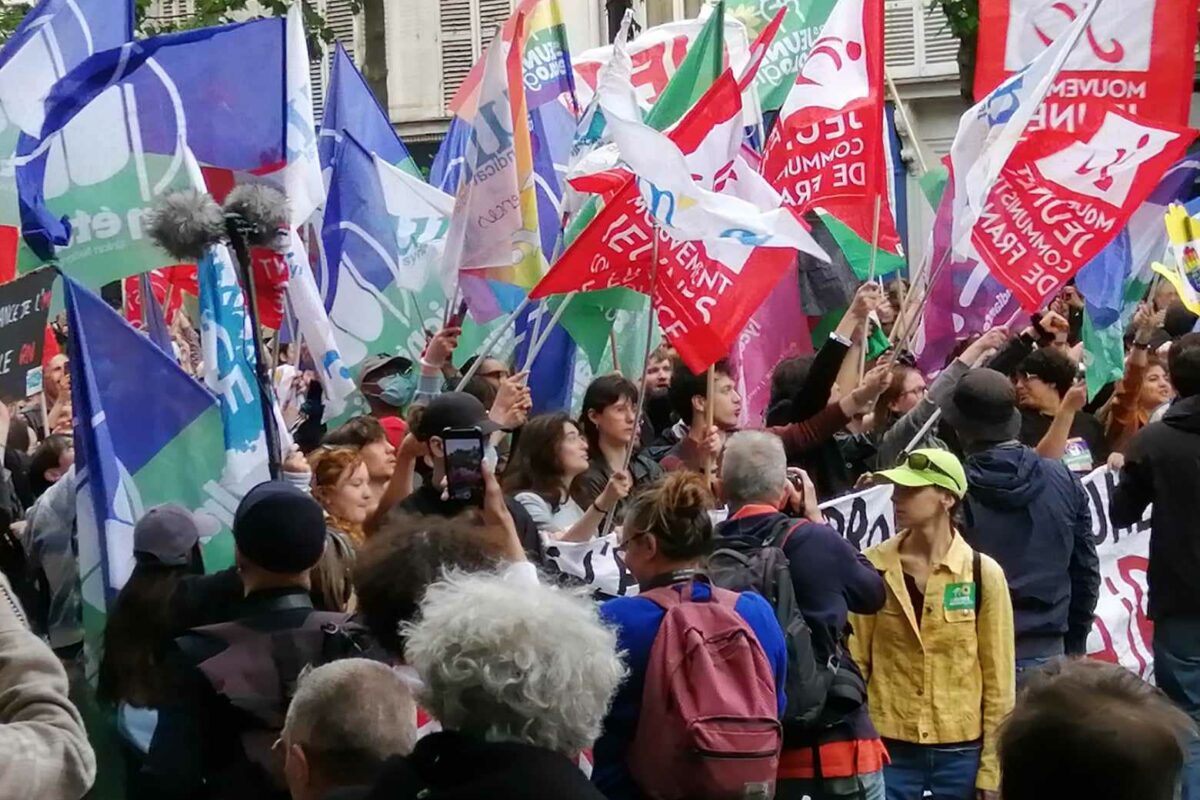
Although the Paris branch of Sciences Po is in the national limelight on TV channels and radio stations, other sites across France also saw protests erupt. Campuses in Rennes, Grenoble, Lyon, Saint-Etienne, and Dijon were blocked by students protesting in solidarity with Palestine. Lille’s ESJ journalism school was also blocked on Thursday. 

Sorbonne Clignancourt Campus Protests

The morning of May 2nd, hundreds of students voted to block the Sorbonne University’s Clignancourt campus.

A general assembly was called after an occupation of Paris’s prestigious Sciences Po University calling for a ceasefire in Gaza. 

Fearing a shutdown of the mobilization by the police, activists at Clignancourt rallied their classmates to evacuate their campus to show their solidarity with Sciences Po.

After a few rounds of sloganeering and rallying in front of the entrance, they marched to the nearest metro station to ride to the historic Sorbonne Latin Quarter campus to join forces with students from other branches of the prestigious school.

I talked to two militants engaged in the mobilisation at the Clignancourt campus.

Lina, a history and geography student, told me that the US campus occupations to protest Israel’s war in Gaza served as an “example.” 

For her, escalation is necessary. “We can’t expect things to change by handing out pamphlets. We need to block [our universities].” For Lina, the situation is dire – she didn’t hesitate to call Israel’s war in Gaza a “genocide” and in which universities should not be “complicit.”

Sasha, a literary arts masters student and member of the New Anti-Capitalist Party (NPA), was one of the organizers of the assembly, which he said drew 150 participants. Despite the spontaneous ambiance I felt at the blockade in the afternoon, publicity on social media allowed activists to announce the morning gathering with some advance notice.

He said that students recognized Emmanuel Macron’s complicity with Israel’s actions as a primary inspiration for their revolt. 

For Sasha, the campus occupations in the US are particularly inspiring since they are taking place in the heart of the dominant world hegemon. He admitted that France was a smaller western power, but that it was complicit in the “genocide” of Palestinians through its weapons exports to Israel.

Towards a new wave of student activism?

Movements in solidarity with Palestine are seeming to pick up traction as the weather improves and student protests sprout worldwide.

On Friday, Australia saw a wave of protests ignite across multiple campuses. Participants in rallies called for divestment from Israeli institutions and also cited the US universities occupations as an inspiration. 

This current upswell of solidarity with Palestine and newfound attention to anti-imperialist analysis could inspire future generations of young activists and students.

As the Palestinian death toll of Gaza rises to 34,600 since October 7th, 2023, urgent mobilization is needed from students and the left to call for a lasting ceasefire and the reconstruction (and eventual liberation) of the territory.