The Left Berlin News & Comment

This is the archive template

What Will India decide?

2024 will go down in history as landmark elections in India


07/05/2024

India’s general elections began in April this year. These elections are the largest electoral exercise in the world, where 800 million people will vote and decide the fate of a fifth of the world’s population for the next five years. Over the last 77 years, with the exception of the Emergency years of 1975-77, independent India has retained its reputation for being a democratic republic, conducting free and fair elections at regular intervals, both at federal and provincial levels. India’s diverse nature has been reflected by different political parties and coalitions coming to power. Since 2014, however, when the Bharatiya Janata Party (BJP) came into power under the leadership of Narendra Modi, the political milieu in India has changed radically. Under Modi’s rule as Prime Minister, the BJP has tried to establish single-party hegemony at the federal and provincial level using every possible trick in the book. These elections are crucial because they may well be the end of India as we know it.

In order to understand why the BJP are such a big threat, it is necessary to dig into their provenance and look at the rise of Modi in particular. The BJP are the electoral wing of the Rashtriya Swayamsevak Sangh (RSS) – a Hindu nationalist organisation founded in 1925, with the explicit objective of establishing a Hindu state in South Asia. The early ideologues of the RSS were inspired by the rise of fascism in interwar Europe, and were instrumental in inventing the concept of Hindutva. Nathuram Godse—the man who assassinated Mahatma Gandhi—was a lifelong member of the RSS (although they unsuccessfully tried to distance themselves from him). After Gandhi’s assassination, the RSS was banned for a short while by the Government of India. This ban was only lifted after they agreed not to participate in electoral politics. The RSS circumvented these restrictions by creating an organisation called the Jana Sangh, which, over the course of time and various organizational experiments, metamorphosed into today’s BJP.

The BJP’s first stint in power at the federal level was between 1998 and 2004, when they formed a coalition government. In 2002, Narendra Modi was the Chief Minister of the western Indian state of Gujarat. Under his tenure, Gujarat witnessed a pogrom against Muslim minorities, with with as many 2,000 (mostly Muslim) deaths. Several accusations were levelled against him and his government, for being an active participant in the massacre of Muslims. His closest ally, Amit Shah—the present Home Minister of India, and Gujarat’s Minister of State in 2002—had been charged with organising the killing of Sohrabuddin Sheikh, a man linked to the murder of Haren Pandya, a rival to Modi from within the BJP. During the court proceedings, several key witnesses turned hostile, judges recused themselves, and one of the judges died under mysterious circumstances. Eventually, the case ended up being dismissed. Together, Modi and Shah are a formidable team that rely on fear and intimidation tactics to have their way with the legal and political system.

After coming to power at the federal level, Modi’s BJP government had adopted two objectives—the complete liberalization of the economy, and the transformation of India into a Hindu nation-state. The trend towards economic liberalization is not new, and has been steadily sharpening since 1991, when the Indian economy was opened up. Broadly, government spending per capita on education and healthcare has gone down, while the share of the private sector has gone up, thus enabling the commodification of basic social welfare. The BJP has also loosened labour laws, taking away the basic rights of workers by increasing working hours, contractualizing permanent jobs, and revoking the right to protest. Agricultural laws have been changed, in order to pave the path for corporations to enter into agricultural markets; this led to massive farmers’ protests in 2021. The BJP has also brought reformed mining laws, making it easier for corporations to expropriate the country’s natural resources, often leading to the displacement of indigenous communities who have lived in mineral-rich regions for thousands of years.

These changes have particularly benefited one mega-corporation—the Adani Group, a longstanding friend and donor to the BJP. Gautam Adani, once the world’s second-wealthiest man, has benefited not only from India’s domestic policy, but also its foreign policy, as it expands its activities from Australia to Israel. This is not new: crony capitalism has been entrenched in the Indian economy for decades. The biggest trick that the BJP have pulled, however, has been to create a class of financial instruments called electoral bonds, that allow corporations to make anonymous donations to political parties. Buyers of these instruments remain anonymous to the general public, but not to the party that they donated to, allowing them to receive favorable contracts from the state. A recent Supreme Court judgment made these bonds illegal, and forced the State Bank of India to reveal the names of donors. Analyses of the data reveal that the BJP received close to 50% of all the money under this scheme, to the tune of $700 million. A list of donors reveals a number of corporations, many of whom would have wound up benefiting from receiving preferential government contracts.

Ideologically, what is unique to the BJP is the hegemonic control over the Hindu nation-building narrative that it has managed to achieve, through a combination of intimidation and propaganda. What this means is that if you dare to criticise the BJP, you become a target for attack through the various channels that they now control. Since 2014, India has witnessed an unprecedented attack on reason, protest, and any sort of activity that the government considers a threat to its interests. The scale of this attack is so vast that it is difficult to summarize in a single article. But if we zoom out a bit, a clear pattern emerges. The BJP has mobilized an army of propaganda warriors/internet trolls, whose job is to spread mis- and disinformation. This happens on social media and through tools like WhatsApp, birthing the satirical phrase, “WhatsApp University”. The electronic media, particularly English and Hindi television channels and newspapers, are largely owned either by Adani or other corporations close to the BJP. These media sources indulge in unabashed praise of the government, and shut down any kind of dissent, using terms like “anti-national” or “terrorist”, effectively rendering this government beyond critique. The BJP’s propaganda cell (the IT cell, as it is popularly known) is so strong, that it has even been successful in creating large scale communal violence across India. In addition, the BJP has successfully birthed a sophisticated group of right-wing “intellectuals”, who justify all the atrocities, violence, and attacks on civil liberties, under the garb of national pride, and spin it as creating a new decolonial history of India.

More recently, the BJP has seen scrutiny for instrumentalising institutions like the Income Tax Department, the Enforcement Directorate, and the Central Bureau of Investigation, using them to attack political rivals. Journalists and activists who have been vocal against the government have faced raids in their homes, or arrests under draconian security laws, and have seen imprisonment without trial. Laws like the Sedition Law, the National Security Act, and the Unlawful Activities (Prevention) Act have all been strengthened, so that one can be incarcerated for years without bail, and presumed to be guilty until they prove their innocence. Universities are not only facing discursive violence, through changes in academic practices and the outright banning of any anti-government discussions, but also actual violence, where the police and Hindu nationalist mobs have physically assaulted protesting students and teachers.

The biggest challenge for the BJP to turn India into a Hindu state is the country’s more than 200 million Muslim citizens. In this regard, their tactics have also been twofold—breaking the morale of the community, and actively turning the Muslims of India into a second-class citizenry. In January 2024, Narendra Modi inaugurated a grand temple at the exact site of the Babri Masjid—a 400 year old mosque, destroyed in 1992 by a Hindu nationalist mob under the leadership of LK Advani, a prominent BJP politician. This is not an exceptional event. One of the slogans that the BJP use says that the Babri demolition was “just the beginning”, and that other mosques in Kashi and Mathura are next.

While the mosque demolitions act as a symbolic reminder to Muslims about their secondary status, in recent years, Muslims have also been lynched by so-called cow vigilantes, under the pretext that they were consuming or carrying beef. Muslim localities and houses have been demolished, solely because their residents protested against the government. Inter-faith marriages between Hindus and Muslims increasingly require special permissions from judges, due to the moral panic around “*Love Jihad”*. On multiple occasions, BJP leaders (including ministers) have called for an economic boycott of Muslims. The resemblance to 1930s Germany is stark, but probably unsurprising, given the party’s provenance. In order to degrade the Muslim population to a second-class citizenry, the Modi government recently passed a law (the Citizenship Amendment Act, 2019) and intends to use it to initiate a countrywide citizenship register. This implementation was hindered by mass protests and the pandemic. However, the ulterior motive behind the law is to strip as many Muslims as possible of citizenship, and then declare them foreign nationals. This process has already been initiated in the north-eastern state of Assam, where 1.9 million people have presently been declared stateless.

Under these circumstances, the BJP’s defeat in the next elections is of utmost importance for the future of India as a democratic state. Unfortunately, the situation does not look promising; the opposition is neither strong nor unified enough to combat the colossal financial and organizational strength of the BJP. Moreover, the Election Commission of India has been losing its credibility in recent years, as it has favoured the BJP over other political parties. A free and fair election is supposed to be an impartial process that reveals the will of the general public. But this process itself is at stake, as the BJP relies on coercion, money, intimidation and propaganda. They have repeatedly bought out winning opposition candidates, or threatened them to get them to join the BJP when they have been short of a majority. Thus, there is no guarantee that BJP will lose even if there is a free and fair election. The judiciary, which has remained independent and a check on the government’s arbitrary practices, has also lost its credibility, as Supreme Court judges that have favoured the BJP agenda have been given ministerial positions upon retirement.

All signs point towards the BJP having no intention to leave office. With plans for gerrymandering, and changes to how many representatives each federal state will have at the national level, it appears that a few states from the Hindi-speaking parts of India (a bastion of support for the BJP) shall have larger electoral weight going forward. At this point, India will not only face threats against its democracy, but could fall into an actual political crisis, which might not be resolvable through elections or other democratic processes.

While we cannot predict the future, there is reason believe that 2024 will go down in history as landmark elections in India: perhaps even the last.

254 EURO

War is also when you are scolded for being in a good mood.

Last night I had a nightmare. In it, my dad was murdered in my rented apartment. He was killed in such a gruesome way that doctors refused to take his body to the morgue. That’s why, like at the beginning of the war, I went to live in the office building again. And in the gay church, which is practically outlawed in Ukraine.

I tried to fall asleep immediately, refusing to live in such an ugly reality. But when I started to drift off, I realized I wanted to escape not from reality, but from the nightmare. It’s worth mentioning that I don’t have a dad. Just as I don’t have a homeland.

When discussing war, we talk about Ukraine and Russia, forgetting that the state is a myth that exists only as long as people believe in it. And we forget about people.

Today, many are more concerned about the fate of the state than the fate of its people, which is both shameful and frightening. Logic suggests that the fate of the state will determine the destinies of millions of people, so the fate of the state should take priority. But the nuance of reality suggests otherwise; what’s good for the state isn’t always good for the individual.

Let me show you an example that recently occurred in a Ukrainian mining town, my hometown. The town has been occupied by the Russian army for 2 years now. Finally, one of my friends decided to emigrate. She left through Crimea to Russia, and from there to Turkey. Eventually, she decided to settle in Lithuania. However, she didn’t like it there and decided to return. But she wasn’t allowed back home. Not having obtained a Russian passport in 2 years meant she didn’t support the new government, so she was denied entry.

A huge number of people got Russian passports in territories under occupation. My other buddies did it but that one girl refused. War devalues everything, but we must still realize that emigration is difficult and traumatic, and not suitable for everyone. It’s important to understand I’m not claiming that emigration is harder than war; I’m asserting that it’s also difficult. And so, many choose to live under shelling just to avoid the hardships of emigration. To adapt, many have to get Russian passports if they want to work.

What? Isn’t a job worth someone’s safety? Recently I read the news that two Ukrainian men were detained for illegally crossing the border. Surprisingly, they were not trying to escape, but to return. They could not find jobs in Europe and after a while went back. Since they left Ukraine by crossing the river, they decided to return the same way, but were caught.

Back to our story. Upon returning to Lithuania, my friend suddenly sent me 254 euros. That same evening, she called me and asked to write a book about her situation. I found it funny, not only her intention but also its realization – 254 euros. Why exactly 254? It turned out to be simple – it was her last bit of spare money, what she had planned to spend on leisure after paying rent and other obligatory expenses.

Naturally, I returned the money to her, promising to tell her story in an upcoming essay. By the time I got around to it, the story had taken a turn: a successful date in Vilnius rendered her problems  insignificant. More proof that home is not just a place on the map but an internal feeling.

I write this again to emphasize that not everything that is good for the state is good for the individual. Many today support Ukraine, but how many think about those living in the occupied territories? What will happen to them if these cities return under Ukraine’s control? The cynicism with which Ukraine regards the guys who left the country suggests that even people who have received Russian passports in the occupied territories will be subject to oppression by the Ukrainian authorities.

Let me remind you that the occupied territories are located in eastern Ukraine, and therefore, the most Russian-speaking cities are located there. In my mining town, there are no Ukrainian-speaking people at all. At least there weren’t while I lived there. The Ukranian liberation of Russian-speaking cities during a period of aggressive Ukrainization is a dangerous matter. It warrants at least public discussion.

What do the Ukrainian authorities do for emigrants? They limit access to consular services. They intimidate us with monthly news about deportation. They call for the closure of integration programs for Ukrainians in the EU. There are endless debates within Ukraine about how many years to imprison those who left. Could the same fate await my dear grandma if Ukraine regains my mining town?

Thinking about this is like waking up again in the office and in the church. And again, everywhere there are corpses, but now they are  strangers’ dads’. The question is not who will win. The question is why people feel bad even when they do win.

It’s been 2 weeks since I received the strange payment of 254 euros, and I’m still thinking about it. I remember Gabriel Garcia Marquez, who sold his fridge to afford to write a novel. Besides the fridge, he also had to sell his radio. And to send the manuscript to the publisher by mail, he pawned his wife’s hairdryer and blender.

When discussing the war in Ukraine, I often talk about the decline of culture as one of the reasons for the war. If writers and artists could more easily find financial support, there would be more works that foster a more critical attitude towards current events. How does this work? Culture shapes values that create a defense against the influence of war propaganda.

For example, a propagandist will never admit to not believing in heroism, but a writer can and should. Are you curious why someone would not believe in heroism? And what’s wrong with heroism in the first place? The thing is, heroism often embodies an attraction to death, which is the opposite of a love for life. In other words: one who finds life more terrifying is less scared of death (you can read more about it in the first essay I wrote for The Left Berlin which is called A Closer Look at Heroism).

Putting such a person on a pedastal in front of society is reckless, but it benefits the state during wartime to push citizens towards reckless actions, such as sacrificing their own lives for a myth. The duty of a writer is to stand on the side of humanity, even knowing that at the moment they may believe the state is their only friend. Remember, to write a novel, one writer already had to sell a hairdryer and a fridge.

But what if the writer doesn’t have their own fridge? Is it worth hoping for support from the state? True art stands on the side of humanity, while the state doesn’t always do the same. That’s why the paths of creativity and the state often diverge, and accordingly, support should be sought not from the state, but from the people. We all know who funds propaganda. Resisting it is often a selfless act of individuals who need your support. Fighters for justice in the capitalist world often find themselves in a weak position, but it’s within our power to change that.

Looking at my friend’s odd gesture, I wonder about the likelihood that she tricked me. What if she knew I would return her money, but her gesture would inspire me to write this essay? Yesterday, I spoke to her on the phone. She laughed but declined to comment.

This piece is a part of  a series, The Mining Boy Notes, published on Mondays and authored by Ilya Kharkow, a writer from Ukraine. For more information about Ilya, see his website. You can support his work by buying him a coffee.
“The only place to reflect critically is on the streets”

interview with Robert Yerachmiel Sniderman, Adi Liraz, and Eliana Pliskin Jacobs about their artistic project WE SEE


05/05/2024

WE SEE / WIR SEHEN / ΕΜΕΙΣ ΒΛΕΠΟΥΜΕ / אנחנו רואות / نحن نرى is a project conceptualized by artists Adi Liraz and Robert Yerachmiel Sniderman, with Eliana Pliskin Jacobs as a collaborative performer. The multi-site performance between Ioannina, Greece, and Berlin, Germany took place on March 29th, 2024. It was the shabbat evening after the 80th year since the deportation of Liraz’s grandmother. The artists sat, walked, and reflected on the unfolding atrocities in Gaza, repeating “Gaza my love, we see”. It draws on historical imagery of antisemitism in Germany, particularly the blindfolded figure representing a blind Judaism known as Synagoga. The artists insisted on their presence as a protest in the places where their families had been exterminated by National Socialism.

For Adi Liraz, it connected to the murder of the family of her grandmother in Ioannina. For Eliana Pliskin Jacobs, it connected to the murder of her great-grandparents in Berlin. For all the artists, insisting on reflecting upon these histories of violence was essential to protest the ongoing mass killing and ethnic cleansing in Gaza. They gazed through historically imposed blindfolds, to comment on the systematic repression in Germany and beyond – of pro-Palestinian Jewish voices. These demand the right to see their Holocaust histories in constellation with other acts of mass violence, underlining “Gaza my love, we see”.

They wrote that, “Facing the mass killing + ethnic cleansing of Palestinians perpetrated by the State of Israel*, we, carrying these stories, refuse the fascism forced on Jews by Nationalists + Philosemites. You tell us we lie. Thirty thousand murdered; 13,000 children; 1.8 million displaced; 700,000 in most severe starvation; 1.3 million in acute hunger facing it; 70% homes destroyed; 1 million ghettoized in Rafah waiting invasion. You tell us we lie. You tell us burn + bury through infants in incubators, water, universities, hospitals, poets, flour or we blaspheme our ancestors Nelly + Rivka + Annetta + Nissim + Erna + Martin or we’re not ourselves, you blindfold us, Gaza my love, we see you inside ourselves.” Full project statement here.

I was wondering about the historical background of the Ecclesia and Synagoga figures. Can you explain their meaning and how they inspired this latest project?

AL:  I work as a freelancer-guide at the Jewish Museum of Berlin. There are two replicas of figures from the 15th century in the core exhibition. A year or a year and a half ago Robert came with a group of students, I gave them a tour and showed them the two figures. Since then Robert and I have conversed about them. Already from the Middle Ages, I think the 11th century, and even before that they appeared in 5th century Rome. Around then, the church started propaganda against Jews using the figures, Ecclesia and Synagoga. This was to promote Christianity by presenting Judaism as backward, blindfolded – and Christianity as a queen looking to the future. Everyone could see them. This further influenced hatred towards Jews that developed into actual violence against Jews.

RYS: We thought about Synagoga as one part of an ancient racial imagination of Jewish blindness. There’s a 13th century public engraving on the Schlosskirche in Wittenberg, a UNESCO World Heritage Site, wherein Jewish men are depicted suckling a pig, while one opens and stares into the animal’s anus. The image references a sermon from Martin Luther, declaring Jews find the Talmud inside a pig’s anus; the Talmud, being, as Daniel Boyarin has written, that which “maintained a diasporic existence.” To us, this “Jewish Sow” image was also one on Jewish blindness. A German convert to Judaism in recent years sued to remove the engraving. Historical preservation laws prevailed. Adi and I took a position that such public imagery should remain, yet accompanied by some form of permanent, if changing, intervention, because it evidences a deep, thousand-year legacy buried in a contemporary German discourse that isolates Nazism in history, culture, and power. But the roots are so deep and the visual discourse, on blindness in this case, remains potent.

AL: To contextualize this within contemporary discourse, most often when you hear the word antisemitism, or hate against Jews – in Germany it is almost always in connection to refugees from Muslim countries or Palestinians. In a way it seems like German society is trying to push away their own responsibility for the deep-rooted hate against Jews within its own history. The word anti-Semitism comes from Germany. Of course we cannot deny that anti-Semitism also exists in Muslim countries. But this is actually something that was  reflected from the colonial projects of Christianity to either convert other people to Christianity or conquer and occupy Muslim countries. That brought with it this idea of the Jew as powerful, rich, conspiring. We tried to reflect on that in this work.

RYS: And to use the figure actually as a performer: to take the statue from the museum to the streets. To re-inhabit that figure in order to create a visual, ethical, cultural intervention in the contemporary landscape.

I found it really interesting how multi-sited your interventions were, between Greece, Ioannina; Germany, Berlin; referencing Palestine, Gaza; and enacting memory-scapes stretching back generations and histories. How did these physical and memorial places come together for you all: for Adi and Robert as the work’s conceptualizers and for Eliana as a performer?

EPJ: I think that one of the most interesting elements about this performance is that it looks across so many spaces, especially towards what’s happening in Palestine and also seeing inside ourselves. It was very powerful that Adi and I were doing the same thing at the same time in our – as much as Jews can call it such – ancestral homelands. I found this spanning a very powerful part of the work.

AL: For me, the core of this work is commemoration of different violent events in which people are being mass murdered or ethnically cleansed. I don’t think there is a justification for competition between who has suffered more. It’s possible to feel several things and not only one pain. When we look at the 80th commemoration day of my ancestors in Ioannina, I can also commemorate the expulsion and murder of Eliana’s great-grandparents; and the contemporary violence acts against the population in Gaza.

RYS: What you called a multi-site performance, Sarah, is connected for me to the idea of how we perform our diaspora, or diasporas in the plural. Because Jewish history contains multiple diasporas. The bifurcation of our world into exile and Israel is a Zionist narrative. When we perform in multiple sites, we pull traditions from those sites and cultures. We serve our diasporas, we perpetuate our diasporas. We say: We live, Jews live.

EPJ: Within Yiddish-speaking communities of Eastern Europe there was a very strong concept of Doikayt, meaning “hereness”, being here. Zionism as the default mentality of Jews was only imposed on many Jewish communities after the Holocaust. Before, there was a widespread cultural pride in diaspora, at least in the Yiddish community of Eastern Europe.

AL: Just to add on to that, the National Socialists argued that Jews do not belong in Germany and need to go to Palestine. So actually there is a strong connection between imposed Zionism and National Socialism. This is the significance of working here in Ioannina for me. Because it used to be Ottoman for such a long time. But dominated by a Muslim empire, it welcomed and even invited Jews to be part of it. But I do not ignore the atrocities committed by this empire towards other populations and later towards Jews in Turkey.

Eliana on train tracks in Westhafen, Berlin which originally led to Auschwitz. Photo: Denis Esakov

In the six months since October 7th, how do you feel about doing this recent artistic work in an atmosphere of increased pro-Palestine repression and silencing of speech? Where do you think artistic actions fit in this space?

AL: Pari El-Qalqili and Nahed Samour argue that political art or the arts in general, cannot exist anywhere else in the moment but in the street. In Germany after October 7th, there is censorship of critical voices. So the only place to actually reflect critically is on the streets. Many people are not talking at all or are very selective with their words, especially people who don’t have German or European citizenship. We can also think about the meaning of protests. There are demonstrations, which often end with a mass arrest – and there is a kind of protest through creating interventions, using different kinds of materials and tools through art. In a way there is more freedom of speech in these kinds of actions. So if we look at it from the perspective of protest, there is more possibility to express and create criticism through art. If we look at it from art institutions, it is more possible to be critical out on the streets – than in the institutions themselves. Since October 7th, in the institutions is such a strong censorship and repression.

EPJ: As Adi mentioned, everybody’s scared, but nobody actually knows what would happen if you step across the boundary. I think there might even be more leniency than we’re aware of. For instance a large Jewish institution in Germany (name redacted) liked our Instagram post about the project. I think the only way to find out the boundary is to push against it gradually. Conversely, I think there is absolutely no discourse in Germany, or in the rest of the world now, on what is going on right now within a larger historical context. Perhaps it’s too present for people to step back and see historical phenomena in perspective. But I wish this were addressed even in demonstrations in Germany. Both in terms of Germany providing weapons for Israel and providing the enormous spark that eventually led to all this in the first place.

RYS: I think that if we were able to have an informed and truthful discourse around this—the ties between the Holocaust and the ongoing Nakba—it would be different. We would all be different. Honestly, I see a lot of antisemitism at demonstrations. I’m sorry to say this. I’ve seen signs that read: “Zionists are indigenous to hell” and “If you love them so much why don’t you give them your land”. These phrases mask earnest widespread anti-colonial and humanitarian desperations that I share. And they scald the very pulse of the extreme vulnerability and volatile relationship to land and politics Ashkenazi and Sephardic Jews have bore over the past thousand years. It is a vulnerability and volatility that is at the root of this cycle of genocide we see tearing our world apart today. I think it’s because we can’t have this conversation nearly anywhere that there’s so much personification, radicalization, and mystification of its trans-generational roots and trajectories. It’s as if at once Jews were the only victims that ever existed but now (as Zionists) they’re the only perpetrators. Between them Nazism forming this bridge of exceptionalism. But Palestine/Israel is part of the former Ottoman Empire, the slow dismantling of which, over centuries, constituted multiple genocides and ethnic cleansing campaigns from every ethno-sectarian direction. The catastrophe of Palestine/Israel extends all these histories.

We’ve touched on repression in Germany as well as other places. Alongside this, at least as I have observed within leftist Jewish contexts in Berlin and New York, there is often a discourse about the privilege of being Jewish. Namely, that Jewish people have some leverage to not get punished as badly as many more precarious people intervening. They can use their status as a model minority in Germany to intervene, particularly to help the Palestinian cause. What do you think are the potentials and pitfalls of intervening as a Jewish artist in Germany?

AL: There was a time when I thought I was protected in Germany because I’m Jewish and Israeli, and then I learned that this is bullshit. Of course, in comparison to other discriminated groups we´re more privileged, but it’s not like we are protected. We can also be accused or lose our access to certain things when we become too vocal about some topics. Each time when we say things that do not fit into the “Jew box”, are not well digested, we can also be excluded.

EPJ: And I might add that the idea of the privileges of being Jewish in Germany are based in discrimination, in stereotyping and generalizations about a particular desired kind of Jew. Germany wants to protect its Jews but it wants to protect its good Jews. There are a couple of bad Jews – let’s just push them to the corner and not listen to them.

RYS: I think we need to say that Palestinian-Germans and peoples, in this context, especially Muslim and Arab, without papers or with precarious papers, of course they’re always more vulnerable when demonstrating, when making statements, when doing the kind of work that the three of us feel more or less able to do. When we create such things in the streets of Europe we are thinking about their circumstances and trying to enact a solidarity with them and their families.

Where do you think the use of certain terms, words, or terminologies fits within such solidarity and broader possibilities of artistic intervention, especially in German spaces? In this recent project, you all had a lot of debate over whether to use the word “genocide” to describe what is going on in Gaza. It is not about a lack of information or disagreement with this term to describe what is going on, but rather about a climate of fear and intimidation when people use this word in Germany, alongside a broad lack of contextualization and discussion.

AL: Yes, earlier we were talking about fear, also of certain terminologies, these things are also dynamic. Some things that we were able to say before October 7th became forbidden afterwards. Some things that in the first couple of months after October 7th were forbidden are now allowed. It’s constantly changing. The only thing that is stable is the fear put on us from Germany. This causes us to doubt and rethink how we express ourselves and the use of the word genocide. I have read the official definition of what the German government considers genocide so many times. Each time I read it, I don’t understand why it does not apply to what is happening right now in Gaza. I was afraid to use it until recently because of the fear of what could happen to me. We had a conversation around whether to use “genocide” in our project description because we both have certain ideas and are afraid and trying to protect ourselves. It’s ridiculous because we are all Jews! Eliana and I have ancestors who were murdered by Germans in events defined as genocide in the official definition, and yet we are afraid to use this word. It’s ridiculous.

EPJ: Precisely. We are afraid of accusations of anti-Semitism, which is absurd. Because we are using this term in the context in which we are talking about our great grandparents who were murdered by anti-Semitism. The descendants of those who murdered them are now accusing us of committing the same crime (“anti-Semitism”) that their great grandparents did to murder ours. They put the responsibility of their own crimes and atonement onto the descendants of their own victims.

AL: This is what our performance is about. They put the blindfold on us, they try to blind us, but they don’t succeed.

RYS: And we see through other means. Why are we doing this? Why have we been yelling about these things along with many other Jews and Palestinians and non-Jews and non-Palestinians for years, decades? From a Jewish perspective it’s about the integrity of our ancestors. We don’t want to see our ancestors and the crimes against them used to justify or obfuscate the crimes against other people. This is a horrible, violating feeling. After receiving the violence, there’s very little that’s worse than this.

Adi performing through Ioannina. Photo: Chrysanthos Konstantinidis

This recent piece connects back to both of your broader artistic practices and their motivations. Robert, there are intersections with your recent action in Warsaw with  Joanna Rajkowska, and your different walking actions in Berlin. Adi, this connects to your project Asking for Nelly (2019), a walk in Ioannina about your grandmother’s younger sister. It links to Megorashet (2022), a walk in Heidelberg reflecting on the city’s entanglement with Greek symbols and German nationalism; and Alle Erinnerungen fließen ins Meer und wieder raus (2021) an action of remembrance of three German-speaking poets, May Ayim, Semra Ertan, and Rose Ausländer. In your works, there are intersections with walking and rituals of commemoration. How are your broader bodies of work in dialogue with this recent collaboration?

AL: Yes, it directly relates to Asking for Nelly, which was in Ioannina five years ago shortly before the recent performance, March 25th. It was the 75th commemoration of the deportation of the Jews of Ioannina. Five years ago I was walking while wearing a similar dress and holding a projector that projected the image of the sister of my great-grandmother, Nelly. I walked from the place where the deportation started, through the synagogue, to the family´s house. This time I wasn’t walking, I was sitting. I sat because I wanted to look through the blindfold to the location where the Jews of Ioannina were deported from. I wasn’t walking – but looking. Many of Robert’s and at least one of Eliana’s have commonalities, with elements of commemoration, public rituals, aiming to receive solidarity from the audience. For me, this is one of the main reasons why I create art in public space. But it’s also about accessibility, about bringing communication and storytelling to people. To create the possibility to learn and interact not only by going into prestigious institutions. It’s also a spiritual experience; people are feeling very connected and there are moments of exchange, of learning and of communality.

RYS: I felt honoured to have created this piece with Adi. This is our first significant collaboration. My family was not deported or murdered in the Shoah, but were exiled during the Pogrom era in the late 19th century and early 20th century. I felt moved to work with Adi and Eliana in the exact sites where their families were deported to their murder in order to together protest for life. It was a very intense practice. I realize it follows the trajectory I’ve taken in recent years; that is a process of poetic mediation, in helping others imagine a way through tumultuous conditions of memory, violation, and land. Adi and I have created a visual language with the blindfold. It is a potent supplement in its context, and I think could be used by others to cut through the imprisoned yet urgently necessary discourse of the Holocaust and the Nakba. It is a kind of public performance that reaches quickly and deeply into mold-infested undercurrents of social imagination which fuel today’s atrocities. It reaches to find another language, to transmute this violence.

Thank you all for sharing your thoughts. Any final words?

ESP: I condemn Germany for using their murder of our great grandparents to justify the murder of countless more today. For putting the responsibility of atonement for its own genocide onto its own victims. And for turning the lesson that it should have learned from its past – never again shall there be systematic extermination – completely upside down as it now supports systematic extermination. I urge the German public to recognize the inherent diversity of Jewish discourse, and to hear the many voices of those of us who cry “Stop supporting the killing of our sisters and brothers!”


Berlin evicts pro-Palestinian camp that set up in front of the Reichstag

Free speech is being taken apart in front of our eyes. It is time for German civil society to stand up


04/05/2024

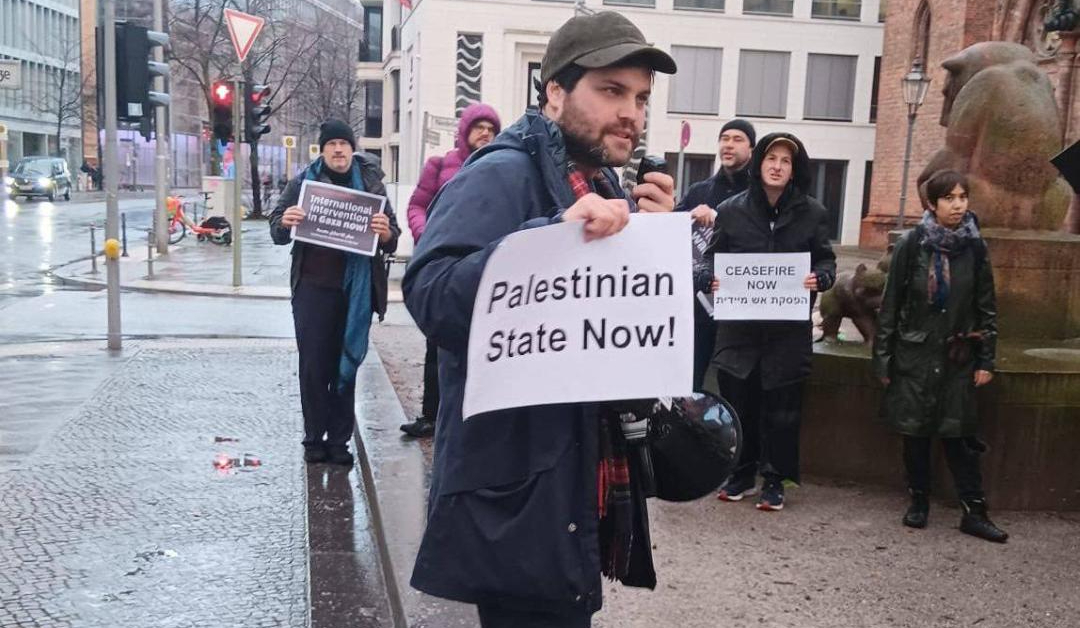
After seven months of protests against the genocide in Gaza—which has been sponsored, encouraged, and defended by Germany—police brutality toward pro-Palestinian activists is no longer surprising to those paying attention. A fortnight ago, Germany made headlines for the banning and live-streamed dissolution of the Palestine Congress in Berlin.

Following that, on April 26, hundreds of police were dispatched to carry out massive, violent arrests of peaceful protestors occupying a camp in front of the Reichstag. Activists had established the camp only weeks before, on April 8, in order to publicly demand an end to the genocide in Gaza, and to protest against Germany’s collaboration. When peaceful demonstrators arrived across the street in order to protest the campers’ eviction on April 26, many were rounded up and arrested. According to police sources, 161 arrests were made that day alone, and 41 criminal investigations were opened.

The encampment began on the day that Nicaragua sued Germany in the International Court of Justice in The Hague for its complicity in the genocide in Gaza. During the intermittent weeks, there have been activities, talks, and concerts hosted within the camp. Yet there have also been daily arrests and unprecedented rules that the police appeared to come up with on the spot, such as campers having to move all tents daily, and the banning all languages other than German and English. After protests at the camp, police allowed Arabic to be used for a few hours while there was a translator, so people could pray. In the name of fighting antisemitism within the peaceful encampment, not only Irish, an official EU language, but also Hebrew was banned.

Other bans implemented by police included a the removal of a sofa from the encampment, thereafter nicknamed “comrade sofa” (I recommend following our comrade’s Instagram), tables, chairs, hanging things from trees, and red triangles (which led to the painting of red circles by protestors). Unable to break the morale of the campers with arrests and absurd rules, and recognizing the beginning of summer tourist season, which attracts hundreds of tourists daily to the esplanade in front of the parliament where the encampment was installed, police gave an immediate eviction order at the site.

This order claimed that prohibited acts had taken place, such as speaking in languages other than German or English, saying “from the river to the sea”, and critically, because the grass on the esplanade must be protected. As Philip Roth writes in Operation Shylock: “It is too ridiculous to be taken seriously, and too serious to be ridiculous”.

Arbitrary arrests and bans are a constant occurrence at demonstrations and events in support of the Palestinian cause. During the last seven months in this country, there have been arrests for: wearing kufiyas, shouting “Free Palestine”, wearing stickers with a fist on them, and calling the police Nazi or antisemitic for are laughing at the kippah with a watermelon motif worn by a Jewish colleague, who was arrested by force the next second by the same police officer.

In addition, arrests have been made for minors for carrying marbles with which they were playing, for displaying maps of Palestine from 1947 to the present day, Jewish activists wearing the Star of David in the colors of the Palestinian flag, carrying a banner reading “Jews against Genocide,” or calling the police ridiculous in public. This is all done in the name of fighting antisemitism in Germany—and it is an incomplete list of arrestable offenses.

It should be mentioned that what these arrests mentioned above have in common is that the people targeted are either of migrant origin, mostly Palestinian, as Germany is home to the largest Palestinian community outside the Middle East, or Jewish. What this points to is two things: the deep-seated racism and antisemitism in the German police, and the low presence and engagement of white Germans at demonstrations and events.

This silence, and thus complicity, of a huge part of German society will be the subject of study for decades to come. The pro-Palestine encampments being set up on US campuses, and the growing solidarity of students and professors stand in stark contrast to the largely silent college campuses here in Germany.

With honorable and courageous exceptions, students are silent; a good part of the faculty and management of universities, including the now misnamed “Free University” of Berlin, are advocating the expulsion of students for “political reasons,” which has been exclusively applied to Palestinian solidarity efforts. The same university had already sent riot police in December to forcibly break up a pro-Palestinian assembly and brought charges against some of its students.

Rather than prompting an outcry in defense of free speech and the right of assembly in the sacrosanct public universities, the German press and society became divided between condemning these students who, without evidence were branded as dangerous antisemites (several of the students were in fact Jewish), or simply looking the other way.

It is in this breeding ground of apathy, constant criminalisation, excuses and, let’s not kid ourselves, absolute support from a large part of society, even some who consider themselves leftists, that the German state is skirting democratic boundaries and slipping into authoritarianism in all matters pertaining to the Palestinian liberation movement.

But here, right now, Germany’s adjustments toward authoritarianism don’t seem to matter; in fact, it is welcomed by too many who accept German politicians and media framing it as a fight against jihadist terrorism and antisemitism. Right now, critical thinking, in general, is conspicuous by absence. While much of German society has indicated privately that they that Israel is going too far, few seem to be showing up in public to defend these beliefs.

Nor does this majority appear to care that in Germany today, there is no full right of speech or assembly when criticising the same genocidal actions they allegedly take issue with. This may be because they do not agree with what is said at pro-Palestinian demonstrations, which many interpret in black and white terms, to be for either Palestine or Israel, since the political and historical context has for decades been either banned or directly rewritten in Israel’s favour.

The absurdity reaches Dantesque limits when the anti-Deutsche (known also as anti-Germans, they are a theoretically left-wing anti-fascist movement, which opposes the establishment of the German state due to its crimes in World War II) While their motto is “Never again Germany,” they presently fill the streets with stickers of the Israeli flag next to the anti-fascist flag, as if Netanyahu and his government were not extreme right-wing politicians; organize events about antisemitism without first inviting Jewish comrades to talk about their experience; inviting a singular, token Jewish participant onto their panel, complain about anti-German hatred in videos of the aforementioned camp where “Fuck You Germany” was shouted.

Apparently only the anti-Deutsche can complain about a country that is actively complicit in the genocide in Gaza—a genocide in which many of the camp’s protesters have lost dozens, or hundreds of family members and friends—a country which is forcibly suppressing demonstrations, riding roughshod over the right of assembly and free speech of those who inconvenience it.

What is Dead May Never Die: The Rebirth of Campus Occupations

The Columbia University occupation and it’s violent dispersal has rebirthed the haunting spectres of 1968 student radicalism.

On Tuesday, I awoke to the news that Columbia University students had stormed Hamilton Hall and renamed it “Hind” Hall after Hind Rajab, the five year old child murdered by an Israeli tank on January 29 when fleeing the Tel Al-Hawa neighborhood of Gaza City. This development follows a week-long Gaza Solidarity Encampment, which has activated campuses nation-, and now, worldwide. 

The latest occupation and escalation was a direct response to the university writing a public statement the previous day stating they would not divest support to Israel; their demand for the protest to be broken up by 2 pm with threats of suspension for participating students.  

Vietnam Protest

Hamilton Hall was last occupied on April 23, 1968, when students stormed the hall and took the college president hostage. The event also had a notable German anti-Fascist flavour with the “Springer Demonstration”, an event “supporting German speakers against Fascism”, and a screening of the German anti-imperialist film “Three Penny Opera” from 1931.

The students’ message was that Columbia University was complicit in the ongoing atrocities in the Vietnam War. The uncovered link was between the IDA—Institute for Defense Analysis—and the University, an institutional member of the IDA. 

Additionally, the protests revolved around segregated gymnasiums in Morningside Park and the eviction of black and hispanic families to clear more land for a campus expansion. Students stood in solidarity with arrested student protestors, and the demands made on April 23, 1968, had to deal with the students’ fates. 

Today’s Protests 

The demands from the current protest are eerily similar to those in 1968, if even more depressing in the university leadership’s craven complicity with atrocities. 

Columbia has over 13 billion dollars in endowment funds, which the Columbia University Apartheid Divest, a coalition of campus groups, has campaigned to bring into the spotlight. Investments the university has made in companies such as BlackRock, AirBnb, Caterpillar, and Google, are directly linked to the Israeli government’s genocidal campaign against Palestinians.

For example, Airbnb rents out apartments in the West Bank, and Israel uses Caterpillars’ bulldozers to destroy the homes of Palestinians and clear land for new settlements. The link between private ownership and investments is directly linked to the creation of new markets and landed interest for capitalists to expand their businesses on occupied land.

This form of protest has worked before. In 1985, Columbia divested support from companies that supported the Apartheid regime in South Africa…

Columbia also has a special relationship with Tel Aviv University, offering a dual degree program and creating the Columbia Global Center in Tel Aviv. These global projects and initiatives entrench collaboration with the genocidal actions of the Israeli government, with the profit margins the involved corporations stand to gain from them. 

Media Response

In the intervening years between the Vietnam protests and the current protests, the playbook has more or less stayed the same for those liberals and conservatives siding with capitalists: protesters are accused of siding with illiberal forces, claim they’re naive, young, and stupid, or, most provocatively, called them agents of foreign forces or antisemitic terrorists.

In her article for the Telegraph, Janet Daley typifies the response by conservatives and even some liberals.

“My generation of student radicals fought for liberty. Today’s are a delusional cult,”

It approaches it from the cynical, “that was then, this is now, the young should know more and do less,” which was the same kind of brow-beating patronizing many conservatives hurled at activists like Daley in 1968 and justified the violence on them.

In the most extreme examples, liberals have relitigated the Vietnam War protest and come up against its contradictions and conservation of private interest. The general attitude of these conservative and liberal voices is unified: “How dare you disrupt our peace and tranquility and side with forces we don’t like.” How dare them, indeed. 

Divestment Campaigns Work

More than ever, American and European capitalists are desperate to have their utopian liberal project be seen in lockstep with the expansion of settlements in the Israeli government’s occupation of historic Palestine. More than ever, this liberal project will remain entrenched in its ethnic cleansing violence when it inconveniences them or their profit margins, and that goes for the treatment of protestors as well.

If Columbia and other universities don’t want to divest support from Israel, the protesters should continue to force the question to the university’s faces and wallets. The lives of students not supporting the protests and the politicians who visited the college and booed should be disrupted. These disruptions, beyond anything else, are what will force the hand of capitalists. Bourgeois hands of reaction are guided by the ghostly, seductive promise of blood-drenched lands cleared for their profit-driven market. Non-violent protests and disruptions to daily life should continue until all the protesters’ demands are met. 

…the end of the occupation was a negotiation of violence between state officials and campus administration officials whose bourgeois interests were on the line.

This form of protest has worked before. In 1985, Columbia divested support from companies that supported the Apartheid regime in South Africa after a long pressure campaign by campus activists. The university took a 4% decrease from its portfolio. 

By Tuesday night, the New York Police Department had brought a small army to break up the occupation at ‘Hind’ Hall. As with much of the handling of the protesters, the end of the occupation was a negotiation of violence between state officials and campus administration officials whose bourgeois interests were on the line. But this is not the end. This form of protest will continue to spread as global boycotts force capital to buckle under the pressure of the misery they are complicit in. Then, as now, it will continue.