The Left Berlin News & Comment

This is the archive template

Between a Rock and a Staatsräson: What’s Up With German Media?

German coverage of Gaza has been substandard at best—is unconstitutional state pressure to blame?


28/01/2024

‘Freedom of the press and of reporting through radio and film broadcast are guaranteed. Censorship does not take place,’ asserts Article five of the German constitution. Supposedly this encodes journalistic freedom into the fabric of the Republic. Yet,  as politicians’ assertions of solidarity with Israel, German reporting on violence in Gaza, is either pro-Israel, or is timid and incomplete. Vice Chancellor Robert Habeck said in a much-praised speech on November 2nd, ‘The security of Israel is German reason-of-state (Staatsräson)’. Through omission, hesitation and manipulation approaching propaganda, some channels reflected his words clearly. But others seemed hindered by them and try to convey that there is more to the story without betraying where their sympathies lie.

Tagesspiegel is headquartered in Berlin. The outlet provides news both digitally and in print. Die Zeitungen, which monitors newspaper activity in Germany, ranks Tagesspiegel as the highest-quality regional paper in the country as reviewed by experts. However reporting on the Israel-Hamas conflict tends to concentrate on antisemitism, the Israeli hostages, local terrorism threats, and Israeli military activity. 

The 167,000-follower @tagesspiegel Instagram account underwent an apparent tone shift around mid-December, when content became more weighted in favour of Palestinian voices in Berlin and abroad. Posts included headlines like ‘Four in ten of those killed are children’; ‘The humanitarian catastrophe in Gaza is beyond all imagination’ overlaid on images of young boys among rubble; ‘Protests against Hamas in Gaza following the death of a teenager’; and a post highlighting the conflation of grief with ‘terrorism’ within Germany. These and others, appear to humanise Palestinian victims of the conflict and reflect support of their struggle. 

The social media presence contrasts with headlines on the Tagesspiegel homepage.  While the reporting illustrated in the above posts is also published on the site, it is interspersed among opinions such as the justification of Israeli attacks on non-military targets due to Hamas’ ‘Fusion with civilians’ and an article quoting Munich cardinal Reinhard Marx in a  headline suggesting Islam a whole be ‘stopped’.

A possible explanation for Tagesspiegel’s contradictory social media and homepage presence could be related to the age of readers in differing media. More than half of Instagram users in Germany are under  30, and TikTok has a particularly young user base. Those older than 30 use the Holocaust to base their views on the conflict or have oriented their opinions around violence during early 2000s which culminated in Israeli settlers’ withdrawal from the Gaza Strip. In contrast many of those under 30 likely encounter the conflict for the first time in the aftermath of October 7th. Crucially, civilian narratives out of Gaza now circulate on social media platforms such as Instagram and Tiktok and shape public opinion. “Curated” coverage allows the paper to drive positive engagement via @tagesspiegel while providing enough pro-Israel content on tagesspiegel.de to maintain the status quo. Thus they evade accusations of so-called ‘Anti-Israel antisemitism’.

Beyond local news, the nation’s most-viewed, most-trusted source Tagesschau (ARD) included consistent nightly reports for several weeks on the Hamas-Israel conflict in its 8pm segment. The 15-minute  broadcast attracts nearly 10 million viewers on an average night—a 34.5% share of the market. Notably, this cultural institution beloved by the German public was confronted with a decisive event several weeks ago when ARD’s own reporters in Israel were held and threatened by Israeli soldiers.

An article on their website called  the event ‘a clear attack on freedom of press’, and a corresponding instagram post received more than 250,000 likes and over 7,000 comments. Five days later, an interview was published on the Tagesschau website under the heading Journalists Are Obligated to Document Crimes. In the article, one of the affected journalists, Jan-Kristoph Kitzler, addressed Israeli campaigning to discredit foreign journalism.

In the weeks following Kitzler’s ordeal, Tagesschau 20 Uhr featured a series urging the public to critically engage with media surrounding the conflict. It illuminated reporters’ unique challenges in the area. For example, a story documenting journalist Mohammed Abusaif’s efforts to flee Gaza. Abusaif claimed that civilians keep a wide berth of journalists, as they are thought to be favoured targets by the Israeli military.  The broadcast  on the November 29th slot dedicated several minutes to address wartime media literacy. Moderator Judith Rackers said that images obtained during conflict are often supplied by the involved parties, ‘difficult to verify, and often false’. Her words reflected a press release from the Deutsche Journalisten-Verband (German Journalists’ Association or DJV). A clip of celebration during a hostage exchange authored by Hamas follows, after which an interviewed ARD fact-checker affirms that opponents in war ‘naturally want to show their side of the story’. 

As the broadcast cuts to the next clip, a voiceover claims that the same is true of Israel—that ‘selected’ journalists are accompanied by Israeli military personnel to document the war’s progression. The example in the clip, was originally from an American news agency. It traced the Al-Shaifa Hospital story. Israel justified bombing the hospital with claims that Hamas commando headquarters were concealed in tunnels beneath its foundation. The voiceover says that the military ‘wants to show evidence of a commando headquarters—journalists are shown tunnels and guns’. Following the footage, media scholar Steffen Siegel explains that the ‘great seductiveness’ of images is in their immediacy and the spontaneity with which the public reacts to them. 

Dedicating several minutes of a 15-minute programme to educating the public on media literacy following an ‘attack on journalistic freedom’ victimising colleagues, further coupled with the CBS Morning banner on footage of Al-Shaifa Hospital begs a question. Namely, is the nation’s most popular news source grappling with the line between the German state’s pro-Israel sensibilities and responsible reporting? Tagesschau coverage has reasonably sown distrust toward information transmitted via the IDF and of Israel’s motivations among viewers. However it remains a far cry from, for example, CNN reporting that openly questions the verity of IDF claims that a Hamas commando central was located beneath the Hospital.

While honest reporting on Gaza is in the interest of the German public and therefore the duty of public broadcasters, a wariness surrounding stories negatively reflecting on Israel leaves Tagesschau with few tools to represent the truth. Foregoing what should be abundant ground coverage for a media literacy lesson during their most precious time slot betrays ARD’s ambivalence. But, as with CBS footage of Al-Shaifa, the German media again looked to the USA following The New York Timesreport stating that Israel had received repeated prior warning of Hamas’ plans for attack. 

Source attribution is crucial to news media because the credibility of information depends on it. It also allows journalists to present information that they otherwise are not qualified to, separating the presentation from the realm of subjectivity and personal opinion. Their own convictions are muted and they are perceived as a neutral vessel for factual information. On December first, ARD newscaster Susanne Daubner introduced the NYT report with a question: ‘Did Hamas’ attack on Israel really come as a surprise?’ Because responsibility for the information lies elsewhere, her provocative intonation and the following discussion with Tel Aviv correspondent Christian Limpert received a degree of protection from accusations of anti-Israel bias.

Hiding behind Uncle Sam, appealing to viewers to cautiously consume the data they encounter—alludes to an unseen force restricting ARD’s coverage. With freedom of the press and from censorship enshrined in the constitution, what is the invisible rope tying the hands of German news coverage? According to some scholars, it’s the same Staatsräson Robert Habeck mentioned in his speech. 

A document published by the Bundestag late 2023 elaborates on German Staatsräson as an obligation to protect Jewish lives and to the security of Israel, assumed within the text to be interchangeable. It provides Staatsräson as justification for Germany’s vote against recognising Palestine as a UN-non-member observer state in 2012. The obligation to Israel’s security is categorised as an obligation to ‘facilitate a political environment which reduces tensions between Israel and neighbouring Arab countries.’ Closer analysis of Palestinian sovereignty as a threat to Israel is not presented in the document.

Deutschlandfunk, traditionally broadcasts through radio and other audio media but also summarises current events on its website. It has taken an interest in politicians deviating from the accepted pro-Israel doctrine. Opinions which include criticising Israel for having ‘no plan’ for its fight against Hamas; or United Nations General Secretary Antonio Guterres’ opposition to Israel’s actions and warnings against escalation. Early reporting lent significant attention to Israeli and international casualty numbers alongside the Palestinian civilian death toll; an IDF blunder resulting in the death of 13 hostages; collapse of the healthcare system in Gaza; collective punishment per the UNO; protest bans, as well as efforts against domestic antisemitism. Arguably Israel-sympathetic content appears to have dwindled with the war’s progression. 

The outlet tackles Staatsräson’s impact on the German media in an episode of their Breitband podcast. An expert guest interviewed on the podcast, was Meron Mendel, the Anne Frank Education Centre director, professor and historian. Mendel argues that while global news had the same point of origin on October 7th—the shock of Hamas’ attack—coverage in the US and much of the world has since developed in a direction unlikely to be followed by German coverage.

Mendel assessed the initial coverage worldwide portraying Israel as ‘victim’ and Hamas as the ‘perpetrator’, as an image that proved increasingly difficult to maintain. As Israel’s counter-offensive progressed, mounting civilian costs became incompatible with the idea that Israel was acting in self-defence. Turning to American media, he cites the Washington Post’s front-page dedication to images of Gazan child casualties, claiming that ‘such a strong gesture of empathy with Gazan civilians would be interpreted as anti-Israel’ in Germnay. Arguing the German media presents as much more reserved than its American counterpart.

Staatsräson is defined in the episode as either ‘the interests of the state bear importance above all others’ or is ‘a critical, unshakeable principle of the state’. On the latter definition, the German state holds Israel’s right to existence as inviolable and that ‘the security of Israel is the security of Germany’. Note that legal scholar Martin Morlok calls this use of the word a ‘terminological misnomer’. Staatsräson provides a foundation for a nation’s geopolitical handlings. The moderators posed the question, ‘does Staatsräson apply only to the state of Germany, or also to the German media?’

Mendel answered, ‘[the idea that a] government tell its people what to think is anti-democratic’; further, the term has no legal underpinning and is propagated by politicians without an understanding of its meaning or regard for the broader consequences of doing so.

These ‘broader consequences’ are evidenced in Axel-Springer Verlag. The owner of BILD, Welt, Politico, and several daily papers including Berliner Morgenpost among other outlets, declared itself  ‘unrestrictedly on Israel’s side’ and amended company policy It now demanded explicit support of ‘the state of Israel’s right to exist’, of employees. The move was praised by former Bundestag Member Jürgen Trittin (Die Grünen). In an interview with weekly newspaper Die Zeit Trittin said that so much should be expected of ‘every publishing house and every political party.’ His words prompted a statement from the DJV rejecting politicians’ attempts to intervene in ‘responsible reporting’. Even if no such demands have been made outside of the Axel-Springer family, the shadow cast by so-called Staatsräson on Germany’s most influential sources is inescapable, driving them to reserved and duplicitous coverage of Gaza.

Mendel acknowledges that the German media must be aware of the resonance that reporting could have with an antisemitic German public. Antisemitism had a clear foothold in German society prior to October 7th. The 2022 Leipzig Authoritarianism Study of more than 2.5 thousand participants found that more than a quarter at least partially agreed with the statement, ‘Even today Jewish influence is too strong’, while 23% said that Jewish people are fundamentally different and don’t ‘fit’ with German society, and a similar number saiod that Jewish people use ‘more tricks than others’ to ‘get what they want’. Audiences could therefore be primed to twist information into fuel for preexisting antisemitic beliefs. 

Material presented by Tagesschau, concern from the DJV and the content of the Breitband episode overlap in their message that the conflict requires extra care and meticulousness. Mendel’s proposed solution is to simply dedicate more time and pages to reporting on the conflict to avoid reanimating Germany’s fraught anti-Jewish history while also truthfully documenting atrocities in Gaza. In his own words: ‘German antisemitism is no reason not to broadcast civilian suffering—this obligation is essential to all reporting’.

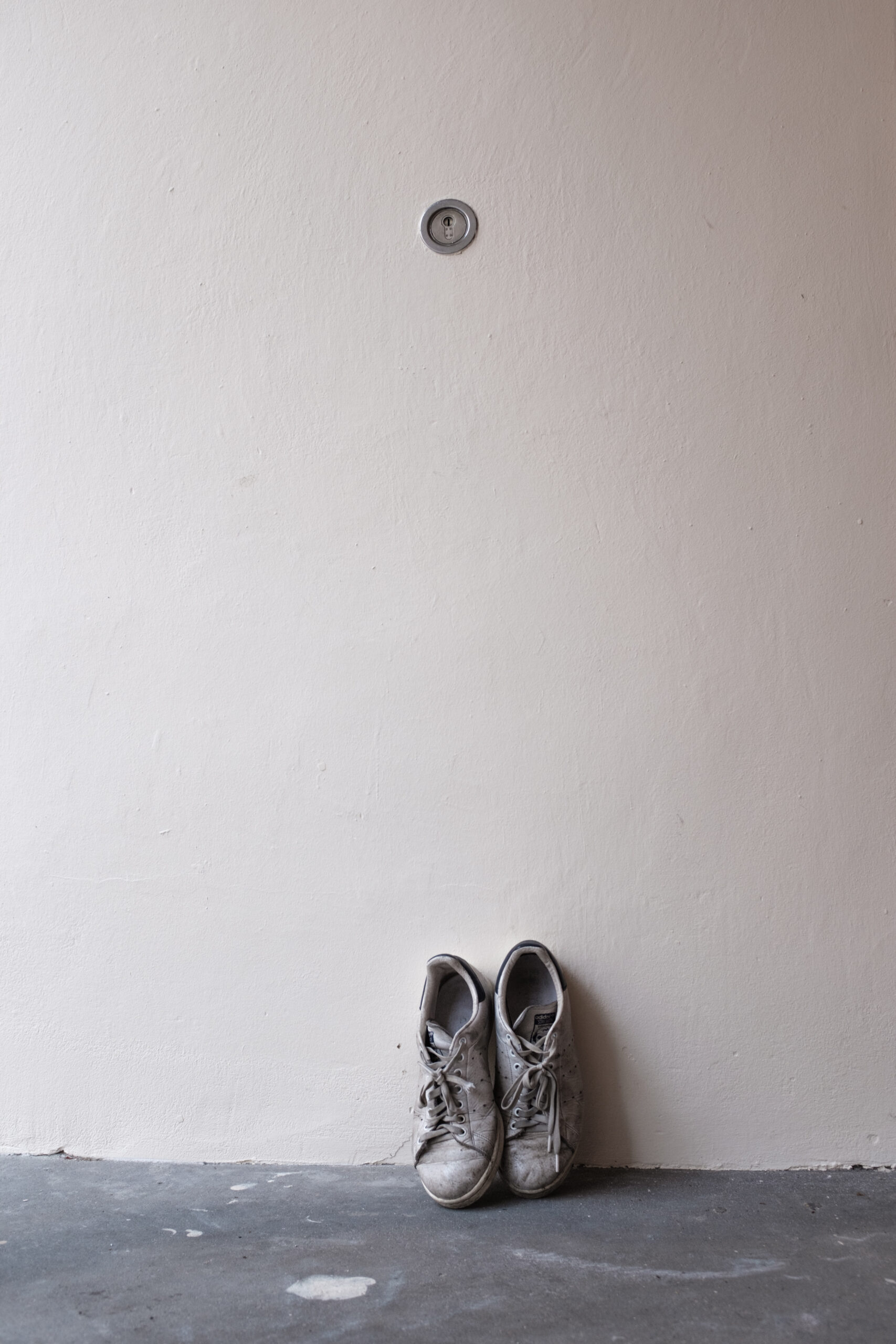
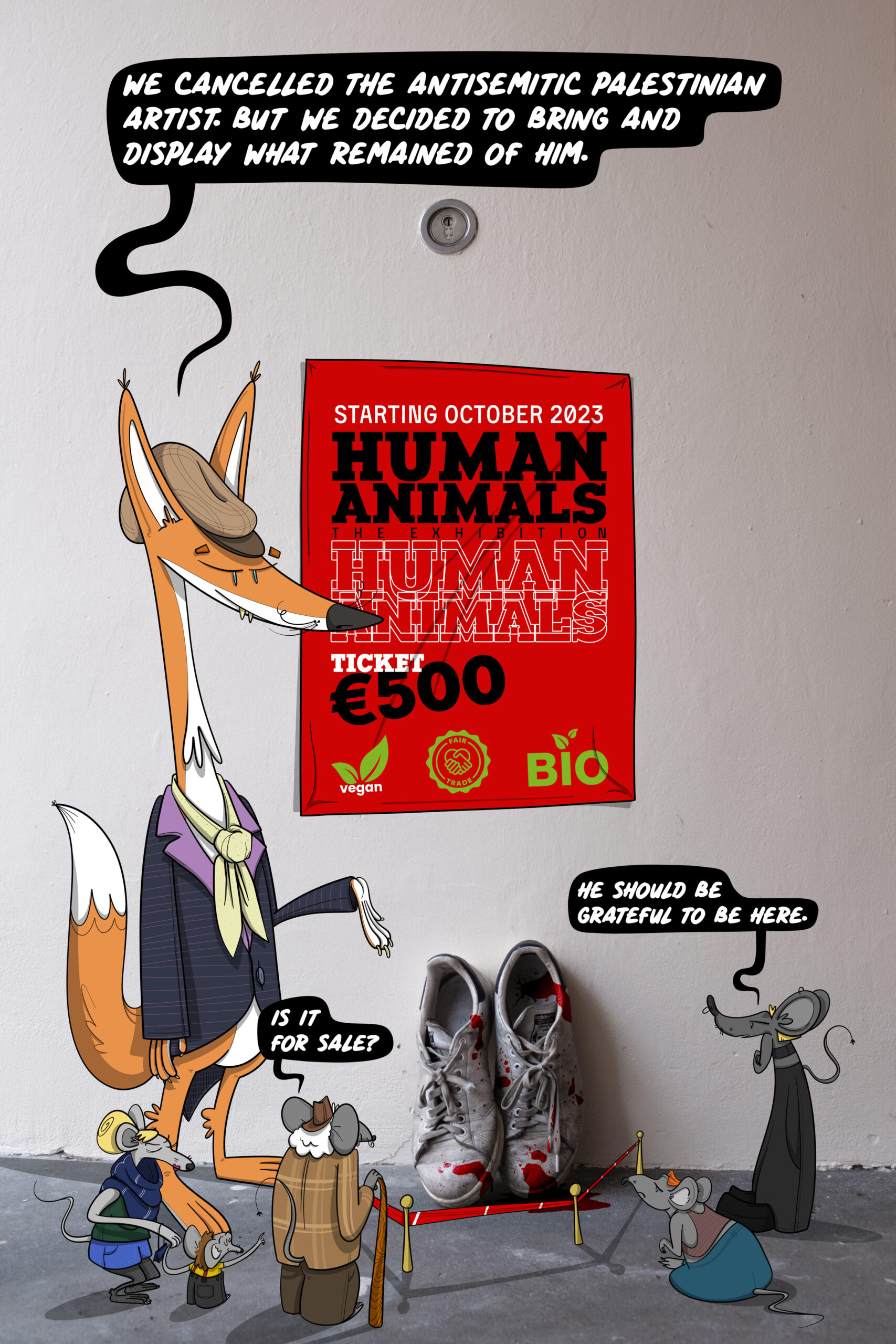
“It’s so Berlin!” 2: “Cancelled Remains”

The second instalment in our series of photographs and cartoons about Berlin and Palestine.


27/01/2024

Following last week’s contribution “Blind Orders“, here are the latest works from Berlin-based Palestinian artists Rasha Al Jundi and Michael Jabareen.

Photo: Rasha Al-Jundi


Cartoon: Michael Jabareen


The art and cultural scene in Berlin specifically and in Germany as a whole, hasn’t been “Palestinian-friendly” for some time now, long before October 7th 2023. The loose use of the anti-Semitism card against Palestinian or pro-Palestinian culture creators by a curator, art space, event funder or biased politician has led to the cancellation of events or award ceremonies for those culture creators. In some cases, this madness has led to unfair legal action against the latter.

As struggling artists ourselves, we decided to take this issue up in this image, which includes a pair of white sneakers as the abandoned items.

Titled “Cancelled Remains”, this image features two of the most spotted wildlife dwellers in the urban landscape of Berlin. Rats and foxes blend into the general cultural sector of the city, taking up its typical arrogant attitude. The city’s art bosses rushed to cancel Palestinian and pro-Palestinian artists’ activities including talks and exhibitions (we don’t even know where to pitch any work in this hostile context).

At the time of writing this caption (31.12.2023), we had lost more than 22,000 Palestinians in occupied Palestine. Many of those lost lives were culture creators. In the midst of the genocide, a mother in besieged Gaza held up what remained of her killed son: his white shoes. She screamed in agony and kissed the shoes.

Now imagine her son was an artist and the “civilised” world held an exhibition of his remains for entertainment.

Image taken in Kreuzberg, Berlin (2023).


“It’s about making us all stronger and safer through collective action”

Interview with 2 members of the Arts and Culture Alliance Berlin (ACAB) about artistic freedom and Palestine in Berlin


26/01/2024

Note: This interview was carried out on Monday, 22nd January, the day in which the Berliner Senat announced its withdrawal of the “Anti-Discrimination” clause.

Hello, thanks for agreeing to talk to us. Could you explain a little about your organisation?

ACAB is an alliance of artists who came together in the past few months after the Hamas attacks in Israel and the subsequent genocidal bombing that began in Gaza. The cultural scene in Berlin was very, very quickly becoming even more sensitive, prone to censorship and repressive than it had already been. So we assembled a meeting and started working together.

ACAB stands for Arts and Culture Alliance Berlin. The main goal was to make sure that the most marginalised amongst our community of artists are not the ones who are being left behind in the struggle. Unfortunately, they have been the ones who have been feeling the brunt of the cultural repression that’s been playing out at the moment.

There’s been this idea that arts and culture somehow need this kind of political repression in a heavier way than other fields. There’s a displacement of actual fighting against fascism onto people who are trying to speak out against the genocide.

It’s been Arabs, Muslims, Palestinians, and people who support Palestinian Liberation who are losing funding, being de-platformed, and generally being cancelled by the establishment arts scene in Germany. This is part of the concerted effort of Germany to stand fully behind Israel’s manipulative upside down claims to have a right to defend itself when defence has become an obliterative offence.

Because Germany seems to think that the issue with all of this is just Jews and not genocide, it is forbidding any kind of dissent from within the country. Anyone in culture who’s even potentially in support of Palestine is an antisemite. And because of the right wing idea that criticism of Israel is antisemitic, the entire spectrum of political actors are clamping down and silencing critiques of Israel.

Who is involved in ACAB?  

It’s an alliance of cultural workers. And that can be defined as broadly as possible – anyone who calls themself an artist. If you have a similar feeling to us, you are welcome to join.

We felt the need to organise on a more grassroots level than what was already established through organisations like the Bundesverband Bildender Künstlerinnen (BBK) – an official body that represents the interests of visual artists and who are also doing amazing work. We also saw the need to organise from an intersectional position that centres the politics of the artists who stand the most chance of being silenced right now and generally speaking, those are not German. There’s a rift that’s opening up between what Germans believe is a left-wing politic, and an actual representation of marginalised voices in this country.

We saw that yesterday [21st January] in the demo against the AfD, where the Palestinian bloc was attacked by people at that demo. There’s a constant struggle where the German Left is paralysed by not knowing how to avoid antisemitism while also avoiding anti-racism.

A lot of people have chosen to exclusively privilege antisemitism. But we’re trying to say that all of these forms of discrimination are intersectional and must be treated equally. We cannot allow right-wing violence, even if it’s done by someone who claims to be a victim such as the State of Israel. That’s something that seems very hard for Germans to understand right now.

Can we say something about the “anti-discrimination” clause? ACAB has now organised two demos outside the Berliner Abgeordnetehaus against the clause. What does it mean for artists who live in Berlin?

Much of Germany’s cultural sector is publicly funded. That means that tax money pays artistic labour, for the existence of artistic institutions, and for our studios to be subsidised. Much of the cultural sector comes from public funding.

Now the CDU is in power in Berlin and their senator has decided to impose an “anti-discrimination” clause to be added to all funding contracts. If you sign it, you must accept the IHRA definition of antisemitism, which states that critique of Israel is antisemitic.

I was reading the clause again last night to be sure about the wording. And there’s one line which says that you agree not to work with anyone who is suspected of working with extremist or terrorist groups. This is for me, very worrying.

That means that the definition of who gets labeled a terrorist or extremist organisation is left to the often biased opinions of public officials. Groups who support Palestinian solidarity would be much easier to define as a terrorist or extreme rather than a right-wing German group.

Were the clause to be put into effect, what kind of cultural scene would we have? We would have people who did not have any qualms in endorsing Israel’s actions, who are either pro-Zionist or simply ambivalent or indifferent to genocide. It would be a very, very different cultural scene than the one that we have.

We are not against actual anti-discrimination measures. We absolutely believe in anti-racism and anti-discrimination, but the most marginalised people must be safe. What we have seen uses the language of anti-discrimination, but the so-called “anti-antisemitism” measures are being used as a weapon against marginalised artists.

It’s important to say that we don’t think of artists being completely free of politics. We believe in freedom of speech only up until the point that it is not discriminatory to others. The far right has used the language of freedom of speech for decades. But when we talk about freedom of speech, we talk about freedom towards a liberatory critique of power.

Has there been a reaction from white German artists to the clause?

Of course. They’re trying to show their support. But it’s not universal, and there’s a bit of a tipping point around freedom of expression. Any artist worth their salt knows that you can’t do this.  You’re getting a lot more people who may not be so sure about Palestine or antisemitism, but they’re sure about freedom of expression.

They’ll distance themselves very carefully to try to feel like it’s not too close to what they feel uncomfortable with. But when it comes to freedom of expression, and what can be said and done as art, they know that if they endorse the censorship, they will lose their legitimacy as experts in culture.

More than other demographics, artists are internationally networked. And internationally, people on the Left have sympathy for Palestine. It’s different within Germany, where the Left is very confused right now. But internationally the Left is far more secure. In the art field itself, there is a larger sympathy for a pro-Palestinian position than outside. For German artists, that’s kind of alienating and a bit threatening.

How have cultural institutions reacted?

We need arts and culture platforms to be able to maintain spaces for freedom of speech and criticism. But the institutions across the board were silent or pro-Zionist even before the government proposed the discrimination clause. The spreadsheet “Index Palestine” has kept track of how cultural institutions were reacting, and almost all of them were completely silent while so many events were being cancelled, and artists were being de-platformed.

On top of that, they were checking our Facebook posts or Instagram posts. If the clause goes into effect, this will put the institutions in the position of deciding who they want to work with, and who’s a safe bet. This censorship enters into the institutions and makes artists choose between getting funding and solidarity.

This is very dangerous for art because everyone starts to surveil each other. Institutions can say: “Oh, you made a post, you signed a letter that somebody else in favour of BDS signed.” It gets very insecure very quickly, because art does not generate money on its own. We need funding. The cultural scene is very dependent on external sources of money.

In other countries, where art is entirely based on foundations and private funding, the people who are affiliated with Zionism are just pulling shows and withdrawing money. Here, where it’s coming from the public funding and the government, the abuses of power are very intense.

I’m quite bolstered in my optimism in knowing that the cultural scene of Berlin can’t happen without us. Further, we have a voice because of public money. This is why it just seemed so urgent and necessary to start organising.

It was announced in today’s demo that the clause has been withdrawn. How much do you know about why this has happened? Is this a permanent thing? What happens next?

Since we were outside at the demo, we didn’t get to watch the proceedings. I’m just going on what we heard from other people inside. We can accept this as a victory because whatever the plan was, it is now no longer. The plan has been put on hold or at least postponed.

But we will definitely continue organising. Artists have now been awarded funding for 2024. They are all organised and ready to fight the clause if it shows up in our contracts. We will keep going. I don’t think the fight is over.

We want to make sure that things don’t get worse. There’s always going to be more to work on. If we win the fight on the anti-discrimination clause, we have 4 million other things. There’s so much more to do. The fact that we’re organised and we’re finding each other and building trust with each other is always going to be a good thing, no matter what.

Do you think your demonstrations affected the decision? 

Definitely. The first demonstration was really impactful. By the time they got to today’s meeting, they would have already made the decisions. So I think today was much more symbolic. But it’s good that we did it anyway. There’s been a lot of work going on behind the scenes that has definitely shifted things. But it’s not the end.

Part of what we’re doing is just for us. We’re doing this to show each other that we stand up against this. We are all working as hard as we can to build the culture that we want in our communities. This is a really big step. We have this network now and we have accountability to each other.

Berlin’s art community is diverse. There’s some who are pro-Palestine, others who are not so pro-Palestine, but for free speech. Some artists support you, but are very wary of signing any open letter because they know that this could mean that they lose work or funding.

What can artists in Berlin do to support what you’re doing and what you’ll be doing in the future?

We have open meetings, they’re welcome to join us. There’s lots of work to be done. Argue with Germans. There’s a discursive shift that needs to happen around what is fascism and where their voices are needed. We need everybody to get into these conversations and try to sway public opinion. It’s gradual, it’s not like you just step out and you’re fully radicalised. You take steps towards feeling more secure in what you are comfortable committing to.

If people are scared of signing letters, I would say that the more people do it, the more safe we are all together. If 10,000 artists in Berlin sign a letter, they can’t cancel all of us. That’s what was also really encouraging about the most recent letter against the anti-discrimination clause. It had a very wide reach with 5,000 signatories. I don’t know how many working artists there are in Berlin, but that’s a good proportion.

You don’t have to do it alone. There are ways that you can contribute to struggles without having to put your name out there or having your face in the media. It’s about making us all stronger and safer through collective action. This has been our guiding light in the ACAB group.

What is happening in Germany?

Palestine, the AfD and the German left.


24/01/2024

All this week massive demonstrations have been taking place in Germany. This includes an estimated 350,000 who rallied on Sunday 21 January in Berlin.

The demos are in opposition to the Alternative für Deutschland (AfD) participation in a meeting held by right wingers and fascists in which they proposed to ‘remigrate’ vast sections of the German population.

The Correktiv magazine reported on a meeting held in a villa by a lakeside addressed by a far right wing extremist Martin Sellner, the Austrian leader of the ethno-nationalist Identitarian movement.
Plans were outlined for the future of certain communities in Germany. These communities were to be relocated to a territory in North Africa.

The meeting was attended by several high level members of the AfD, a right wing populist party with an increasingly dominant fascist wing, several prominent businessmen and even some members of the Tory-like CDU party.

Not only ‘foreigners’ were to be dealt with in this way but also those German citizens that ‘failed to integrate’ were to be deported.

This can be passed off as the ravings of deluded extremists, but comes at a time when the AfD are becoming the second party and the main opposition to an increasingly unpopular Red-Green-Yellow coalition of the Labour-like SPD, the Greens and a smaller pro business party, the FDP.

In several important upcoming state elections the AfD may take the leading positions.

It’s also a populist movement that comes from the countryside, is badly handled by the authorities, and shows signs of being influenced by the far right. The AfD MP, fascist Björn Höcke, strongly supports the farmers protests and demands. Martin Seller also supports them, and on some demos the flag of the Landvolkbewegung, an antisemitic countryside movement from 1920s, has been seen.

At the same time, increasing authoritarianism is evident in German policing. This is especially true of protests agains Israeli genocide in Gaza.

In the wake of October 7th, protests against the Israeli assault on Gaza were banned by the police. In Berlin’s Neukölln district people were arrested for showing visible signs of support for Palestine, including the wearing of the Keffiyeh. The slogan ‘from the river to the sea’ is prohibited, under threat of arrest. A main street, Sonnenalle, in a largely migrant area, was sectioned off and people were forced to undergo identity checks.

During one pro-Palestine demo, Jewish activist Iris Hefets was arrested for holding up the placard, “As an Israeli Jew: Stop the genocide in Gaza”. She was arrested again during another demonstration shortly after.

Last Sunday, the 14th of January, police attacked the annual Luxemburg-Liebknecht march, which has been held since the 1920’s, except during the Nazi years. The excuse was the pro-Palestine participants participating in the march. The police claim that a person was using the banned slogan. The attack took place near the former Stasi HQ in east Berlin.

This follows the German government’s total support for Israel and it’s attacks on Gaza. Former Chancellor Angela Merkel declared that support for Israel was a ‘reason of state’ for Germany. This is a semi-legal justification that makes Israel’s security a matter of national interest for Germany.

Some see this unwavering support as an exculpation of German guilt for the Holocaust, but other reasons may be involved.

It allows Germany to cover over its failure to fully denazify the state apparatus after the war. For example, many judges kept their positions. Consequently, antisemitism is still deeply imbedded in German society, and a long list of fascist organisations since the fall of Hitler has culminated in the AfD today. The police and other state security agencies show strong support for the right wing. Crime statistics regularly show that homegrown white supremacy far exceeds any supposed threat posed by people from a migrant background. The state knows this all too well, as a native-born German with far-right sympathies tried to shoot his way into a synagogue in the city of Halle in 2019, killing two people.

However a key reason for the German stance is that it allows Germany to cover its World War Two actions and remain on the international stage as an integral part part of the West’s military alliances.

The war in Ukraine saw a huge lurch towards militarism on behalf of the German government and its dominating parties. The traffic light coalition had planned to double the money – to €8 billion – given to Ukraine to continue the war against Russia. Germany is considering supplying Israel with around 10,000 rounds of 120-millimeter precision tank ammunition. This comes after other increases in military spending and a more aggressive stance towards the possibility of German military intervention through NATO, thus increasing the presence of German imperialism on the world stage.

German Chancellor Olaf Scholz joined in the anti-AfD march that took place in Potsdam as did his Green Party foreign minister Annalena Baerbock. It is she, of course, that is leading the increases in military spending.

They are rightly condemning the proposition by the AfD to construct an ethno-nationalist state around German nationalism and racism. Unfortunately, at the same time in Saxony-Anhalt the CDU-led government has made citizenship conditional on the acceptance of the right of Israel, an ethno-nationalist state, to exist. This racist measure is to be debated in the Parliament, the Bundestag, and made to apply to the entirety of Germany. It is being proposed by the Tory CDU but it is said that other parties are sympathetic.

The German left however, has a problem.

The German wing of Fridays for Future separated from the global movement when Greta Thunburg declared her support for a ceasefire in Palestine. It is reported that they have also prohibited pro-Palestine protesters from joining the anti-AfD rally in Berlin.

This is not unusual. The majority of the left it seems, goes along withe the reasoning of the German state. This includes the majority of The Left Party. Leftists that support Palestine have been denounced as anti-semites by others, and some have branded pro-Palestine supporters as ‘Nazi ticks’. How deep this goes is indicated by the crisis in the proclaimed antifascist supporters of Hamburg football club St Pauli. International groups have felt forced to disaffiliate and some closed altogether after bitter exchanges and the club’s failure to move away from its pro-Israel position. This includes major groups in Italy and Scotland.

Through perseverance and courage Palestinians and their supporters in Germany have managed to win the space to hold demonstrations. These have become more frequent as the situation in Gaza becomes ever more dire. The marches and protests are overwhelmingly Palestinians, other migrant communities and nationals from other European countries. The German left, apart from a few groups, is absent. It seems however that they are somewhat detached from German public opinion. In a recent poll by a leading broadcaster, 61% of people said that they thought Israel’s actions were not justified, with only 25% supporting them.

This attitude of the left is very worrying. The scapegoating of Muslims and migrants by the state can only lead to further deepening of the support of the AfD. Whilst those on the left see Palestinians and Muslims as a problem or inherently antisemitic they will be unable to tackle the AfD. It is Muslims, Palestinians and their supporters that are facing real discrimination on the streets now.

Recently The Left Party split around Sahra Wagenknecht, who wants to be, ‘economically progressive but socially conservative’. The left, she says, should stop going on about minorities, which can only aid the right. It is well proven that faced with real racist parties or ones opportunistically spouting racism people generally opt for the real thing.

The huge mobilisations against the AfD are of course to be hugely welcomed. It shows that underneath the seemingly calm exterior of German society there is uncertainty about the future and that there is a willingness to take to the streets about it.

The protests have been very popularly based. Their intention to culminate in a protest around the Reichstag indicates this. A nascent organisation seems to have been formed, with groups sprouting up around the country. A key demand is the problematic call to ban the AfD. That may halt its immediate advance but it won’t deal with the reasons for their growing popularity. Similarly, calls for the movement to be channeled into voting against them, whilst necessary, does not tackle the real problem.

That is the growing economic uncertainty in society and the detachment of politicians from the lives of the populace. It is also caused by the mainstream politicians’ demonising of migrants and by their Islamophobia.

To tackle that, a movement on the streets is needed, to call out the AfD as fascists and to confront them wherever they appear. But a social movement is also needed, one that can offer hope to the disenfranchised instead of the Nazi movement of despair.

The movement for Palestine has set off a huge global wave of radicalisation to the left.

The massive mobilisations and the refusal of people in Germany to swallow the lies about Palestinian resistance despite all the mainstream media and all the political parties telling them they should back Israel is a source of tremendous hope.

A small number of activists in Germany are working in the right direction.

I wish them luck.

Ecuador in flames

Solidarity with Latin America

The narco-right declares war on the people

After seven years of right-wing government, Ecuador has gone from being the second safest country in the region to being one of the most violent. Neoliberal dismantling of the state, takeover of judicial institutions and forces of repression by narcopolitical actors has allowed drug traffickers to expand operations in the country. In this scenario of precarization and violence, it is mainly poor, racialized young people who are recruited as cannon fodder by criminal organisations.

The Violent Spiral

Due to geopolitical readjustments and the interests of national elites and major world powers, Ecuador has become a strategic location for the storage, distribution and export of cocaine to Europe and the USA. Ultimately, cocaine trafficking is a colonial practice: consumption is concentrated in the imperial centres of the north, while the south is left to deal with the violence and plundering of resources. Gangs, with links to international cartels, fight for control of territory and trafficking routes in an upsurge of violence that has generated dozens of prison massacres, waves of insecurity in the streets and fear among the population. Last year was the most violent in Ecuador’s history2023 saw more than 40 murders per 100,000 inhabitants, the highest figure in Latin America. This is profoundly painful, and we condemn Ecuadorian bloodletting at the hands of the narco-state and its key figures both within and outside government.

Shock Therapy

On January 9th we witnessed an unprecedented new explosion of violence. After trafficking gang Los Chernos’ leader (known as ”Fito”) escaped from jail, banana magnate Daniel Noboa’s government admitted that it had no idea as to his whereabouts, declared a state of emergency and announced it was putting into operation “Plan Phoenix”, which envisions the construction of mega-prisons inspired by the authoritarian security model of El Salvador’s rightist president Nayib Bukele. This triggered a series of violent events which shook Ecuador and the world; prison mutinies with prison guards taken hostage, vehicles in flames, the live-broadcasted takeover of a television channel by criminal gangs, and kidnapping attempts at the University of Guayaquil. The resulting curfew, evacuation of workplaces and educational establishments, self-isolation and circulation of violent videos on corporate media and social networks fueled panic in the population.

The War Decree

This extreme violence paved the way for President Daniel Noboa to sign Decree 111, which declares officially that an “internal armed conflict” exists in Ecuador; the justification for which is said to be the fight against criminal gangs and drug trafficking. However, the decree carries imminent dangers for the Ecuadorian people and for popular organisation. By announcing a state of war against groups considered “terrorists and non-state belligerent actors”, the state runs the risk of giving organised criminal gangs the false status of “combatants.” The rhetoric of “good state vs bad criminals” obscures the fact that actors at the highest levels of the state, of politics, the police and private enterprise play an active role in the networks of violence and profiteering from drug trafficking.

Hate

The most disturbing thing is that Decree 111 constitutes a new peak in the militarisation of social life and the criminalization of impoverished youth. Within a week of its implementation, we have seen with horror how Decree 111 has given the police and military a blank cheque to abuse the rights of anyone who shows a “suspicious attitude”. Racialized young people from the poorest districts have faced increased aggression from the forces of repression. The population has been deprived of freedom and basic rights, and put under generalised suspicion. While the narco-state generates turmoil and fear, the hegemonic mass media stoke racism and hatred of the poor, providing justification for dangerous demands to “give a bullet to all of them”.

Authoritarian Neoliberalism

The authoritarian state is sustained by mass repression and terror. In Ecuador, there will shortly be a inappropriately named “public consultation”. Noboa plans to instrumentalize the rhetoric of the “war against terrorism” both to strength the police and armed forces, and to deepen neoliberal restructuring. State terrorism and impunity could be the bloody outcome. In economic terms, the government has already announced that it will finance the supposed “war against drug trafficking” through an increase in Value Added Tax. This increase is a profoundly unfair measure which will principally impact the already depressed incomes of the poorer sectors of society. Meanwhile, the Noboa Banana Exporter company, which belongs to the family of the president, has debts of 88 million dollars and has been denounced for labour exploitation. It is essential that the oligarchy pays its debts and stops robbing the Ecuadorian people. Without health care, housing, education and decent work, the authoritarian narco-right will continue to make inroads in the impoverished social base of Latin America.

The Attack on Popular Organization

After 2017 the governments of Lenin Moreno and Guillermo Lasso deepened neoliberal austerity, increased social inequality and forced hundreds of thousands of Ecuadorians to emigrate in search of a better future. At the same time, they intensified repressive practices against indigenous and popular mobilizations. The “war against terrorism” today serves the narco-right in power as a tool to further stigmatize and criminalize the organisations and social collectives that fight for a dignified life for everyone.

The regional right and US interference

The intensified ”shock therapy” since January 9th strengthens an authoritarian, militarised politics that will only intensify the spiral of violence in Ecuador. But the extremism of the narco-right crosses  frontiers. On January 10th Patricia Bullrich, the Minister of Security of the anarcho-capitalist Javier Milei in Argentina, announced that she was prepared to send military support to Ecuador, stating, “this is a continental issue”. The extreme rightwing government of Israel, in the midst of committing genocide against the Palestinian people, has also offered security collaboration to the rightist Noboa. These alarming signals make Ecuador the epicentre of the strategy of securitization and death at the regional level. The bloody echos of violence perpetrated against our brothers and sisters in Colombia and Mexico with the excuse of the “war against drugs” stopped being only a distant memory some time agothe old playbook of “internal armed conflict” is being recycled on the impoverished, racialized bodies of those considered disposable. Already in 2022 then-president banker Guillermo Lasso, asked the United States to apply a “Plan Ecuador”Noboa’s Decree 111 is the perfect terrain to enable imminent US interference, which has already spilled a great deal of blood in Latin American history.

Solidarity Without Borders

Our voices of denunciation will never be silenced by terror imposed in an attempt to paralyze us. Confronted with the politics of death, we respond with our profound love of life and hope. We have the historic task of constructing viable alternatives so that our people can live well. We will continue building networks of solidarity with all the oppressed peoples who have experience in resisting the blows of repression and in designing better collective futures. It is more important than ever to be alert, to support each other and strengthen popular organisation and resistance everywhere. Solidarity between comrades will keep us going in this dark period. We remember more than ever our comrade Dolores Cacuango, indigenous communist leader:

“We are like grains of quinoa. If we are alone, the wind will blow us away. But if we are together in a sack, the wind can do nothing. It can make us sway, but it cannot make us fall”

This article first appeared in Spanish on the Bloque Latinoamericano Berlin website. Translation: Ian Perry. Reproduced with permission