Want to meet non-German political activists? Want to discuss how we can change the world?
Then you’re warmly invited to the LINKE Internationals Summer Camp. This week-end in the Naturfreundehaus Hermsdorf (similar to a youth hostel).
Registration and accommodation are free. And you get the following:
Speakers from India, Turkey and Western Sahara
Introduction to campaigns like Deutsche Wohnen & Co Enteignen, Migrantifa and the Jewish Bund
Workshops on how can socialism be fun (with the Right2TheCity cheerleaders) and how can parents be involved in politics?
Discussion with candidates at the coming elections
The full programme is here. Register by filling in this survey.
For last-minute information, the following information will appear in this week’s weekly Newsletter from theleftberlin. If you don’t get the Newsletter already, you can subscribe by sending a mail to teamleftberlin@gmail.com.
After all the waiting, Summer Camp starts tomorrow (hence the Newsletter coming out a day early). We’ll be meeting at 12.45 on the Northbound platform (direction Wittenau) of the U8 at Alexanderplatz. For people who want to stay in Berlin to attend the unteilbar demo (more later), you need to get the U-Bahn to Wittenau (S-Bahns are on strike this week-end) and then the 220 bus to Almutstraße. From Almutstraße it’s a 10 minute walk to the Naturfreundehaus Hermsdorf, Seebadstraße 27.
We’ve spent enough previous Newsletters telling you what you can expect, and you can see a full programme here. Here’s a little practical information:
All the beds are now booked, but there are some sofas and camp beds. If you want to stay overnight, best bring a sleeping bag – even if you have a bed, as bedding costs extra.
Please take a Covid test before coming, even if you have been vaccinated. A self-test is ok.
Everything is free, but we will have a whipround to pay for the food. Drinks will be sold Saturday evening at a reasonable price.
If you tried to register on Monday or Tuesday, the survey software wasn’t working. Don’t worry, there are still places if you just turn up, but it would help us know how much food we need if you fill in the survey again.
As mentioned already, tomorrow also sees the great unteilbar demo – for a society of justice and solidarity. Summer Camp was booked months ago, hence the clash. But you can go to the unteilbar demo – meet at the Straße des 17 Juni at 1pm, and come along to Summer Camp afterwards. Unteilbar is our Campaign of the Week.
Afghan Refugees trapped on the Polish Eastern Border
European migration policies are putting vulnerable refugees in even more danger
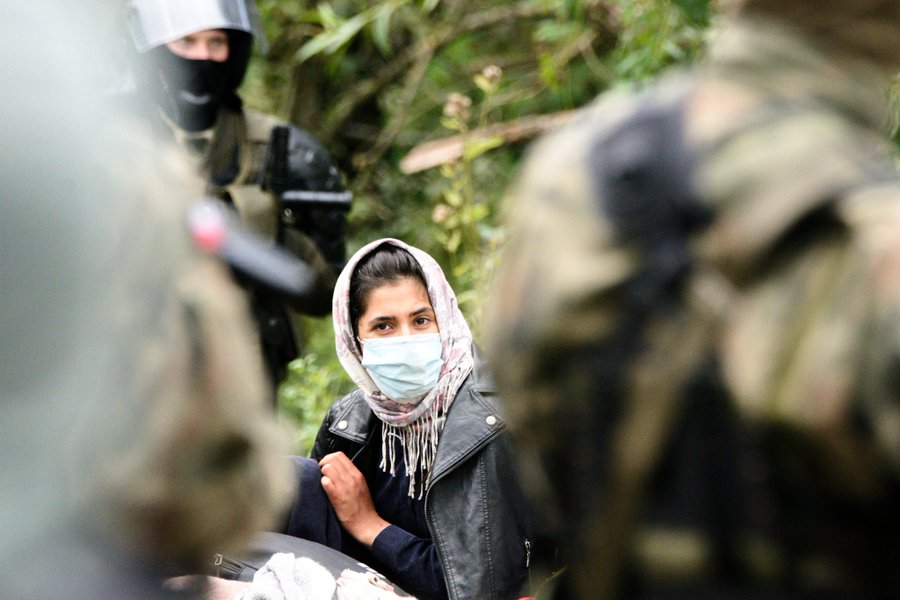
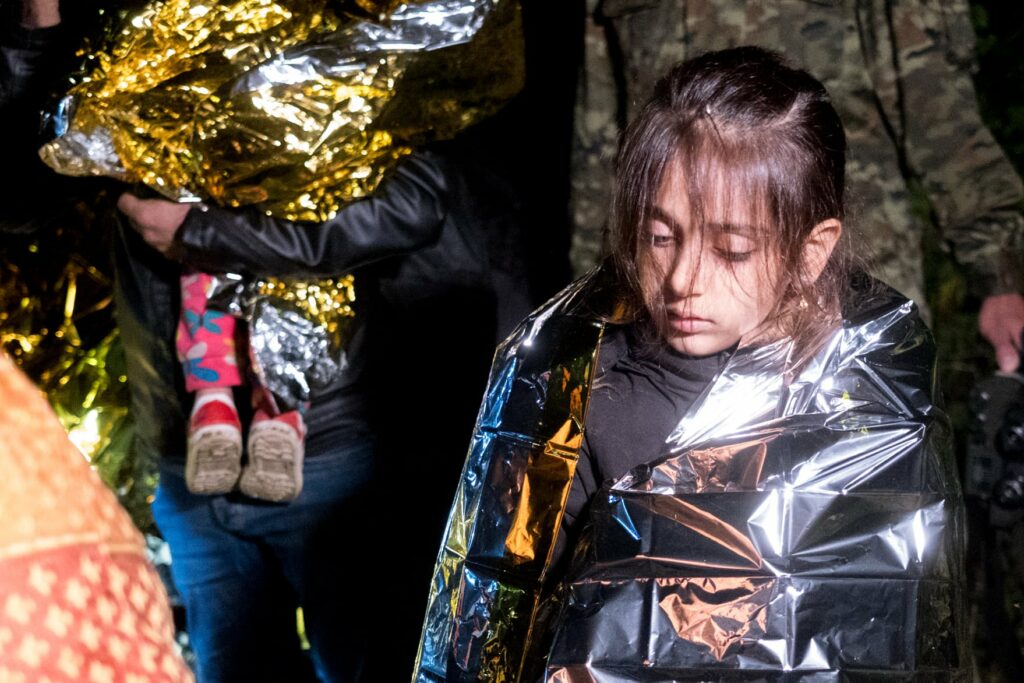
According to the Ocalenie Foundation, an organization which provides assistance to refugees, 32 refugees are trapped on the Polish border with Belarus, close to Usnarz Górny. They include women and a 15 year old girl.
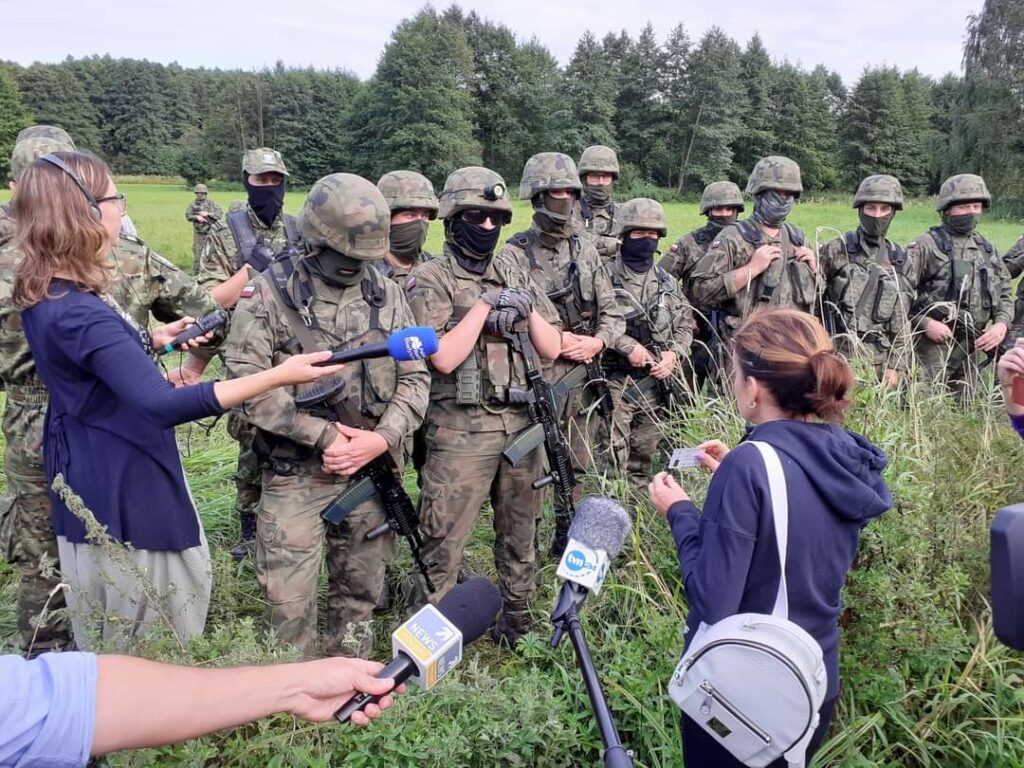
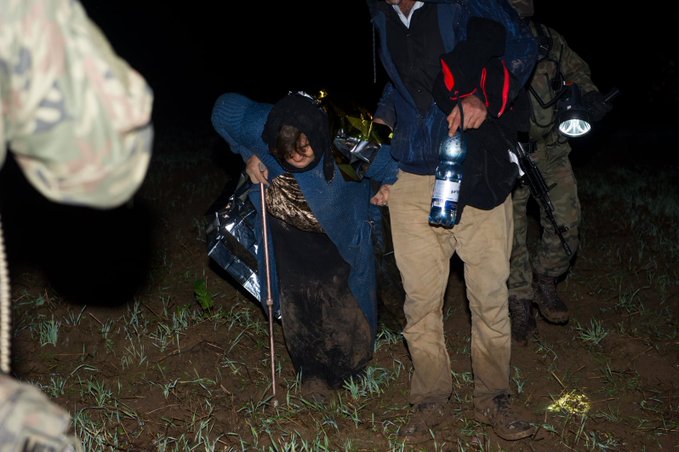
The refugees can’t move forward and they can’t go back. They are trapped on the border surrounded by the Polish military on one side, and Belarusian soldiers on the other. The standoff has been going on for about 20 days already, and they say that they have no water or food. Images show them soaked by the rain and freezing. One of the women is complaining about difficulties breathing and pain in the kidneys. Her condition is critical. It is not exactly clear what’s wrong with her, because no medical workers are present. There has been no help, either from the Polish side or from Belarus.
The Ocalenie Foundation also reports that the health of other refugees is also deteriorating: 25 people are ill, 12 of them seriously. Yet potential help is just a few hundred metres away. For weeks activists have been trying to organize support and to provide food, water and necessities to the group of trapped refugees, but the border guards are actively preventing contact. Belarusian authorities have closed the country’s borders to prevent the refugees from returning. Poland is arguing that the refugees are currently on Belarusian territory, meaning they should apply for asylum in that country.
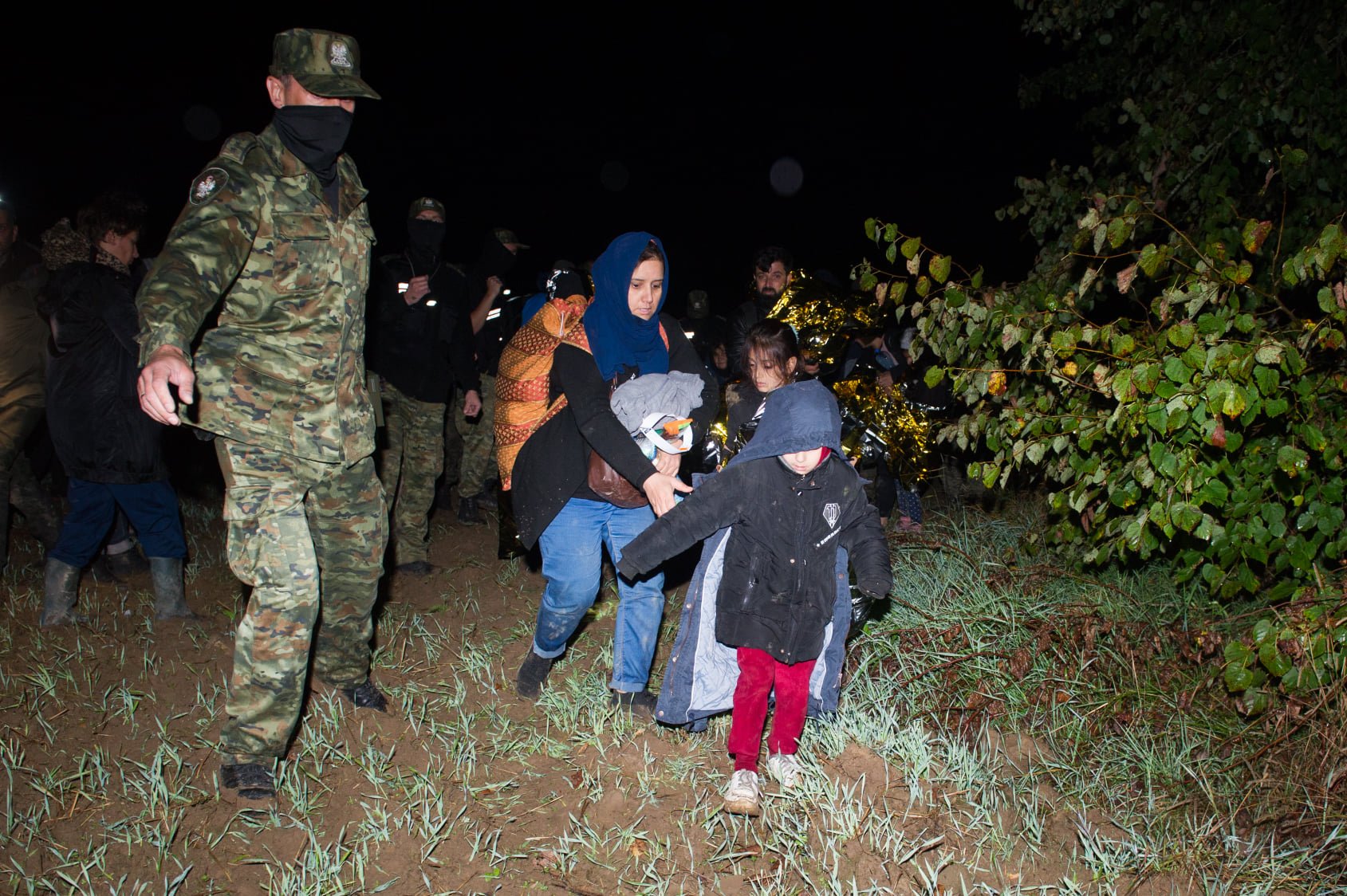
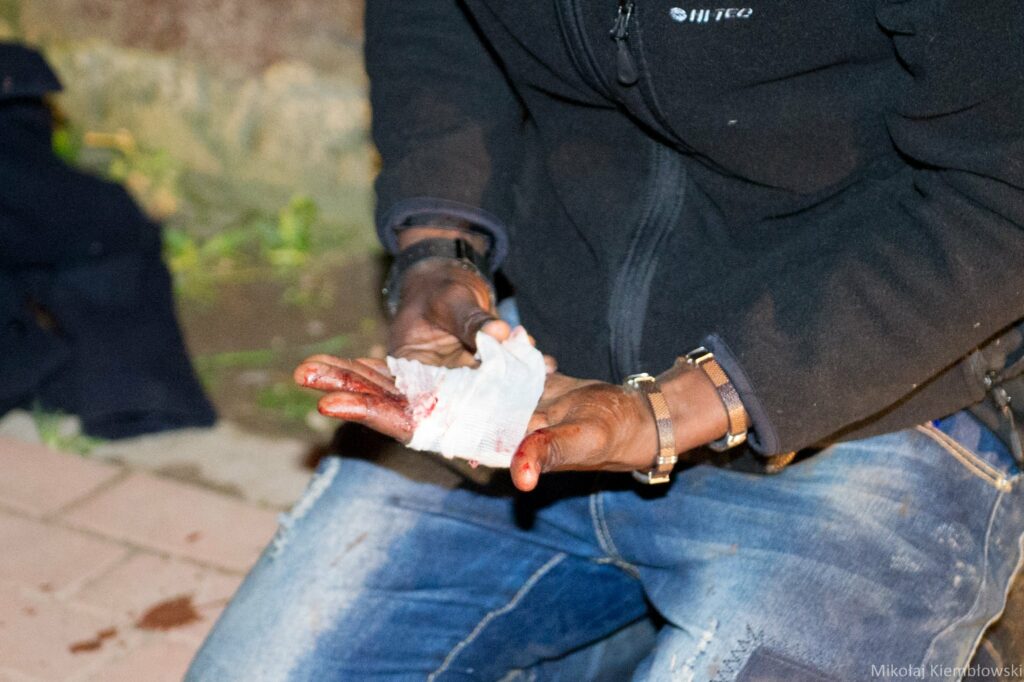
The situation all over the Eastern EU-border is tense and inhumane. According to activists’ reports, illegal push-backs from Poland to Belarus are happening on a regular basis. These are the actions of state services which prevent migrants from applying for international protection by forcing them to return to Belarus after crossing the Polish border, even when they declare their will for protection. The actions of the border guards are violating both human rights and the Polish Constitution and are exposing refugees to unnecessary danger.
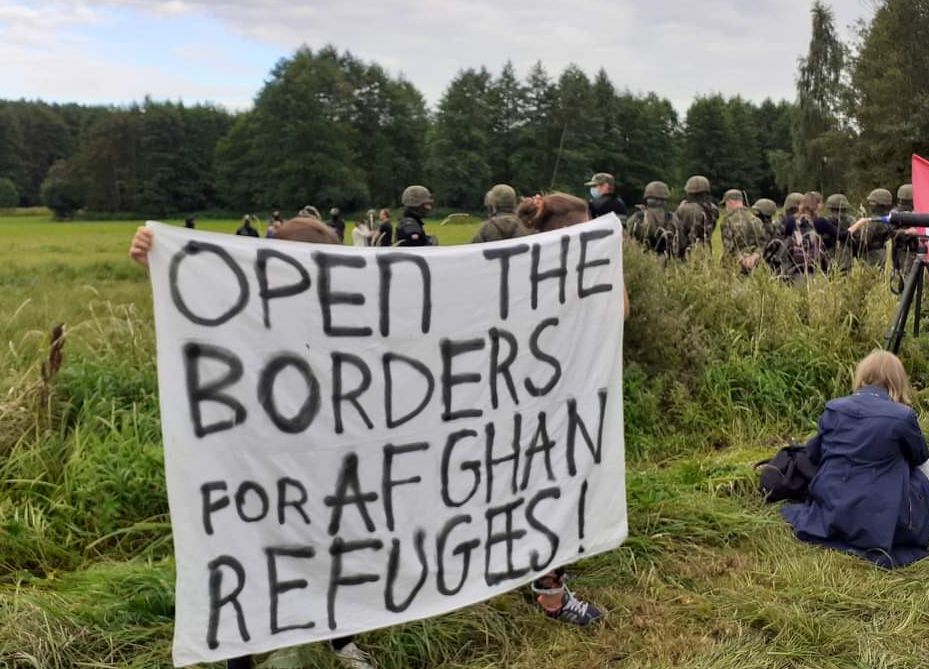
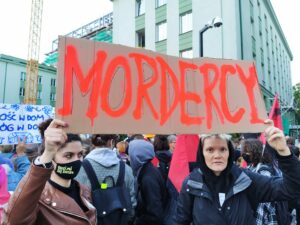
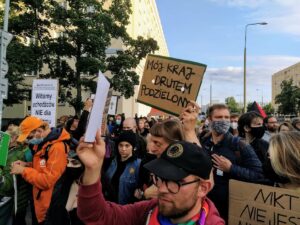
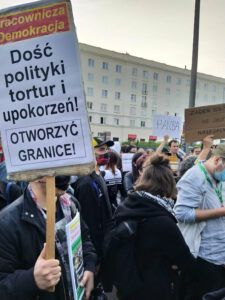
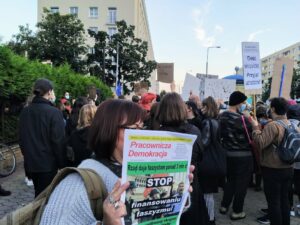
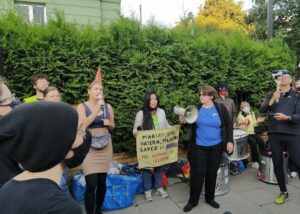
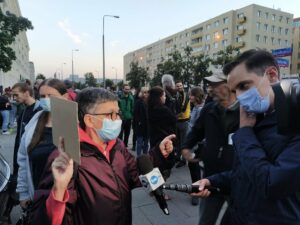
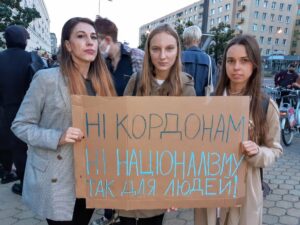
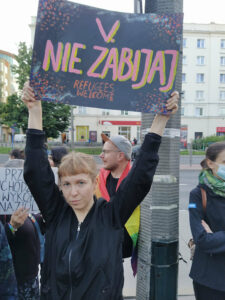
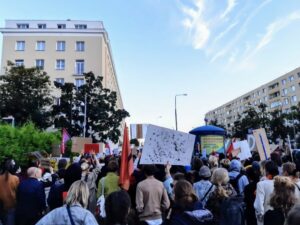
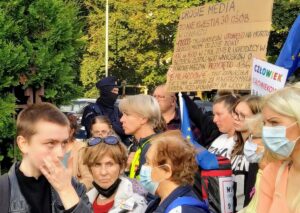
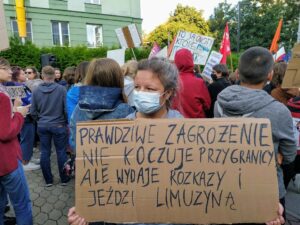
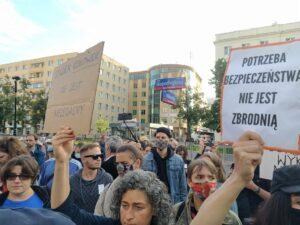
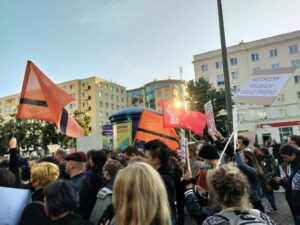
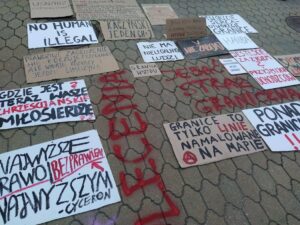
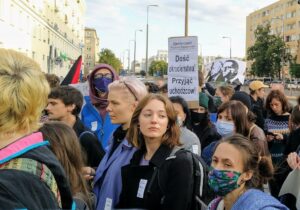
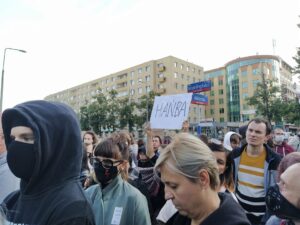
The violations by the Polish border guards, who are commissioned by the Defence Ministry, have caused great indignation in Poland. Protests demanding that the refugees are welcome have taken place all over the country and are supported by the left parties. Demonstrators hold posters and banners with slogans saying: “Border of Shame”, “Enough cruelty!”, “Enough of the policy of torture and humiliation!”, “No human is illegal”, “We do not want Polish borders of death”, “Decency is more important than order”, “Accept Refugees, kick out the Nazis.”
There are fundraising campaigns to help collect food, water, clothes, tents, sleeping bags, and money for legal aid. The MEP of the left party Razem, Maciej Konieczny, was admitted by the border guard to meet the group of refugees. He managed to hand over sleeping bags and powers of attorney for legal representation in Poland. Grzegorz Pietruczuk, the only left-wing mayor of a district (Bielany in Warsaw) offered to provide housing for Afghan families after they are allowed to enter Poland.
Fortress Europe and “Migration Diplomacy”
This group of Afghan refugees is not an isolated case. Soon after they arrived, information reached the public about nine Somalian women trapped on the Polish-Belarus border near the village of Bobrówka. Many groups of migrants, including women and children, have arrived at the Polish border to the West of Belarus and at the Latvian and Lithuanian borders to the North. While some of them are Belarusians seeking refuge from Lukashenko’s regime, many more are Middle Eastern refugees – mostly Iranians, Afghanis, Syrians, Kurds, and members of the Yazidi minority in Iraq. They’re hoping to ultimately reach the EU.
The governments of Lithuania, Latvia, and Poland are interpreting the increase in migrants reaching their territory as a threat to their national security. Speaking to the Financial Times, the Lithuanian president, Gitanas Nauseda, accused the Belarusian authorities of engaging in a “hybrid attack against Europe” by offering package travel deals via the state-run tourist agency Tsentrkurort.
On Monday 23rd August at a press briefing near the Belarus frontier, Polish defence minister Mariusz Blaszczak said “we are dealing with an attack on Poland. It is an attempt to trigger a migration crisis”. Many commentators see the reason for the current escalation at the Belarusian borders as an effect of sanctions which the EU imposed on Belarus last year. It is also an impact of the politics of its neighboring countries, especially Latvia and Poland, who present themselves as allies of the Belarusian opposition and take in people fleeing Lukashenko’s regime.
The kind of “migration diplomacy” implemented by Lukashenko is nothing new. A similar situation occurred in the aftermath of 2015 when the Turkish President Recep Tayyip Erdoğan adopted a more aggressive stance toward the European Union. Erdoğan threatened to flood Europe with migrants if European Union leaders did not offer him a better deal to keep refugees in Turkey.
In May 2021, Morocco froze a deal with the European Union about managing migration to the Spanish exclave, Ceuta. The reason was Spain’s decision to offer medical treatment to Brahim Ghali, the leader of the Frente Polisario, a political organisation claiming liberation for West Sahara from Moroccan occupation. Fearing a new refugee influx, Poland is increasing its security measures on the border with Belarus by building a 2.5m high wall, similar to the one built by Hungary on its border with Serbia in 2015, and Lithuanian soldiers are installing razor wire on the border with Belarus. Turkey and Greece are both installing walls and surveillance systems to prevent asylum seekers from Afghanistan from reaching Europe.
It’s a disturbing state of affairs considering the various reports pointing out that increased border security leads directly to violence against refugees. It puts them at risk of returning to unsafe countries and leads to a disturbing rise in avoidable deaths, as countries close off certain migration routes, forcing migrants to look for other, often more dangerous, alternatives. This is a fatal sign of a failure of European migration policy. EU politics are leading to migrants being detained and subjected to gross human rights violations in transit countries in Eastern Europe, the Balkans, West Asia and Africa.
The argument propagated by the right-wing and liberal media saying that letting migrants in would favor Lukashenko and Putin is dehumanizing and acts as a cover for the real reasons why people decide to leave their homes. It is also is the main reason for the polarisation and destabilization of society. The Polish authorities are running a heated campaign using the state-owned media, presenting refugees as a threat to health, security, and stability. This has been accompanied by right wing politicians declaring the need to “protect the Polish family and guarantee security for the nation from possible terrorist attacks”. This form of fear management policy was previously used by politicians in 2015. The racist rhetoric turned out to be successful: in May 2015 72% of Poles were in favor of letting refugees in, in October 2015 – after a massive hate campaign – the support sank to 21%.
European countries have adopted policies of outsourcing migration outside of the EU to keep migrants out of their own territory at all costs. The securitisation of the EU’s asylum and immigration regime is currently funded by billions of Euros. The idea that a hard external border is important has been imposed into the European economic integration project and serves to construct refugees as the dangerous Other.
Capitalism needs borders in order to maintain its system of wealth accumulation through maximum exploitation. The borders of the European Union are entangled with global postcolonial politics of race and the global neoliberal politics of labour mobility and subordination that produce and capitalise upon these racialized differences. Poland’s policy of marginalisation and exclusion of racialized non-Europeans aims at stabilising the internal economical order. Thus capitalist territorial imaginations remain central to the European project.
Eastern European Route
The human rights violations happening at the Eastern border of the European Union aren’t new. Since 2016, activists and human rights organisations have been reporting cases of regular disregard of EU- and international law for people trying to apply for international protection at the Terespol/Brześć.
People have been camped for weeks on the train platform on the Belarusian side of the Polish border sometimes, trying to cross. The Polish Border Guards arbitrarily refused passage to refugees, mainly from Chechnya, Ukraine and Tajikistan. According to many reports, the vast majority who tried to pass at official border crossing points were returned immediately and refused the right to seek asylum. Officers refused to submit an application for international protection. The main reasons for the refusal were the lack of valid travel documents and a claim that those people were “economic migrants”.
In 2020, the European Court of Human Rights decided that Poland has ignored applications for asylum submitted by newcomers to the Border Guard officers, and violated several articles of the European Convention on Human Rights (including the order to protect against torture and inhuman or degrading treatment). There have been cases reported which expose the inhumane treatment of migrants by the Polish and Belarusian border authorities including sending back Chechen refugees to Russia and violent treatment by armed border guards.
The European Commission has maintained cooperation with Belarus since 2016, and supports it financially in the construction and/or renovation of detention centres. While the EU is sanctioning Belarus and refusing to recognize Lukashenko as the lawful president, the cooperation on migration continues. Once again, this shows the hypocrisy of the European Union’s border regime: it presents itself as a protector of fundamental rights while equipping regimes violating those rights.
Although European nations may have formally rejected their colonial past, there is still a deeply uneven and imperialist power balance between Europe and countries of the Global South. Western powers are unable to face the consequences of leading and/or participating in the imperialist war in Afghanistan, including an inability to rescue people and establishing safe escape routes. This clearly shows the brutal failure of Western interventionism and the idea of “peace and state building” which is based on domination-submission dynamics which aim to maintain the peripheral status of the region in global capitalism.
It is time to take responsibility and face the consequences of years of intended destabilization and exploitation in the region. Countries on the outskirts of the European Union need to follow international law instead of breaking it. People seeking asylum must be let into the European Union while their cases are handled. This is the minimum that must be guaranteed under the current conditions.
The Left should go even further and demand opening the borders and freedom of movement as a fundamental right. We must criticize the European asylum system and migration law, as part of global migration management, which creates and reproduces inequality and secures Europe’s position in global capitalism through restrictions on immigration. The function of such restrictions is on the one hand to maintain a high competition between workers, so that they agree to work for less, and on the other to keep the undocumented migrants down, so they can be even more easily exploited and intimidated with the threat of deportation. More restrictions will never stop migration.
The economic needs of workers struggling to make ends meet will force them to cross borders, no matter what the risk is. Borders exist almost exclusively for the world’s working classes. Fortress Europe is becoming more and more militarized, as European powers fear the uncontrolled migration from the Global South. While there are very few legal routes for migrants in the global context, for the world’s billionaires and their capital it is quite the opposite. Their capital can flow under the almost borderless globalized economy.
In The Communist Manifesto, Karl Marx and Friedrich Engels declared that “the working men have no country” which means that national divisions are just another obstacle preventing the working class from realising their common interests. A common struggle for freedom of movement is an essential part of international working class solidarity and a basis to build networks of resistance.
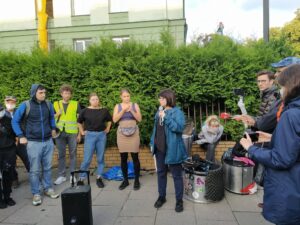
Gallery 1: more photos from the Poland-Belarus border
On the border with BelarusDoctor being prevented from reaching the Afghan refugeesOne of the 32 Afghan refugees stuck on the border“Pushback” of refugees over the border to Belarus. Photo: Mikołaj Kiembłowski“Pushback” of refugees over the border to Belarus. Photo: Mikołaj KiembłowskiPhoto: Mikołaj KiembłowskiPhoto: Mikołaj Kiembłowski
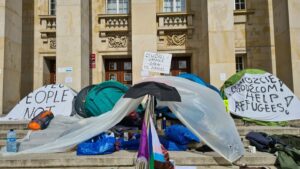
Gallery 2 – photos of the protests in Poland (first picture – 2nd day of protest in Wrocław (01.09.2021). Others taken from the Pracownicza Demokracja facebook page. Reproduced with permission)
“Domestic violence is a global problem”
Interview with the director of a new award-winning documentary
Interview with Chloe Fairweather (CF), director of the film Dying to Divorce, which has just been nominated for a Prix Europa award and will be showing in Berlin on Friday
Can you start by introducing yourself
CF: Hi I am Chloe Fairweather – the director of Dying to Divorce.
Why did you make Dying to Divorce?
CF: I was in Turkey working on different short films to go with feature articles with journalist Christina Asquith. We were actually working on something completely different when she had heard about the work of the ‘We Will Stop Femicide Platform’, and we decided to work up a story completely on spec. I filmed the activist from ‘We will stop femicide’, Aysen, meeting Arzu. Arzu’s legs and arms had been shot at close range, when she tried to leave her husband. I remember we were both so shocked by the level of the violence, we felt a real urgency to get the story out there. Arzu was so keen to tell her story, that it really drove me to work on this film. I started talking to the Producer Sinead Kirwan and we both felt that although this was about Turkey, the story of women standing up for themselves was universal.
Sinead has said elsewhere that you started hoping that you could change the law, but came across too many obstacles in Turkish society. How have people in Turkey reacted to your film?
CF: We have had an overwhelmingly positive response to the film in Turkey. Due to censorship it has not been widely seen yet but Turkish audiences tell us they think its really important because it is the first real record of all the events of the past 5 years in one narrative. Things have changed so much since the attempted coup that the Turkish audience really appreciates the opportunity to actually reflect on that change.
Do you think that domestic violence is a specific Turkish or Muslim problem?
CF: No. Domestic violence is a global problem. We have had to do a lot of research into femicide and it’s shocking how high the levels are all over the world. Things are bad in Turkey but unfortunately not unique. We also don’t think that religion is the reason – sometimes it is the excuse but the religion used changes from country to country, so it’s not a Muslim problem, otherwise how could explain levels of violence in Russia or even the US.
What seems to more of the common denominator is the existence of opportunistic politicians who refuse to condemn violence against women, and attack those who are protesting this violence.
Do you think that there has been a rise of domestic violence since Erdogan came to power?
CF: According to We Will Stop Femicides there has certainly been a rise in femicides in the last few years. It is difficult to say the two are directly related. But it is true that the number of women being killed even since 2015 has risen sharply.
How has Covid affected women trapped in abusive relationships?
CF: Covid has negatively affected women all over the world at risk of abuse. Abuse thrives on isolation and during Covid support was not very easy to access. In Turkey there has been the double blow of Turkey withdrawing support for the Istanbul convention.
This year, Chlöé Zhao became only the second woman to ever win the Best Director Oscar and a few directors like Céline Sciamma are finally starting to gain critical acclaim. Are things improving for women in film, and how far do we still have to go?
CF: Things are improving but there is still a long way to go in terms of removing the structural barriers for women filmmakers. There are many assumptions made about a female director and male directors are often seen as a ‘safe’ pair of hands. On top of that, women face the burden of dealing with expensive childcare so often need to be out of the workplace longer. But I think there are some positive things evolving. Documentaries seem to be much better then dramas, but there is still definitely not equality.
Do you have any future projects planned? What do you intend to do next?
We have a couple of exciting projects in the pipeline that look at female resistance and resilience, but at the moment we are concentrating on releasing Dying to Divorce.
From November 25th to 10th December it is the UN 16 Days of Activism to Stop Gender Violence. We want to organise as many community, festival, and cinema screenings of Dying to Divorce across the world during this period.
Dying to Divorce will be screened in Berlin this Friday (3rd September) as part of the Human Rights Film Festival. Doors open at 7.30pm, the film starts at 8.45pm.
Film Preview – Where No-One Knows Us
An astounding film about Chechen refugees in Vienna will be finally released on September 2
After a twice delayed release because of Covid-19, 2nd September will finally see the German release of one of last year’s best films. “Ein Bißchen Bleiben Wir Noch” (English title: “Where No-One Knows US”) is based on Monika Helfer’s 1994 novel “Oskar and Lilli”, but by making the kids refugees from Chechenya, Iranian -Austrian director Arash T. Riahi has added an extra degree of political urgency.
The film starts in an apartment block in Vienna. Police storm a flat to find the 9-year old Oskar and 13-year old Lilli on their own. Although their mother soon returns, the police are set to take them away anyway. So the mother slips into the bathroom where she slits her wrists while her two kids escape to the roof. They can only hide for so long, though, and while their mother is sent to a psychiatric hospital, the kids are fostered out to two different families, who live an hour away from each other. Lilli is sent to live with the lonely Rut and her deadbeat photographer boyfriend Georg. Oskar, on the other hand, finds himself with two smug vegetarian teachers, who he only ever refers to as “die Lehrerin” und “der Lehrer”.
Der Lehrer has a beard and plays a makeshift accordion at inappropriate moments. Die Lehrerin sneaks pieces of meat when she’s at the supermarket and thinks no-one’s watching. They also have a screaming child and an ageing mother with Parkinson’s disease (who, as Oskar says, “dances without music”). Oskar strikes a bond with the old woman, somehow aware that they are both trophies – there to display the liberal generosity of a couple who have no obvious interest in their thoughts or feelings.
Oskar, the eternal optimist, makes smiley faces out of everything he sees – from food to furniture. He regularly writes his mother letters, which are never answered as he doesn’t know where to send them. He believes that she’ll be waiting for them in their old flat, and when Lilli and he manage to briefly reunite, they twice try to return home. The first time, they find a blood-soaked bathroom, which the police have not got round to cleaning. The second, the locks have been changed and someone else is living there.
Lilli is not as optimistic as her brother. She develops a skin disorder and – following nightmares of being driven out of Chechenya – starts wetting the bed. Meanwhile, the photographer boyfriend thinks that Lilli is cramping his style, and makes a deal with her. He’ll try to track down her mother, so that she’ll be out of his hair.
Lilli is almost entirely sullen with one notable exception. On a ride at the Prater Gardens, she receives a message from the photographer saying that he’s found an address for her mother, As she glides through the air arms outstretched, the look on her face is one of unbridled joy. This is a rare moment of pleasure in a heartbreakingly sad film, remiscent of the final scene of Systemsprenger.
Lilli remains petrified when she sees policemen, feeling that any contact with them will result in her deportation. It’s not an unreasonable fear. And while Oskar is proud that his father is a freedom fighter, Lilli knows that he’s a political prisoner – and possibly dead – which would mean that their return to Chechenya, could be even worse than their current situation.
In a press statement, Riahi explained that
“’Ein bisschen bleiben wir noch’ is not a film about the refugees who are coming to us now, but a film about the future of their children. Children who are growing up in Europe, who master the national language better than their mother tongue, who don’t know their homeland except though stories, but cannot find any space here.”
He goes on
“because of increasingly strong laws, not everyone will be able to stay here. And so it is up to us as a society to draw attention to other possibilities of living together away from the bureaucracy, and to concentrate on the similarities between us and the so-called “foreigners” and not on what divides us.”
“Ein Bißchen bleiben wir noch” is not a film full of hope. How could an authentic film about refugees in a country that doesn’t really want them be any different? Most of the protagonists – including the mothers of both Lilli and Oskar and of Lilli’s Austrian friend – are deeply damaged by an uncaring system, and only their small children are able to offer any support.
Towards the end, Oskar tells his mother that you can buy anything nowadays, which is kind of true, but this only works if you have any money. Yet, despite the general air of hopelessness, the film does manage to show occasional moments of joy, right up to the final scene which threatens to offer us a glimmer of hope before bringing us crashing down for a final time.
Nonetheless, “Ein Bißchen bleiben wir noch” is not a miserable film. This is in part down to the remarkable performances by Leopold Pallua as Oskar and in particular Rosa Zant as Lilli. They bring us into their hopeless world and silently demand our empathy. This means that we leave the film not just appalled at the gross injustices experienced by Oskar, Lilli and many people like them, but also motivated to fight for a better and fairer world.
Where No One Knows Us will be on general release in German cinemas from 2nd September
We must all fight together – Voting rights for all
Non-Germans aren’t just victims. We’re an essential part of the fight in Berlin
Speech given at the LINKE Neukölln rally, “Unite the struggles,” 28th August 2021
My name is Phil Butland. I’m the speaker of the LINKE Berlin “Internationals” group, which tries to connect and activate non-Germans in Berlin.
Voting rights for all
When we set up our group – 7 or 8 years ago – one in ten Berliners had no German passport. Now, nearly a quarter of Berliners do not have German citizenship.
We live here, we work here, we pay taxes and rent here – we are Berliners! But we have few or no voting rights.
At the general election, only Germans are allowed to vote. At the local elections, EU citizens may vote, but not people from other countries – this means that Britons now have no voting rights here. Non-Germans also can’t vote in the referendum for fair rents, even though we all must pay high rents.
We demand “no taxation without representation.” If you pay taxes, if you pay rent, you must also be allowed to vote.
Not just victims
Many of us are in Germany because of the foreign policy of Germany and the EU. Some of us are refugees – here because of war, famine, and the climate crisis. Others are so-called “economic migrants.” German foreign policy is responsible for a youth unemployment rate of over 50 percent in some South European countries. That’s why many of us are here.
But we aren’t just victims – we are fighters. Ten years ago, we occupied the squares in Spain, we went on strike in Greece, we made the Arab Spring. Then we fought against our own governments – and we are still fighting them. If the German government attacks us, we’ll fight them too.
Unite the struggles
But we know that we can’t win on our own – we are too weak and there’s too few of us. That’s why we need you. But you need us too.
We are now in Germany, and are fighting together with our German comrades for better working conditions, for social justice, and for fair rents.
When health workers strike, non-Germans are also there. When there are protests against rent rises, we are there. When there’s a fight against racism, we’re there – often as the people who are affected. Our strength is our unity.
That’s why I’m proud to be speaking at a rally that’s called “Unite the Struggles”. We need you. You need us. We’re only strong when we’re united.
Come to Summer Camp
I don’t want to speak for too long, but before I stop, I want to make you an offer. Every year, the LINKE Internationals organise a Summer Camp on the edge of Berlin. The next one takes place next week-end.
In the Naturfreundehaus Hermsdorf, we’ll hear speakers from Western Sahara, India and Turkey, speakers from Migrantifa, the Jewish Bund, and the trade unions. And of course, we’ll hear speakers from die LINKE and Deutsche Wohnen & Co Enteignen.
We’ll be talking together about the coming elections and referendum, and how we can bring Germans and non-Germans together. We invite you to come and talk with us, to celebrate with us, but also to join our fight.
The ruling class always tries to divide us. They say we must fight against each other. Our message is the opposite – we need each other. We must fight together.
Hasta la victoria siempre! Hoch die internationale Solidarität!
We use cookies to ensure that we give you the best experience on our website. If you continue to use this site we will assume that you are happy with it.