The Left Berlin News & Comment

This is the archive template

French Presidential Elections: the Meaning of the First Round Results

Continuing collapse of the traditional parties, polarization to left and right.


11/04/2022

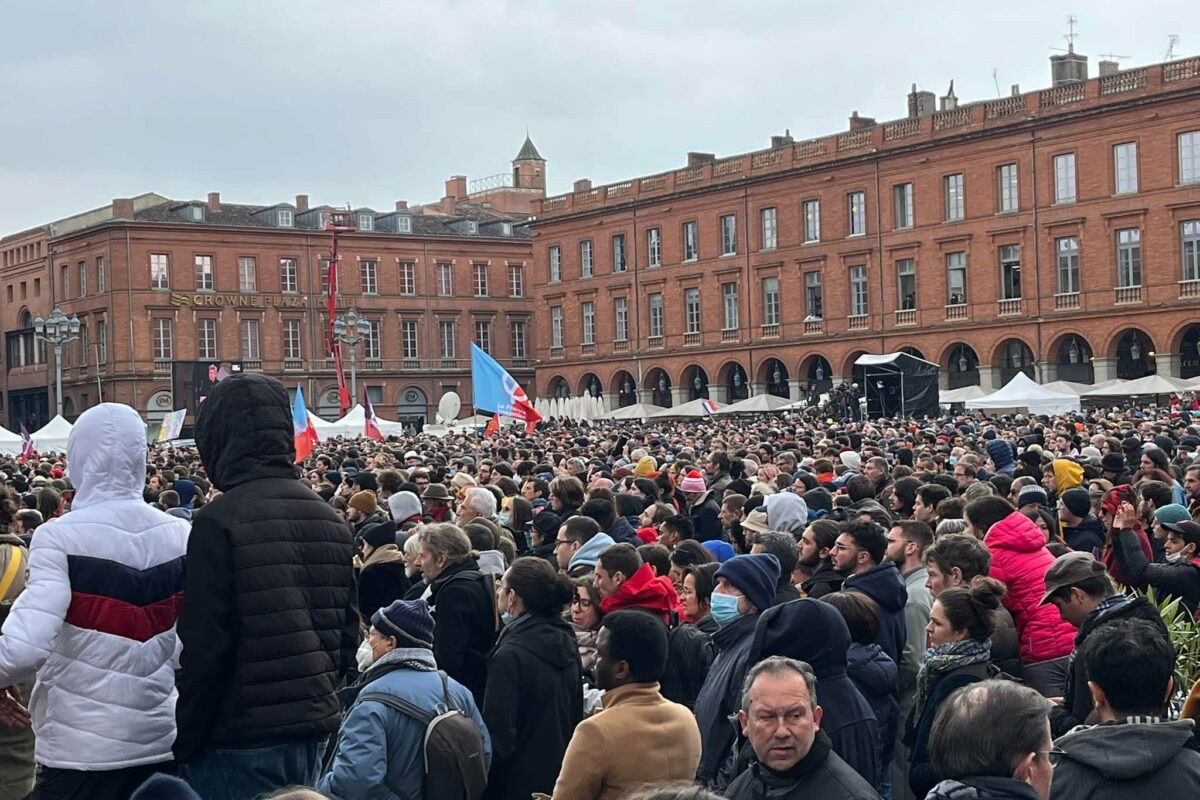
With the results now in for the first round of the presidential elections, initial conclusions can be drawn. The figures used here were those available after 97% of votes had been counted.

There are almost forty nine million adults registered to vote in France (two and a half million others did not bother to register, and residents in France who have not taken French nationality cannot vote).

On Sunday 10th April, twelve million people stayed at home (disproportionately young and working class people). Thirty five and a half million went out to vote.

Nine and a half million voted for Macron; eight million voted for Le Pen; seven and a half million voted for Jean-Luc Melenchon of the France Insoumise.

Two and a half million voted for the second fascist candidate, Zemmour.

One and a half million voted for Pecresse, the candidate of the traditional right, the Républicains – this was a humiliatingly low figure. Even more humiliating was the fact that only 600 000 voted for the Socialist Party candidate, Hidalgo; 800 000 voted for the Communist Party candidate, Roussel; One and a half million voted for the Green candidate Jadot; 450 000 voted for one of the two Trotskyists

What we are seeing is a polarization, with the collapse of traditional centre-left and centre- right parties, and a breakthrough of both the far right and the radical left.

The 22% for the France Insoumise is a tribute both to the quality of Mélenchon’s radical programme and the ability of the movement to mobilize a broad alliance, including grassroots antiracist groups, people from ATTAC, parts of the revolutionary left and of the left of the Socialist Party. Many of these forces have serious disagreements with the FI on various issues, but understood that to keep the fascists out of the second round of the elections would have been a huge step forward. Mélenchon got huge scores in multiethnic working class towns around Paris.

The Mélenchon campaign was magnificent , the most exciting radical left electoral campaign for several decades, based on the most transformative programme since at least 1981. The tremendous combativity and class consciousness of French workers these last twenty years has allowed left reformism to be reborn as a mass movement with an insurgent tone, in a new organization, the France Insoumise, which will be at the centre of left politics now for a number of years.

As the dynamic of Mélenchon’s campaign showed itself in mass meetings and unprecedented levels of door to door canvassing, a number of appeals to vote for Melenchon were published: an appeal of hundreds of university lecturers, another of Yellow Vests, another of Muslim activists. Sections of the Young Communist movement and several influential left Socialist Party people declared for Mélenchon, as did a remarkable number of anarchists.

Those sections of the Left – the Communist Party and the far left – which did not call for a vote for Mélenchon, preferring narrow party interests or not understanding the situation, will no doubt pay an important political price for this, and the France Insoumise will dominate the dynamic Left for several years. The decision of the two biggest revolutionary groups (the NPA and Lutte Ouvrière) to oppose the FI candidate was in my view a huge mistake. An independent Marxist voice is indispensable, but it must be deployed where the mass of radical left political activists are. A policy of critical support for Mélenchon, and fraternal implication in the many crucial debates of strategy and comprehension would have allowed Marxists to have immeasurably more influence, and could easily have made the difference which got Mélenchon through to the second round.

This second round will, then, pit Thatcherite Macron against fascist Le Pen.

Five years ago, the pressure to vote Macron “in order to stop the fascists” was enormous, and the debate on the left between the two rounds was acrimonious. The end result in 2017 was that Macron won against Le Pen by 66% to 34%, that is, twenty one million votes to ten and a half million, while twelve million voters stayed at home and three million voted blank.

Mélenchon, who showed sympathy both for those who voted Macron against Le Pen and for those who boycotted the second round because they did not want to choose between two evils, was ferociously attacked “for being soft on fascism”.

This time round, things will be more complicated. People can see that five years of Macron have actually made the far right much stronger. Under great pressure from the mass strikes and from the Yellow Vest movement, Macron turned more and more to Islamophobia as a useful diversion. Last year’s laws “against separatism” have allowed him to ban a series of organizations which defend Muslims, and, most recently, to ban one of the main pro Palestine campaigns. His vicious neoliberal attacks and these racist policies vastly encouraged the far right. Mélenchon is absolutely right to say “a contest between Macron and Le Pen is not a duel, it is a duet!”

Opinion polls show Le Pen quite close to Macron in the second round, though I am expecting Macron to win out.

It is crucial not to get bogged down in an aggressive row between those who will reluctantly vote Macron and those who will boycott the second round or vote blank.

I myself think voting for Macron is not justified. But the best thing for the next two weeks would be if there were antifascist mobilizations which brought people together to oppose Le Pen whether or not they are intending to vote Macron. A day of antifascist mobilization has been called for Saturday 16th.

The parliamentary elections in June will be a chance to increase the number of France Insoumise Members of Parliament, and build this new movement which is giving hope to so many, despite today’s defeat.

The Curious Case of Eric Zemmour

Fascist? Right wing populist? How can we understand the man who came from nowhere to shape the narrative of the French presidential election?


10/04/2022

An Establishment Fascist?

Eric Zemmour has a storied history of racial incitement, proposing outrageously hostile policies against Muslim immigrants to prevent the “reverse colonisation” of France, and he is a staunch defender of Vichy France. Despite this, writers such as Philippe Marliere contend that designating him as a fascist is un-rigorous analysis. The crux of this refutation is that unlike the Le Pen clan, Zemmour has been a mainstay of French cultural-political life, readily welcomed by the French establishment. Whereas Jean-Marie Le Pen was treated as a vulgar outcast, Eric Zemmour was based within French conservative media outlets such as Le Figaro and CNews (France’s equivalent of Fox News).  Zemmour  is  an Algerian Jew of Berber stock, and a pied noir, a common name for European and non-Arab settlers of Algeria. Furthermore, he has expressed an admiration of the Communist Party of France and its former leader Georges Marchais.

Comparison with one clear example of fascism today, that of India under the Bharatiya Janatiya Party (BJP), makes the contrast very clear. The latter carries markers of the classical definition, lacking in Zemmour.  There is no paramilitary organisation like the RSS in France; there is no equivalent rejection of the state’s foundational principles; there is nothing close to state-sanctioned ethno-religious pogroms; and, as already mentioned, there is a deep connection to the French establishment in the case of Zemmour. That did not exist for former roadside tea seller Narendra Modi.

There is however, a common ideological foundation between Zemmour and the BJP. Zemmour articulates an alternate history and promulgates a mythos of a France that was but is no more. This mirrors the nostalgia for a glorious past not unlike fascist politicians. This ideology has parallels with the Hindutva ideological framework developed by Vinayak Damodar Savarkar, the ideological father of the BJP. Clearly, labelling him a fascist in the conventional sense of the word is inadequate. He is ‘fascistic’ but not a ‘classical Fascist’. He is a personality that is amenable to adjectives and adverbs but resistant to nouns.

An Organic Intellectual

I posit that he is an organic intellectual of a modern, distinctly French fascism. He is an ideological founding father who might become comparable in stature to Savarkar. That is destined to be valorised after his death rather than to lead a vanguard fascist movement.

Italy had Mussolini and his blackshirts, Germany had Hitler and the SA (later SS). However France,  being on the winning side of World War I, only had a collaborating government under one-time hero Philipe Petain, which lacked both ideology and a vanguard paramilitary movement. Perhaps the mess of contradictions in the story of Eric Zemmour can be explained by a nascent yearning for an abortive French fascism. Zemmour gives voice to this yearning, awakens and mobilises the social base that has been germinating over the decades.

In his essay, ‘The Intellectuals’, Gramsci stated:

The mode of being of the new intellectual can no longer exist in eloquence, which is an exterior and momentary mover of feelings and passions, but in active participation in practical life, as constructor, organiser, “permanent persuader”, and not just simple orator…”

Zemmour’s successful career within the media and his prolific output matches the description of “permanent persuader”. With self-published twenty books, the most successful  (Le Suicide francais) selling over 500,000 copies, he created a body of work. This shapes a grand narrative of French history stretching back to the Treaty of Paris in 1763, ending the Seven Years’ War. In it there are some classic indicators of fascism, namely a warped and convenient interpretation of history. But instead of asserting a Hitlerian view of racial supremacy that will inevitably rise to dominate the world, Zemmour expresses ‘melancholy’ for a France that has withered (one of his books is titled Melancolie francaise). But then we oscillate back to fascist habits of finding traitors within the nation (leftists, feminists, homosexuals, and of course Muslims) and giving anti-materialist explanations such as “the erosion of virility” and the “breakdown of traditional values”.

Such assertions lack rigour, but they represent an earnest intellectualism on the part of Zemmour. While politicians on the right participate in a culture war for their own interests, Zemmour sounds committed to everything he says to the point of self-defeating. His vicious diatribes against Muslims led to multiple convictions for incitement, a truly remarkable achievement in a country where routine Islamophobia is rationalised across the political system in the name of Laïcité. His defence of Vichy deportations of Jews is barely tempered Holocaust denial, which would have consigned any other political figure to obscurity.

This invulnerability further lends credence to the notion that he is not a fascist but rather a product of the French upper class gone wayward: vocalising its most vicious thoughts, sowing seeds in the soil of French political thought already tilled by the Le Pens. He is increasingly unlikely to progress to the runoff now that the attack on Ukraine has precipitated a decline in polls for him due to his past expressions of sympathy towards Russia and repudiation of NATO. However, the mainstreaming of his most radical and violent ideas has surely laid a firm intellectual foundation for a leader to emerge in the future that will lionise him.

Chaos is An International Ladder

The first wave of aberrations created by the period of crises (after 2008) included the rise of: Viktor Orban and Fidesz, Donald Trump, Nigel Farage and UKIP, Matteo Salvini and the Lega Nord, Santiago Abascal and Vox, and of course Marine Le Pen and the National Rally – to name just a few. These political formations conceived of themselves as maverick movements from outside the “established structures of politics”. They claimed those structures had brought ruin to the “native” working class abandoned by the political left in favour of cosmopolitanism. All these parties succeeded in shifting the political zeitgeist. Traditional parties rushed to adopt both their rhetoric and policy prescriptions. Ruling parties portray these capitulations as sensible responses to shifts in public opinion. That process exonerated them from their own role in ploughing the soil for the far-right.

But the initial opportunism of empowering the far-right to facilitate neo-liberal assaults on electorates is beginning to have uncontrollable consequences. The far-right has grown into a sentient movement with its own media infrastructure, extra-parliamentary political action groups, and even its own think tanks. Deviation from far-right orthodoxy by party leadership is seen as treasonous by the rank and file. The revolution is willing to eat its own children.

Politicians from ruling parties expect political dividends in wholeheartedly embracing the far-right, while any attempts to moderate within the far-right political parties risks excommunication. For example, Pablo Casado’s efforts in Spain to turn the Partido Popular (PP) into the older sibling of Vox stands out. However, this manoeuvre did not strengthen the PP, but resulted in a surging support for Vox. Now the PP is propped up electorally by absorbing voters from the now emaciated Ciudadanos. Zemmour may be having the same effect in France.

In her attempts to outmanoeuvre Emmanuel Macron in the French electoral system, Marine Le Pen has moderated some of her most radical positions. This peeled off support from the political base of centre-right les Republicains, but earned her the taunts of being “soft” on Islam from Macron’s party. The process that began with ruling parties that enabled the far-right has now come full circle. An establishment figure like Zemmour can now successfully expand the frontier for the far-right through rhetoric of lost French supremacy, “reverse colonisation”, and sovereigntism.

It is possible that Zemmour is occupying the space Le Pen vacated while Le Pen has absorbed more affluent centre-right voters in her turn towards “moderation”. These questions will be decisively answered after the election. My suspicion is that Zemmour is not peeling away votes from Le Pen as much as he is radicalising the traditional voters of the centre-right. He is, through his intellectual labours, expanding the social base for fascism to succeed in the future as opposed to splitting the far-right vote. Polling suggests that Le Pen will win about the same percentage of the first-round vote as her last attempt. Key indicators to test this hypothesis will be the age, geographical, and class composition of his and Le Pen’s voters on election day.

Prospects for The Future

Climate change, war, dispossession, malnutrition, migration, and disease. These processes follow each other sequentially and synergistically. We cannot imagine the exact nature of the political reaction these processes will spark in the Global North. But we can say with confidence that within a timescale of decades, a full-throated, organised, and violent fascism will emerge. In absence of a pro-active management of these world historic challenges, fascism can and will flourish.

Where will this fascism get its blueprints from? In the US and Canada, neo-Nazism will resonate with the settler colonialism ethos foundational to these states. Italy and Germany have their fascist traditions that serve as readily available templates. The United Kingdom may disintegrate into its constituents and produce an English fascism that, I think, will mirror that of France.

Both France and England  suffer from a nostalgia for an all-conquering imperial past (albeit a relatively short lived one under Napoleon for France); and both experienced large influxes of immigrants from former colonies which today are the target of nativist racism. Perhaps Zemmour’s methods and policies will influence an English fascism that lags behind France’s in maturity.

Eric Zemmour provides a blueprint to impose his hyper-assimilationist disciplining of any and every citizen that does not follow his prescriptions of ‘Frenchness’. This is a conventional recipe that Zemmour advocates for using a confected, but original, narrative of French history and culture.

In opposition, Jean-Luc Melenchon’s line of rebuttal appears most promising. He asserts confidently that France is a mongrel culture not a unitary one. Of all the political heavyweights he, and his party La France Insoumise, offer the strongest rejection of Islamophobia and racism. The electoral effects of this are evident in his support from French voters of migrant backgrounds. Melenchon’s radical proposals include the constitution of a Sixth Republic and he articulates an alternative vision of sovereignty in the realms of space, information technology, and the sea. To combat Zemmour-ism, it turns out one needs a counter-narrative of commensurate intellectual depth. Among all French presidential candidates Melenchon has the most depth.

To conclude:

Zemmour is not a fascist but an intellectual persuader-in-chief at the zenith of his career. He is bound to the French state and wants to restore it to perceived past glories. This insular focus on France and restoration is distinct from a fascist desire to create a new and purified machine to project racial dominance. However, ideas can be revised, expanded, refuted or re-envisioned. As world crises proliferate and intensify, Zemmour’s ideas can be foundational for a future fascist messiah. For the left, there is an urgent need to meet this new challenge of a fascistic intellectual of, for, and by the ruling class. Jean-Luc Melenchon’s intellectual labours offer both a glimmer of hope and a template.

Interview with Dr. Anna-Esther Younes

German-Palestinian academic discusses her personal pursuit of justice against state surveillance and blacklisting of public figures.


07/04/2022

Dr Younes, you are an expert in Islamophobia and in 2019 you were invited to speak at a Die Linke Berlin conference to discuss strategies for combating racism and far-right extremism. But then you didn’t appear at the conference after all. What happened?

Well, I was invited to present the Islamophobia Report in particular and my work on far right networks and anti-muslim racism therein, too. I was disinvited the day before the event at around 6pm in the evening – the event was supposed to take place the next morning. When some people asked Linke party chair Katina Schubert why I wasn’t there, Schubert said some horrible things about me in public when I wasn’t there and couldn’t defend myself. Schubert stated that there should be no debate about the Middle East and that I am probably close to BDS. Schubert then put me in the context of terrible things: Referring to the incident in Halle, which took place about a month before on Yom Kippur. That’s when a white, right-wing terrorist attacked a synagogue and then drove to a Döner store and continued his shooting spree there. Two people were killed that day by white supremacist terror! Schubert spoke about this anti-Semitic terror that had happened one month prior, and how that relates to Right Wing extremism and a “boycott against Jews”, about a clear position of the Left regarding BDS, and then also towards me. The events in Halle, as well as BDS were used to explain their choice of disinviting me. Since, according to her, BDS does not belong in the Left there can be no cooperation because of the terror against Jews that happened in the near and far past. 

Later on, in a personal meeting, it was stated that they also couldn’t invite me anymore, because it would have caused a public scandal to invite me and the party just couldn’t afford it. Which stands in opposition to planning this event with me for almost two months, for instance. Let’s not forget that the file was sent the afternoon before the event was supposed to take place. However, I seemingly became a “threat” one day before through this file. 

You later learned that Die Linke had been sent a secret dossier about you compiled by RIAS Berlin and the MBR (the so-called Antisemitism Research and Information Centre, and the Mobile Advice Against Right-Wing Extremism, respectively). How did you find out about this?

The reason for my disinvite is that MBR/RIAS seemingly sent a “file” to Katina Schubert, which shows my ostensible support for anti-Semitism as well as my Islamist worldviews as – allegedly – expressed in a peer-reviewed academic article about Hamas’ women’s movement that I published more than 10 years ago. The file states that I support Hamas and justify sexism. Other people are mentioned in this file, too. Following the circulation of this secret file about me, several activists also feared to be observed and monitored. That is why there are more people now joining this campaign and demanding their data from RIAS/MBR as well. 

The file was leaked to me eventually from someone inside Die Linke, after it had already circulated and several people had already told me about a “file about me circulating”. I mean being disinvited isn’t new to many of us, but after hearing about a file I was getting worried. Eventually, someone leaked it to me just a few days apart from my mother having had another of her Stasi-file viewings. So that gave it another “the-personal-is-political-is-public” twist. Another reason to get active.

What was the response of RIAS when you asked to see the contents of the dossier?

According to the EU Data Protection Law (article 15 of the GDPR), I used my right to ask RIAS to give me the access to the data they had collected on me and shared with others. RIAS refused to comply with my request, claiming I had no right to information under data protection law. Instead, they invoked an exemption that is provided by the GDPR (article 85) and that would allow them to process my data for “journalistic purposes” and “scientific research”. Nevertheless, producing the dossier and transmitting it to third parties without my consent, which led to my exclusion from the event, is in my opinion not compatible with the “journalistic” and “scientific research” exemption.

That is why, among other reasons, we challenged RIAS’s argument in front of the Berlin Data Protection Authority. Unfortunately, the Data Protection Authority didn’t become active in our case for almost two years. This is why we decided to sue the DPA as well, for “inactivity”. Right now, both cases are pending. The case concerning my “secret file” is before the 1st Chamber of the Administrative Court of Berlin – this chamber of the court deals with data protection law, statistical surveys, and disputes under the Stasi Records Act. The latter law gives the right to access the data contained in the files that the secret police from East Germany used to collect on its residents.

With the support of the European Legal Support Center (ELSC), you are now suing the umbrella organisation of which RIAS Berlin and MBR are a part. What is the legal basis for your complaint and what do you hope to achieve through this lawsuit?

I personally hope to draw attention to the overall issue of a climate of fear, silencing and the destruction of people, their careers, and their reputation in society. This is not just about me or what is being written and sent around behind my back only. This is also about all the other people that are regularly disinvited or misrepresented in public. I had the choice of either keeping quiet and not drawing more attention and violence toward me, or else we could use this file to draw attention to the fact that many of us are actually disinvited regularly, with disinformation campaigns following our tracks, and so on. This public campaign and the court cases would have not been possible without the ELSC and I am incredibly indebted to their legal and advocacy work. Everyone there is working non-stop, yet there are too many cases by now all over the place, not just in Germany. In short, the ELSC and me “met” when I just learned about my file and they just started operating – we met at the right time, so to say. Overall, this whole case was made possible, because people there worked tirelessly to defend the rights of people unjustly accused of the heinous deed of anti-Jewish racism or Islamism. 

The ELSC has also launched an open letter and a campaign in your support, signed by prominent figures including Judith Butler and Noam Chomsky. Can you give us an overview of who has been supporting you and why you think it has resonated with so many people?

Well, this is not just about me. And I think we made that clear in our public statements and calls for support. Obviously, because it is a lawsuit, there has to be one person suing and it was – by coincidence I believe – my file that was leaked given the particular circumstances. Yet, I think why so many people supported it, is because it has reached an extent in Germany now, where it becomes more obvious for people from the outside that something is deeply wrong. But there are also more people now who try to wrap their heads around what’s happening here and try to prevent more damage. That gives us more public legitimacy, too. 

It might also be driven by the fact that court cases are actual material claims: we are making a legal appeal to maintain democratic structures for everyone in Germany and I think this drew the interest of people, as well. Court cases are concrete and give people the possibility to fight for their rights, with public legitimacy.

Another equally important issue is the personal investment: Achille Mbembe, for instance, answered immediately. I think a lot of people were driven by this sentiment – Judith Butler has been attacked several times in this country for allegedly supporting anti-Semitism based on her support for Palestinian Human Rights. There has been a lot of support from the outside of Germany immediately.

What can readers do to support your campaign?

We really need financial donations for our lawsuits against the Berlin Data Protection Authority, which didn’t process our case for almost two years now, as well as the court case against MBR/RIAS and they are the most important thing now. Even if just enough people donate 10 or 20 Euros, it would already be great.

I would like to emphasize here once again that it is not just “my” campaign. There are numerous other people affected by this “kind of surveillance” who could experience similar unfair treatment as I experienced. Intellectuals and activists from Palestinian and Jewish peace protest and solidarity and human rights movements are equally affected, as are artists and scholars who strive for a critical approach or decolonial and anti-racist expression. It resembles what we witness in France and the “Islamogauchisme” accusations. In order to unite our voices against this form of “silent caesura,” some have already announced that they will join my lawsuits. 

We also hope that people spread the message and share the content of the ELSC website, where this case and others are explained and where the legal advocacy work for people unjustly accused of anti-Jewish racism or Islamism can find a platform. There is also a special file explaining the violations against data rights in this particular case. The reason why I am mentioning that one, is because I believe this issue might become more important and virulent in our societies.

Read more about Anna’s case on the ELSC Website.

How Useful is Jean-Luc Mélenchon (part two): Taming the Capitalist State?

France Insoumise is the most important Left organisation in France today. Showing solidarity means having comradely discussions about Left patriotism and foreign policy.


06/04/2022

In the first part of this article, I analyzed the potential of the new left movement which has been built up in France around Jean-Luc Mélenchon and The France Insoumise, and explained why I thought revolutionaries should support this movement, while, obviously, retaining an independent critical voice. In this second part, I will look at some major differences Marxists have to the main thrust of France Insoumise politics – in particular concerning left patriotism and foreign policy, and I will consider the limits of left governments under capitalism.

Jean-Luc Mélenchon’s programme aims at a “citizen’s revolution” through the ballot box, leading to a rapid and decisive break with the last few decades of wealth trickling ever faster upwards into the pockets of the one per cent. The France Insoumise aims to use state power to break with the main thrust of capitalist neo-liberalism.

How much power does the government have?

There is every reason for anti-capitalists to be cautious about such claims. Whether in Britain in 1964 or 1974, in France or Spain in 1981, or in Australia in 1972, claims for radical change through elections have generally turned out disappointing to say the least. [1] Harold Wilson, the 1960s Labour Prime Minister in the UK, wrote in his memoirs [2] of how stunned he was to realize how little power he had compared with the giant capitalist concerns who could pull the capital investment out of the UK economy, and in the 1970s the IMF showed UK Labour PM James Callaghan who really ruled the roost when push came to shove.

To look at a French experience which I will come back to later in this article – the election of Socialist Party president François Mitterrand in 1981 – who better to understand what left governments can and cannot do than Mitterrand’s wife, Danielle Mitterrand. She recounts how she discussed government power with her husband:

“I used to ask François, “Now you have power, why don’t you do what you promised?” He replied to me that he did not have the power to stand up to the World Bank, to capitalism, to neoliberalism. He said he had won a government, but had not won power. In this way, I learned that being the government, being the president, was not much use in these societies subjected to capitalism and dominated by capitalism. I lived through this experience for fourteen years [Mitterrand was president from 1981-1995]. Even if he tried to avoid the most negative side of capitalism, his dreams very quickly began to collapse […]”

Far more recently, the experience of novel left organizations such as Syriza in Greece and Podemos in Spain, both of which exploded onto the scene in the context of the collapsing of compromised social-democratic parties, have shown they could raise hopes and expectations but, faced with organized ruling class resistance, were not up to the mark. The harsh austerity at present established in Greece is one of the tragic results.

Revolutionaries must analyze these past experiences and patiently explain the limits of electoral politics while taking into account what is new in each situation. Mélenchon’s positions open up important opportunities for us. Faced with the concern that past left governments have abandoned the interests of workers, Mélenchon does not at all avoid the question. On the contrary, he has recently given lectures about what went wrong in the 1980s, and why Mitterrand disappointed. One of these lectures, given in May 2021, on the fortieth anniversary of Mitterrand’s election was entitled “1981: the revolution suspended”. Another was entitled “a complete balance sheet of François Mitterand’s presidency.”

In the first of these, he presents a historical analysis of the Socialist Party victory in 1981, as the end of a political process of which the main accelerator, he insists, was “the ten million workers on strike” in 1968. He underlines that the reforms introduced by Mitterrand were more wide-ranging than has often been recognized: the nationalization of dozens of banks, of electricity companies, engineering companies and of motorways, the doubling of the budget of the ministry of culture and the taxing of the rich. And he insists it is not reasonable to think of Mitterrand and other left leaders as intending to betray.

Mélenchon blames the turn to austerity, only two years after Mitterrand’s 1981 election, on a lack of political courage, a lack of strategy on the left of the left, and a lack of mass mobilization. He takes the time to present thoroughly the arguments in defence of left reformism and its prospects. He deserves serious and thorough fraternal responses from revolutionaries, but such responses are very rare on the French left. [3]

Left patriotism

Apart from this debate about the feasibility of radical transformation of society through parliament, there are two other aspects of France Insoumise politics that I would like to analyze, which have often provoked dismissive comments or insults from the far left rather than convincing responses.

Firstly, one of the France Insoumise ideas with which Marxists cannot agree is the use of left patriotism, and the promotion of those symbols of the French nation – the tricolour flag and the national anthem, the Marseillaise. Mélenchon saw no difficulty, when he recently spoke in Burkina Faso, declaring “I love my country”, and he looks forward to a time when France, having left NATO and rejected colonialist attitudes, plays a positive role in international relations. Marxists, in contrast, have always proclaimed that working people have no homeland, and in wartime, revolutionaries in imperialist countries prefer that their country lose the war. All this does not mean that we must not analyze the specificities of Left patriotism in France today, and it is certainly imbecilic to assimilate Mélenchon’s left patriotism to that of the far right.

The FI leadership consider that national symbols and national pride do not have a fixed meaning. For the right, the flag and the anthem symbolize the supposed glories of colonialism, but, says Mélenchon, the revolutionary origins of the tricolour and the Marseillaise mean they can be used by the left. The right want to tell the people that the soul of France is about Christian tradition and Great White Men, but Mélenchon insists that the soul of France is the barricades of 1789 or 1848, the Paris Commune of 1871, the great strikes of 1936 and 1968, or the Resistance against the Nazis under the Occupation. His idea of France, he says, is “creolization” – mixing cultures and ethnic groups to form something new and vibrant.

Left patriotism obviously sounds less insane when the national motto is “Liberty, equality and brotherhood!” rather than the British motto “Dieu et mon droit”. And the FI is not the only one to go for patriotic symbols. The Yellow Vest movement in France frequently used the tricolour flag and the Marseillaise on demonstrations, and this was not due to far-right influence (which declined quickly after the beginning of the movement). [4] One could see on the Yellow Vest demonstrations groups singing the Marseillaise punctuated with chants of “Macron Out” and other movement songs [5] such as

Here we are, here we are
Although Macron doesn’t like it, here we are!
For the honour of the workers and to build a better world
Although Macron doesn’t like it, here we are! 

Nevertheless, if Mélenchon’s left patriotism is structured and progressive in intention, this does not make it correct. One immediate problem it poses is that patriotism, including left patriotism, supposes an identification with the interests of “the country”. Supporting one’s country in the football or at the Olympics is the least of it. We are supposed to feel good if “France” wins market share in aeroplane manufacture, feel sad that it was not the Covid vaccines developed in France that won out, and worry if China is gaining “too much” influence in French-speaking Africa. We are supposed to be horrified at the prospect that some territory at present part of the French Republic – Martinique or Guadeloupe for example – might move towards independence. So, even if the FI programme plans to leave NATO and build a new relationship with French-speaking Africa, the continuing identification with the national state is more than likely to conflict with an identification with the international working class.

Another serious drawback, if patriotic symbols are used to build a left political force, is that these symbols do not have the same meaning for everyone. What is the meaning of symbols like the French flag to those from former colonies, or from African countries still today mistreated by French imperialism? Mobilizing that important part of the French working class of North African heritage is hardly going to be facilitated by patriotic symbols. So, if left patriotism may speak to people, it is fraught with political dangers.

Some on the Left here have denounced Mélenchon for moving away from symbols such as the red flag and the hammer and sickle. This is to misunderstand the meaning these symbols often have in France, the country which fifty years ago had the strongest Communist Party in Europe. Given the crimes of Stalinism and the alliance of the CP with austerity Socialist Party policies while waving ever more red flags, the rejection of these symbols by most workers is unsurprising.

This question of which symbols to use has sometimes led to slightly bizarre situations. At the final meeting of the 2018 Summer School, there was a plan to sing The Marseillaise. Most of the FI MPs were on stage and led the singing, while the music was piped through the loudspeaker system. There was no plan to sing the Internationale. Yet, once the Marseillaise was finished, while the MPs were clapping, several voices from the several hundred in the hall began the Internationale. After twenty long seconds of hesitation, the MPs joined in. Of course this is only an anecdote, but it has its importance. Clearly a majority of people in the room were happy to sing both anthems, and, in my view, this shows an atmosphere where serious debate is possible and Marxists have plenty to say.

Foreign policy

Patriotism is obviously closely linked to foreign policy. France is a major imperialist state. For example, as it just wound down its operation in Mali (a resounding failure), voices on the right were worrying about the declining influence of France in Africa. In a television interview, Mélenchon was attacked because he declared “Mali belongs to the Malians” and said that if the government of Mali decided they wanted no more French troops in the country, he as president would bring them home. The TV journalists were incredulous at the idea that France did not have a God-given right to send its troops wherever it wanted to without asking.

Mélenchon’s foreign policy programme is certainly a welcome slap in the face for the defenders of imperialism. Nevertheless, his plan is to use French state power in a different manner, certainly nothing more radical than that. This is his statement on international power and alliances:

Of course, we are leaving NATO […]First of all, I want to restore our military sovereignty. France with nuclear deterrence must remain independent and manufacture its weapons without depending on American imports. Why should we take on the quarrels of the Latvians or Estonians with Russia, which have been going on for a thousand years? Why should we guarantee the physical borders of Ukraine? I want a non-aligned, alter-globalist France. [6]

So we see the plan is to retain nuclear weapons as a lever for international power, but to use that power differently. This position is in many ways a logical extension of left patriotism. And although non-alignment is preferable to enthusiastic support for war, we are a long way from overthrowing imperialism, and a very long way from reminding workers that loyalty to their class internationally is immeasurably more in their interests than loyalty to their country. Mélenchon recently declared “If I’m leading this country, anyone who wants to push us around had better watch out!”

Conclusion

These three examples (the limits on the power of left governments, the use of left patriotism and the attitude to French foreign policy) all serve to underline how important it is for Marxists in France to have an independent voice. But an independent voice is only useful if it is heard where the masses of political activists who want change are – and in France today, that is massively around the France Insoumise.

Because there is no obstacle to revolutionary currents being active within the France Insoumise, I think this is the best place to be. In a period when most workers are not conscious of the difference between a social revolution and a “citizen’s revolution through the ballot box” it is particularly important that revolutionaries participate in fraternal debate in a milieu of many thousands of activists, not in a milieu of a few hundred. At least three small revolutionary groups, two of around a hundred members each (Gauche révolutionnaire and Révolution!) and one larger current (Ensemble Insoumis) are active inside the FI. Each of them had a stand at the August 2021 Summer School, and two of them produce independent revolutionary papers.

Since he left the Socialist Party to form the Left Party (Parti de gauche) in 2009, Mélenchon has written seven or eight books about political strategy and how to defeat neoliberalism. There is a real shortage of marxists seriously taking up the debate with these ideas of the new left reformism.

John Mullen is an anticapitalist activist in the Paris region. His political website is here

Footnotes

1 Ian Birchall’s classic and very readable book on reformist socialism is still one of the best explanations. Ian Birchall, Bailing Out the System

2 Harold Wilson, The Labour Government 1964-70, Penguin, Harmandsworth, 1974.

3 A basic revolutionary response from twenty years ago can be found, in French, here 

4 See my article here 

5 This and other Yellow Vest songs can be heard in this video 

6 Le Monde 18 January 2022.

“The only way for Russians to end this war is convince soldiers to stop fighting”

Interview with a Russian Socialistist about the anti-war movement in Russia


05/04/2022

Thanks for being here and talking to us. Could you start by introducing yourself. Who are you? What’s your background? What are you doing in Berlin-Brandenburg?

My name is Sasha. I was born in Ukraine, but I grew up and spent most of my life in Moscow. I’m a member of a number of Russian anti-war initiatives. In Berlin, I’m doing a PhD on the socialist women’s movement in the Soviet Union after the Second World War.

Could you say something about the Russian Socialist Movement? Who is it? How big is it and what are its general politics?

The movement was founded in 2011 as a result of the unification of number of progressive left movements in Russia. They are progressive, left democratic socialists. They used to want a revolution, but now it’s become a bit more realistic. They keep taking part in grassroots activism and protests, but also during recent years, they decided to take part in the elections.

For example, at the last Parliament elections, they supported Mikhail Lobanov, a democratic socialist and trade union activist, who won the campaign on the ground. But then our elections were stolen via internet voting. They also had a number of other candidates in different regional elections.

In contemporary Russia, elections are not something that stabilised the system, quite the opposite, they normally cause protests and mass mobilization — first, through the movement of election observers, and later with mobilization of the electorate whose votes were stolen. After the last elections, there were some protests, but not as huge as we were expecting. But we believe that it is an important experience of politicization for many people.

So we are looking for new tactics in the current political situation in Russia. Our movements are involved in different anti-war initiatives. We are acting in these initiatives anonymously because it’s safer. Our movement had been open, but the current political situation in Russia does not allow us to be that open any more.

The Russian Socialist Movement has issued several statements, it keeps running its social media, but the focus is more on the domestic situation in Russia. They are trying to cooperate more with trade unions, local student organisations and other grassroots organisations.

Could you say something about the recent anti-war protests in Russia? One or two weeks ago, the Western media was full of these protests. And now there’s very little coverage. Does this mean that the protests have stopped?

The truth is that such visible protest which is so common for liberal democracy is just not a good tactic for the Russian authoritarian state. The recent protests brought more demoralisation than inspiration to people. Around 15,000 were detained. Others have received fines. There was another attempt to organise these huge street protests on 2nd April, but it was unsuccessful.

The police have learned how to prevent crowds on the street from uniting. They blocked the major streets and the major squares. Although hundreds of people were coming from different directions, they were not able to meet each other and join their forces. This brought a lot of frustration and disappointment.

It is of course important for people to feel co-presence, but in regimes like Russia where the state has had so many years to perfect its mobilization against any type of street politics, we have to come up with different tactics. Activists are spreading leaflets and stickers, printing out prohibited media and putting them into post boxes in their neighbourhoods, etc. There has been already a catalogue of different anti-war activities developed.

Feminist Anti-war Resistance have called a Women in Black protest, which was started by Israeli women against the occupation of Palestine in 1988. The women* dressed in black stay in silence in crowded places. When people approach them, they start talking, they explain what’s going on. Since it has been announced, hundreds, if not thousands, of women from all over the country, including small villages took part part.

There are many creative actions, like commemoration of people killed by Russian army in Mariupol by putting up wooden crosses, as people in Mariupol have to. The goal was to gather 5000 crosses all over the country, as many as there are civilian victims in Mariupol — the action took place in at least 41 cities and towns. People made these crosses, attached information about Mariupol victims and put up the crosses in their yards, near their houses or on bus stops — wherever people can see them.

One more tactic, borrowed from Turkmenistan, is to write anti-war slogans like “No War” on banknotes. A growing number of people is not only making, but receiving these banknotes in the cafe or from the ATM.

The current anti-war movement is emphasizing the importance of security. We should not expose ourselves to police violence. There is still not the level of grassroots mobilisation against the war that would allow sacrificing yourself for the cause. People are still very atomised, very afraid.

So, the idea is just to spread information and show resistance and discontent on the everyday level while keeping those who do it hidden so that these people feel that they are not alone, and the level of mobilization will steadily grow. There are lots of people who are against the war, so might join some anti-war protest in the future.

Is the anti-war movement making any specific demands apart from Stop the War?

It partly depends on what part of the anti-war movement you’re talking about. The demands of the demonstration on April 2nd were withdrawal of Russian troops, but also the exchange of captured soldiers from both sides, and the announcement of real military losses on the Russian side.

Another demand is the cancellation of recent anti-constitutional laws, for example one that sentences you to up to 15 years in prison for publishing “fake information about activities of Russian military forces abroad”, which means any news about the situation in Ukraine.

Some are also demanding sanctions against Russian oligarchs and even Russian oil and gas. But these demands cannot be published in Russia because it’s a criminal offence.

When the war started, we were all just shocked and started doing whatever we can without actually thinking about strategy. Our only demand was the withdrawal of Russian troops. But now we see that we need different tactics, like demanding to know the real numbers of dead soldiers or the exchange of captured soldiers.

These are tactics suggested by the Committee of Soldiers’ Mothers, which was established during that Afghan war and was very active during both Chechen wars. By bringing captured soldiers back, they are able to circulate the real information about what’s going on the battlefield.

This helps kill the spirit of the army because the only way to end this war is convince soldiers to stop fighting. But we have no access to the army, so the only way to circulate information in Russia is amongst their parents and colleagues, where we can promote the idea of not going to the war or leaving the battlefield and letting them know how bloody the war is.

On 1st April, regular spring conscription started in Russia – it is still compulsory. We are planning to circulate information about how to avoid conscription via websites that are popular amongst teenage boys or young adults like Twitch or 4chan. We are thinking about tactics which broaden our audience, and reach channels which are not part of feminist or Left-Wing discourse.

What can you say about the work done by anti-war activists outside Russia?

People abroad have opportunities, say, to administer Telegram channels and social media. They can post relatively safely on behalf of different types of initiatives. There are some editorial boards in exile. You can also register a fake account on a foreign phone number and spread news about what’s going on in Ukraine which is difficult for people in Russia to do via Russian social media Vk.com and Ok.ru.

We can also establish connections with different Western movements and do fundraising. For example, the Feminist anti-war resistance has launched a strike fund. They cannot crowdfund in Russia because people are already poor. But we can support those Russians who are planning to maybe go on strike and those who already were fired because of their anti-war position.

What links does the Russian anti-war movement have with activists in Ukraine?

There is an anti-imperialist struggle in Ukraine, and it’s important for the Russian anti-war movement to establish and maintain these connections. We try to support our Ukrainian comrades who are fighting to increase their visibility and support whatever demands they have.

A number of Russian anti-war initiatives are actively collaborating with Ukrainians, subsiding their social movement and offering solidarity. We normally try to support them and circulate information through our channels.

Our common ground is not what many left wing people would dream of, that we should take up guns against our own governments and capitalists on both sides because the Ukrainians, in my opinion and some of my comrades, are fighting an anti-imperialist war now in our common interest. It’s not time for them to go against their own government.

That’s very different from the Bolsheviks during the First World War, even though we do distribute Kollontai’s brochure “Who Needs the War?” from 1916, which ends with her call that our main enemy is in our country. We think that this is applicable for Russia, but we do not want argue with our Ukrainian comrades about their tactics now. We stand in full solidarity with them.

Recent polls have said that support for Putin in Russia is not just large, but it is growing. Do you think that these polls are reliable?

I’m personally very sceptical. Some agencies said the level of rejection is very high and people do not want to talk about Putin on the phone with an unknown person. Neither me, nor my friends in Russia would never pick up a phone when unknown numbers call them. None of us would discuss politics with this unknown person because the consequences are predictable and unnecessary. I don’t think in that sense we have a public sphere.

Also, there are questions like what you think about the prime minister, but the prime minister is not such a prominent public figure in Russia. It would be interesting if they did a poll and used the names of some politicians who exist and some who don’t exist. What would be support of the fake ones? This would inform us way more about public opinion (and limitations of knowledge about it) than these types of polls that just show the level of fear in society.

It’s clear that your main job as Russian socialists is to oppose Putin. There’s been a lot more debate on the international left about the role of NATO. How is NATO discussed in Russia?

We are aware that growing military spending in European countries is not something that should be supported. But for us, a very clear stance regarding Russian imperialism is of the first importance. We support military support of the Ukrainian resistance and write that Ukrainian people should have access to weapons that they need to fight Russian imperialism.

We believe that Russia should be defeated in this war and we have no illusions about any types of compromises and where they will take us. For us, right now, there is no ambivalence about Russia’s position in this war.

But as for debates in Russia, discussing NATO or sanctions in a negative way actually feeds Russian propaganda. And it’s difficult to do it in a nuanced way because that’s the main discourse of Russian public media — that we are just defending ourselves because NATO was preparing an attack on Russia. Despite the fact that NATO countries were actually providing weapons to Russia.

So, any type of engagement with criticism of NATO in Russia might be read as the opposite of a clear anti-war stance and as justification for the war. We try to avoid this topic in public discourse.

One final question. What can socialists and feminists in Germany and elsewhere do to support Russian socialists, feminists and the anti-war movement?

The best thing is to support Ukrainian comrades and their demands. We do not want our anti-war stance to be used against them. Above all, we want Ukrainian left wing and feminist activists to be heard.

Secondly, if you have any spare resources after supporting our Ukrainian comrades, you can donate to our strike fund. And circulate information about the Russian anti-war movement.