With Germany being one of the countries that continues to provide military support for the genocide of Palestinians in Gaza, it is difficult not to feel the irony when contemplating the German moral superiority complex based on the idea that they “have learned from their history.” But it takes some intellectual effort to understand the position of the German authorities, who, through repeated acts of mental gymnastics, still seek to convince their citizens that supporting Israel—at this stage of the genocide—remains morally acceptable. However, recent polls show that the German population increasingly rejects the German government’s actions and expects that the government’s attitude toward its unconditional support for Israel begin to change. It seems that German Staatsräson is clashing with the people’s will. This article will delve into the relation of three related aspects that could help understand this situation: the instrumentalization of the culture of remembrance as a top-down endeavor, the reversal of the role of victim and perpetrator in German’s historical consciousness, and the persecution of dissenting voices based on the instrumentalization of that culture of remembrance.
Remembrance and victimhood: Were Germans the first victims of Nazism?
The culture of remembrance is a complex issue because it involves nothing less than the construction of postwar German identity. There has been careful construction of a discourse that speaks to the thriving culture of remembrance: various monuments and commemorative plaques scattered throughout Berlin attest to the reality of a discourse that seems to have resonated with part of the German population. Beyond commemorating the crimes committed by the Nazis against the Jewish, Sinti and Roma, communists, socialists, homosexuals, disabled people, and many other victims, it seeks to raise awareness of the danger of such fascist ideologies. In this sense, there is a clear message about the horror of these crimes and the importance of ensuring that they are never repeated. But remembrance in Germany is not limited to monuments; we will see how stories can change the most fundamental content, and that what the German state wants Germans to think about their past does not correspond to what people actually think.
Much of this culture attracts large numbers of tourists every year, drawn not only by the scars of war but also by the countless places commemorating the crimes committed by the Nazis. In this way, not only has the image of a completely “denazified” Germany emerged, but it has also served as one of the many elements of the tourism industry that offer the culture of remembrance as another attraction, valuing the work of memory that has been done in this country and showing how Germans have definitely left their nazi past behind.
However, the discourse driven and promoted by the German state since the Second World War, has been filled with a sense of blame projected to the whole German population (including future generations) for the crimes of the Nazis. This blame game has shaped the so-called raison d’état, which states that Germany, according to the moral dictates of its historical guilt, has a special debt to the Jewish people that translates into unrestricted support for the state of Israel. It is interesting to note that this discourse only works if the role of the perpetrator is accepted unconditionally, which apparently is not so obvious. We will show, with specific examples, that over the decades, something seems to be happening regarding the assumption of the role of perpetrator or the descendant of a perpetrator.
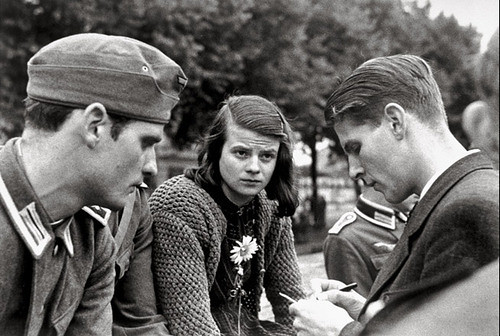
In a 2022 program, German comedian Jan Bömermann presented the case of an Instagram campaign called “I am Sofie Scholl,” in which a German influencer reconstructed the story of the leader of the student resistance group “White Rose” during the Nazi regime. Sofie Scholl was arrested and later executed by the regime after distributing pamphlets at her university denouncing Nazi propaganda. The White Rose is one of the few known cases of student resistance during that period.
The German government funded the project to bring history closer to young people through a more “fresh” perspective, using a series of media devices, mainly short day-in-the-life videos posted by an actress from Sophie Scholl’s point of view. It should be noted that this resistance movement consisted of only a handful of people, that is, very few in relation to the vast majority of students who were either supporters of the regime or silent spectators. But as the German state is well aware, some things are worth remembering and others that are less so.
But what is really interesting is that many people came to the Sophie Scholl project’s interactive chat to recount stories of their grandparents––who were Nazis or fought on the front––as “victims of war.” With his characteristic irony, Bömermann presented these comments as a clear case of historical distortion that twists the relationship between victim and perpetrator. The comedian remarked, not without irony, “We, the perpetrators, were also victims in a way, and in the resistance. Deep down, we were all like Sophie Scholl” (17:00-17:07). He criticized the project for its historical inconsistencies, as its creators seem to have emphasized the digestibility of the story at the expense of the historical accuracy. By recreating situations that never existed, Boemermann notes, “Sophie Scholl on Instagram finally gives us—the grandchildren of war criminals—the chance to feel like we are part of the resistance” (19:21-19:26).
These distortions of family memory are undoubtedly problematic, especially when confronted with the “official” discourse on the Holocaust, which was established in the country as a way of critically confronting its own past and presenting Germany as having truly learned the moral lessons of its history. This may be a symptom of the fact that post-war Germans were not allowed to mourn their dead—precisely because many of them were war criminals.
Where are the perpetrators?
In his book The Disappearance of the Perpetrators, German author Hannes Heer examines how the crimes of the Wehrmacht were presented in German memory. He points out: “By silencing the crimes known to all and reinterpreting its own history, the German collective attempted after 1945 to ensure continuity and, at the same time, to create an identity that conformed to the norms of the time and guaranteed a positive image of itself.” His research describes a process of exoneration concerning historical and family memory and the narrative that began to establish itself as “truth” during the Cold War.
The Cold War and the state doctrine of anti-communism did the rest, even giving the appearance of retrospective justification for the crimes of the Wehrmacht in Poland, the Soviet Union, and the Balkans. In general, the traces of the Nazi era and its crimes were so thoroughly erased and eliminated that one could have the impression that the Nazis and National Socialism had never existed in Germany.
The Disappearance of the Perpetrators, Hannes Heer, p. 26
This passage does not refer to a general trend in the country, but rather to the specific way that the crimes of the German army were treated in the public sphere in the context of denazification. Over time, the narrative of the crimes themselves began to change, with family stories finding interpretive space within official history.
The description of this shifting narrative is consistent with another study from the early 2000s entitled “My Grandfather Was Not a Nazi,” which presents several cases of conversations with Germans of all ages about the Holocaust and family histories associated with that period. In that study, many of the participants demonstrated extensive knowledge of history. Still, they showed particular difficulty relating these events to the real lives of their parents, grandparents, and great-grandparents, and to the specific roles they played in them. Despite demonstrating quite extensive “theoretical” knowledge about the crimes of Nazism, in their accounts and family stories, they exonerated their ancestors, even though they were soldiers and more than a few were fervent Nazis. The authors point out: “A total of 2,435 stories are told in these conversations. Quite a few of them change from generation to generation, so that anti-Semites become members of the resistance and Gestapo officials become protectors of the Jews.” The study does not seek to provide a psychological explanation for this phenomenon, but rather to describe how the German public handled a culture of remembrance and how collective memory has been formed by selectively incorporating historical facts and family stories, creating some sort of living memory that overshadows the existence of perpetrators who were their own relatives.
This form of historical distortion, coupled with the reworking of family stories, reinterprets the soldiers of the German Wehrmacht or Nazis as victims rather than perpetrators. This type of narrative and historical distortion, which takes place at the level of family memory, also seems to be operating in other elements related to guilt, historical responsibility, and remembrance, such as the notion of antisemitism. An article published in 2018 in the German newspaper Welt was already showing signs of a shift in self-perception regarding antisemitism among the German population. The article pointed out that “According to a representative survey, one in five people believe that their ancestors helped Jews or other persecuted people during the Third Reich.” The text has the title: “How today’s Germans whitewash the Nazi era.”
While Germany´s support for the genocide in Gaza happens with the diplomatic and military cover of Israel, we hear repeatedly how the accusation of antisemitism is made above all against the immigrant Arab population living in Germany through the notion of “imported antisemitism” as if anti-Semitic sentiment among the German population is not a problem at all. This trend is worrying as it adds another aspect to the dehumanization of the Other that now pervades European societies themselves, including the chancellor, who, with clear racist rhetoric, is labeling immigrants and the Arab population as threats to European culture.
We want to highlight the importance of this trend towards a change in Germans’ self-perception of their past and the repeated exercise of a “hegemonic” state-directed narrative. Clearly, the German state has led a process of commemorating the Holocaust as a symbol and civilizational rebirth, but with content that seems to be less about the Jewish descendants of Holocaust victims and more about the State of Israel.
The civilized post-war Germany is now falling apart
Hans Kundnani wrote in an article in 2024: “The memory of the Holocaust did not take root in the political class of the Federal Republic until the 1980s. Over the past two decades, this culture of remembrance has receded, as Germany has abandoned the belief that the Holocaust conferred a responsibility toward humanity and replaced it with an exclusive responsibility toward Israel.”
This new responsibility of the German state towards the ideology of Zionism has already been analyzed in recent articles and books. Kundnani summarized Germany’s stance toward Israel as with the phrase “Zionism above all,” referring to the words from the German anthem popularized by the Nazis. This ongoing logic of equating Israel and “all Jews” and the criticism of Israel as antisemitism makes it very difficult to have a fair debate based on historical facts about this issue. This is because too many talking points emanating from the Israeli hasbara machine are taken at face value by the German media.
The fact is that both movements described above—the shift from a discourse of perpetrator to one of victim, and its fervent anti-antisemitism (or philosemitism) adopting the slogans of Zionist propaganda—seem to form a strange historical notion of the new German identity. A problematic identity driven by the German state, media, and academia, whose Zionism is cloaked in uncritical philosemitism and pro-NATO, pro-war tendencies, and Russophobia. A renewed identity that is not only absolved of the crimes of its ancestors but, given its support for Israel’s biopolitical/thanatopolitical project as a colonial state, is sold as being “on the right side of history” while repeatedly denying that genocide is taking place in Gaza. This, incidentally, generates a double erasure of Palestinian life, since on the one hand it supports their annihilation, while at the same time denying that this process of annihilation—genocide—is actually happening. Again, the German position concerning Israel within this geopolitical chessboard is sadly summed up in the idea of “Drecksarbeit” as expressed by the current chancellor in reference to Israel’s actions in the Middle East, by attacking all of its neighbors, provoking a situation of endless wars. In this relationship between the “West/Israel and the Rest,” we have returned to the darkest moments of European colonialism. The only good thing about the clumsiness of Donald Trump or Friedrich Merz is that they are brutally honest in what they say.
Recent essays by Hans Kundnani and Leandro Fischer have developed the history of the new civilizational order of the West in the post-World War and Cold War era, which required a spectacular confrontation with the nazi past. Spectacular in the literal sense, because it was based on a performance that led to the development of a sophisticated culture of remembrance which selectively proposes what should be remembered and what should not. Meanwhile the so-called process of denazification was never real, but rather a gigantic process of image cleansing, coupled with a growing commitment to the State of Israel, which sealed the political pact between these two nations, whose historical basis is the Holocaust.
Authors such as Norman Finkelstein have shown how, in the United States, the repeated use of the memory of the Holocaust served clear political purposes at a time when Israeli politics was shifting to the right. Israel and the Holocaust only began to be taken into consideration in the US as a symbolic and political project after the 1967 war. Neither Finkelstein nor we deny the horrific reality of the Holocaust, but instead critically point out its political and media use during the Cold War, which was the result of political calculation.
Today, this political calculation, following Finkenstein’s reasoning, is evident in the repeated use of the Staatsräson narrative and the guilt complex, which is supposed to rally all Germans behind Israel regardless of what its government does. This still seems to work with the older generations, who are perhaps more exposed to continuous pro-Zionist brainwashing. Still, it works less well with young people, who seem to be more capable of recognizing genocide when they see it on screen every day. How else can we explain the Zionists’ desperation to control TikTok and X in favor of pro-Israel algorithms?
We have to fight against Zionist authoritarianism
Today in Germany, we are witnessing the development of a full-fledged police state to discipline internal dissent, mainly racialized populations, immigrants, and leftists who have come out to protest against the genocide in Gaza, denouncing the German state’s complicity in the ongoing genocide. This occurs not only through the excessive but also politically irresponsible use of accusations of antisemitism based on the IHRA, which is an imprecise definition whereby any criticism of the genocide and the state of Israel can be labeled as such.
Even more shameful is the use of the memory of the Holocaust to defend a state that has committed repeated crimes against the Arab population in the Middle East, while the police and juridical power in Berlin are persecuting protesters and activists who are supposed defenders of terrorism. This teaches us that we can no longer be ignorant of the pro-Zionist narratives that the German state tries to instill in its population, especially when it comes to evoking its “historical responsibility.” Because if we talk about historical responsibility towards the Jewish people, it does them no favor to equate them with Israel, a state that is hated throughout the world because of its brutality and countless crimes. Moreover, Israel’s criminal actions will probably increase the trend of real antisemitism, that is, the rejection and persecution of Jews for being Jews, because of Israel´s government’s claim to kill Palestinians to defend Jewish life.
Germany has failed to set a moral standard regarding the lessons of its past. And I believe that the world, the global South, will take note of this and will not forgive it so easily. There are already people in Germany who know that the crime against the Palestinians is a crime against all of humanity, regardless of whether the politicians in power, with their racist, selective humanism, are unwilling to see the Palestinians as human beings. What else could it be but plain and simple racism masquerading under these assumptions of selective humanism?Let us hope that the German people rise against the dictates of their own state and government that have not only openly supported another genocide, but also defended it in the name of “Western civilization,” as war criminal “Bibi” Netanyahu likes to say. Germans now have the responsibility to confront their own past more genuinely and less under the direction of state institutions that have dictated, from the top down, how people should think and act about it. Because now it is clear that Germany’s debt is not to Israel, but to Palestinians. Otherwise, we could find ourselves with a worrying trend towards historical revisionism where the “perpetrators” effectively become “victims” and the “liberators of yesteryear” become “eternal enemies.” This trend, which would reverse key historical facts, is a sign of the alarming pro-war and Zionist tendency in Germany. We must resist it at all costs.