The Left Berlin News & Comment

This is the archive template

Dockworkers on strike, whither Germany?

Dockworkers in twenty-one Mediterranean ports strike against military involvement and war


06/02/2026

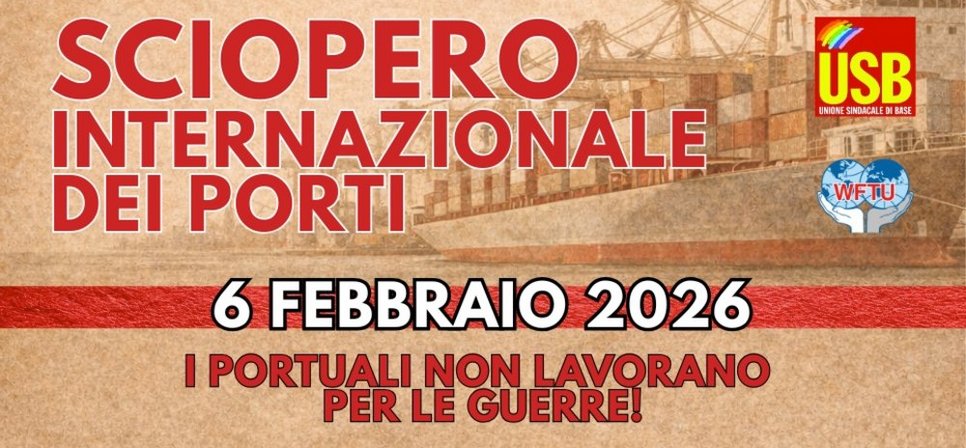
Strike banner reading in Italian translated to English: "Dockers don't work for war"

On the 6th of February 2026, dockworkers in twenty-one ports across the Mediterranean, stretching from Tangier, Morocco to Mersin, Turkey, will go on strike. They are striking under the slogan: “The Ports do not work for War”. The strike is led by the Italian-based Unione Sindacale di Base (USB) and is affiliated with the World Federation of Trade Unions (WFTU)—their parent organisation.

Their demands are spelled out in unequivocal terms on the USB website. Here are their demands:

  • Guarantee that European and Mediterranean ports are places of peace and free from any involvement in the war
  • Oppose the effects of the war economy on our wages, pensions, rights, and health and safety conditions
  • Block all arms shipments from our ports towards genocide in Palestine and any other war zone, and to demand a trade embargo on Israel from governments and local institutions
  • Oppose the EU’s rearmament plan and to stop the forthcoming EU and European governments’ plan to militarise strategic ports and infrastructure
  • Reject rearmament as an alibi to introduce further privatisation and automation of ports

In an increasingly belligerent Europe, defense spending has consistently increased year after year. This trend has persisted for the last decade. In 2025, EU member states have spent more than 2% of their GDP on defense. This is a ~63% increase in defense spending compared to 2020 . 

On the other hand, the population at risk of poverty hovers close to 20% in Italy, and even higher in other EU states. The statement by the Italian union makes it clear that these imperialist wars and militarisation are not in the interest of workers, and never will be. 

As Fabian Lehr points out in this incisive analysis, a war economy based on imperialism, cannot be in the interest of workers. It will only benefit large corporations, like Rheinmetall, who will make windfall profits by charging the State whatever they can get away with. This is already reflected in the stock markets—good harbingers of what to expect—where Rheinmetall’s shares have more than doubled over the last year. The problem with a war economy is, that once you turn metal into tanks, bombs, and guns, there are only two possibilities: either they sit around as inventory, or you find a way to sell or use them.

Over the last two years as Israel commits genocide in Gaza, Germany has actively exported arms to the Israeli military. Germany happily ranks as their second largest supplier worldwide. With this re-armament drive, it seems like Germany will have to look for even more warring parties to sell to, or perhaps invent a war of its own.

German trade unions

While the dockworkers strike is a clear sign that the WFTU holds a principled, class-oriented, anti-war stance, the trade union discourse in Germany is far more concerning. At its annual press conference on January 26th, IG Metall—Germany’s (and one of the world’s) largest trade unions comprised of 2.2 million members—released its Initiative for Jobs and Economic Recovery. It says:

The situation is objectively difficult, but by no means hopeless. Now it’s about setting the right course. Because there are stable industries undergoing transformation and promising fields of the future. These are described in the “High-Tech Agenda Germany” and outlined by the IG Metall “Opportunities Map”: Besides products for the mobility and energy transition, aerospace, AI and quantum computing, defense and security, medical technology, and robotics. We must now seize these opportunities boldly and decisively.” 

The Union takes a conciliatory tone towards state policy, and towards big businesses. One gets the feeling that the German worker is expected to be thankful to the Union for getting them “opportunities in fields like aerospace, defense and security”, but is not supposed to question the foundation on which this edifice is built!  

Why is there such a stark difference between the response of Italian and German unions? One possible reason is that the right to strike in Italy is an individual right; there is no obligation for a strike to be called by a union. Alternatively, in Germany there are far stricter rules around who can call for a strike (only trade unions), and for what reasons (quite restrictive). 

This interview with Mohammed Alattar, a Palestinian dock worker from Hamburg, shines a light on the nature of the problem. Responding to a question about the difference between unions in Italy and Germany he says: 

Unlike Germany, the unions in Italy are combative and pursue much more the interests of workers than those of the government. Union executives, trustees, and other workers have marched together on the big demo. I have even witnessed how workers, by occupying a terminal, prevented the loading of a ZIM ship with armaments for Israel. Here, on the other hand, the DGB has nothing better to do than to repeat the pro-Zionist propaganda narratives of the German government and to support the militarisation of Germany.

It is not all gloom and doom though. Initiatives like Rheinmetall Entwaffnen have been organising at local and national levels to try and shut the weapons industry down. A group of trade unionists called Gewerkschafter 4 Gaza have been trying to get the trade unions in Germany to change course.

Forcing structural change in Germany will be a huge challenge, but perhaps the Mediterranean dockworkers strike can inspire workers in Germany to reclaim their power from Union bosses—and lead an illegal strike or two, so that one day we no longer have to take to the streets and say: “Deutsche Waffen, Deutsches Geld, morden mit in aller Welt!”
EU-funded violence against people on the move in Bulgaria 

Human rights violations have increased since Bulgaria joined Schengen


05/02/2026

At Europe’s south-eastern external border lies Bulgaria: a country which has been in political crisis for years and just saw major Gen Z-led protests, which caused the collapse of its government. But it also has a decisive role in upholding Europe’s border fortress. Bulgaria is often the first European Union country on the so-called Balkan migration route. People who come from Syria, Kurdistan, Afghanistan, Iraq, Iran, or Morocco will likely enter the EU from Turkey into Bulgaria. 

Many human rights violations have been published since 2015, directly asking EU bodies to increase pressure against Bulgaria’s illegal practices at their southern border with Turkey. Instead, Bulgaria became a member of the border-free Schengen zone in 2025. The EU Commission could have used the accession process to force Bulgaria to comply with human rights standards. A missed chance. Rather, since Bulgaria joined the Schengen zone, reported human rights violations have continued as multiple testimonies indicate. 

Border violence 

The Balkan route has been a topic of discussion for the past ten years. Bulgaria started building a 230km barbed-wire fence at its southern border in 2017. To cross this border, people on the move walk for days, crossing rivers and forests with temperatures dropping to minus 10 degrees Celsius. Making it across does not guarantee people the right to seek asylum, although this is enshrined in the 1951 Geneva Convention. Every year, tens of thousands of people are illegally pushed back at the Bulgarian border. In 2023, 175.000 cases of illegal pushbacks were identified, and at least 70 people died due to exhaustion, dehydration or hypothermia. 

People on the move report illegal and violent pushbacks directly at the border to Turkey, as well as hundreds of kilometres away from the border back to Turkey. Some people describe being taken to the police station for 1–3 days before being forced into police trucks back to the border, without a chance to ask for asylum, a clear violation of international law. During pushbacks, people are beaten with fists and sticks. Police dogs are used to catch and attack people, phones are destroyed, people are strip-searched, and valuables and clothing are stolen, leaving some only in underwear without shoes in freezing temperatures. Racist smears, such as calling people read as from the so-called Middle East or Northern Africa “Taliban”, have been published by Human Rights Watch and No Name Kitchen, two organisations, among others, taking testimonies of people on the move. Some people have been shot at

After years of reporting by activists, non-governmental organisations and investigative journalists, EU-bodies are quite aware of the situation at the Bulgarian-Turkish border. But Bulgaria plays a key role in the border security enforcement of the EU. Due to its crucial geographical position as the first EU country on the Balkan migration route (with Greece), the EU directly benefits from these illegal border practices. 

Supported by Frontex

Frontex, the EU’s border agency, also operates at Bulgaria’s border to Turkey in cooperation with national authorities. They support border surveillance through patrolling, thermo-vision equipment and police dogs to detect “irregular migration”. The EU tripled the presence of Frontex in 2024, in preparation for Bulgaria joining Schengen. In their own words, their operations focus on ensuring fundamental rights and human dignity.

Activists on the ground call out Frontex for their role in the region regularly. The presence of Frontex does not lead to more safety. Rather, officers are directly involved in border violence. Internal reports of Frontex have shown that their officers have taken part in illegal pushbacks. 

In 2024, three boys died at the border. While people on the move die regularly due to neglect or actions by authorities, this case got more publicity. Human rights groups had the location of the minors and could have possibly prevented their deaths if they had not been actively hindered in their rescue actions by Frontex and national authorities for days. Frontex published a report blaming Bulgarian authorities for these deaths. But local activists and organisations have called out Frontex for their role in interfering with rescue actions of activists on the ground. 

Beyond the border region

Europe also benefits from the harsh system placed on people on the move once they have made it into Bulgaria. People on the move are usually taken to closed camp facilities to start their asylum process. Lyubimets detention centre in the south of Bulgaria is one of those camps. It was built in 2011 as part of Bulgaria’s efforts to prepare for the Schengen accession process. Lyubimets has 5-meter-high walls with barbed wire fences, guards patrolling, and visiting hours limited to two hours twice a week. It is a closed facility; people are never allowed to leave except when their time is up, or they manage to pay for a lawyer to appeal their stay. People are regularly detained for 18 months without trial. There is also the infamous Busmantsi detention centre, located on the outskirts of Sofia. It is known for its inhumane conditions and arbitrary detention practices. It has operated since 2006 and is also funded by the European Union. These places do not feel like a prison by accident. They are designed to do so. 

In Lyubimets and Busmantsi, as well as in other facilities, people on the move regularly report unsanitary conditions, insufficient nutrition and heating, violence by police officers, unannounced deportations, and violations of their rights to receive visitors and see lawyers as well as access to privacy and  fresh air. Infestations of bedbugs, lice, cockroaches and rats are persistent across all facilities. Medical help is rudimentary, and psychological assistance is not provided. 

Even visits by European Union committees have reported physical violence and verbal abuse by guards and inhumane living conditions. But the EU continues to finance this system of neglect. Between 2023 and 2024 alone, the European Union has provided millions of euros each year to Bulgaria for its migration policies: €45 million (2023), €141 million to Bulgaria and five other EU member states (2023), €85 million (2024) to Bulgaria and Romania, and another €20 Million (2024) to Bulgaria alone. Despite the financial support, all national detention centres are deteriorating. The capacity has decreased from 5,160 places to 3,225 in 2024 due to premises identified as unfit for living. 

The lie of voluntary return

That Bulgaria is reducing the number of positive decisions taken on asylum requests since 2023 goes hand in hand with the overall strategy of isolation and “fortressingof the EU. For Syrians, this meant a drop of asylum approvals from 90% to 18% in 2024, even before the fall of the Assad regime. At the same time, Bulgaria has increased deportations. People who sit in detention facilities are deported quietly and without warning, not providing them the chance to appeal. 

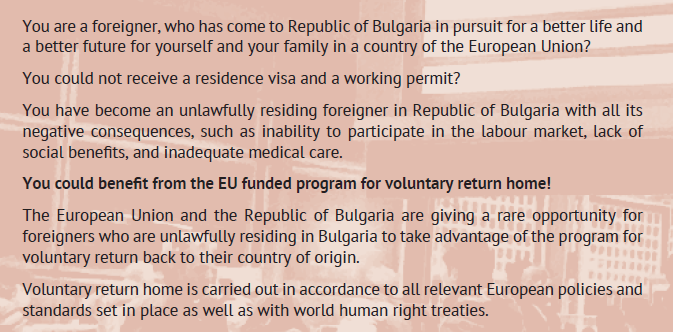
If no deportation agreements with countries exist, pressure is increasing to sign a “voluntary” return agreement. Bulgaria launched a new Assisted Voluntary Return and Reintegration (AVRR) Programme in 2024. Three-quarters of the funding comes from the European Commission. 

Voluntary returns are defined by the United Nations refugee agency as based on a “free and informed choice”. But since the start of the programme, people have reported being forced to sign. The consequence of not signing is often (prolonged) prison time, leaving people no real choice but to agree to their own deportation. Some people have reported not receiving translations when forced to sign documents, only to later find out they agreed to a  “voluntary return”. 

These violent and degrading practices are intended to lead to despair. The hope for a more peaceful future is intentionally being destroyed. And it is working. More and more people are signing “voluntary return” papers. The EU is once again not upholding its own standards. 

If public pressure does not increase, these practices will become even more systematised. Red lines are crossed without much happening— three minors die, and business at the border continues as usual. Rather than any consequences, EU countries, above all Germany, are more frequently deporting people back to Bulgaria based on the accelerated Dublin procedure, notwithstanding family and personal ties in Germany, or the inhumane conditions people on the move face on the ground. 

What is needed is what human rights organisations have been calling for for years: safe and legal ways to seek protection in Europe, an end of violent pushbacks, abuses and arbitrary detention, more humane conditions in camps, independent observers in the border region to ensure compliance with international law, more transparency and an end to the criminalisation of people on the move and activists on the ground. 

Red Flag: Is it 1933?

In his weekly column, Nathaniel Flakin looks at the proto-fascist methods of ICE in Minneapolis


04/02/2026

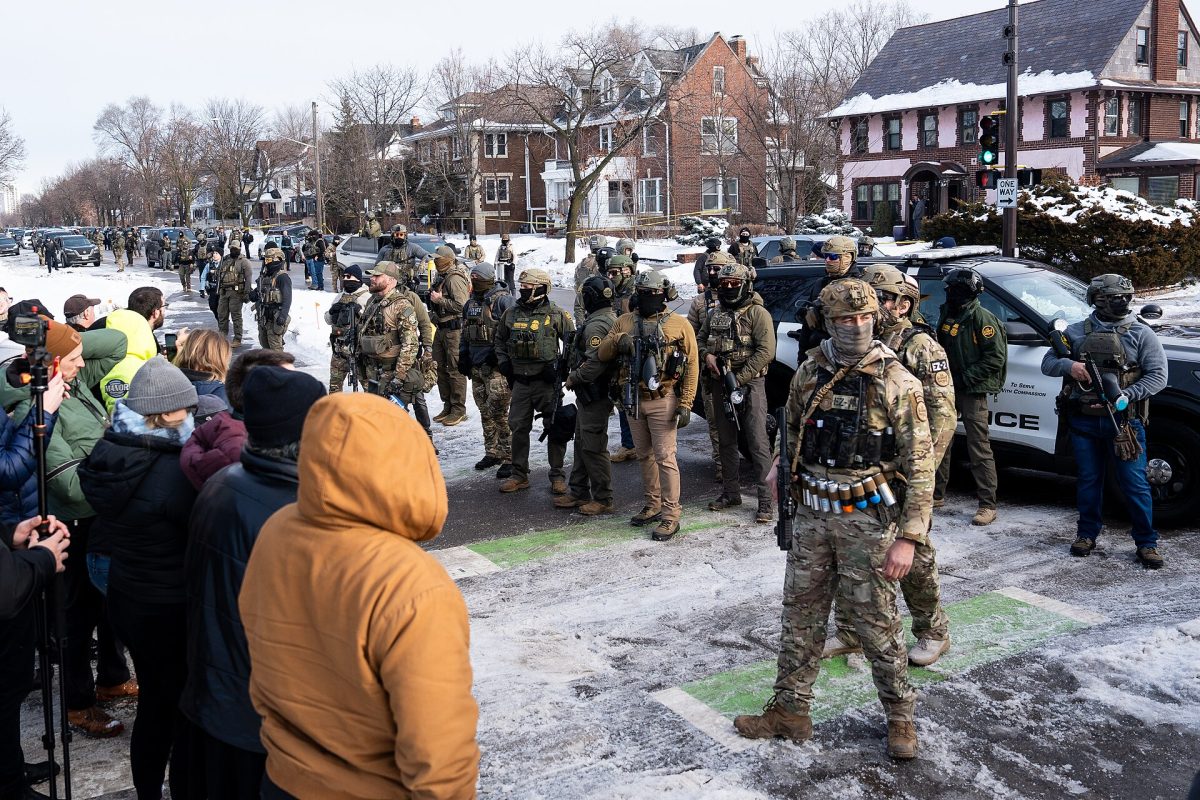
Image: Chad Davis (https://chaddavis.photography/sets/ice-in-minneapolis/)

The brutal terror on the streets of Minneapolis, with masked thugs arresting people for having the wrong accent or the wrong skin color, reminds many people of the Nazis. The podcaster Joe Rogan, after enthusiastically endorsing Trump in 2024, has been wondering: “Are we really going to be the Gestapo? ‘Where’s your papers?’ Is that what we’ve come to?”

Minnesota governor Tim Walz said: “We have got children in Minnesota hiding in their houses, afraid to go outside. Many of us grew up reading that story of Anne Frank. Somebody is going to write that children’s story about Minnesota.”

Right-wing actors, including the U.S. Holocaust Museum and the Department of Homeland Security, energetically reject the comparisons. (Even as the DHS account is a constant stream of white nationalist memes). They point out that ICE is merely targeting “illegals” whereas the Gestapo went after German citizens—as if the Nazis didn’t attack Jewish immigrants from Eastern Europe for not having proper papers.

Comparisons

Historical comparisons do not claim two things are identical—no two historical phenomena are exactly the same. A comparison highlights both similarities and differences. As the liberal commentator Masha Gessen explained—after they were cancelled in Germany for pointing out parallels between the genocide in Gaza and the liquidation of Jewish ghettos“comparison is the way we know the world.” Or as Leon Trotsky put it:

To judge the correctness or erroneousness of a historical analogy it is necessary to clearly define its content and its limits. Not to resort to analogies … would mean simply to reject the historical experience of mankind. The present day is always different from the day that has passed. Yet it is impossible to learn from yesterday in any other way except by the method of analogy.

In that spirit, what are the similarities between Minneapolis in 2026 and Germany in 1933? What are the differences?

Fascist Ideas

It’s easy to note the similarities, not just because of the state-sponsored racist violence on the streets, but also because ICE agents are clearly fans of fascism, with Gregory Bovino marching around in an SS-style coat as he mocks the “chosen people” (he’s a classical antisemite).

ICE has absorbed a lot of fascist thugs, which is why the Proud Boys and other far-right gangs are less visible than a few years ago—many have changed their uniforms.

Stephen Miller has had a fascist worldview since he was in high school, and this extreme violence is in the service of a desire to build national strength through racial purity. Miller would clearly love to be at the head of the Gestapo in 1933 (in spite of his Jewish heritage, since national identities are always contradictory).

But just because individuals in the White House have fascist views, it does not mean fascism is in power.

Trump’s Weakness

We also need to look at the limits of this comparison. The Nazis created the Gestapo, short for the Secret State Police, in April 1933, by amalgamating different police agencies and supplementing them with their own fascist militia, the Nazi stormtroopers of the SA. The Gestapo was later put under the control of a different Nazi squad, the SS.

The Gestapo came into being several months after German elites had put Hitler in power on January 30, 1933. The Reichstag had burned and the Nazis had carried out a reign of terror against their opponents, setting up concentration camps across the country and banning the Communist Party.

In early 1933, the Nazis had two million stormtroopers in paramilitary formations—enough to terrorize opponents in every corner of a country of 66 million people. Down to the last village, antifascists were being murdered, tortured, or forced out of the country.

This shows us a crucial difference: ICE, despite a rapid expansion, has something like 22,000 agents in a country of over 340 million. The Border Patrol has several tens of thousands more.

While the Nazis were able to consolidate all German police under their control, we are seeing how the repressive forces in the U.S. are fragmented. (This does not mean that the national guard or the cops can ever be our allies, but they are not part of the ICE campaign either). This is because the U.S. ruling class itself is fragmented and not solidly behind Trump.

The heroic and relentless protests in Minneapolis have forced Trump to make a tactical retreat, recalling the Nazi cosplayer Bovino. The masses in the U.S. have not yet suffered a historic defeat—they are capable of levels of mass resistance that were completely impossible in Germany before the name Gestapo ever appeared.

Despite all the cruel spectacle, Trump is actually rather weak. The majority of people in the U.S. oppose the ICE terror, and Trump’s coalition is showing fractures—his actions are “outside the relation of forces.” The campaign, up to and including multiple public executions, was designed to break the will of people to resist the far-right agenda—but it has backfired.

Bonapartism

What we are seeing in the U.S. is not fascism but rather a weak and unstable Bonapartist government. Bonapartism can be a prelude to fascism—see Brüning, von Papen, and Schleicher, who were Hitler’s immediate predecessors. But Bonapartism does not automatically pave the way for fascism—that is determined by the class struggle. Only if the masses’ independent organizations are crushed can fascism roll over their skulls like a tank. Trump and Miller would obviously love to do that, but they currently lack the power to pull it off.

That’s why a comparison between ICE and the Gestapo, between Trump and Hitler, has important limitations. Trump has more in common with Louis Bonaparte, the “grotesque mediocrity” who proclaimed himself Emperor of the French in 1852. Napoleon III, the nephew of the original emperor, had to precariously balance between opposing classes, relying on a base of lumpenproletarians in the cities and peasants in the countryside. Like Trump, the latter Bonaparte was a buffoon who relied on constant spectacle, and concentrated the entire executive power in his hands. It is no coincidence that both need gold and jewels as signs of their power.

Marx’s analysis of Bonapartism shows how, in a time of great unrest, the ruling class can come to rely on a strongman who appears to make the state independent of society. But such a regime is necessarily unstable. 

Fight

To say we are not under fascism is not to call on people to chill out. It’s the opposite: An authoritarian wave is rolling around the planet, and fascist forces are growing in its wake. Many ICE agents are motivated by fascist ideology, and they use proto-fascist methods against civilians.

It’s precisely because we do not live in fascism that we can and must organize mass resistance—it is a time for boldness and optimism. As the strikes and grassroots resistance in Minneapolis have shown, the authoritarians are not all-powerful. They can be stopped. With a nationwide general strike, we could derail Trump’s whole agenda and stop figures like Miller from realizing their Nazi dreams. This was no longer possible in Germany by mid-1933, as the Gestapo was founded. 

Red Flag is a weekly opinion column on Berlin politics that Nathaniel has been writing since 2020. After moving through different homes, it now appears at The Left Berlin.

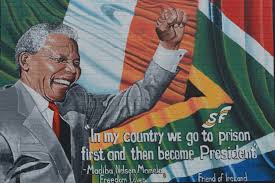
11 February 1990: Release of Nelson Mandela

This week in working class history

On 11th February 1990, Nelson Mandela was released from Victor Verster Prison near Cape Town. Addressing a crowd of 50,000 people, he declared, “Our march to freedom is irreversible.” Millions watched this historic event on television. Mandela’s release marked a significant step toward dismantling apartheid—institutionalized racial segregation—in South Africa in 1994. However, the US government, under Presidents Bush and Clinton, was slow to respond. Mandela was banned from entering the USA until 2008.

Nelson Mandela was born in the Eastern Cape in 1918. He attended his first demonstration in 1943 in Alexandra, outside Johannesburg, successfully opposing a 20% increase in bus fares. He joined the African National Congress (ANC) but later criticized its leader, Alfred Xuma, because “he enjoyed the relationships he had formed with the white establishment and did not want to jeopardize them with political action.” In 1944, Mandela co-founded the more radical ANC Youth League.

In 1956, Mandela was arrested for high treason in a trial that lasted five years. Following the Sharpeville Massacre in 1960, where police killed 69 demonstrators, over 18,000 people were detained, and the ANC was banned. Mandela was convicted in another trial in 1962. Resistance continued with strikes in the early 1970s, the Soweto uprising in 1976, and the first openly political strike in 1982, involving 100,000 participants. These actions ultimately led to a series of strikes throughout the 1980s, contributing to the downfall of the apartheid regime.

In response to the Sharpeville Massacre, Mandela began to believe that armed struggle was essential for the liberation of Black South Africans. Although some have portrayed him as a pacifist, he became the central organizer of Umkhonto we Sizwe, the ANC’s armed wing, starting in 1961. By 1985, the apartheid government indicated they would release Mandela if he renounced violence. He responded by stating he would remain in prison until the ban on the ANC was lifted.

Mandela’s release and the dismantling of apartheid did not lead to full equality in South Africa; instead, it instituted what Patrick Bond has termed “class apartheid.” In 1994, South Africa was forced to adopt a neoliberal IMF plan, which included cuts to state spending and public sector wages. Subsequent governments took further actions, such as orchestrating the Marikana massacre of striking miners. Nevertheless, Mandela’s release represented a significant victory, showing that with sufficient mobilisation, it is possible to overcome even the most repressive states.

News from Berlin and Germany, 4th February 2026

Weekly news round-up from Berlin and Germany

News from Berlin

More climate activists convicted for paint attack on Brandenburg Gate

Around two and a half years after the paint attack on the Brandenburg Gate in Berlin, four more climate activists have been fined: the Tiergarten District Court found three men and one woman guilty of property damage and resisting law enforcement officers, a court spokeswoman said on Monday. The fines range from 1,200 to 3,300 Euros. According to the indictment, the four convicted individuals were involved in the protest in September 2023 along with ten other members of the group “Letzte Generation.” During the protest, the Brandenburg Gate was sprayed with paint to draw attention to the climate crisis. The public prosecutor’s office has lodged an appeal. The verdict is not yet final. Source: rbb

Spore Initiative defies hate graffiti

Last week, the Spore Initiative building in Neukölln was the target of a deliberate attack. The word “remigration” was spray-painted in large letters on the façade—a charged term that plays a central role in current political debates and in the rhetoric of the AfD. The graffiti was met with horror by the team and the neighbourhood, but also with determined composure: “We will not be intimidated, but we are alarmed,” commented press spokesman Gurmeet Singh. Unfortunately, incidents like this are nothing new in Berlin. More than ten years ago, theatre performances were targeted by right-wing disrupters: for example, Falk Richter’s play Fear at the Schaubühne was repeatedly interrupted. Source: taz

News from Germany

Tenants are not allowed to make a profit from subletting

People who go abroad for a longer period of time often sublet their flat—often at a higher price. The Federal Court of Justice has now ruled that no profit may be made from this. The legitimate interest of a tenant in subletting is to cover housing-related expenses, stated the Federal Court of Justice (BGH) in Karlsruhe based on a case from Berlin. The purpose of subletting is not to create the opportunity to make a profit. The Federal Ministry of Justice is currently planning legal regulations for the furniture surcharge. Source: spiegel

CDU faces criticism over scrapping entitlement to part-time work

CDU politicians are calling on their party to scrap Germany’s “Rechtsanspruch auf Teilzeitarbeit,” a law which entitles full-time employees in the federal republic to reduce their hours to work part time. “Those who can work more should work more,” Gitta Connemann, who heads the business wing of the CDU, told the magazine Stern. The magazine has also seen a leaked copy of the policy paper, titled “No entitlement to lifestyle part-time.” The paper is expected to be presented at the CDU’s general conference in Stuttgart in February, where members will vote on whether it should be adopted as party policy. In 2024, 29% of the German working population worked part time. Among female employees, 49% worked part time. Source: iamexpat

Bavarian AfD would be for deportation police modelled on ICE

The AfD plans to introduce an “Asyl-, Fahndungs- und Abschiebegruppe” (“Asylum, Tracing and Deportation Group” or “AFA”), modelled on the American ICE, should it enter government in Bavaria following state elections on March 8. The Bavarian AfD also said it would make life even more inhospitable for people seeking asylum in Germany, by cutting their financial support and giving them only “bread, a bed and soap.” In the most recent “Sonntagsfrage” poll, which asks respondents who they would vote for if an election were held this Sunday, 39% of those surveyed in Bavaria said the CSU would have their vote, while 19% would vote for the AfD, 13% for the Greens and 9% for the Freie Wähler. Source: iamexpat

How bureaucratic hurdles exacerbate the shortage of skilled workers

Germany is in need for foreign skilled workers. But migrants face many hurdles if they want to work here. For instance, the number of refugees has risen sharply since 2015, but the government has not succeeded in getting most of them into work. As a result, dissatisfaction with German immigration policy has grown among the population. Besides that, there are many reasons why new employees do not want to renew their usual two-year contracts, including homesickness, family problems and difficulties with integration. According to Jörg Biebrach, Head of Nursing at the BDH Clinic in Vallendar, it is therefore very important for employers to make foreign employees feel welcome here. Source: dw

The small rebellion of ver.di

There is a hint of a general strike blowing through Germany. This week, there were temporary walkouts at schools, daycare centres, university hospitals, municipal authorities, and on trains, underground trains, trams and buses. Two major wage disputes are coinciding at the moment: one in the public sector and one in local public transport. And in both cases, ver.di plays the leading role in the dispute. That means power. As expected, Bild ran the headline on Sunday: “No strikes at an inopportune time!” Almost all regions and major cities in Germany were affected by the strike on Monday: only Lower Saxony was unaffected. Source: jw

Merz says economy his main focus after jobless numbers hit 12-year high

German Chancellor Friedrich Merz (CDU) said that boosting the economy would be his focus in 2026, after data showed that unemployment has powered past the 3 million marks to a 12-year high. Labour Office figures on January 30 highlighted the lag in the jobs market from the economic stagnation of the last few years, with 177,000 more people out of work in January than in December, bringing the total to 3.08 million. The unemployment rate jumped by 0.4% to 6.6% in seasonally unadjusted terms. The picture improved slightly when accounting for seasonal trends. Nevertheless, Economy Minister Katherina Reiche (CDU) said Germany must pivot toward new “growth engines”. Source: reuters

Federal Ministry of the Interior sees no moderation in new AfD youth organisation

The German government affirms the new AfD youth organisation shows no sign of moderation compared to its dissolved predecessor. In response to an interpellation by Green Party MP Marlene Schönberger, the responsible Ministry of the Interior writes that the composition of the federal executive committee of Generation Germany (GD) shows a high degree of personnel continuity with the former Young Alternative (JA), particularly at the official level. “There are known links between members of Generation Germany and other extremist organisations.” Generation Germany was founded in November 2025, following the dissolution of the Young Alternative, which had been classified as proven right-wing extremist by the Office for the Protection of the Constitution. Source: faz