Speaking of homelessness and annoying neighbors, it is a fact that finding accommodation in Berlin, in the first place, is a mission impossible. This is mostly due to rising rental costs due to speculation in the city’s property market. Gentrification through the influx of wealthy individuals or investors has increasingly rendered parts of entire neighborhoods out of any average person’s reach. Fair and accessible housing has become a commodity.
To top that up, finding accommodation with what is known as “anmeldung” (registration of residence) is almost a fantasy. This is mainly due to the bureaucratic system that is by design slow and very inaccessible to many, especially migrants to the city. Without “anmeldung”, one cannot get a bank account or tax number and consequently, cannot get a formal job in Germany.
New comers to Berlin, whether Germans from other states and with low incomes and/or migrants name this as one of the major hurdles they have faced. For some who have lived in the city for years, they still struggle with finding affordable housing with “anmeldung”, and have to therefore move places every few months.
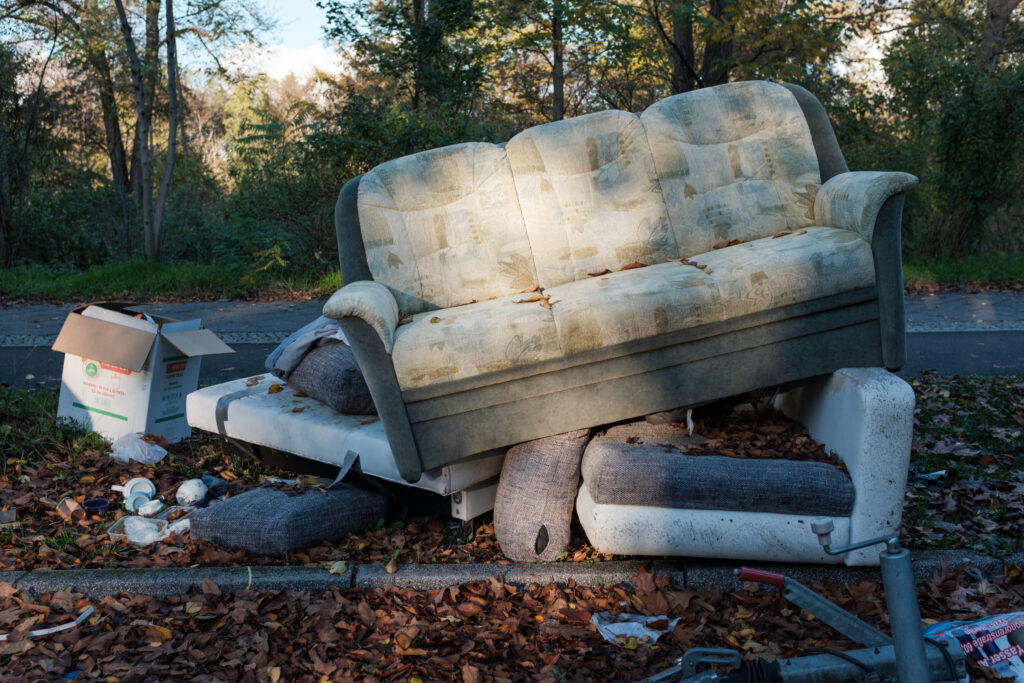
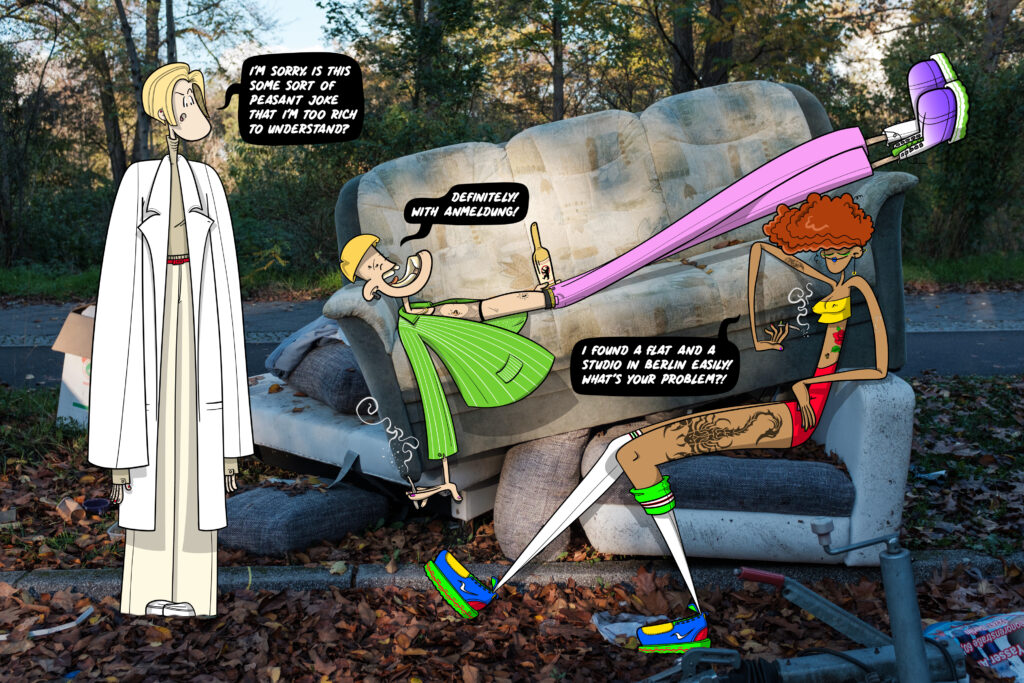
In this image, the abandoned things include a whole living room set.
Titled “Layered Crisis”, we wanted to tackle the affordable housing issue coupled with gentrification of popular neighborhoods in Berlin. The usual young city dwellers of different backgrounds cynically discuss this matter over a layered abandoned outdoor living room, while their wealthier counterpart seems to be out of touch with the realities that they are creating.
Recently, grassroots activists have started a campaign that calls for easing “anmeldung” procedures for all, to resolve the consequences that arise from its absence. They are also calling for increased social housing projects, and for removing existing ones from the market, to reduce the possibility of their annexation by private investors.
This is, unfortunately, a “normal” obstacle that is faced by every new arrival in Berlin. It affects the German born and the migrant. So if you find a couch to sleep on for a few months with “anmeldung”, take it. You never know when you would be kicked out in search for a new couch in this jungle of many layers.
Image take in Neukölln, Berlin (2022)
Letter from the Editors, 14th March 2024
International Day of Action against Racism and Fascism
We’ll start with an apology. Last week, because of technical problems, we sent out the Newsletter from the previous week. Sorry for that. We hope that the problem is now fixed. If you don’t get a Newsletter or the wrong one arrives, we also publish the Letter from the Editors every week at www.theleftberlin.com.
Saturday is the International Day of Action against Racism and Fascism, with activities across the world, including in Berlin. At 2pm, the Antifascism roundtable and Aufstehen Gegen Rassismus are calling a rally Close Down the AfD. Hostility and assaults are everyday life for refugees and peoples affected by racism. Exclusion, oppression and police violence determine the life of People of Colour and Black people. State racism helps the fascist right to grow. In many countries, extreme right wing parties are a serious threat. We must stop the extreme right making gains in the EU parliament in the June elections. The protest is outside the AfD-near Desiderius-Erasmus-Stiftung, Unter den Linden 21.
Also on Saturday, from 5pm POC art collective and the LINKE Berlin Internationals @berlinleft cordially invite you to the film screeningAisheen, Still alive in Gaza. This is a repeat of the showing which was planned for 10th February. Doors open in oyoun, Lucy-Lameck-Straße 32 at 5pm. Food will be served shortly after 6pm to mark Iftar. The film will be then shown around 7pm, followed by a discussion with Palestinian activists Ramsy Kilani and Fida’a Al-Zaanin. ‘Aisheen, Still alive in Gaza’ is a documentary by Nicolas Wadimoff (Arabic with English subtitles) 86 minutes – 2010. Entry is free but there will be a collection for women in Gaza.
Because of the Syria rally, the walking tour (Anti-)Colonialism in Berlin will be starting at 3.30pm – later than advertised. Germany isn’t well know as a colonial empire. But in just a few decades at the end of the 19th century and the beginning of the 20th, the Kaiser’s troops massacred hundreds of thousands of people across Africa and Asia. Today, Berlin is full of reminders of the city’s colonial past. In our (Anti)Colonialism tour, we look for signs of oppression and resistance. We will be meeting at 3.30pm in front of Akademie der Künste at Pariser Platz. This is opposite the Brandenburg Gate and next to the Hotel Adlon (S-Bhf Brandenburger Tor). The tour will end around 6pm near U-Bahn Rehberge.
Also on Sunday, at 7pm, it’s our latest Palestine Reading Group. This week is our first attempt to look at Palestinian literature, specifically the works of Ghassan Kanafani. You can find the selected reading here. The Palestine Reading Group takes place every week, on either Friday or Sunday (partly depending on room availability). Check the page of Events which we’re organising for the coming dates and subjects under discussion. If you’d like to get more involved in the group, and suggest and vote on future subjects, you can join our Telegram group and follow the channel Reading group. Meetings are currently in the Agit offices, Nansenstraße 2. There is a meeting for moderators (open to anyone who’s interested) half an hour before the meeting starts.
Also at 7pm on Sunday, there’s a showing of the Indian film Court. Join us for a screening of a Kafkaesque walk through the Bombay High Court, in which a young lawyer defends a man charged with abetting suicide through revolutionary poetry. The film will be shown in Bligisaray, Oranienstraße 45 (between U-Bahns Moritzplatz and Kotbusser Tor).
On Tuesday, there’s the latest meeting of Revolutionary Readers – A FLINTA* book club on leftist revolutions around the world. Once per month, we would like to choose a different book about leftist revolutions around the world throughout history and then come together to think critically and discuss/analyse their successes and missteps to better inform our own ability to organise. This month, the group is discussing Frantz Fanon’s Wretched of the Earth. The text is available for free here. It is also available in libraries around Berlin. This book club is for FLINTA* persons and is open to comrades of all education levels. It takes place in the AGIT Offices, Nansenstraße 2, at 7pm.
There is much more going on in Berlin this week. To find out what’s happening, go to our Events page. You can also see a shorter, but more detailed list of events in which we are directly involved in here.
Two dates for your calendars:
On Friday, 22nd March, the Berlin LINKE Internationals are organising a public meeting Neosovereignism in the West African Sahel: Burkina Faso, Mali and Niger with Prof. Dr. Baz Lecocq, Franza Drechsel (Rosa Luxemburg Foundation), and Dr. Lamine Doumbia. It’s at 7pm in Karl Liebknecht Haus. More information in next week’s Newsletter.
Please note: the LINKE Internationals Summer Camphas now been postponed to avoid clashing with a big demo against the AfD. Summer Camp will now take place on 21-22 September, still in the Naturfreundehaus Hermsdorf.
This week’s Campaign of The Week is the Palestine Conference which will take place in Berlin from 12-14 April. As Palestinian, Jewish, German and international activists, we will publicly accuse the German government of aiding and abetting the genocide in Gaza. You want to hold German politicians accountable for their support of war crimes? You want to resist the silencing in Germany about the genocide in Palestine? Then make the Palestine Conference possible with your donation! Together we can create the momentum and bring our movement into the offensive.
If you are looking for Resources on Palestine, we have set up a page with useful links. We will be continually updating the page, so if you would like to recommend other links, please contact us on team@theleftberlin.com. You can also find all the reading from our Palestine Reading Groups here.
In News from Berlin, 1,000 demonstrate against Tesla in Grünheide, conference discusses poor delivery conditions for delivery riders, and park planned on the site of Tegel airport.
In News from Germany, Letzte Generation plan a Spring of resistance with new forms of action, Sahra Wagenknecht Alliance to contest local elections in Eastern Germany, rail workers announce a new strike, and writer Deborah Feldman says that Germany’s support for Israel is endangering Jewish people.
This week’s Video of the Week is Jonathan Glazer’s acceptance speech after his film The Zone of Interest won the Oscar for best film not in English. In his speech Glazer calls out Israel’s use of the Holocaust to justify the ongoing bombardment of Gaza.
If you would like to contribute any articles or have any questions or criticisms about our work, please contact us at team@theleftberlin.com. And please do encourage your friends to subscribe to this Newsletter.
Last Sunday, Portugal headed to the polls for an early general election to the National Assembly, in which two thirds of the 10 million population came out to vote – the highest voter turnout rate in three decades.
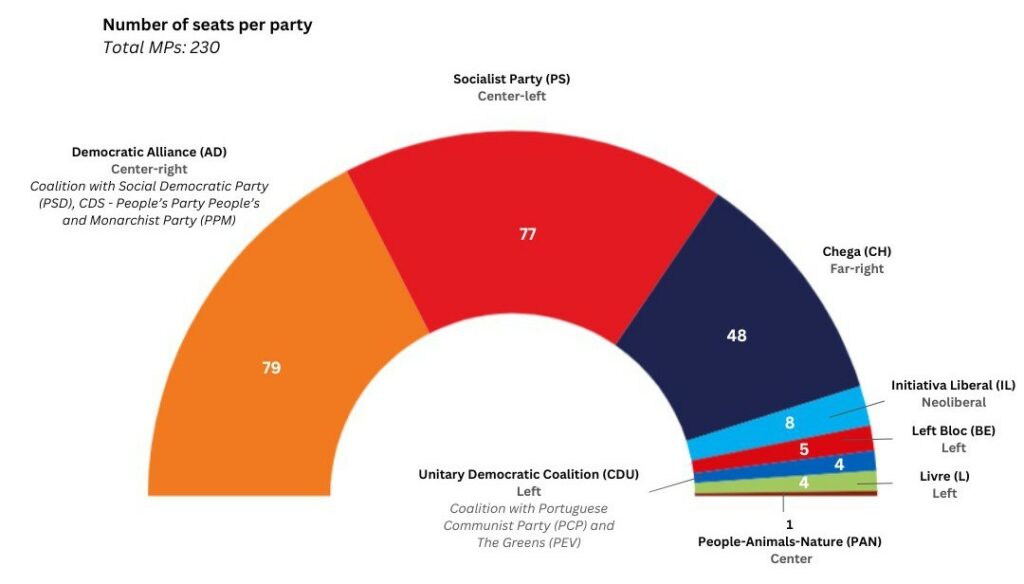
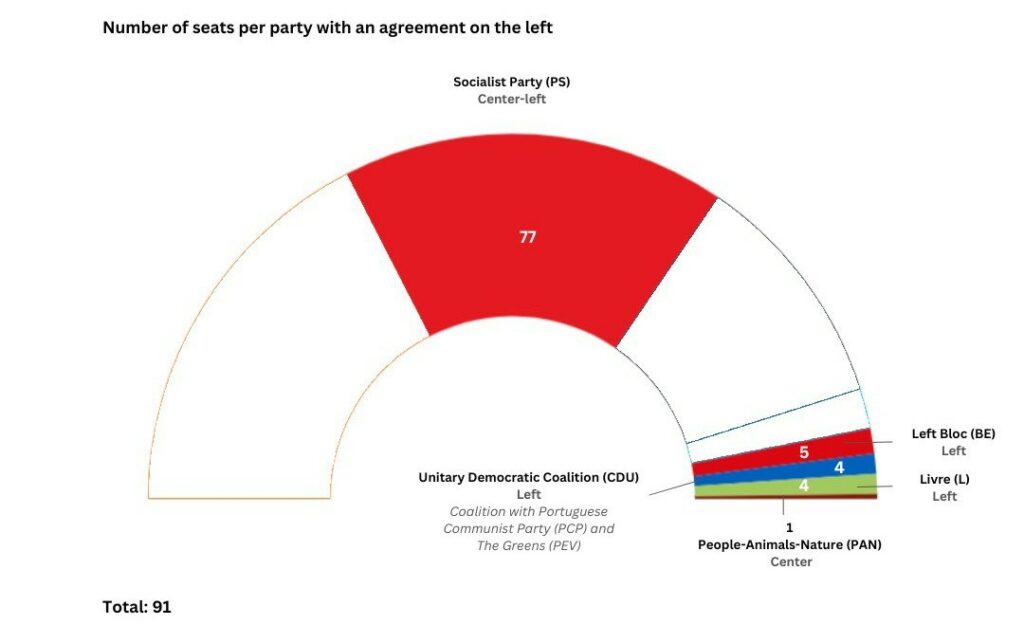
While the results mark the country’s shift to the right, there remains only a two seat difference between the two mainstream parties, who have alternated in power since the end of Salazar’s dictatorship, leaving some room for ambiguity about the future. The Democratic Alliance – a center-right coalition led by the liberal-conservative Social Democratic Party (PSD), with the support of the Christian democratic CDS – People’s Party – and the People’s Monarchist Party (PPM) obtained 79 seats. The Socialist Party (center-left), which has been in power for the last eight years, won 77 seats.
Even more concerning is the fact that, out of the 230 seats, the populist far-right party Chega (“Enough” – that defends things such as chemical castration of sexual offenders, or removing the nationality of naturalized citizens who commit crimes) secured 48 seats – almost as many as there have been years of Portuguese democracy – coming in third place and tripling their 2022 vote. Chega now holds immense negotiation power, with one in every ten electors choosing to side with them, marking yet another nail in Europe’s democratic coffin. Ironically, the rise of the far-right comes in the year that marks the 50th anniversary of the Carnation Revolution in Portugal, that overthrew the dictatorship the country lived through between 1933 and 1974, and started a revolutionary process in the years that followed, with the participation of the workers and popular masses.
Graphics: Ines Colaco
How did we get here?
Between 2015 and 2019, Portugal was ruled under a political agreement established between the center-left Socialist Party (PS), the Left Bloc (BE) and the Portuguese Communist Party (PCP), a pact that became known as “Geringonça”, roughly translated to English as “contraption”. That pact succeeded in overthrowing the right from power. It forced PS to the left by pushing back on austerity measures imposed via the troika and the previous government, and by advancing social rights that inspired political leaders all over Europe.
The formal pact ended in the 2019 election, by the socialists’ ambitious strategy, that despite their efforts, did not achieve a parliamentary absolute majority, and had to keep negotiating and compromising to maintain the support of the left parties. However, the COVID-19 pandemic took a big toll on the Portuguese economy and the left partners’ support was conditioned on specific proposals and red lines. These were to guarantee sturdy measures in wage increases, improved labor laws and strengthening the National Health Service – measures that, despite their previous defense, the Socialist Party was now intransigent in including in the 2022 state budget, instead preferring to be closer to the Portuguese right – and therefore provoking new elections.
Prime minister and PS leader António Costa successfully achieved his absolute majority in the 2022 campaign, by blaming the left-wing parties for the political crisis (resulting in the Left Bloc and the Communist Party losing some of their seats), and seducing the Portuguese historical moderate-center electorate into a “useful vote” to keep the far-right away. At the same time, the right wing increased its fragmentation, with a dull Rui Rio leading the Social Democratic Party (PSD), and a growth of the far-right Chega, coming in third place with over 7%.
Having achieved its desired absolute majority, all the elements were in place for a period of stability led by the Socialist Party – which quickly crumbled down when the Prime Minister Costa and several members of his close circle saw themselves involved in investigations of illegalities and alleged corruption cases around lithium and green hydrogen. Although Costa was not accused of any crime, the suspicions of his potential involvement in the cases of influence peddling and corruption led to his resignation, and to the subsequent dissolution of the parliament in December 2023, calling for new elections.
The corruption cases turned out to be a blessing for the far-right Chega, who based its campaign on anti-corruption and anti-immigration stances, under the slogan “clean Portugal”. They have benefited from the anti-democratic right gaining momentum throughout Europe, having recently joined the Identity and Democracy (ID) group – alongside the German AfD, Salvini’s Lega and Le Pen’s Rassemblement National. Internally, they have equally bad influences, such as the MP Pacheco de Amorim, a former member of the far-right terrorist group MDLP and grandson of a monarchist close to Salazar. The party’s savior-like leader, André Ventura, previous member of PSD, used his ex-TV football commentator platform for his political project, becoming famous by attacking Roma communities, and later on bringing back a reminiscence of the dusty “god, country and family” fascist regime slogan.
Supported by a right-leaning mainstream media that is always running after their next clickbait, and using social media to reach young voters, Chega has wrongfully masqueraded as a home to those who feel forgotten and neglected – such as those living in Algarve, a very touristic district in the south of Portugal, where the party was the most voted. The region, which has seen a spike in tourism, has been severely affected by low wages, precarious and seasonal labor agreements, increases in the housing prices and struggles in the access to healthcare, illustrating the PS’s absolute majority government’s failure in tackling people’s problems, as pointed out by the left parties. In this sense, Chega rode the wave of labeling themselves as an “anti-system” protest party, when they are, in fact, a strong advocate for the capitalist system, as they receive funding from major economics groups and represent the worst of the political establishment.
What happens now?
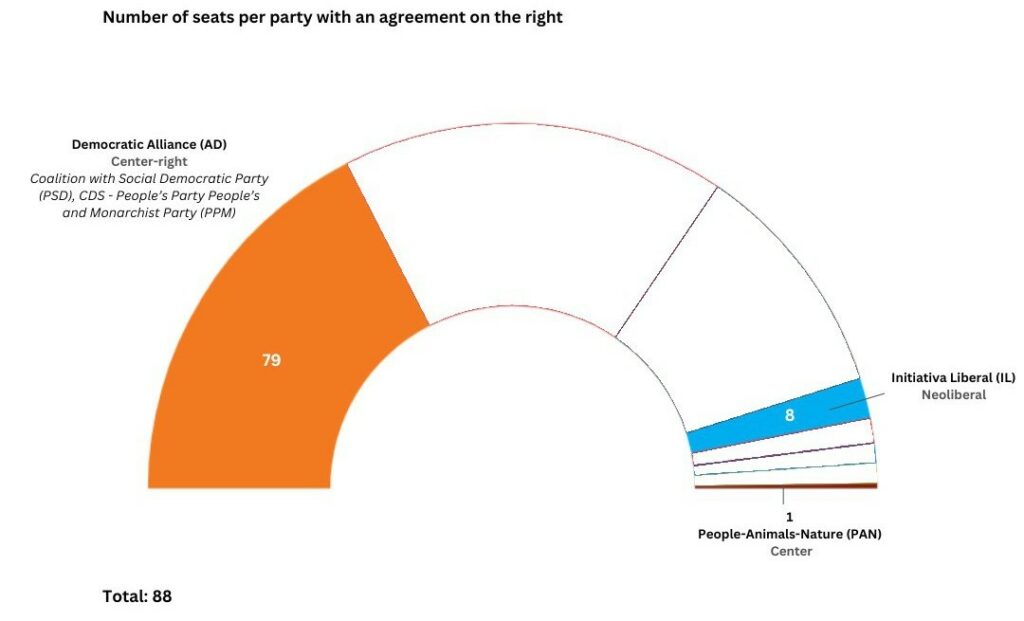
Despite the narrow win of the Democratic Alliance – a party that includes the conservative CDS, whose vice-president Paulo Núncio has defended a new referendum to revert abortion rights – the election results mark the country’s shift to the right. The Democratic Alliance’s victory was so marginal that they’re unable to form a governing majority with their preferred partner, the neoliberal Liberal Initiative (IL), that came in fourth place. This suggests that a right-wing majority set up without Chega will be out of the question.
With neither of the two mainstream parties able to secure a majority ruling coalition, the country is at a crossroads, which brings the question of governability to the center. A moderate alliance between the Socialist Party and the Democratic Alliance is out of the picture, as the new socialist leader Pedro Nuno Santos has already assumed the opposition role, and both parties led a campaign incompatible with that. A socialist rejection of the center-right budget bill will result in new elections, and AD’s leader, the social democrat Luis Montenegro, might go afterwards for a campaign requesting an absolute majority, under the disguise of stability.
Faced with this scenario, will Montenegro remain true to his “no is no” response to the racist Chega (who has already threatened to reject the state budget if there are no negotiations) by honoring his unwillingness to work with the far-right party? Or will he give into an agreement with the anti-democratic force to approve the 2025 state budget? Mariana Mortagua, leader of the Left Bloc, has her suspicions: “Are we completely at peace and confident that, when the time comes and they need to get power, the right won’t find a way to make an agreement between themselves?”.
A third hypothesis might thicken the plot, one that echoes the Social Democratic Party’s internal fragmentation, which might go as far as bringing back the austerity king, Pedro Passos Coelho. The former Prime Minister (between 2011 and 2015) and former PSD’s president, Passos Coelho goes down in history with a bad track record of carrying out salary and pension cuts, proudly implementing the EU-IMF austerity package and even suggesting that the solution to unemployment of the youth was to emigrate. He might be more willing to find agreements with the far-right than Montenegro. The leader of the People’s Monarchist Party (PPM), another right-wing coalition partner of AD, has also shown his openness to negotiate: “I don’t see any harm. I wasn’t at all scared of an opening to Chega”.
However, not all is lost. Although to the left of the Socialist Party, the communist PCP lost two seats, the pro-European left party, Livre, almost tripled their vote, securing four seats. The Left Bloc also resisted, keeping their 5 MPs and increasing their votes by around 30.000 against the 2022 election – forming a strong opposition bloc.
Hope is not obscene
Portugal’s politicians operate in one of western Europe’s poorest countries, where the minimum wage is set at 820€/month, with a skyrocketing housing crisis (that has set the average rental price in Lisbon at 2.000€/month), part of the populations finding solace in populist, inflamed speech out of desperation. In this sense, I’m reminded of Ken Loach’s most recent movie, The Old Oak, which asks: isn’t hope obscene?
Faced with a period of political turmoil, in which the far-right insists on refocusing the debate by pointing fingers and fabricating logics of us against them, the traditional right-wing bears responsibility, by so often being unable or unwilling to hold their ground, and legitimizing a discriminatory agenda. We cannot afford to give into the demagogic tactics of creating false enemies instigated by hate speech and racist ideologies. It is the democratic parties’ role, more than ever, to roll up their sleeves. For the left, that means we must continue to do what we do best, while also reflecting on new strategies to do so: to give voice and body to the concrete material struggles, which in the Portuguese case, means tackling the low wages, the housing crisis, and access to healthcare.
On the latter point, it is imperative to continue to relentlessly defend one of the April Revolution’s biggest conquests: the public National Health Service (SNS), which guarantees universal and free access to health care for all, and which has been systematically threatened with underinvestment and drained by the private sector, thus degrading its public facet.
At the same time, the country is faced with a severe housing crisis. This has been fueled by a 2008 financial crisis recovery plan based on foreign investment – supported by government measures (such as special tax schemes for digital nomads, or the Golden Visas) – and a spike in the tourists seeking short-term rentals, diverting homes to tourism instead of residential use. These factors have resulted in the prices rising so much that affordable housing for the country’s average income is no longer a reality (in a place with one of Europe’s lowest public housing percentage of around 2%). People are being pushed out of the major urban centers, such as Porto and Lisbon (where the housing prices have increased by 120% between 2012 and 2022). This is the case when they are not evicted from their homes altogether and facing homelessness. The social movements and the left parties have been organizing around this – namely through major national demonstrations that gathered thousands of people under the slogan “A House to Live” – and particularly in Lisbon through a local referendum inspired by the one done in Berlin by Deutsche Wohnen Enteignen. Yet, the parties in power have systematically failed to tackle the issue.
In the year that celebrates the 50th anniversary of the Carnation Revolution, its heritage is well remembered by the foundational stones it built that brought profound changes to Portuguese society, and which need to be defended today: labor rights, housing, universal healthcare and reproductive rights. Reclaiming a political agenda that offers real solutions with rights and justice at the center is the only way to counteract the feeling of abandonment and lack of hope, which Loach’s The Old Oak so beautifully replies to, by illustrating that shared spaces of encounter and understanding are desperately needed to bring back community and those who feel alienated and abandoned.
There’s much we can learn from those who fought at the time for bread, freedom, and roses – or, in this case, red carnations: flowers that year after year fill the streets on 25 April, alongside those shouting “Fascismo Nunca Mais” (“Fascism Never Again”). The rise of the far right might try to stain the memory of the revolution, but just like 50 years ago, we’ll be many on the streets. Our red carnations are not withering; we’re just on time to start planting them again.
Don’t worry about left-wing extremism
Terrorism by the RAF and the Vulcan Group? There are far bigger problems
German newspapers are full of stories about left-wing terrorism. On February 26, police arrested Daniela Klette in her apartment in Kreuzberg. Since then, police have been kicking down doors across Friedrichshain searching for Klette’s companions Volker Staub and Burkhard Garweg. The three are the last fugitives of West Germany’s Red Army Fraction (RAF), a terrorist group that dissolved itself back in 1998. The »Terror Oma«, a 65-year-old who danced capoeira and baked Christmas cookies for neighbors, doesn’t sound like much of a threat. A neighbor told a journalist: »I had been living next door to the comrade for years, I had no idea!« He added: »Red front!«
A week later, persons unknown knocked over a high-voltage powerline in Brandenburg, shutting down the new Tesla factory outside Berlin for more than a week. The company claims the losses will be in the hundreds of millions of euros. Germany’s Prosecutor General is investigating against the »Volcano Group«, which claimed responsibility in a statement criticizing Tesla’s »extreme methods of exploitation« and environmental destruction.
I’m going to say it: I’m not too worried about left-wing terrorism. I don’t think you should be either. Right now in Germany, 674 Neonazis with warrants for their arrest are in hiding. When the police and the media put endless resources into a search for leftists who abandoned armed struggle three decades ago, they leave these Nazis in peace. This is not a hypothetical. Since 2015, we have seen an enormous wave of right-wingers attempting to commit murder, with dozens of arson attacks per year against refugee housing. Nazis have murdered hundreds of people since 1990. The left-wing »climate terrorists« of Letzte Generation, in contrast, block traffic. I’ve been called a terrorist for joining protests against the G20.
Let’s look at Tesla again. The anarchists of the Volcano Group might have damaged a power line. But Musk’s factory is sucking up the region’s groundwater and planning to clear 100 hectares of forest. This is supposed to save the planet, but electric cars are a scam that consume enormous resources. Musk’s path of destruction doesn’t end in Brandenburg. He carpeted a South Texas town in waste when a SpaceX rocket exploded. And most dangerously, he spreads antisemitic conspiracy theories, while he uses his wealth to give a platform to Neonazis.
It is precisely those Tesla workers who have the power to really shut down the factory, and then convert it to the production of trams and trains. Organizing those workers is a lot harder than damaging a power line. But it’s the only way we’re going to stop the destructive »Green capitalism« that Musk stands for.
This is a mirror of Nathaniel’s Red Flag column in Neues Deutschland. Reproduced with permission
From 12-14 April we are organising the Palestine Conference 2024 in Berlin. As Palestinian, Jewish, German and international activists, we will publicly accuse the German government of aiding and abetting the genocide in Gaza.
You want to hold German politicians accountable for their support of war crimes? You want to resist the silencing in Germany about the genocide in Palestine?
Then make the Palestine Conference possible with your donation!
Together we can create the momentum and bring our movement into the offensive.
The Palestinians are suffering genocide. Israel is destroying Gaza and its population. While the International Court of Justice sees signs of genocide in Palestine, the German government increased its arms deliveries to Israel tenfold in 2023. In January 2024, with starvation looming in Gaza, the German government declared that it would stop its financial support for humanitarian aid to the Palestinians. We cannot and will not accept this!
Together with voices of the Palestinian movement and the international community of high repute, we will denounce israeli apartheid, genocide and German complicity in this injustice. A broad germanwide alliance of Palestinian, Jewish and left-wing organisations invites you to show your solidarity with Palestine.
Here you will have the opportunity to enter into dialogue with confirmed guest speakers. Among them are Greece’s former finance minister Yanis Varoufakis and Irish MP Richard Boyd Barret. Renowned journalists such as Ali Abunimah and Nerdeen Kiswani will provide critical insights. Doctors such as Ghassan Abu Sitteh, who treated patients in Al-Shifa Hospital during the bombardment of Gaza, will share their experiences. The UN Special Representative for Palestine, Francesca Albanese, will give her assessment of the situation in Gaza. Lawyer Nadija Samour will explain why she filed a lawsuit against members of the German government for aiding and abetting genocide with the Federal Public Prosecutor’s Office in February 2024.
In addition to many other speakers, you can expect workshops and seminars in which you can join in the discussion. The Palestine Conference creates a space for organising and networking. Based on a joint resolution, we will discuss future actions in the workplace, university, school, art and culture. A joint cultural programme and Palestinian catering will ensure community and well-being.
We need your help to make this possible at affordable ticket prices and to finance the journey for our international guests. Make a contribution so that we can say together in April 2024: We Accuse!
We use cookies to ensure that we give you the best experience on our website. If you continue to use this site we will assume that you are happy with it.