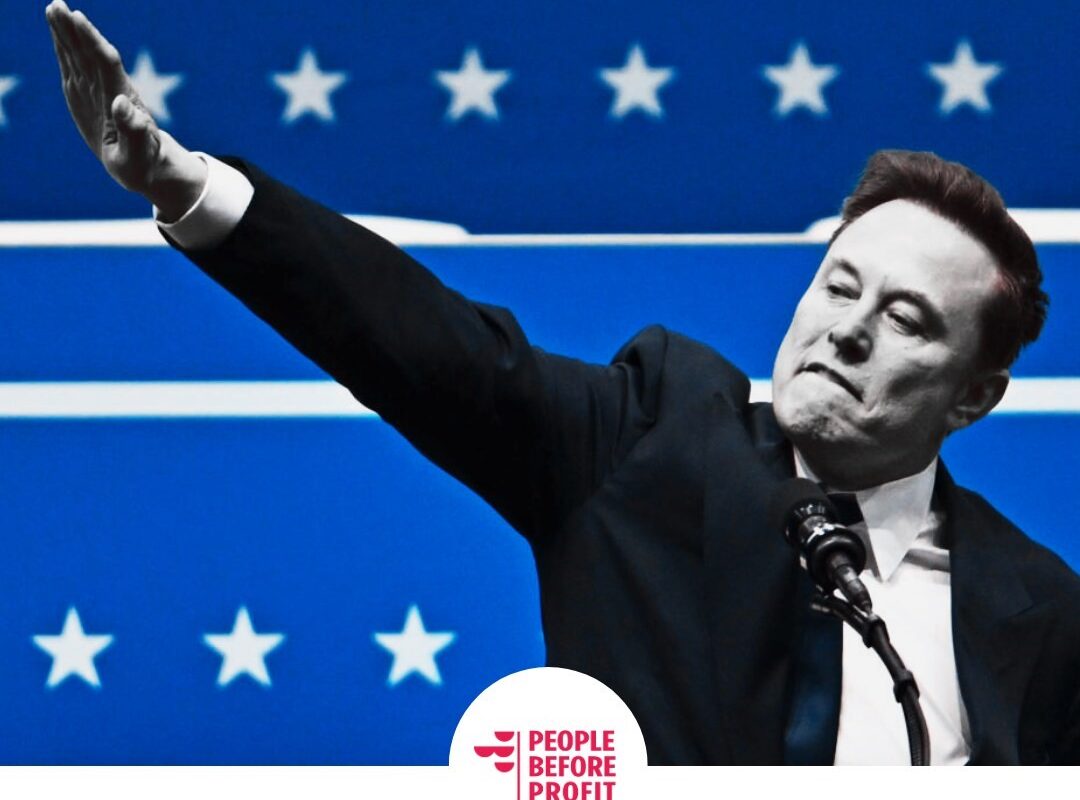
Of course he is. End of article.
The Left Berlin News & Comment
This is the archive templateCategory: Articles
ICHRP – Germany Launched on International Human Rights Day
Growing the solidarity movement for a just and lasting peace in the Philippines
The Left Berlin
20/01/2025
The International Coalition for Human Rights in the Philippines (ICHRP) – Germany was launched in Berlin to mark the 76th International Human Rights Day. The event brought together Filipinos, Germans, and other international solidarity supporters. ICHRP-Germany aims to amplify the campaigns for human rights in the Philippines, expand the solidarity network and promote wide global support for the cause.
Under the theme “Living Solidarity – ICHRP Germany for Human Rights in the Philippines,” the event opened with a discussion on human rights violations in the Philippines, led by Cynthia Deduro of Gabriela Germany. A victim of human rights abuses herself, Deduro recounted being forced to seek asylum in Germany due to government harassment targeting her and her husband for their activism and staunch defense of human rights. She emphasized the worsening situation under the Marcos regime, highlighting the continous and even worsening human rights abuses from Ferdinand Marcos Sr. to his son, the current Presidnet Ferdinand Marcos Jr. She added that there had been no fundamental changes to the dismal human rights situation in the Philippines.
The discussion followed by testimonies of Revd. Christopher Ablon and Kiri Dalena on the genesis and development of their activism. Dalena, a Filipina filmmaker and human rights activist, revealed that her desire for film making exposed her to basic sectors in society who fell victims of human rights violations. These strengthened her resolve to engage in activism and expose these social injustices using the lens of her camera. She added that because of her activism, she and other activists were charged with perjury filed by the National Security Adviser and retired general Hermogenes Esperon, Jr.
Reb Chris, a Filipino priest, activist and musician, recounted that his faith and ministry shaped his engagement in activism. He shared that it started with his involvement with the ecological justice campaign programs of the Church, then later in human rights and peace activism. He live by the conviction to stay grounded in the faith that humans are made in God’s image. He also mentioned the failed “riding in tandem” attempt on his life together with five other priests in Manila in 2019 and the intensified red-tagging against him in 2022 and 2023 that eventually forced him to leave the country.
The launching was also graced by congratulatory messages by Peter Murphy, chairperson of the ICHRP Global Council and Christina Palabay, chairperson of KARAPATAN Alliance for the Advancement of Peoples’ Rights in the Philippines. Both emphasized the importance and urgency of international solidarity to expose and fight against the grave human rights abuses under the US-supported Marcos Jr. regime.
The event concluded with group discussions where relevant recommendations and perspectives on next steps forward and desired activities to further campaign for the protection of human rights in the Philippines were collected. As a manifestation, the participants created two placards, one with a call for the release of Tomas Dominado, a political prisoners, arrested only a few day before December 5; and one placard calling for action and accountability: “Kung hindi tayo, sino? Kung hindi ngayon, kalian? (If it is not us, who will? If it is not now, when will it be?).##
What is ICHRP?
The International Coalition for Human Rights in the Philippines (ICHRP) is a global network dedicated to campaigning for just and lasting peace in the Philippines.
We coordinate with partner organizations on the ground in the Philippines to draw attention to the most pressing issues, and generate moral, political, and material support for the most oppressed and exploited people in the country.
With 65 member organizations across 15 countries—ranging from grassroots solidarity groups to churches, trade unions, and environmental organizations—ICHRP is more active than ever and is always growing.
Here are some of the highlights of our solidarity work this past year:
Campaign on US-backed counter-insurgency
In response to calls from the mass movement in the Philippines, ICHRP prioritized the issue of US-backed counterinsurgency and its effects on the Filipino people this year.
We recognize the National Democratic Front of the Philippines (NDFP) as a co-belligerent force with the Government of the Republic of the Philippines (GRP), qualifying the civil war in the Philippines as an armed conflict subject to international law. The GRP’s frequent violations of international rules of war disguised as counterinsurgency continues to block efforts to build a just peace in the country.
In 2024 we exposed the so-called “counter-insurgency campaign” of the Philippine government through statements, urgent alerts, webinars, videos, and submissions to governments and intergovernmental bodies. We also fundraised for peasant communities who are facing the brunt of state violence.
International People’s Tribunal
In May of 2024, ICHRP was an official sponsor of the International People’s Tribunal (IPT) in Brussels. The tribunal was organized by the grassroots solidarity movement, and brought together a panel of legal experts to produce a verdict based on evidence and testimonies.
The 2024 IPT focused on the war crimes of the Duterte and Marcos Jr regimes, and identified the Biden administration as culpable. After hearing over a dozen harrowing testimonies, the jury unanimously agreed that the Philippine government was guilty of gross violations of International Humanitarian Law with the backing of the US government.
The verdict of the IPT was an important moment in exposing the world to the realities of “counter-insurgency” in the Philippines, which amounts to sweeping repression and violence against any and all dissent.
Conference on Peace Talks
In Europe, ICHRP member organization Catalan Association for Peace held a conference on the path towards peace which featured members of the NDFP negotiating panel and representatives from various other liberation movements around the world, including Columbia, Ireland, Guatemala, and South Africa.
A new ICHRP member organization, CHRP-Germany, was founded and launched this year.
Get involved!
ICHRP’s mission is to advocate for just and lasting peace in the Philippines. Our solidarity is most powerful when we’re unified and organized in action. You can help us build this unity by joining a local ICHRP member organization, or forming your own. Reach out to ICHRP at ichrp.net/contact if you aren’t sure how to get involved!
Must Dance and Have a Moustache
Thoughts on gay male culture as the Village People perform at the Trump inauguration.
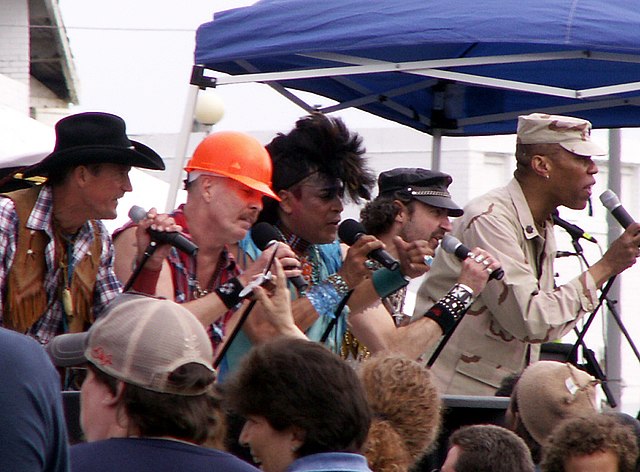
The Village People were absolutely not any kind of gay community project. Many of them weren’t gay, and this was a commercial venture—in the early 70s there existed a post-Stonewall gay market, largely male, who danced to disco in new commercial clubs and liked hearing songs that alluded to, if in a roundabout way, queer life. And so, the band produced an album called Cruisin’—gay slang for seeking casual sex in public places—which included their biggest hit, “YMCA”, a reference the famous sexual shenanigans at the titular chain of institutions in New York. George Chauncey’s classic history Gay New York refers, for example, to a “free for all” and “never ending sex” in the showers (this perhaps isn’t widely understood—a few years ago, visiting Stockport, where I grew up, I chanced on the local Pride parade where the Scouts marched past to the tune of “YMCA”).
Other tracks included “Macho Man”, at a time when a look featuring 501s and moustaches was huge in gay venues. The original recruiting advert for group members specified “Macho Types Wanted: Must Dance And Have A Moustache.” “Go West” referred to San Francisco as a “gay El Dorado”. The journey from New York to the west coast was undertaken by Harvey Milk among others, and the golden memory of pre-AIDS San Francisco is depicted in Armistead Maupin’s Tales of the City books. The repeated “Together!” of the lyrics references, I think, both personal relationships and a new-found sense of community—amid the nod-and-wink references and exploitation of the audience, there are moving bits of social history in the mix. “In the Navy” plays on tropes about horny sailors and on-board sex, with puns about seamen/semen and recruitment to “openings in the navy”.
All of this is tacky, sure. But gay male culture in the 70s, outside of New York and San Francisco, was cobbled together out of all kinds of tacky things. In 70s Britain, John Inman and Larry Grayson were on television. Gay bars were decorated (New Union in Manchester, I’m looking at you) with flock wallpaper and little reproductions of Michelangelo’s David. Disco tracks featured black divas singing of men they had lost (such as Phyllis Nelson’s “Don’t Stop the Train” in clubs where no actual black women were ever present. You can’t invent a subculture overnight, and all this allowed room for retreat and disavowal should it become necessary—it’s a statue by a respected artist, it’s a song about heterosexual love, the Village People are only joking.
The thought that the Village People were only joking, or a straight unwillingness to acknowledge what they were actually referring to ( for example, that a disco song could mention anal sex, even via a double entendre) led to confusion back in the day, as when the US Navy considered using “In the Navy” in recruitment adverts. And the space left open for ambiguity comes into play again now that Victor Willis, the last remaining member of the original group, is performing as part of the Trump inauguration and trying to disentangle “YMCA” from its status as (come at me, Willis’s lawyers!) a gay anthem. A wide streak of opportunism and an eye on the money were always big parts of Village People’s take on queer folk. During the election campaign, presumably thinking of their fanbase, they tried to stop Trump using “Macho Man”. But now that he’s won, “YMCA” is to be, well, straightwashed if that’s where there’s money to be made. The ambiguities of gay male enthusiasm for macho aesthetics return to haunt us as a celebration of hairy-chested hotness is used to praise Donald Trump. Fifty years on, you might think, we have unambiguous queer voices like Lil Nas X and Chappell Roan. But then you hear a censored version of “Call Me By Your Name” playing in Tesco, and questions about representation arise all over again.
AfD plans Deportation ticket for non-Germans
In the run up to the German elections, the AfD make their racist plans clear
Anka Schneiderman
19/01/2025
A massive 15,000 people traveled in 200 buses from all over Germany aiming to block a national conference of the far-right AfD in the Saxon town of Riesa on Saturday, January 11. But two days earlier, a new hate campaign against migrants and refugees from the AfD had claimed public attention. Let’s review events by last week’s timeline.
On Thursday, January 9, Elon Musk had entered the fray. He had decided to influence the February 23 German Federal elections by supporting the AfD. So he had a 74-minute live chat with the party’s leader Alice Weidel. The AfD, which won 10.4% of the vote in the 2021 elections, is polling second in Germany this time, with 22% of the potential vote. The interview was rife with false and dangerous statements, covering topics from migration to National Socialism. In her typical right-wing and revisionist-of-facts fashion, Weidel dismissed pandemic-era mask measures as a “bluff and fraud”. Members of the party have often taken part in demonstrations of the so-called “Querdenker” movement against COVID-19 restrictions, alongside neo-Nazis.
During the interview, Weidel claimed that Hitler was not right-wing but “communist and socialist” She portrayed her party as “libertarian and conservative” and “the only party that protects Jewish life in Germany.” This lie was challenged by the conservative Central Council of Jews in Germany. Musk’s collaboration with the AfD perfectly aligns with the party’s revisionist and inflammatory rhetoric.
On Saturday, January 11, anti-fascist demonstrators arrived early in Riesa to block all roads leading to the hall, delaying the conference by two hours. However the conference proceeded, aided by police using pepper spray, truncheons, dogs, horses, water cannons. All that had for more than a year become familiar to those demonstrators against the genocide in Gaza. They faced tactics of pushing, punching and kicking to clear the blockades. Party co-leader Tino Chrupalla called the demonstrators “terrorists” and thanked the police for their intervention. Why did the police apply these tactics? Ostensibly to ensure “protection of the fundamental rights of both sides.”
It’s worth noting that the AfD is being monitored by the Federal Office for the Protection of the Constitution as a suspected right-wing extremist party. Saxony is one of three states where the party’s extremist nature has already been officially confirmed.
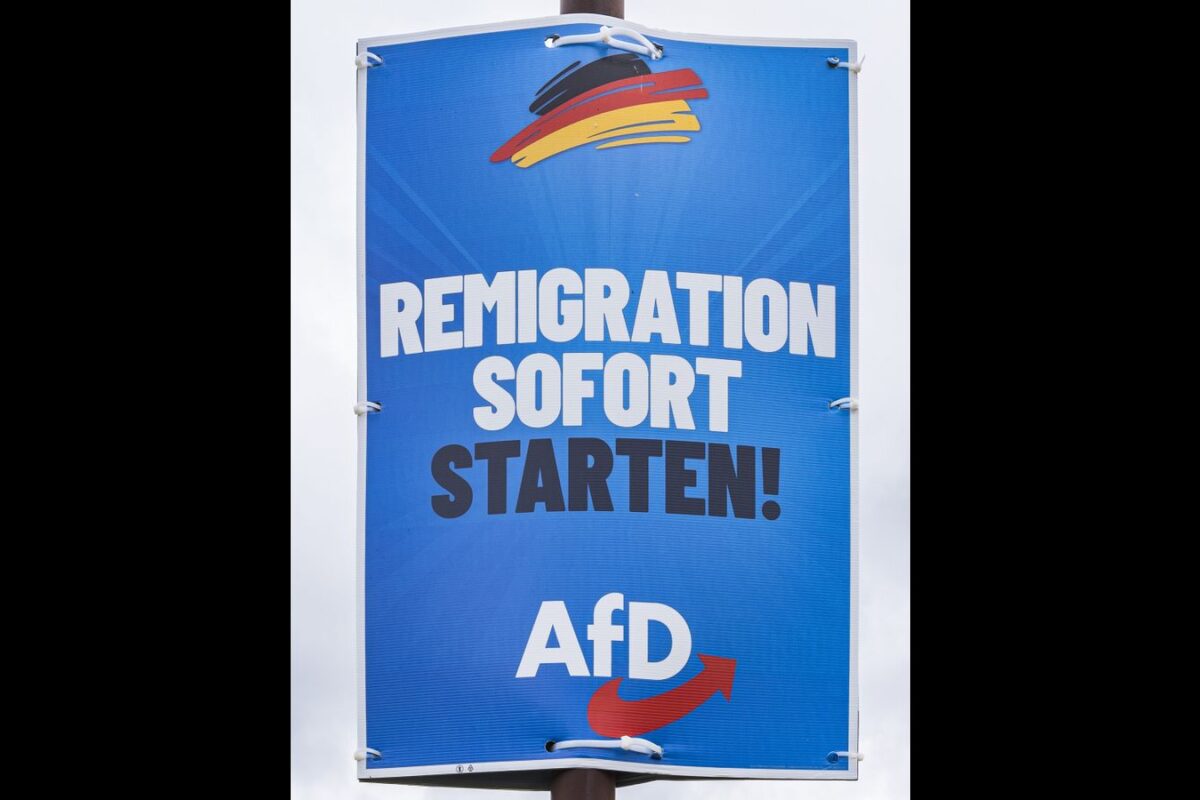
The conference chose Weidel to be the AfD’s candidate for chancellor. In her acceptance speech, she called for “remigration”. In right-wing and Nazi parlance this means the deportation of millions of people, including non-whites with German passports. It is a term that became notorious after a secret meeting between Nazi “activists” and AfD officials in Potsdam a year ago.
During the conference, a new flyer in the shape of a plane ticket was distributed among delegates. Titled a “deportation ticket,” it featured the AfD logo and was addressed to a “passenger: illegal immigrant.” The flight details were transparently xenophobic and racist: departure “From: Germany,” destination “Safe country of origin”. The passenger is to board at “Gate AfD” on 23 February, the day of the election, from “8 am to 6 pm”. Two sentences at the bottom of the “ticket” read: “Only remigration can save Germany” and “It’s nice at home too”.
The 2025 flyer is almost an identical copy of 2011 and 2013 election flyers by another far-right party, the National Democratic Party of Germany (NPD) – which then changed its name to Die Heimat. In 2017, Germany’s Constitutional Court found that the NPD pursued unconstitutional goals in line with neo-Nazi ideology, but stopped short of banning the party.
The campaign bears an unsettling resemblance to the mock-up “one-way” “free train tickets to Jerusalem” for Jews that were distributed in public spaces across the German Reich during the 1920s and 1930s. Whether or not this historical reference was intentionally chosen or even known by the AfD, the striking similarity in political rhetoric and ideological patterns highlights a shared alignment in beliefs.
A QR code on the front of the flyer links to the website of the AfD branch in Karlsruhe, Baden-Württemberg. Marc Bernhard, a member of parliament for the AfD in Karlsruhe, has confirmed the party’s recent flyer distribution campaign. According to Bernhard, between 20,000 and 30,000 flyers were printed and distributed through election campaign stands and by dropping them into letterboxes. He emphasized, however, that there was no targeted search for letterboxes with foreign-sounding names during the distribution process.
On Monday, the Karlsruhe branch published an additional statement on its website, defending the flyer as “fully in line with the current legal situation and the Basic Law.” The reverse of the flyer outlines a xenophobic program titled “one-way economy”. This includes proposals such as “Humanitarian residence only as long as there is a reason for asylum”. History has a lot of examples of future developments of such ‘adequate’ reasons. The programme goes on to “Deportation of all persons obliged to leave the country”. This is explained as: “The demand to leave the country refers in particular to people who are in Germany illegally… such as the 1 million Syrian (former) civil war refugees in the country”. This rhetoric is not unique to the AfD nor to Germany. One day after Assad left Syria, a number of countries have already announced they will stop processing asylum applications.
Most German political parties, including the CDU, SPD, Greens, and FDP, support deportations in various forms. For instance, CDU MP Carsten Linnemann recently called for deportations after just two criminal offenses. This is a low threshold taking into consideration that “offences” like using public transport without a ticket are still considered a crime in Germany.
The AfD’s flyer also called for the “reduction of false incentives”. This includes restricting unemployment benefits (“citizen’s money”) to German citizens, and denying residency rights to asylum seekers and a general call to “stop illegal immigration”. Additionally, it demands an end to “Islamisation,” perpetuating a long-standing and infamous trope in European (far-)right rhetoric. The flyer attempts to placate any potential public outrage by claiming that citizens would not be deported, asserting that the party’s demands were “completely legitimate and legally compliant.”While other political parties may publicly distance themselves from the AfD’s overt xenophobia, the underlying policies are often alarmingly similar. The AfD’s ability to openly express such views allows other parties to appear moderate by comparison, despite sharing overlapping agendas. Meanwhile, Karlsruhe criminal police have begun investigating the campaign for incitement to hatred, but given historical precedent, it is unlikely to lead to significant consequences.
Germany is Remilitarising, Again
Facing an Increasingly Rightwing Society and a Threat From the East, Politicians are Placing their Bets on a Militarised Germany
Rowan Gaudet
18/01/2025
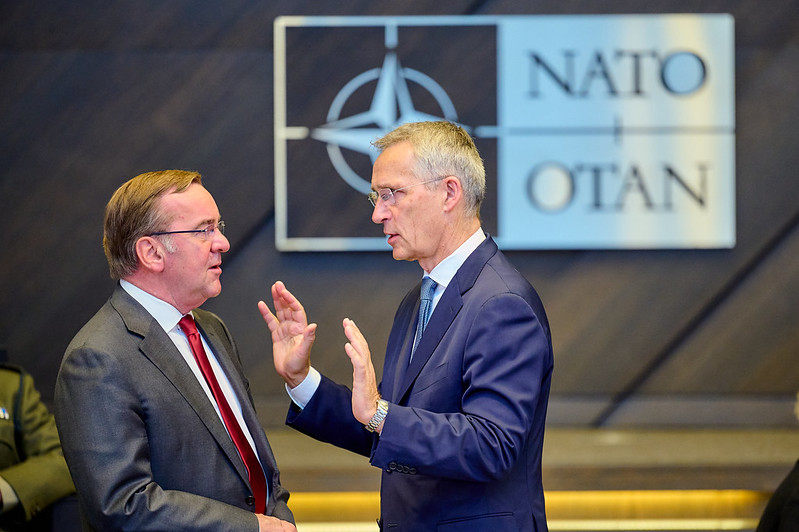
December 18th was an odd day during election season, as Germany’s defence minister Boris Pistorius repeatedly heaped credit and praise on other parties. Responding to questions in the Bundestag, Pistorius thanked the Grüne and FDP several times, and gave a special thanks to the CDU for voting to support the government, despite being in opposition. Together, they passed a spending package for the German military worth over 20 billion euros.
Speaking to the press, Pistorius made one thing clear: “This is not a topic for election campaigns.” He also told them that it marked “the highest sum that has ever been recorded” in Germany’s defence spending. The statement speaks for itself in print, but Pistorius said it in a tone full of self-congratulation.
The funding is going towards numerous different projects, although not all of them are transparent to the public. Among other things, the army will receive PULS missile systems, a rocket-firing truck used by the IDF to carry out the genocide in Gaza and made by the Israeli company Elbit Systems. For the air force, several different types of missiles have been ordered, including Patriot guided missiles and Iris-Ts. On top of that, the Bundeswehr will receive various types of digital security software and logistical structures.
The largest expenditures though, were for the German navy, which among other things will be receiving four U-boats to replace Germany’s aging stock, although these will take seven to eight years to be delivered. The emphasis on the navy points to Germany’s concerns in the North Sea, where it considers itself particularly vulnerable to Russian attacks on infrastructure. Late last year, Pistorius was quick to declare the cutting of two communications wires, one of which connected Germany to Finland, as an act of Russian sabotage. It came out several days later that it was likely a Chinese tanker ship dragging its anchor, despite Pistorius’ quick accusations.
The German government is also looking to increase the personnel in the Bundeswehr, which includes Germany’s standing army, navy and air force. Currently at around 180,000 soldiers, the plan is to increase to 203,000, although Pistorius said in the Bundestag that it will likely end up closer to 230,000.
Is Conscription on the Horizon?
Not only is the number of active soldiers increasing, the government is also planning on sending a survey to German citizens of at least 18 years of age, inquiring into their willingness to serve in the military in times of war, as well as any relevant skills they may have. While men are required to fill out the form, women are allowed to as well, if they want to show sport.
While the government states that this is not a reinstatement of mass conscription, which Germany abolished in 2011, it appears to be a clear step in that direction.
For the most part, Germany’s political parties are all sounding a similar note regarding militarisation leading up to this election, with the exceptions of BSW and Die Linke. The CDU’s platform not only includes raising the number of personnel, but also increasing the number of public oaths and other forms of recognition for the military. They see 2% spending of GDP, as required by NATO, as the minimum goal. While this was to be expected, Robert Habeck of the Grüne’s declaration that Germany needs to nearly double its defence spending to 3.5% has turned some heads.
While Germany’s mainstream political parties stand behind this increased militarisation of both state and society, a poll from March 2024 hints that they need to be cautious not to overstep their militarisation push. Asking Germans whether or not they are in favour of reinstating Wehrpflicht (conscription), 52% stated they were in favour and 43% against.
The numbers change noticeably with age: In the 60+ category, 59% of the population is in favour and 37% against, with similar numbers for 45-59 year olds. But the 18-29 year olds, who would mostly be the ones serving, are much less enthusiastic, with only 39% in favour and 59% against. Women in this age group are especially against, 30% in favour compared to 68% against, while young men are 46% in favour.
The same poll breaks support down along party lines, showing that SPD voters would support reinstating conscription by a slim margin, while CDU, AfD and (ironically) BSW voters support it by 67-68%. The poll shows Habeck to be playing with fire however, with only 37% of Grüne voters supporting conscription.
While it’s important to note that currently only the AfD are calling to reinstate the Wehrpflicht, the mixed numbers here show that the idea has limited popularity already (the CDU has already approved the idea internally in response to a members motion, although it’s not in their election programme). It may be another case of the AfD taking a controversial position which the other parties are then quick to copy. While most politicians are taking care to not bring the issue up for the time being, should the current pace of disillusionment in Germany continue a further shift in favour of militarisation in German society appears likely.
It is worth noting that this is a far cry from the situation leading up to the 2003 Iraq invasion, when Gerald Schröder made his opposition to the war a core part of his (notably successful) 2002 election campaign, and tried to talk the Americans out of it while in office. Die Grüne held a similar position at the time.
Ukraine has in many ways marked a shift for German political opinion, including in the 2014 invasion of Crimea, as journalist Franziska Augstein described back in 2015. It is perhaps unsurprising, then, that Putin’s full-fledged invasion of Ukraine has now caused an even larger revival of German militarism among both politicians and populace.
A Rising Far-Right and A Strong German Military
The new funding programs and CDU’s proposals for public loyalty ceremonies take place in the context of a Bundeswehr with both a long and recent history of far-right extremism. In response to questions from Die Linke, the Defence Ministry released information last December showing that 2023 saw 205 extreme right-wing, racist or antisemitic incidents. These led to 62 soldiers getting fired for such infractions, such as using “heil Hitler” chants. Of those fired, 10 were officers. These overall numbers are a slight decrease from the previous year.
It is hard to imagine any good effects coming from a more militarised German state and society. With an increasingly right-wing youth, a stagnant economy and social services falling apart even before the CDU’s next round of austerity, drastically increasing spending in the Bundeswehr means military service could become the easiest way to access state support. Besides that, strengthening spending in institutions that serve both as recruitment grounds and weapons training for fascists is hardly a comforting thought.
As the CDU are set to come to power, and the AfD seem to become more popular with every election, increasing the strength of the German military raises the obvious question of who will be leading it in 10 years time. It would not be the first time that a social democratic or conservative government paved the way for a dictatorship with military drills and wads of cash for tanks.